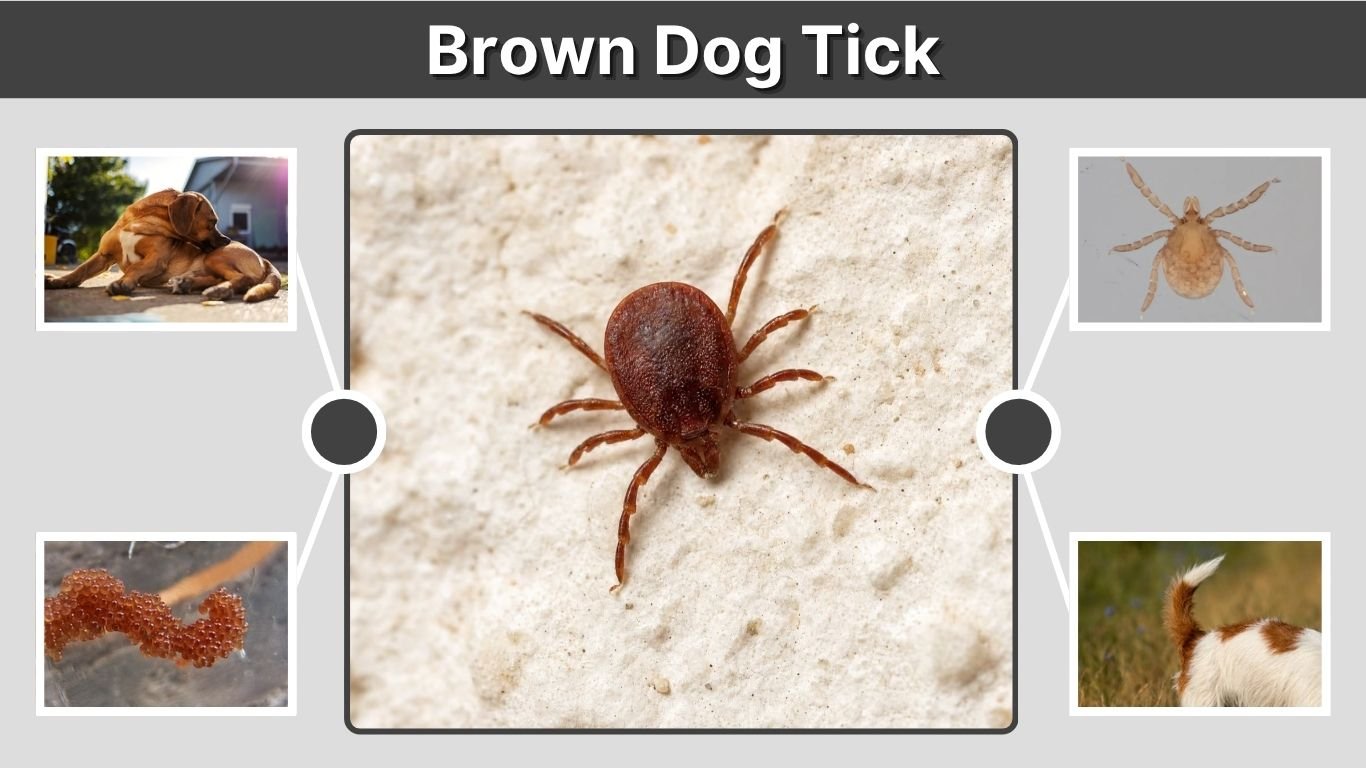
The brown dog tick is a reddish-brown parasite strongly associated with domestic dogs and is unusual because it can complete its life cycle inside homes and kennels. Known scientifically as Rhipicephalus sanguineus, it occurs worldwide and may infest dogs during any life stage. Heavy infestations can become difficult to control, while infected ticks can transmit diseases to dogs and, in some regions, humans. This guide covers brown dog tick identification, size, bites, diseases, engorged appearance, life cycle, removal, treatment, and prevention.
What Is a Brown Dog Tick?
The brown dog tick belongs to the hard-tick family and is closely associated with dogs. Unlike many ticks that depend heavily on woodland or grassy environments, this species can survive and reproduce around human structures. Homes, kennels, shelters, and other places where dogs spend considerable time can support infestations.
Brown Dog Tick Identification
Common characteristics include:
- Scientific name: Rhipicephalus sanguineus
- Color: Yellowish-brown to reddish-brown
- Body: Flattened and oval before feeding
- Markings: Generally lacks the pale decorative markings of American dog ticks
- Adult legs: Eight
- Larval legs: Six
- Preferred host: Dogs
- Distribution: Worldwide
- Habitat: Homes, kennels, yards, shelters, and other dog-associated environments
Unfed adult females are roughly 4–5 mm long, although they become considerably larger after taking a blood meal.
What Does a Brown Dog Tick Look Like on a Dog?
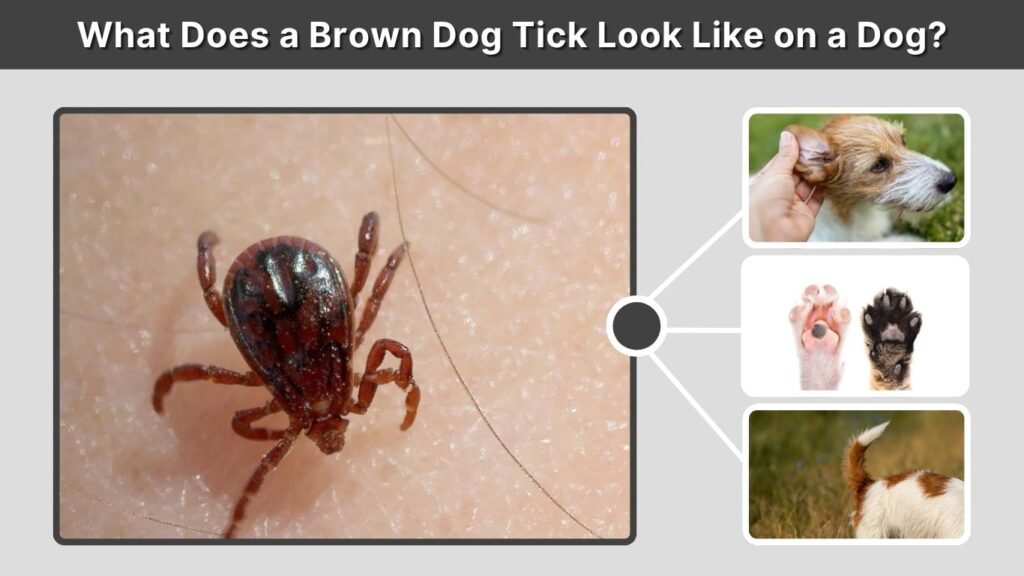
An unfed brown dog tick can resemble a small reddish-brown seed attached to the skin. It may be difficult to notice beneath thick fur. As the tick feeds, its abdomen expands, making an engorged female much easier to spot.
Dogs are the primary hosts for brown dog ticks during all life stages.
Common Places to Check
Look carefully around:
- Ears
- Neck and collar area
- Between the toes
- Under the front legs
- Groin
- Between the rear legs
- Around the tail
- Other protected areas beneath thick fur
Regular inspection is especially important when brown dog ticks have previously been found in the home or kennel.
What Does an Engorged Brown Dog Tick Look Like?
Female brown dog ticks expand dramatically while taking a blood meal. Instead of looking flat and narrow, an engorged female becomes rounded or oval and much larger than an unfed specimen.
Engorged Brown Dog Tick Identification
An engorged female may appear:
- Grayish-brown or tan
- Smooth and swollen
- Oval or bean-shaped
- Several times larger than before feeding
- Firmly attached at one end
- Surrounded by eight legs near the front
Finding one engorged tick should prompt a thorough examination of the dog and its environment because additional ticks may be present.
Brown Dog Tick Life Cycle
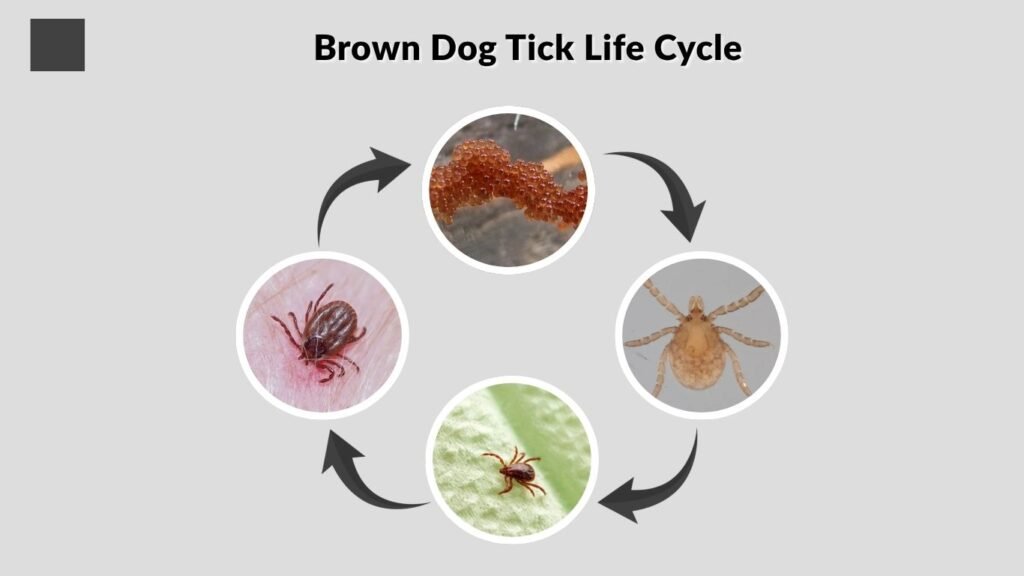
Brown dog ticks undergo four stages: egg, larva, nymph, and adult. They usually have a three-host life cycle, meaning they detach after feeding during different developmental stages before seeking another host. Dogs are particularly important hosts in domestic environments.
Four Life Stages
- Egg: An engorged female leaves the host and lays eggs in a protected location.
- Larva: Six-legged larvae hatch and seek a host.
- Nymph: After feeding and molting, eight-legged nymphs seek another blood meal.
- Adult: Adults feed and reproduce, with dogs serving as their preferred hosts.
Because these ticks can complete their development indoors, an infestation may continue even when a dog spends little time in tall grass or woodland.
What Diseases Do Brown Dog Ticks Carry?
Brown dog ticks are important veterinary disease vectors. The pathogens associated with members of the brown dog tick complex vary geographically, but they have been linked to Ehrlichia canis, Babesia canis, Anaplasma platys, and Rickettsia rickettsii, among others.
Important Diseases in Dogs
Brown dog ticks are associated with:
- Canine ehrlichiosis
- Canine babesiosis
- Anaplasma platys infection
- Rocky Mountain spotted fever in certain regions
Ehrlichia canis, the cause of canine monocytic ehrlichiosis, is particularly associated with brown dog ticks.
Symptoms in Dogs
Signs depend on the particular infection, but a dog with a tick-borne illness may develop fever, decreased appetite, lethargy, weakness, swollen lymph nodes, joint problems, or other systemic illness.
Rocky Mountain spotted fever in dogs, for example, may cause high fever, loss of appetite, swollen joints and lymph nodes, vomiting, diarrhea, breathing problems, and neurologic abnormalities in severe cases.
A dog showing illness after tick exposure should be evaluated by a veterinarian.
Do Brown Dog Ticks Bite Humans?
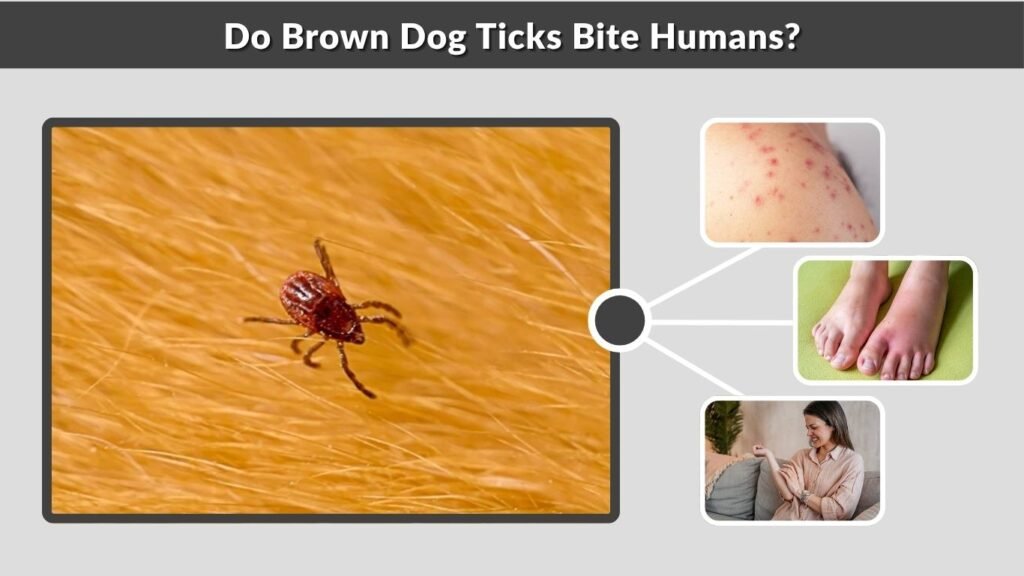
Yes. Dogs are their preferred hosts, but brown dog ticks can also bite humans and other mammals. Human bites are especially important in areas where the ticks carry Rickettsia rickettsii, the bacterium that causes Rocky Mountain spotted fever.
Brown Dog Tick Bite Symptoms in Humans
The bite itself may initially leave:
- A small red spot
- Mild swelling
- Local irritation
- Itching
- Tenderness
The bite mark alone cannot determine whether disease has been transmitted.
Rocky Mountain spotted fever is a serious illness that requires early medical treatment. Anyone who develops fever, headache, rash, or other concerning symptoms following tick exposure should seek medical care and mention the recent tick bite.
Do Brown Dog Ticks Carry Lyme Disease?
Brown dog ticks are not the primary vectors responsible for Lyme disease. In the United States, Lyme disease is associated with infected blacklegged ticks (Ixodes species), not the brown dog tick.
Brown dog ticks are instead important for other pathogens, particularly Ehrlichia canis in dogs and Rickettsia rickettsii in certain regions.
Brown Dog Tick vs Deer Tick
Brown dog tick:
- Uniform reddish-brown appearance
- Strong preference for dogs
- Can infest buildings
- Occurs worldwide
- Associated with canine ehrlichiosis
- Can transmit RMSF in certain areas
Deer/blacklegged tick:
- Adult female commonly has dark legs and a reddish-orange abdomen
- Frequently associated with wooded habitats
- Uses numerous wildlife hosts
- Important vector of Lyme disease
Correct identification helps determine which tick-borne diseases are relevant.
Brown Dog Tick vs American Dog Tick
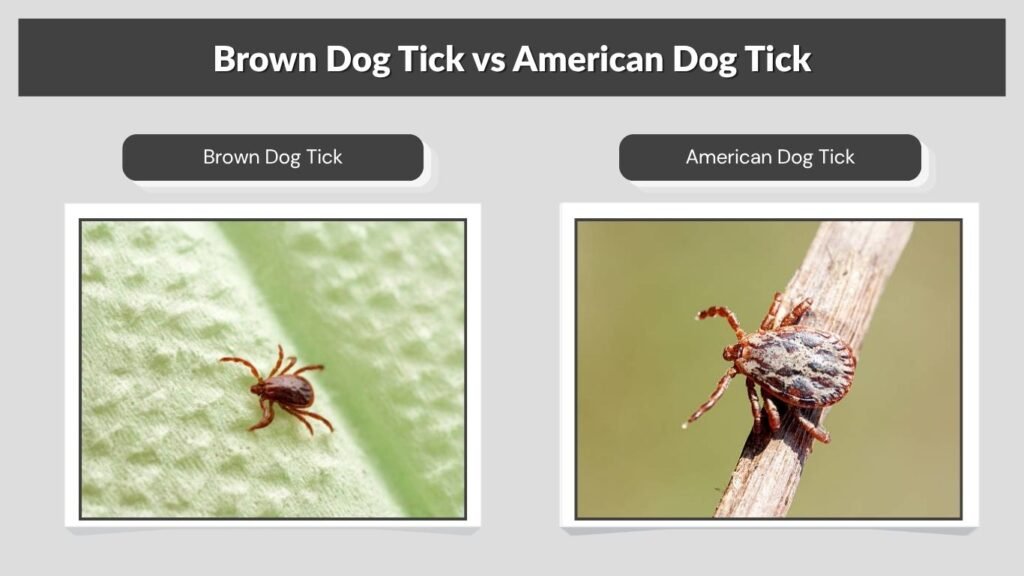
Both species commonly feed on dogs, but their appearance and behavior are noticeably different.
Key Differences
Brown dog tick
- Fairly uniform reddish-brown color
- No prominent pale decorative pattern
- Strong preference for dogs
- Can reproduce indoors
- Common in kennels and homes
American dog tick
- Reddish-brown with cream or whitish markings
- Commonly associated with outdoor grassy and brushy environments
- Frequently uses dogs and other medium-to-large mammals
The ability of brown dog ticks to establish indoor populations makes them particularly difficult household pests.
How to Remove a Brown Dog Tick
Attached ticks should be removed promptly and carefully. Avoid crushing the tick against your dog’s skin.
Safe Removal
- Wear gloves.
- Part the dog’s fur around the tick.
- Use fine-tipped tweezers or an appropriate tick-removal tool.
- Grasp the tick close to the skin.
- Pull outward slowly with steady pressure.
- Avoid squeezing the enlarged abdomen.
- Clean the attachment site afterward.
- Check the entire dog for additional ticks.
If many ticks are present or your dog becomes sick, contact a veterinarian.
Brown Dog Tick Infestation in the House
One of the most distinctive features of brown dog ticks is their ability to establish populations indoors. They can infest homes, shelters, boarding facilities, and kennels wherever dogs provide suitable hosts.
Signs of an Indoor Infestation
You may notice:
- Multiple ticks on a dog
- Ticks crawling on floors or walls
- Ticks around dog bedding
- Repeated infestations after treatment
- Different life stages appearing indoors
Treating only the ticks currently attached to your dog may therefore be insufficient.
Brown Dog Tick Treatment and Prevention
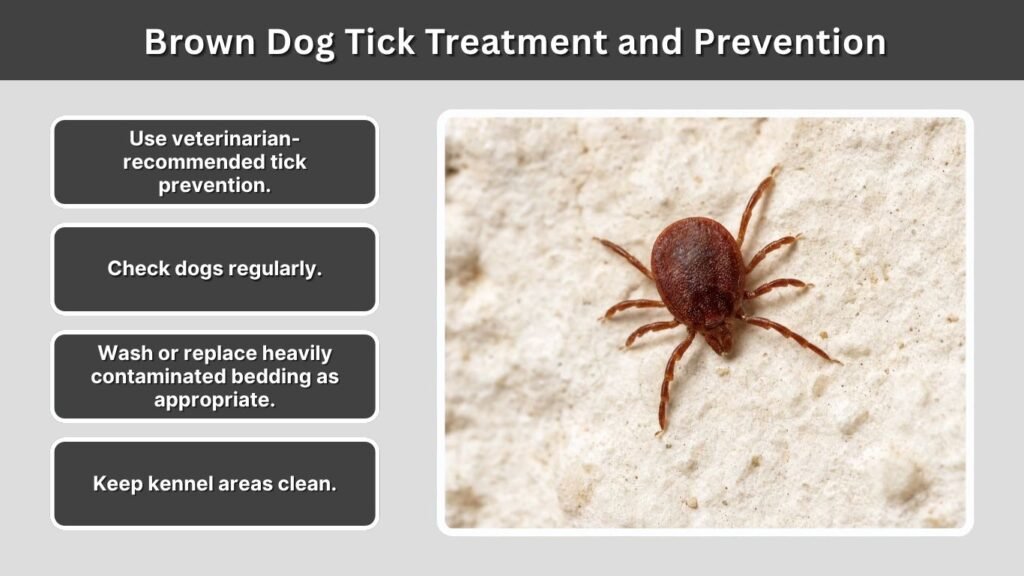
Control should address both the dog and, when an infestation exists, the surrounding environment. Your veterinarian can recommend a suitable tick preventive based on your dog’s age, weight, health, location, and lifestyle.
Prevention Tips
- Use veterinarian-recommended tick prevention.
- Check dogs regularly.
- Wash or replace heavily contaminated bedding as appropriate.
- Keep kennel areas clean.
- Examine cracks and sheltered locations during infestations.
- Treat all pets as directed by your veterinarian.
- Seek professional pest control for established household infestations.
CAPC recommends year-round tick control and notes that brown dog tick populations can occur inside and around homes and kennels wherever dogs are present.
FAQs
1. Are brown dog ticks dangerous?
They can be. Brown dog ticks can transmit several pathogens to dogs and can transmit Rocky Mountain spotted fever to people in certain regions.
2. What does an engorged brown dog tick look like?
An engorged female becomes enlarged, smooth, and oval or bean-shaped. Its color may become lighter or grayish-brown as its abdomen fills with blood.
3. Can brown dog ticks live in a house?
Yes. Unlike many other ticks, brown dog ticks can establish populations inside homes and kennels where dogs are available as hosts.
4. Do brown dog ticks cause Lyme disease?
They are not the recognized vectors of Lyme disease. Brown dog ticks are more strongly associated with diseases such as canine ehrlichiosis and, in certain areas, Rocky Mountain spotted fever.
5. How do I get rid of brown dog ticks?
Use a veterinarian-recommended tick preventive on your dog, remove attached ticks promptly, inspect other pets, clean dog-associated areas, and address the home environment if an infestation has developed. Severe indoor infestations may require professional pest management.