
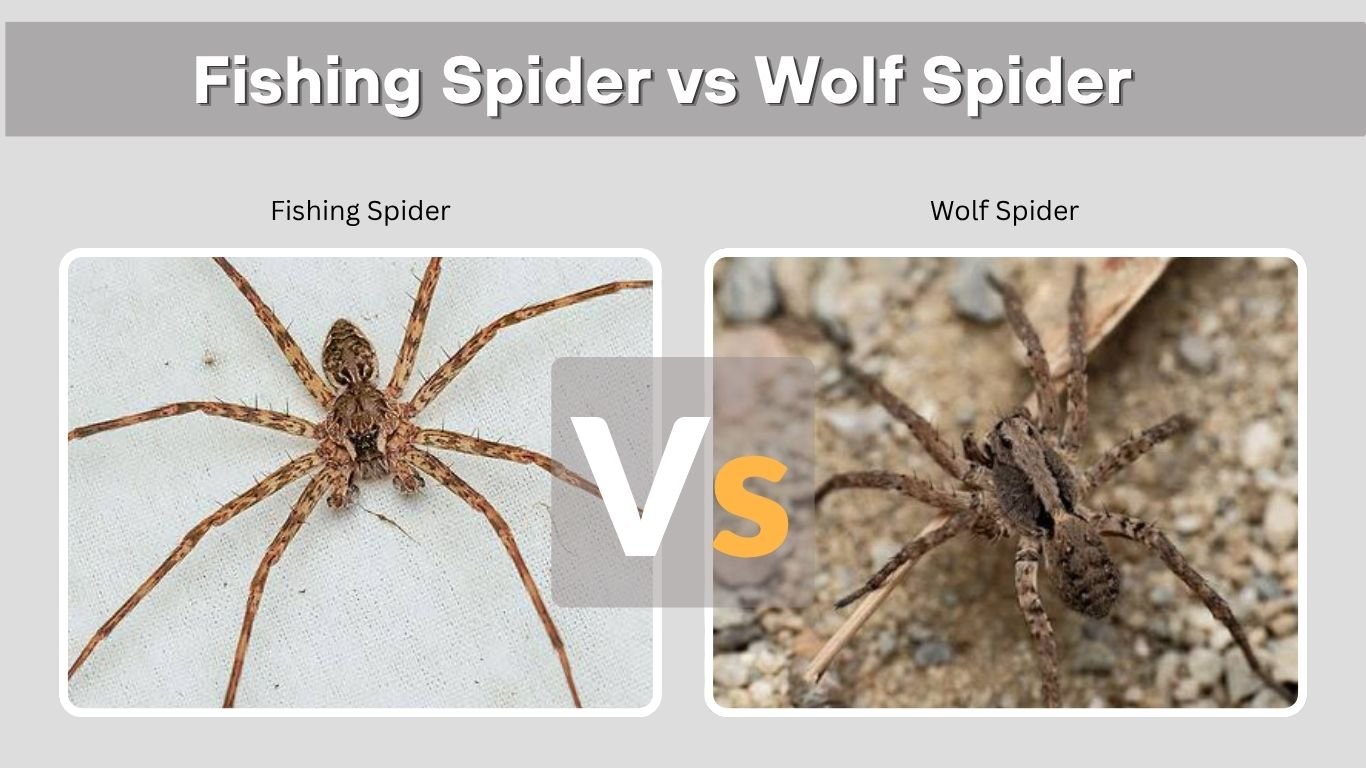
Fishing spiders and wolf spiders are often confused because both are large, brown, fast-moving hunters. They do not build classic prey-catching webs, and both may appear around homes, gardens, basements, or wooded areas. However, they differ in eye pattern, habitat, egg-carrying behavior, body shape, size, and hunting style. Learning these signs makes identification much easier.
Fishing Spider vs Wolf Spider: Quick Comparison
Both spiders can look scary because of their size and speed, but neither is usually dangerous to people. Fishing spiders belong to the family Pisauridae, while wolf spiders belong to the family Lycosidae. NC State Extension describes fishing spiders and wolf spiders as large, brown, hairy, non-webbing spiders that often attract attention because of their size.
| Feature | Fishing Spider | Wolf Spider |
| Family | Pisauridae | Lycosidae |
| Common habitat | Near water, trees, docks, walls, wooded homes | Ground, grass, soil, gardens, leaf litter |
| Body shape | Flatter and longer-legged | Stockier and more compact |
| Eye pattern | Eyes more spread across the front/top of head | Distinct three-row eye pattern |
| Egg sac | Carried in jaws/mouthparts | Attached to spinnerets |
| Spiderlings | Protected in nursery web | Carried on mother’s back |
| Web use | Nursery web, not prey-catching web | Usually no prey-catching web |
| Danger to humans | Low | Low |
| Best ID clue | Long legs, flat posture, often near water or trees | Large forward-facing eyes and ground-hunting behavior |
1. Body Shape and Overall Appearance
Fishing spiders usually look flatter, wider, and more stretched out. Their legs are long and often spread sideways, giving them a broad stance on walls, tree trunks, rocks, or docks. Wolf spiders usually look more compact and muscular, with a stronger ground-running body shape.
Fishing Spider Appearance
Fishing spiders often have long legs, brown or gray-brown coloring, and striped or banded markings. Some species have pale side stripes on the body. They may rest flat against surfaces, which makes them look even wider. Dark fishing spiders are especially common around wooded houses and can be mistaken for wolf spiders.
Wolf Spider Appearance
Wolf spiders are usually brown, gray, tan, or mottled with camouflage markings. Their bodies often look thicker than fishing spiders. They are built for running across soil, grass, mulch, and leaf litter. Many wolf spiders have a central stripe or patterned markings on the cephalothorax and abdomen.
2. Size Difference
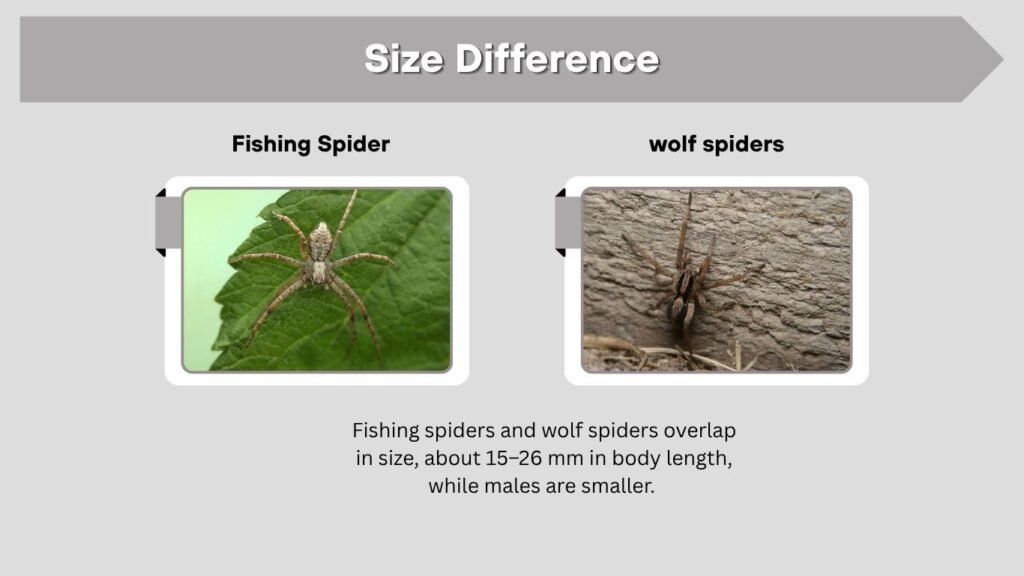
Fishing spiders and wolf spiders overlap in size, which is why many people confuse them. Some fishing spiders may appear larger because their legs are long and widely spread. Wolf spiders can also be large, but many species are smaller than the biggest fishing spiders.
Penn State Extension says fishing spiders are similar in size, shape, and coloration to larger wolf spiders. It also notes that female dark fishing spiders can measure about 15–26 mm in body length, while males are smaller.
Fishing Spider Size
Fishing spiders can look huge when their legs are spread out. The body may not always be extremely large, but the leg span can make them appear intimidating. A dark fishing spider on a wall or ceiling may look much bigger than a ground spider because of its flat, extended posture.
Wolf Spider Size
Wolf spiders vary from small to very large. Utah State University Extension notes that wolf spiders range from small to very large and have a unique eye pattern. Larger wolf spiders may look similar to fishing spiders, but their shorter, stockier shape helps separate them.
3. Eye Pattern
Eye pattern is one of the best ways to tell a wolf spider from a fishing spider. You may need a close photo or safe magnified view, but do not handle the spider with bare hands. Wolf spiders have a very noticeable eye arrangement, while fishing spiders have a different layout.
Wolf Spider Eyes
Wolf spiders have eight eyes arranged in three rows. The most noticeable feature is the pair of large forward-facing middle eyes. This gives wolf spiders excellent vision for hunting at night. Utah State University Extension also highlights their unique eye pattern as an important identification feature.
Fishing Spider Eyes
Fishing spiders also have eight eyes, but their eye arrangement does not create the same “big headlight” look as wolf spiders. NC State Extension notes that fishing spider eyes are positioned on top of the carapace, while wolf spiders have their eyes arranged differently.
4. Habitat and Location
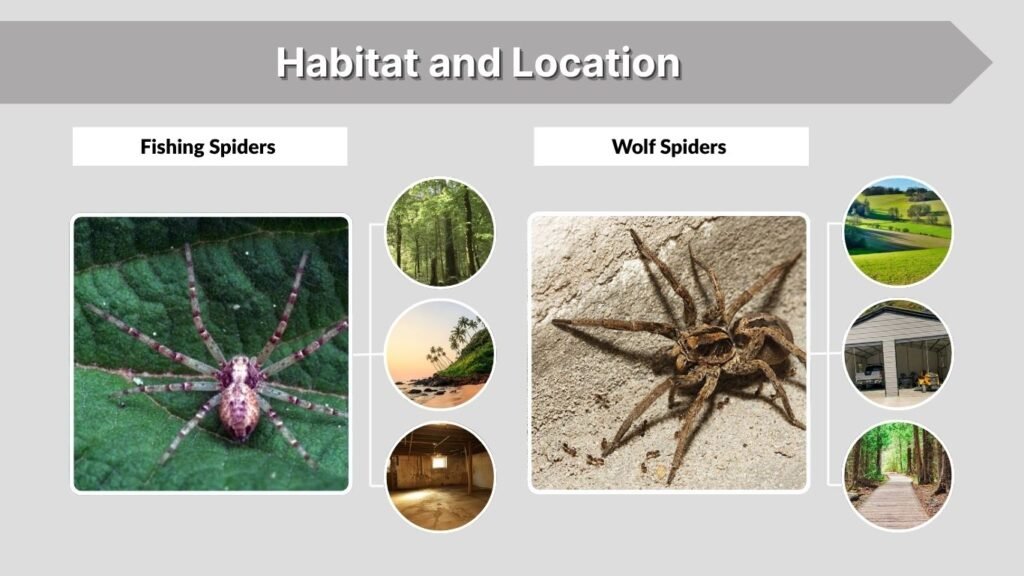
Habitat is another strong clue. Fishing spiders are often associated with water, docks, pond edges, streams, marshes, wet vegetation, trees, and wooded buildings. Wolf spiders are more likely to be found running on the ground in lawns, gardens, fields, mulch, and leaf litter.
| Location | More Likely Fishing Spider | More Likely Wolf Spider |
| Pond edge | Yes | Sometimes |
| Dock or boat area | Yes | Less common |
| Tree trunk | Yes | Sometimes |
| House siding | Yes, especially wooded homes | Sometimes |
| Lawn or grass | Sometimes | Yes |
| Garden soil | Sometimes | Yes |
| Leaf litter | Sometimes | Yes |
| Basement floor | Possible | Possible |
| Running across open ground | Possible | Very common |
Where Fishing Spiders Live
Fishing spiders in the genus Dolomedes are often found near water, where they can detect vibrations on the surface. Some species can run on water and capture aquatic insects. However, not every fishing spider stays beside water. The dark fishing spider, for example, is often found in wooded areas and may enter houses.
Where Wolf Spiders Live
Wolf spiders are mainly ground hunters. They live in lawns, fields, gardens, woodlands, and around buildings. Indoors, they may wander into basements, garages, or ground-level rooms. They do not usually climb walls as often as fishing spiders, though they can still move quickly over many surfaces.
5. Hunting Style and Diet
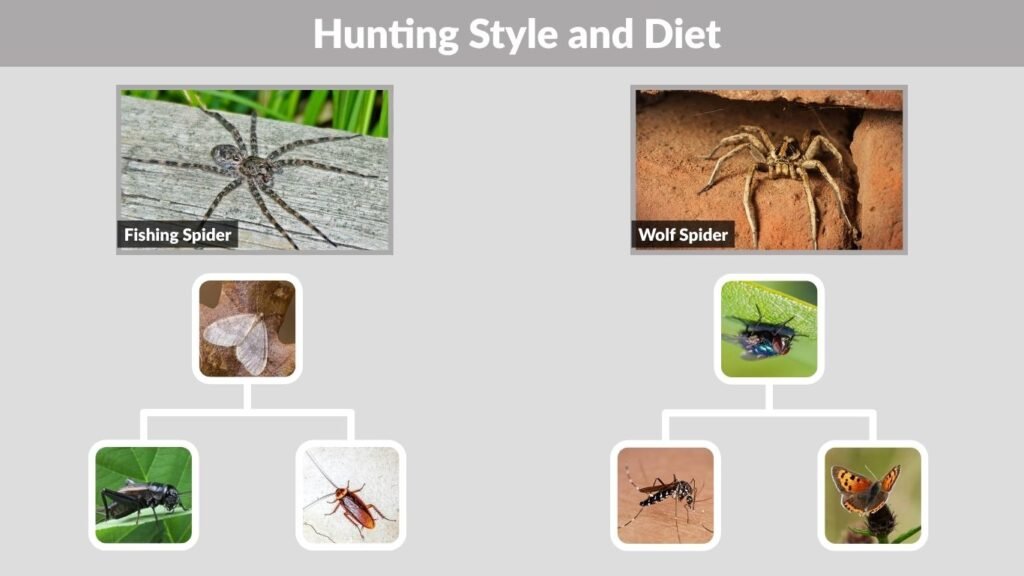
Both spiders are active hunters, but their hunting zones are different. Fishing spiders often wait near water, vegetation, tree bark, or walls, while wolf spiders usually run across the ground searching for prey. Neither spider depends on a sticky web to catch insects.
Fishing Spider Hunting
Fishing spiders can sense vibrations through surfaces, including water. Some species wait with their front legs touching the water and rush forward when prey moves nearby. They eat insects, aquatic insects, other spiders, and sometimes small aquatic animals when available.
Wolf Spider Hunting
Wolf spiders chase or ambush prey on land. They use strong eyesight and speed to catch insects, small arthropods, and other spiders. Their hunting style is more ground-based, which is why they are often seen running across floors, lawns, and garden beds.
6. Web Use
Neither fishing spiders nor wolf spiders build classic orb webs like garden spiders. This is a major reason they are grouped together in people’s minds. However, fishing spiders are part of the nursery web spider family, and females use silk differently from wolf spiders.
Fishing Spider Webs
Fishing spiders do not make sticky prey-catching webs. Female fishing spiders create nursery webs for their young. They guard spiderlings in this protective silk structure for a short time. This nursery behavior is one of the best biological differences between fishing spiders and wolf spiders.
Wolf Spider Webs
Wolf spiders also do not build prey-catching webs. Some species may use silk to line retreats or burrows, but they mainly hunt by movement and eyesight. Female wolf spiders are famous for carrying egg sacs attached to their spinnerets and later carrying spiderlings on their backs.
7. Egg Sac and Baby Spider Behavior
Egg-carrying behavior is one of the clearest differences. If you see a female with an egg sac, you can often tell which group she belongs to by where the sac is carried.
| Reproduction Feature | Fishing Spider | Wolf Spider |
| Egg sac position | Carried in mouthparts/jaws | Attached to spinnerets |
| Nursery behavior | Makes nursery web | Carries spiderlings on back |
| Young spider protection | Guards young in silk nursery | Young ride on mother |
| Easy field clue | Sac appears held in front | Sac appears attached behind |
Fishing Spider Egg Sac
A female fishing spider carries her egg sac with her mouthparts. Later, she attaches the sac to vegetation or a protected surface and builds a nursery web around it. She stays nearby to guard the spiderlings after they hatch.
Wolf Spider Egg Sac
A female wolf spider carries her round egg sac attached to the spinnerets at the back of her abdomen. After the spiderlings hatch, they climb onto her back and stay there for a short time. This behavior is strongly associated with wolf spiders and is useful for identification.
8. Bite, Venom, and Danger
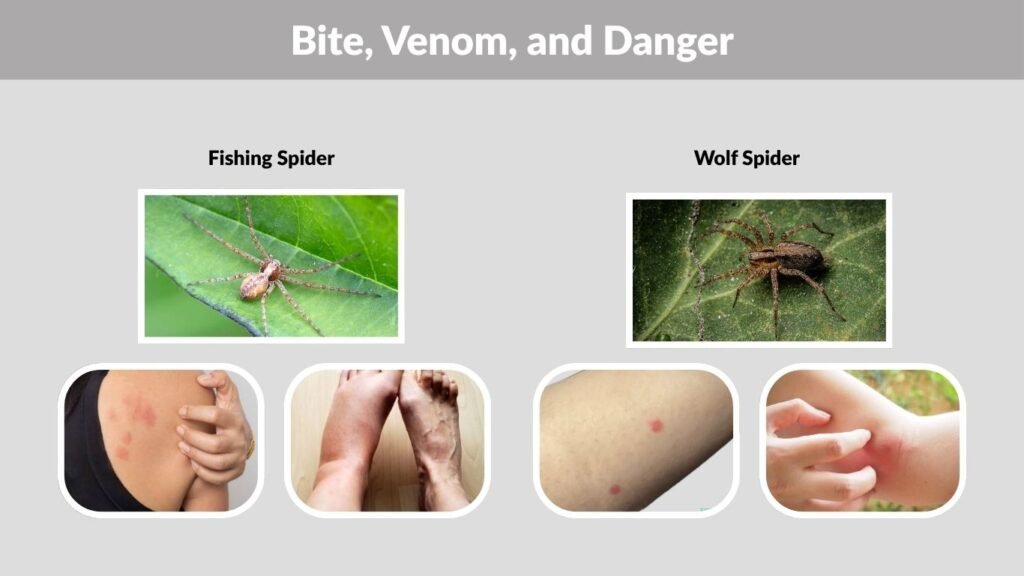
Both fishing spiders and wolf spiders have venom because they use it to subdue prey. However, venomous does not automatically mean medically dangerous. For most healthy adults, bites from either spider are usually not serious.
Fishing Spider Bite
Fishing spiders can bite if trapped, squeezed, or handled, but they are not aggressive. Penn State Extension describes fishing spiders as harmless and rarely biting, even when grabbed. A bite may cause mild pain, redness, itching, or swelling.
Wolf Spider Bite
Wolf spiders may bite in self-defense, but they usually avoid people. A bite may cause local pain, redness, and swelling. Serious reactions are uncommon, but anyone with severe swelling, breathing trouble, dizziness, spreading redness, or signs of infection should seek medical advice.
9. Fishing Spider vs Wolf Spider in the House
A large brown spider inside the house can be alarming, but both fishing spiders and wolf spiders may wander indoors by accident. Their presence does not always mean there is an infestation. Most are simply hunting prey or looking for shelter.
Fishing Spider in the House
Fishing spiders may enter homes near woods, lakes, streams, basements, garages, cabins, or firewood piles. Dark fishing spiders are especially known for appearing on walls, siding, and indoor surfaces near wooded areas. They may look huge because they rest with legs spread wide.
Wolf Spider in the House
Wolf spiders usually enter at ground level through door gaps, cracks, garages, basements, or foundation openings. They are often seen running across floors rather than resting high on walls. If many wolf spiders appear indoors, there may be insects, clutter, or entry gaps attracting them.
How to Identify Them Quickly
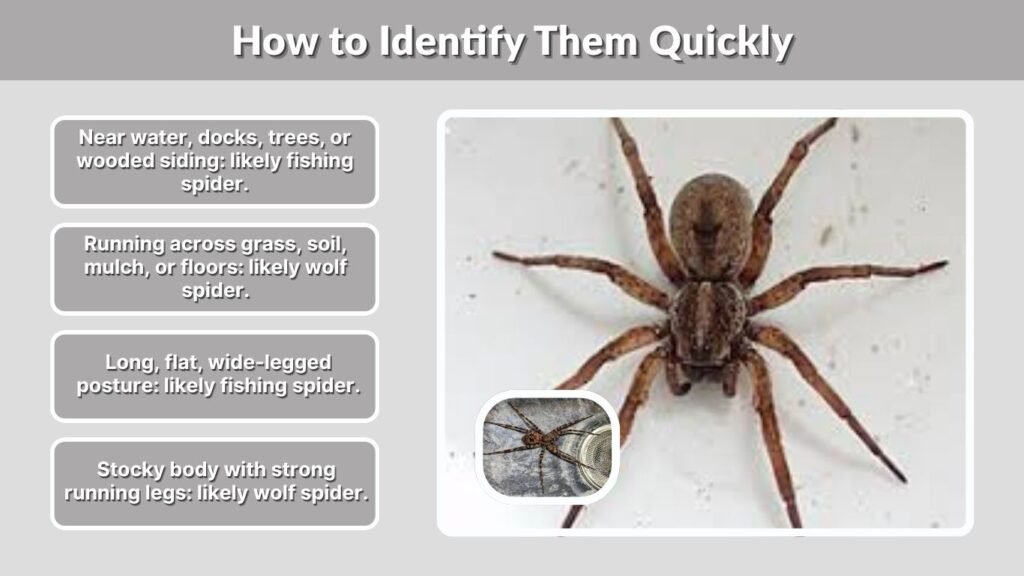
The easiest way to separate fishing spiders from wolf spiders is to look at location, body shape, and behavior. A long-legged spider resting flat on a wall near woods or water is more likely a fishing spider. A stocky spider running across the ground with large forward-facing eyes is more likely a wolf spider.
Quick ID Checklist
- Near water, docks, trees, or wooded siding: likely fishing spider.
- Running across grass, soil, mulch, or floors: likely wolf spider.
- Long, flat, wide-legged posture: likely fishing spider.
- Stocky body with strong running legs: likely wolf spider.
- Large forward-facing eyes: likely wolf spider.
- Egg sac carried in mouthparts: fishing spider.
- Egg sac attached behind the abdomen: wolf spider.
- Babies riding on mother’s back: wolf spider.
- Young guarded in a nursery web: fishing spider.
Which Spider Is Bigger?
Fishing spiders often look bigger because of their long legs and flat posture. Some wolf spiders can also be large, but they usually look more compact. In many side-by-side sightings, fishing spiders appear wider while wolf spiders appear heavier-bodied.
A dark fishing spider on a wall may look enormous compared with a wolf spider on the ground. However, exact size depends on species, age, and sex. Females of both groups are usually larger than males.
Which Spider Is More Dangerous?
Neither spider is considered highly dangerous to humans. Both can bite, but bites are usually defensive and uncommon. The bigger risk is misidentification. People may mistake either spider for a brown recluse or another medically important spider.
If you are unsure, take a clear photo from a safe distance. Avoid touching the spider. For indoor removal, use a cup and stiff paper, or contact a local pest professional if you are uncomfortable.
How to Keep Both Spiders Away
Fishing spiders and wolf spiders help control insects, but most people do not want them indoors. Prevention is mainly about sealing entry points and reducing insect prey.
Prevention Tips
- Seal cracks around doors, windows, and foundations.
- Repair torn screens and gaps around vents.
- Add door sweeps to exterior doors.
- Move firewood and lumber away from the house.
- Reduce clutter in garages, sheds, and basements.
- Vacuum corners, storage areas, and floor edges.
- Use outdoor lights less often at night.
- Control insects that attract hunting spiders.
- Keep grass, mulch, and vegetation trimmed near the foundation.
FAQs
Is a fishing spider the same as a wolf spider?
No, fishing spiders and wolf spiders are not the same. Fishing spiders belong to the family Pisauridae, while wolf spiders belong to Lycosidae. They look similar because both are large, brown hunters, but they differ in eye pattern, habitat, egg-carrying behavior, body shape, and hunting location.
How can I tell a wolf spider from a fishing spider?
Look at the eyes, body shape, and location. Wolf spiders have a distinct three-row eye pattern with two large forward-facing eyes. Fishing spiders usually look flatter and longer-legged. Fishing spiders are often near water, trees, or walls, while wolf spiders are more commonly found on the ground.
Which is bigger, a fishing spider or a wolf spider?
Fishing spiders often appear bigger because their legs are long and widely spread. Wolf spiders can also be large, but many look stockier and more compact. Size overlaps between the two groups, so size alone is not the best way to identify them.
Are fishing spiders or wolf spiders poisonous?
Both have venom, but they are not considered dangerous to most people. Their venom is mainly used to subdue prey. A defensive bite may cause mild pain, redness, swelling, or itching. Serious symptoms are uncommon, but medical help is important if symptoms worsen.
Do wolf spiders and fishing spiders come inside houses?
Yes, both may enter homes by accident. Fishing spiders often enter homes near wooded or damp areas, while wolf spiders usually come in at ground level through cracks, doors, garages, or basements. Sealing gaps and reducing insects indoors can help prevent both.
