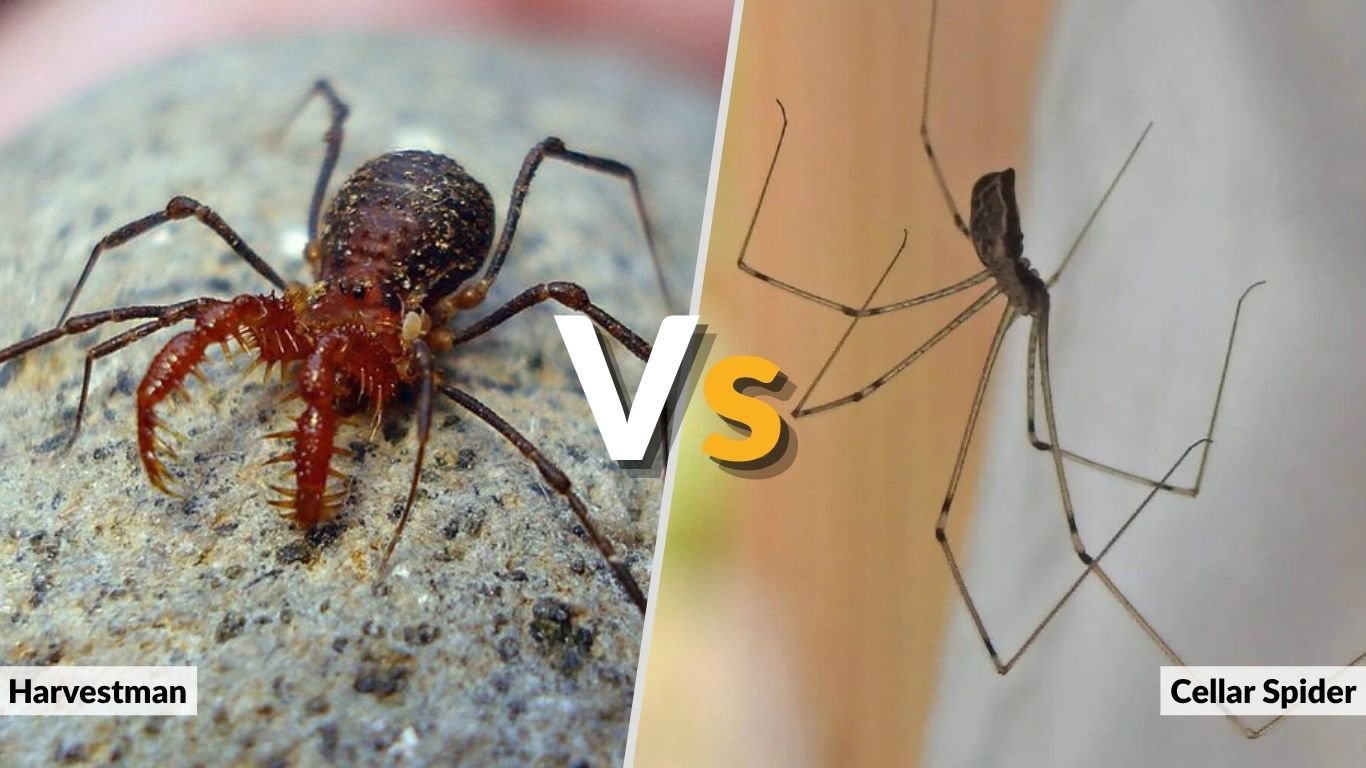
The names harvestman, cellar spider, and daddy long legs often create confusion because all three can refer to long-legged creatures. Many people see a tiny body with thin legs and assume it is the same animal. In reality, a harvestman and a cellar spider are very different. One is not a true spider, while the other is. Knowing the difference helps you identify what is in your home, garden, basement, or garage.
What Is a Harvestman?
A harvestman is an arachnid in the order Opiliones. It is often called daddy long legs, especially in North America. Although it looks spider-like, a harvestman is not a true spider. It has long legs, a small rounded body, and no web-building ability.
Harvestmen are commonly found outdoors in gardens, forests, fields, under logs, near rocks, and around damp shaded areas. They may also appear near homes, sheds, patios, and garages. Unlike spiders, they do not spin silk webs to catch prey. Instead, they walk around searching for food.
Their diet may include tiny insects, decaying plant material, dead arthropods, and organic matter. Because of this, harvestmen can be considered useful in outdoor environments. They help clean up small dead organisms and may also feed on soft-bodied pests.
A harvestman is harmless to people. It does not have venom glands like spiders, and it cannot create silk. The old myth that harvestmen are highly venomous is false.
What Is a Cellar Spider?
A cellar spider is a true spider, usually from the family Pholcidae. It is also often called daddy long legs spider because of its extremely long, thin legs. This is where much of the confusion begins. Both harvestmen and cellar spiders may be called daddy long legs, but they are not the same creature.
Cellar spiders are common inside homes and buildings. They often live in basements, garages, bathrooms, crawl spaces, closets, sheds, and ceiling corners. Unlike harvestmen, cellar spiders build loose, messy, tangled webs. They usually hang upside down in these webs and wait for small insects to get trapped.
Cellar spiders have two main body sections, produce silk, and have venom for subduing tiny prey. However, they are not considered dangerous to humans. They are shy, non-aggressive spiders that usually stay in their webs.
When disturbed, cellar spiders may shake or vibrate rapidly. This behavior can make them look alarming, but it is a defense response. They are not trying to attack.
Harvestman vs Cellar Spider at a Glance
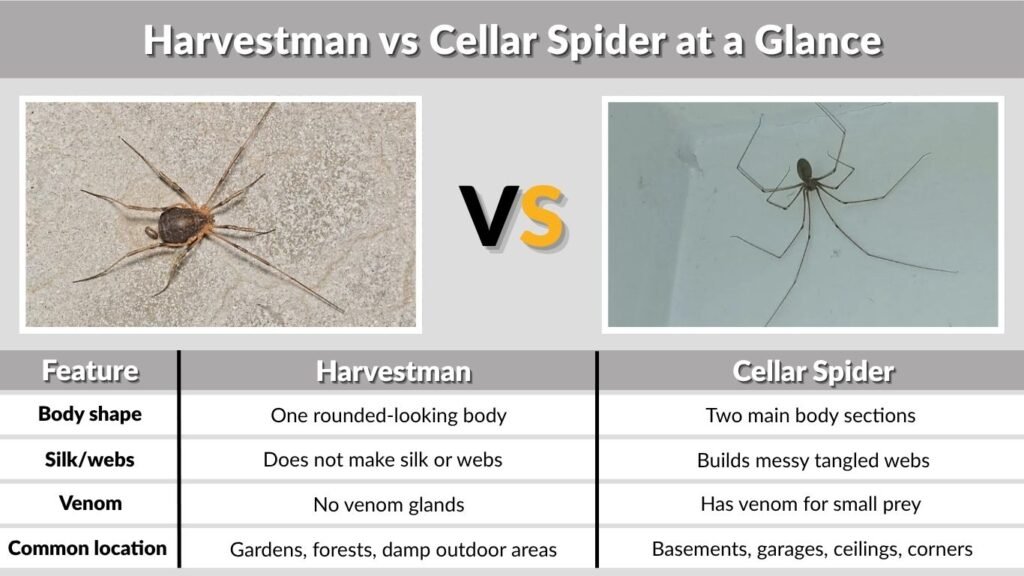
The easiest way to separate a harvestman from a cellar spider is to look for a web. If the creature is hanging in a messy indoor web, it is probably a cellar spider. If it is walking around outdoors and has no web, it may be a harvestman.
| Feature | Harvestman | Cellar Spider |
| Scientific group | Arachnid, order Opiliones | True spider, family Pholcidae |
| Body shape | One rounded-looking body | Two main body sections |
| Silk/webs | Does not make silk or webs | Builds messy tangled webs |
| Venom | No venom glands | Has venom for small prey |
| Common nickname | Daddy long legs | Daddy long legs spider |
| Common location | Gardens, forests, damp outdoor areas | Basements, garages, ceilings, corners |
| Risk to humans | Harmless | Usually harmless |
Harvestman vs Cellar Spider Body Shape Differences
Body shape is one of the clearest differences between a harvestman and a cellar spider.
A harvestman usually looks like it has one small, rounded, oval body. The body sections are broadly joined, so the body appears almost fused. Its legs attach around this compact body, creating the classic daddy long legs look.
A cellar spider has the body structure of a true spider. It has two main body sections: the cephalothorax and abdomen. These sections may be small and delicate, but they are still separate. Cellar spiders often look thinner and more fragile than harvestmen.
How to Check the Body Shape
Use these clues when identifying the creature:
- A single rounded body usually points to a harvestman
- Two visible body sections usually point to a cellar spider
- A body hanging in a web is usually a cellar spider
- A walking body with no web nearby is often a harvestman
You do not need to touch the animal to check. A close look or a clear photo is usually enough.
Harvestman vs Cellar Spider Web-Building Differences
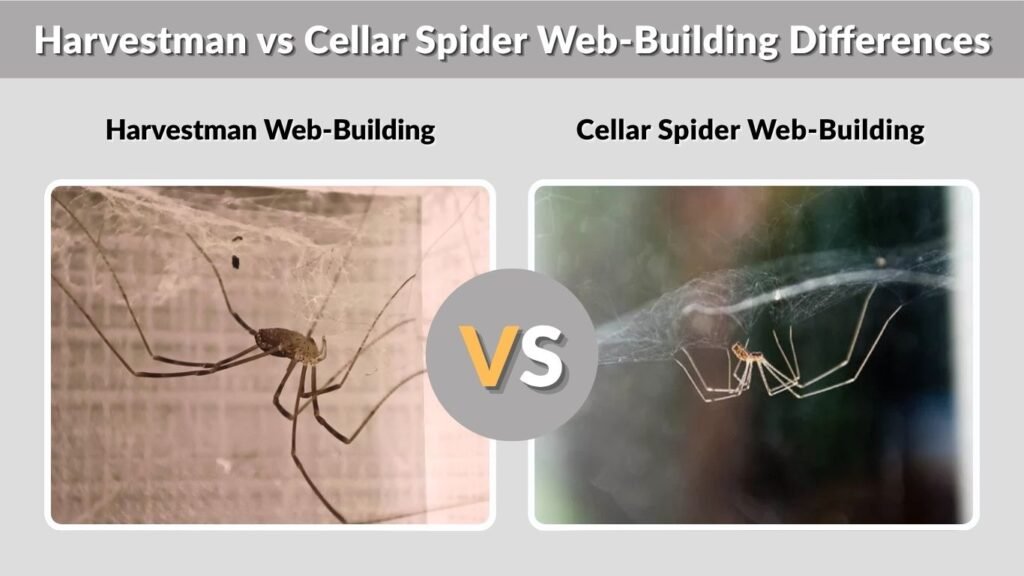
Webs are one of the most important identification clues.
Harvestmen do not produce silk, so they do not build webs. If you see a long-legged creature walking across a wall, patio, garden bed, or forest floor with no web around it, it may be a harvestman.
Cellar spiders do produce silk. They build messy, irregular webs in corners and sheltered areas. These webs may look dusty, loose, and disorganized. You may see the spider hanging upside down in the web.
Common Cellar Spider Web Locations
Cellar spider webs often appear in:
- Basement ceiling corners
- Garage walls
- Bathrooms
- Closets
- Crawl spaces
- Sheds
- Under stairs
- Around stored boxes
If the long-legged creature is sitting in a tangled web, it is not a harvestman.
Harvestman vs Cellar Spider Venom and Bite Differences
One major difference is venom. Harvestmen do not have venom glands. They are not venomous and are not dangerous to humans. They also do not have the spider-like fangs used to inject venom.
Cellar spiders are true spiders, so they have venom for catching prey. However, their venom is used on tiny insects and other small arthropods. They are not considered medically important to humans. Cellar spider bites are rare, and these spiders are not aggressive.
A cellar spider can technically bite, but it usually avoids people. A bite would most likely happen only if the spider were trapped against skin or handled roughly. Even then, serious effects are not expected.
Simple Safety Facts
Here is the practical difference:
- Harvestmen are not venomous
- Cellar spiders have venom but are not dangerous to people
- Neither one wants to bite humans
- Both are generally harmless around homes
- Serious bite symptoms should not be blamed on either without proof
If you have a painful, spreading, infected, or worsening skin mark, it is better to seek medical advice rather than assume it came from a harvestman or cellar spider.
Harvestman vs Cellar Spider Habitat and Location Differences
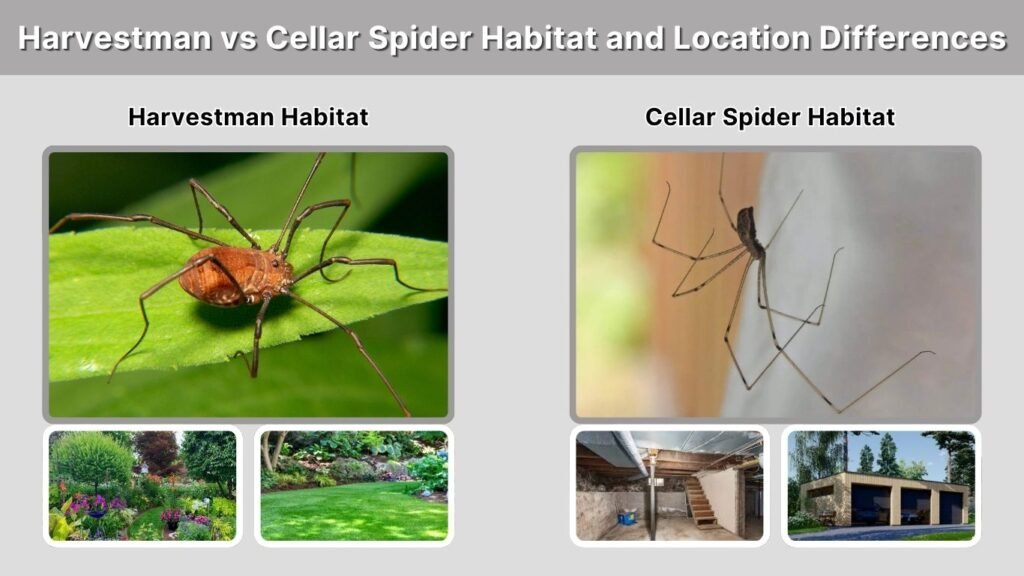
Harvestmen and cellar spiders often live in different places.
Harvestmen are more common outdoors. They like damp, shaded, protected environments. You may find them in gardens, under leaves, near wood piles, around rocks, in forests, and near outdoor walls. They may wander onto patios or into garages, but they are not usually web builders in home corners.
Cellar spiders are more common indoors or around structures. They like quiet places where webs are not disturbed. Basements, garages, sheds, bathrooms, attics, and ceiling corners are ideal for them.
Where You Are Most Likely to Find Each
Harvestmen are commonly found in:
- Gardens
- Lawns
- Forest edges
- Under logs
- Under stones
- Damp outdoor areas
Cellar spiders are commonly found in:
- Basements
- Garages
- Ceiling corners
- Closets
- Bathrooms
- Sheds and crawl spaces
Location alone is not perfect, but it helps. A long-legged creature in a web indoors is usually a cellar spider. A long-legged creature walking outdoors is often a harvestman.
Daddy Long Legs: Why the Name Is Confusing
The term daddy long legs is the main reason people mix up harvestmen and cellar spiders. In some places, daddy long legs means harvestman. In other places, it means cellar spider. In the UK, people may also use daddy long legs for crane flies.
This means the name alone is not enough for identification. When someone says daddy long legs, they may be talking about three different creatures:
- Harvestman
- Cellar spider
- Crane fly
That is why it is better to use physical clues. Count the wings, look for webs, and check the body shape. A crane fly has wings and six legs because it is an insect. A harvestman has eight legs, no web, and a rounded body. A cellar spider has eight legs, two body sections, and a messy web.
Harvestman vs Cellar Spider vs Crane Fly
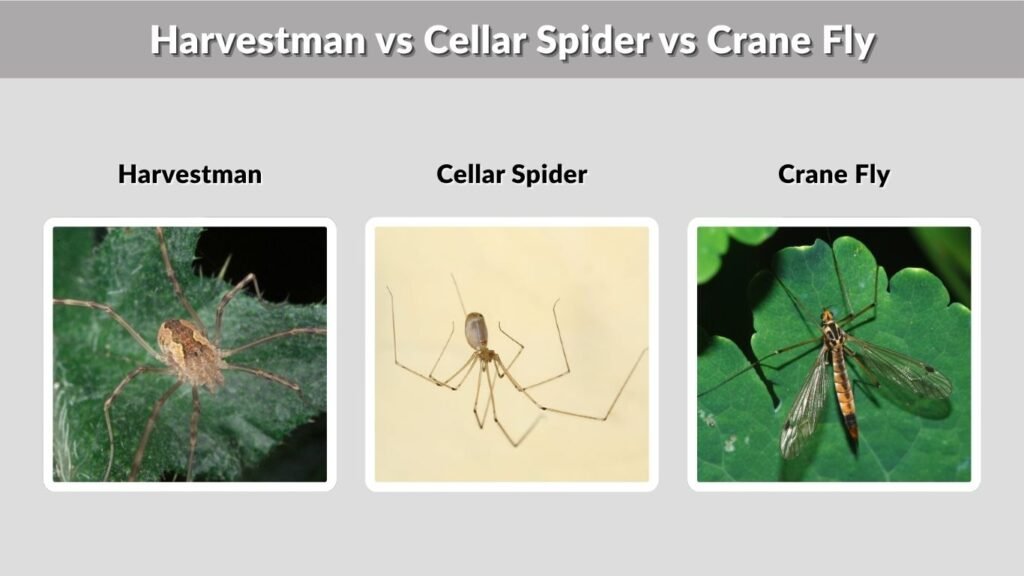
A crane fly is not a spider or harvestman. It is an insect. It has six legs, wings, and a mosquito-like appearance. Many crane flies are harmless adults, although their larvae may feed on plant roots in some cases.
A harvestman is an arachnid, but not a true spider. It has eight legs, no wings, no silk, and no venom glands. It usually walks around rather than staying in a web.
A cellar spider is a true spider. It has eight legs, silk glands, venom for prey, and a web-building habit. It usually hangs in messy webs inside buildings or sheltered corners.
If you see wings, it is a crane fly. If you see a web, it is likely a cellar spider. If you see a rounded long-legged creature walking without a web, it may be a harvestman.
Behavior Differences
Harvestmen and cellar spiders behave differently because they find food in different ways.
Harvestmen are active walkers. They move across surfaces searching for food. They may feed on tiny insects, dead arthropods, decaying matter, and soft organic material. They do not wait in webs because they cannot build them.
Cellar spiders are web-based predators. They stay in tangled webs and wait for prey. When insects touch the web, the spider detects movement and captures them. Cellar spiders may also catch other spiders and small household pests.
When disturbed, harvestmen may run away or drop a leg as a defense mechanism. Cellar spiders often vibrate in their webs to confuse predators.
Which One Is More Common Indoors?
Cellar spiders are usually more common indoors than harvestmen. If you regularly see long-legged creatures hanging in ceiling corners, closets, bathrooms, basements, or garages, they are likely cellar spiders.
Harvestmen may enter homes by accident, but they are not usually indoor web dwellers. If one appears indoors, it may have wandered in from a garden, patio, or damp outdoor area.
If you want to reduce cellar spiders inside, remove webs regularly and reduce the insects they eat. If you want to reduce harvestmen around your home, manage outdoor clutter, leaf piles, moisture, and hiding places near entry points.
Are Harvestmen and Cellar Spiders Good or Bad?
Both harvestmen and cellar spiders can be beneficial.
Harvestmen help clean up small organic matter and may feed on tiny pests. They are part of the natural outdoor ecosystem and are harmless to people.
Cellar spiders help catch insects indoors. They may reduce flies, mosquitoes, gnats, moths, and even other small spiders. The main downside is that their webs can look messy and collect dust.
You do not need to panic if you see either one. In most cases, simple cleaning or gentle relocation is enough.
How to Remove Them Safely
If you do not want harvestmen or cellar spiders around your home, use simple non-chemical control first.
For cellar spiders, vacuum webs from corners, ceilings, and storage areas. Remove egg sacs if you see them. Reduce indoor insects and seal gaps around doors and windows.
For harvestmen, reduce outdoor hiding places near the house. Move wood piles away from walls, clear leaf litter, and reduce damp clutter around foundations.
Chemical sprays are usually unnecessary for either one. If you are seeing large numbers of spiders indoors, the bigger issue may be an insect problem attracting them.
FAQs
Is a harvestman the same as a cellar spider?
No, a harvestman is not the same as a cellar spider. A harvestman is an arachnid but not a true spider, while a cellar spider is a true spider. Harvestmen do not make silk or webs, but cellar spiders build messy tangled webs in corners, basements, and garages.
Why are both called daddy long legs?
Both are called daddy long legs because they have very long, thin legs. The nickname changes by region, which causes confusion. In some places, daddy long legs means harvestman. In others, it means cellar spider. Some people also use the name for crane flies, which are insects.
Can harvestmen or cellar spiders bite?
Harvestmen do not have venom glands and are harmless to people. Cellar spiders can technically bite because they are true spiders, but bites are very rare. They are not aggressive and usually stay in their webs. Neither animal should be considered a serious household danger.
How can I tell them apart quickly?
Look for a web first. A long-legged creature hanging in a messy indoor web is probably a cellar spider. A long-legged creature walking around outdoors with no web is more likely a harvestman. Body shape also helps: harvestmen look rounded, while cellar spiders have two body sections.
Is a crane fly also a daddy long legs?
In some regions, yes, crane flies are also called daddy long legs. However, crane flies are insects, not spiders or harvestmen. They have wings and six legs. Harvestmen and cellar spiders have eight legs and no wings. If the creature flies, it is a crane fly.