
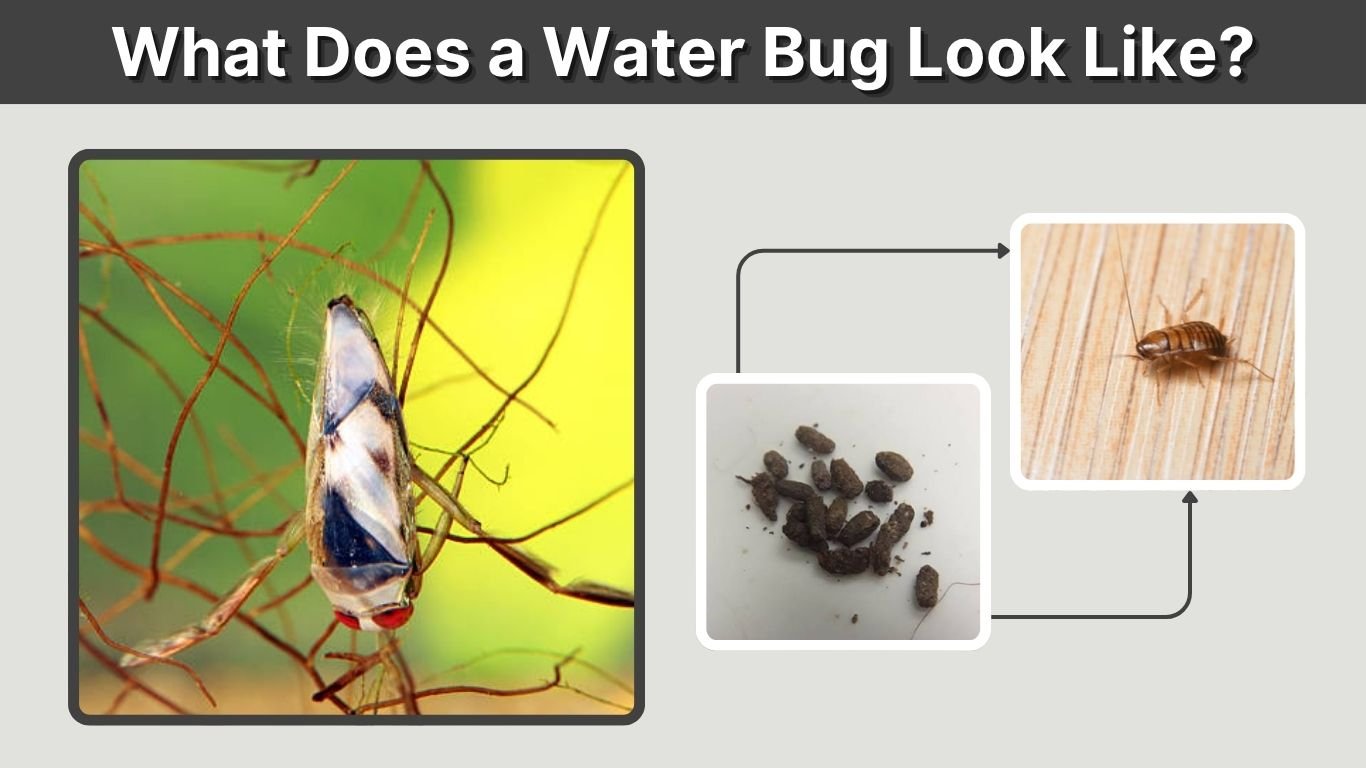
A true water bug usually has a broad, flattened, oval body, brown or olive coloring, six legs, and powerful front legs that resemble claws. However, the name “water bug” is also commonly used for large cockroaches found in damp parts of a house. These cockroaches look different: they have very long antennae, spiny legs, and a flatter, more elongated body. Examining the insect’s legs, antennae, size, color, and location can help you identify it correctly.
What Does a True Water Bug Look Like?
The insect most accurately called a water bug is the giant water bug, a large aquatic predator belonging to the family Belostomatidae. Its body is shaped for moving through ponds, lakes, marshes, and slow-moving water.
A giant water bug generally has:
- A broad, flattened, oval body
- Brown, olive-brown, or dark tan coloring
- Short, partly hidden antennae
- Large, claw-like front legs
- Flat rear legs adapted for swimming
- Wings folded across its back
- A pointed, piercing mouthpart
Depending on the species, adults may measure approximately 2 to 4 inches long. The University of Minnesota describes them as olive-brown insects with prominent claw-like front legs.
Their coloring provides camouflage among mud, dead leaves, aquatic plants, and pond bottoms. From above, the folded wings may form an overlapping pattern across the back.
Why Do Some Water Bugs Look Like Cockroaches?
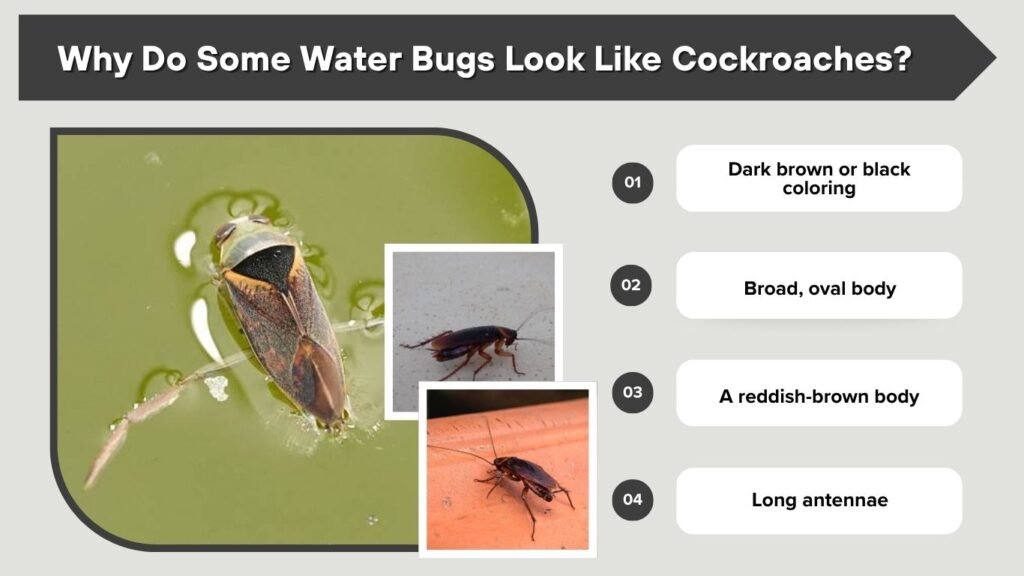
The term “water bug” is frequently applied to Oriental cockroaches and American cockroaches because both species favor damp environments. They may be found near drains, leaking plumbing, sewers, bathrooms, basements, and laundry rooms.
These insects are not true aquatic water bugs. They cannot live and hunt underwater like giant water bugs.
Oriental Cockroach
The Oriental cockroach is the house insect most often called a water bug. Adults are usually about one inch long and have a very dark brown or nearly black body with a greasy-looking shine.
Identification features include:
- Dark brown or black coloring
- Broad, oval body
- Long, thin antennae
- Spiny legs
- Slow, crawling movement
- Short or undeveloped wings
Female Oriental cockroaches have tiny wing pads, while male wings cover only part of the abdomen. Neither normally flies. They commonly inhabit dark, cool, damp locations.
American Cockroach
American cockroaches are reddish-brown and commonly grow larger than Oriental cockroaches. A pale yellow or tan border behind the head often creates a figure-eight-like pattern.
They have:
- A reddish-brown body
- Long antennae
- Six long, spiny legs
- Fully developed wings
- A narrow, flattened shape
- A pale marking behind the head
The American cockroach is one of the largest common household cockroaches and is also sometimes called a water bug.
Water Bug vs. Cockroach: Visual Differences
A giant water bug can resemble a large cockroach from a distance, but several physical characteristics separate them.
| Feature | Giant water bug | Cockroach called a water bug |
| Body shape | Broad, oval, and heavy | Narrower, flatter, and elongated |
| Antennae | Short and difficult to see | Extremely long and obvious |
| Front legs | Thick, curved, and claw-like | Thin, spiny running legs |
| Rear legs | Flat and paddle-like | Long and designed for running |
| Typical habitat | Ponds, lakes, pools, and wetlands | Drains, basements, kitchens, and sewers |
| Movement | Swims and may fly | Usually runs quickly |
| Human risk | Can deliver a painful defensive bite | Bites are extremely rare |
The easiest identification feature is usually the antennae. A cockroach has long, threadlike antennae that may equal or exceed its body length. A giant water bug’s antennae are short and tucked beneath the head.
The front legs also differ. Giant water bugs have thick, curved legs designed to grab prey. Cockroaches have six relatively similar-looking legs covered in noticeable spines.
What Do Baby Water Bugs Look Like?
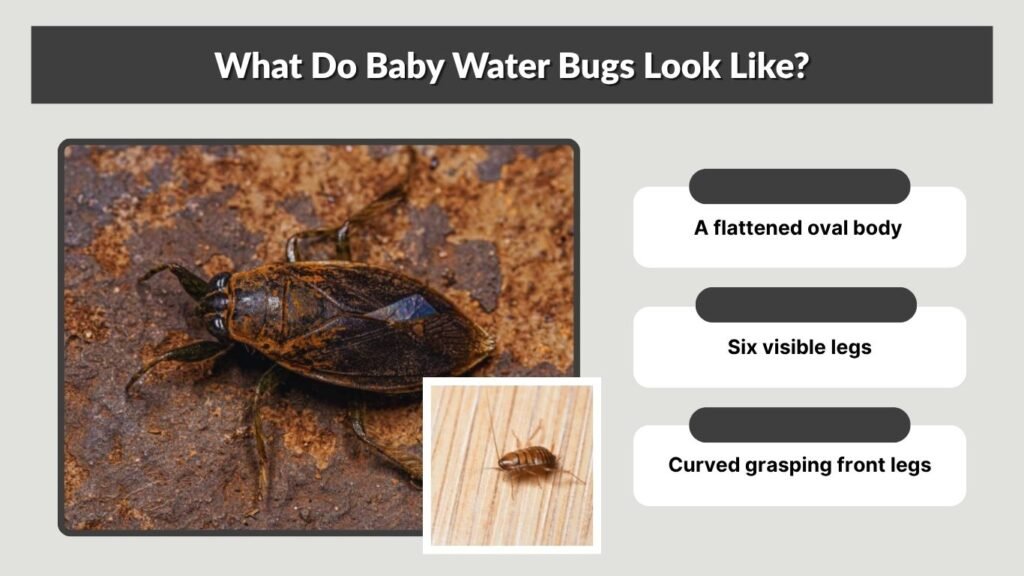
The appearance of a baby water bug depends on whether the insect is a true aquatic bug or a cockroach.
Giant Water Bug Nymphs
Young giant water bugs are called nymphs. They resemble smaller, wingless adults and typically have:
- A flattened oval body
- Six visible legs
- Curved grasping front legs
- Brown, tan, or greenish coloring
- No fully developed wings
As they grow, they shed their outer covering several times. They do not pass through a caterpillar- or worm-like stage.
Cockroach Nymphs
Young American and Oriental cockroaches also resemble miniature adults, but they lack developed wings. They may appear darker, rounder, and more compact than adults.
Finding several small cockroach-like insects in a kitchen or bathroom is more concerning than finding one large aquatic bug. Nymphs indoors can indicate that cockroaches are breeding nearby. Cockroach nymphs are similar to adults but smaller and wingless.
What Do Water Bug Eggs Look Like?
True water bug eggs vary among species. Some giant water bugs attach eggs to vegetation above the water, while in certain species the female deposits them on the male’s back. They usually appear as groups of small, pale, oval or cylindrical eggs.
Cockroach eggs look very different. American and Oriental cockroaches produce an ootheca, or egg case. It resembles a small brown or reddish-brown capsule with ridges along one edge.
A cockroach egg case may be found:
- Beneath appliances
- Inside cabinets
- Near plumbing
- Along basement walls
- Behind stored boxes
- Inside cracks and protected corners
An egg case in the house strongly suggests a cockroach rather than a true aquatic water bug.
What Does Water Bug Poop Look Like?
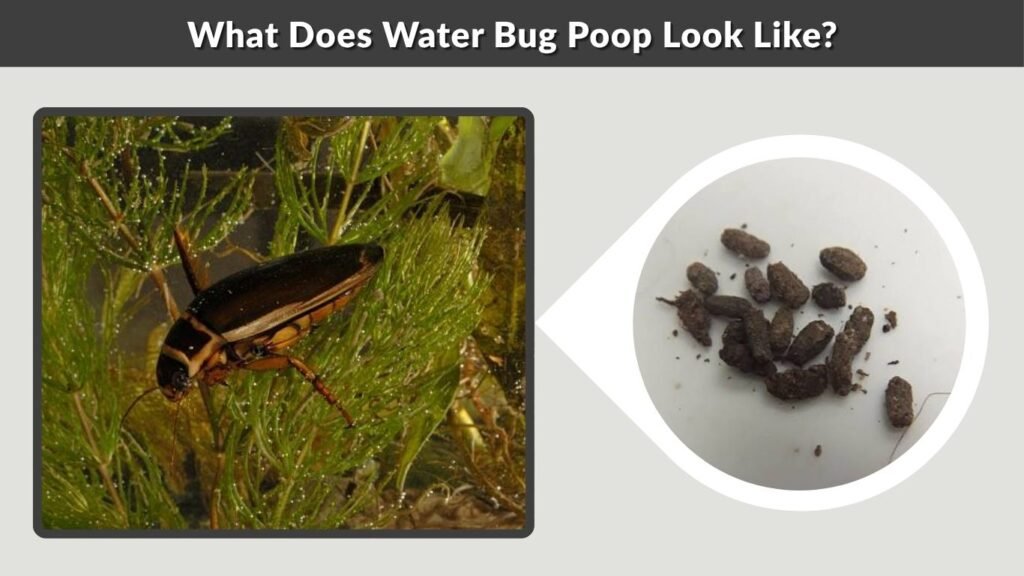
When people ask about water bug droppings inside a house, they are usually describing cockroach droppings.
Large cockroach droppings may look like:
- Small dark cylinders
- Blunt-ended grains
- Black or brown pellets
- Coffee grounds in some cases
- Dark smears near damp hiding places
Droppings often collect along walls, beneath sinks, inside cabinets, behind appliances, and around plumbing openings. Their size and shape vary with the cockroach species and age.
Do not identify an infestation from droppings alone. Mouse droppings, termite frass, food particles, and dirt can look similar. Use sticky monitoring traps or consult a pest professional when identification is uncertain.
What Are Tadpole-Like Bugs in Water?
Tiny organisms that look like tadpoles in stagnant water are usually not giant water bugs. They may be mosquito larvae, mosquito pupae, small aquatic beetles, or other immature insects.
Mosquito larvae generally have narrow, wriggling bodies and frequently move toward the surface to breathe. Mosquito pupae are larger near the front and curved toward the abdomen, producing a comma- or tadpole-like appearance.
Finding these organisms in buckets, birdbaths, pool covers, or standing water indicates that the water should be emptied, cleaned, or properly maintained.
What Is a Stick-Like Water Bug?
A thin insect resembling a twig or walking stick may be a water scorpion, particularly one from the genus Ranatra. It has a narrow body, long legs, and a tail-like breathing tube.
The “tail” is not a stinger. Water scorpions use it to breathe while resting close to the water’s surface. Some grow to approximately two inches, including the breathing tube.
Broader species from the genus Nepa can appear flatter and may resemble small giant water bugs.
What Does a Water Bug Look Like in the House?
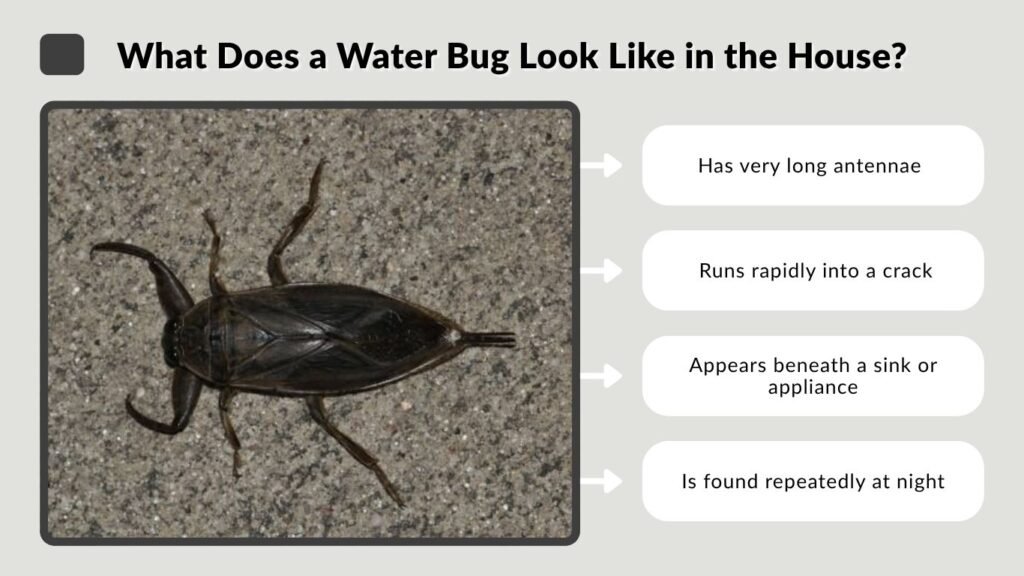
A true giant water bug inside a house is usually an accidental visitor. Adults can fly and are attracted to bright lights, so one may enter through an open door, window, or damaged screen. A single giant water bug does not normally indicate an indoor infestation.
A house water bug is more likely to be a cockroach when it:
- Has very long antennae
- Runs rapidly into a crack
- Appears beneath a sink or appliance
- Is found repeatedly at night
- Has small nymphs nearby
- Leaves droppings or egg cases
Repeated sightings of different-sized cockroaches suggest that they may be living and reproducing inside the building.
FAQs
Are black water bugs cockroaches?
A black water bug found in a basement, bathroom, or near a drain is often an Oriental cockroach. It usually has a shiny, nearly black body, long antennae, and spiny legs. True giant water bugs are more commonly olive-brown and have short antennae and grasping front legs.
Do water bugs look like roaches?
Giant water bugs may resemble large roaches because both have flattened brown bodies and folded wings. However, giant water bugs have short antennae, wide bodies, paddle-like rear legs, and thick grasping front legs. Cockroaches have long antennae and six spiny running legs.
How big is a giant water bug?
Most adult giant water bugs measure approximately two to four inches long, although size varies among species. Their broad body and powerful front legs make them appear especially large. They are considerably bigger than most aquatic insects found in pools, ponds, or other standing water.
What does a small water bug look like?
A small true water bug may resemble a miniature, wingless adult with an oval body and grasping front legs. However, a small dark insect found indoors may be a cockroach nymph. Its long antennae, spiny legs, and indoor location provide important identification clues.
Can a water bug look like a centipede?
A true water bug does not resemble a centipede because it has only six legs and a compact body. Long, segmented creatures with numerous legs are more likely centipedes or millipedes. Aquatic hellgrammites can also appear centipede-like because they have side filaments along their bodies.
