
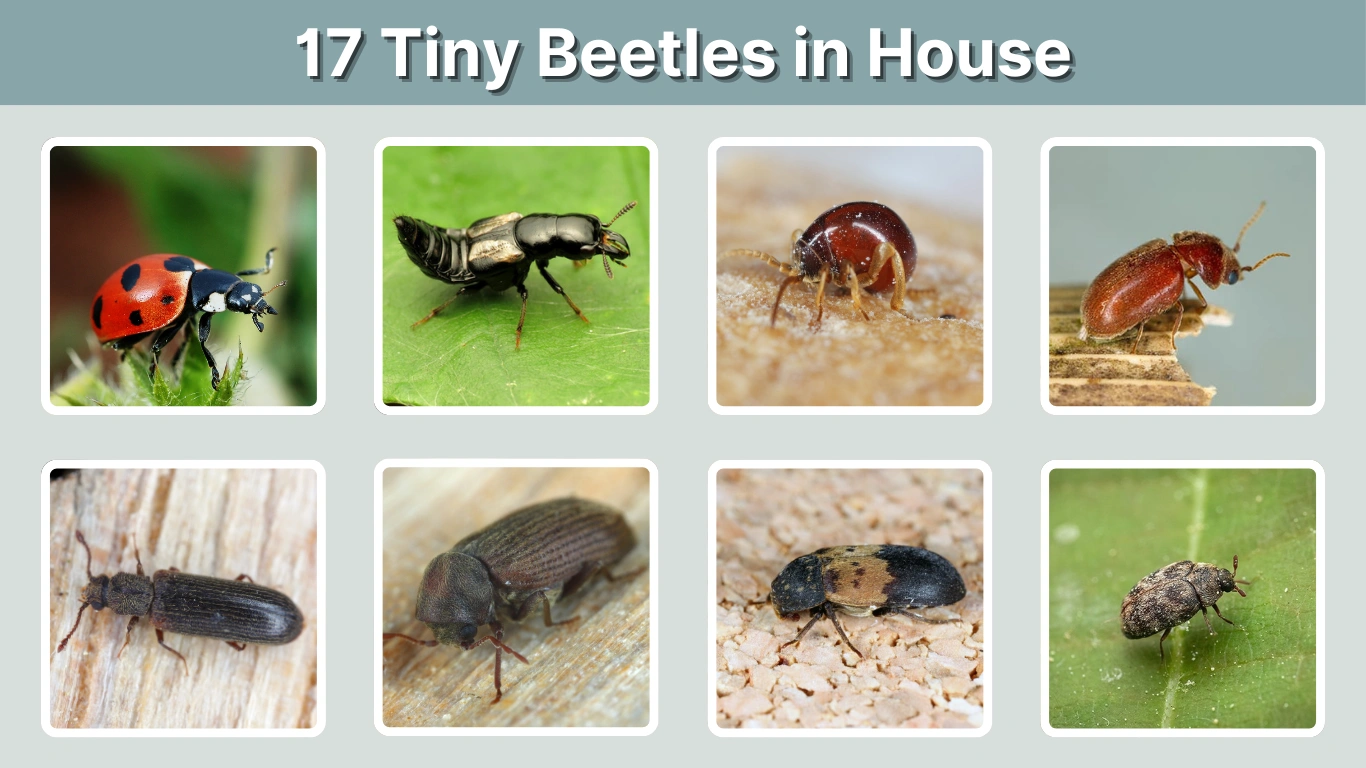
Finding tiny beetles in house can be confusing and frustrating, especially when they suddenly appear in kitchens, pantries, carpets, or near windows. These insects come in many forms—tiny black beetles, tiny brown beetles, tiny flying beetles, tiny round beetles, and even tiny spotted beetles in house—and each has its own habits and preferred hiding places. Some infest food, others damage fabrics or wood, and a few simply wander indoors by accident. In this guide, we’ll cover 17 types of tiny beetles found in homes, their appearance, behaviors, and signs of infestation, so you can easily identify what’s crawling or flying around your living space.
1. Carpet Beetle

Carpet beetles are one of the most common tiny beetles in houses, often noticed as tiny black beetles, tiny brown beetles, or tiny round beetles crawling near windows, carpets, or stored fabrics. Although the adults are harmless and sometimes fly indoors, their larvae can damage natural fibers like wool, silk, and fur, making them an unwanted pest in homes.
Identification
- Size: 1.7–3.5 mm (very tiny beetles)
- Color: Black, brown, or with mottled white, yellow, and orange patterns
- Shape: Round or oval, resembling a tiny round beetle in house
- Flying ability: Adults can fly and are often seen as tiny flying beetles in house
Behavior and Habitat
Carpet beetles usually enter homes through open windows or doors, especially in spring and summer. Adults feed on pollen outdoors but lay eggs indoors near natural fibers, carpets, upholstery, and clothing. Larvae, sometimes called “woolly bears,” are the ones responsible for household damage.
Lifecycle and Infestation Signs
Carpet beetles lay eggs on fabric or hidden crevices, and the larvae feed on organic materials for several weeks to months before pupating. You may notice:
- Tiny shed larval skins in corners or on fabrics
- Holes or damage in wool, silk, or leather items
- Small, tiny beetles in house near windows attracted to light
How to Get Rid of Carpet Beetles
- Regularly vacuum carpets, rugs, and furniture
- Wash infested clothing or bedding in hot water
- Store natural fabrics in sealed containers
- Use insecticide sprays or powders in severe cases, targeting crevices and storage areas
2. Cigarette Beetle

The cigarette beetle is another tiny brown beetle in house, often mistaken for other pantry pests. It is especially common in kitchens and pantries where it infests dried goods, making it one of the most troublesome tiny beetle bugs in house.
Identification
- Size: 2–3 mm (very small beetle)
- Color: Light brown to reddish brown
- Shape: Oval with a humped back
- Wings: Can fly, sometimes seen as tiny flying brown beetles in house
Behavior and Habitat
Cigarette beetles thrive in warm, dark storage spaces. They feed on dried tobacco, spices, grains, dried flowers, and even books. They are often noticed when tiny beetles suddenly appear near stored food items.
Lifecycle and Infestation Signs
They lay eggs directly in food materials, and larvae feed for several weeks. You may notice:
- Tiny holes in food packaging
- Small brown beetles flying around pantries
- Infested flour, spices, or dried leaves
3. Drugstore Beetle
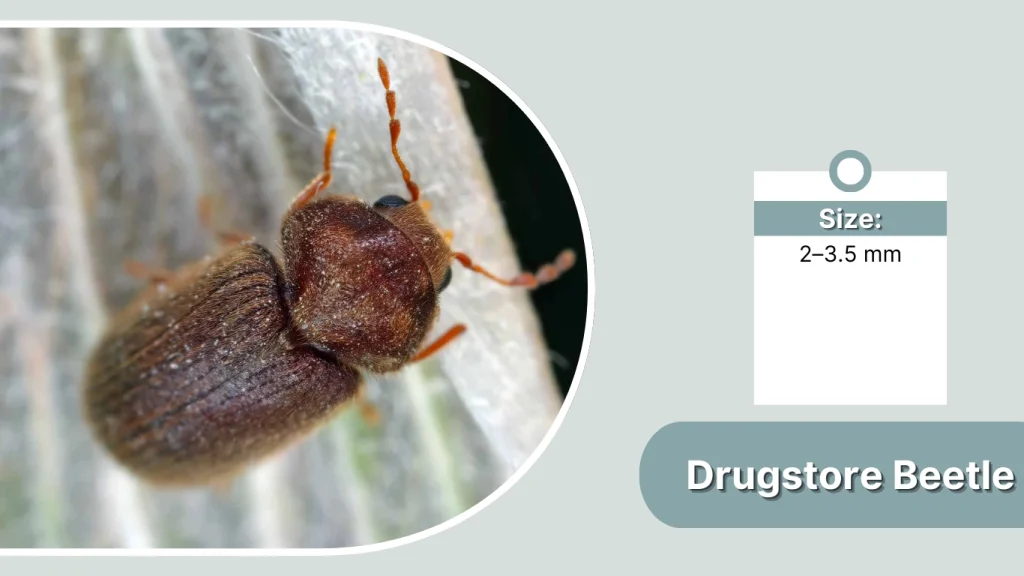
Drugstore beetles are close relatives of cigarette beetles and are another reason why people spot tiny brown beetles in house. They are especially common in pantries and kitchens.
Identification
- Size: 2–3.5 mm
- Color: Reddish brown
- Shape: Cylindrical, resembling a tiny brown beetle in house
- Wings: Active fliers, often noticed as tiny brown flying beetles in house
Behavior and Habitat
These beetles infest dried goods such as bread, cereals, spices, pet food, and even leather or paper. They prefer dark, undisturbed areas where they can reproduce easily.
Lifecycle and Infestation Signs
Females lay eggs on food sources, and larvae burrow into materials as they feed. Infestation signs include:
- Tiny boreholes in packaging
- Presence of crawling or flying beetles near pantry shelves
- Spoiled or clumped food items
4. Flour Beetle
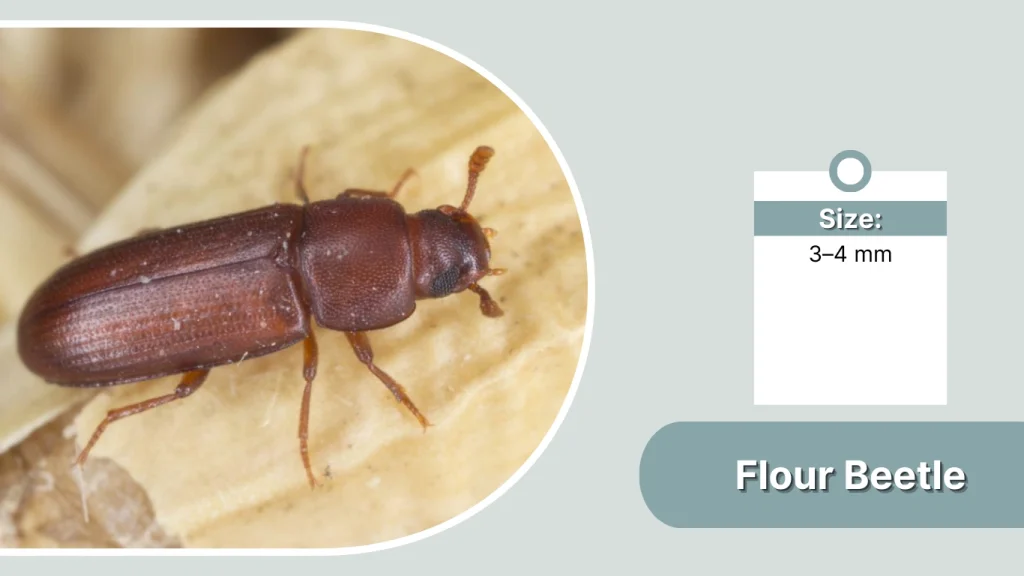
Flour beetles are among the most widespread pantry pests, often seen as tiny brown beetles in house or tiny beetle bugs in house kitchens. They are small but multiply quickly in stored food.
Identification
- Size: 3–4 mm
- Color: Reddish brown
- Shape: Flat and elongated body
- Wings: Can fly but usually crawl inside pantries
Behavior and Habitat
They thrive in stored flour, grains, cereal, and processed food. They do not eat whole grains but infest broken or milled products, making them a common cause of food spoilage.
Lifecycle and Infestation Signs
Females lay hundreds of eggs in food materials. Larvae develop inside flour or meal, leaving clumped, bad-smelling food. Infestation signs include:
- Crawling tiny brown beetles in pantry shelves
- Spoiled flour with a foul odor
- Small beetles gathering near light sources
5. Confused Flour Beetle
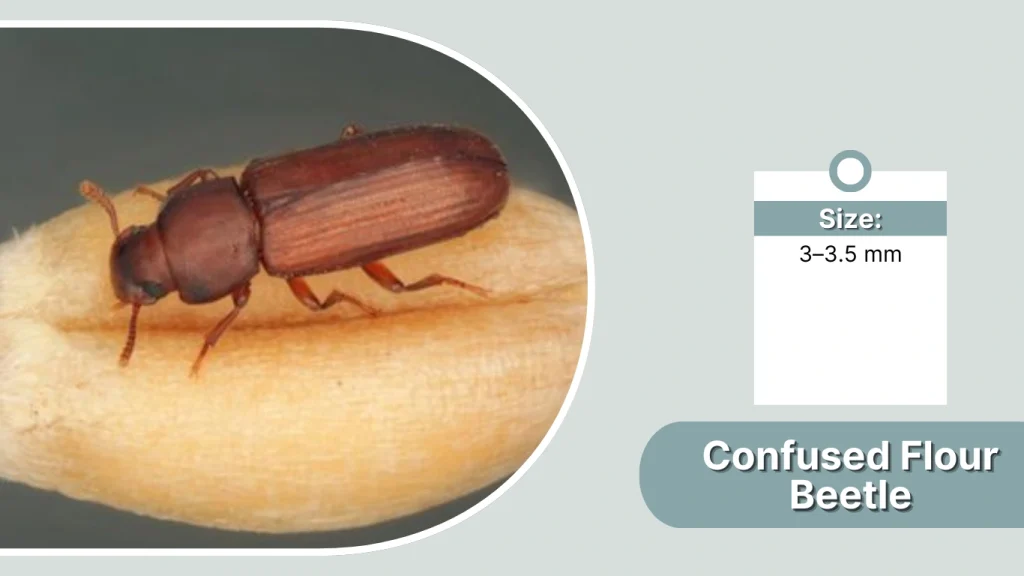
Confused flour beetles are nearly identical to regular flour beetles, making them another frequent tiny brown beetle in house pantries.
Identification
- Size: 3–3.5 mm
- Color: Reddish brown
- Shape: Long, flat, and narrow
- Wings: Cannot fly, unlike other pantry beetles
Behavior and Habitat
They infest flour, cereals, spices, dry pet food, and stored grains. They prefer warm environments and are very resilient, living for months inside pantries.
Lifecycle and Infestation Signs
Eggs are laid inside food sources, and larvae feed as they grow. Infestation signs include:
- Tiny brown beetles in house kitchens crawling in flour or cereal boxes
- Foul-smelling, damp, clumped flour
- Small beetles seen wandering near storage shelves
6. Red Flour Beetle
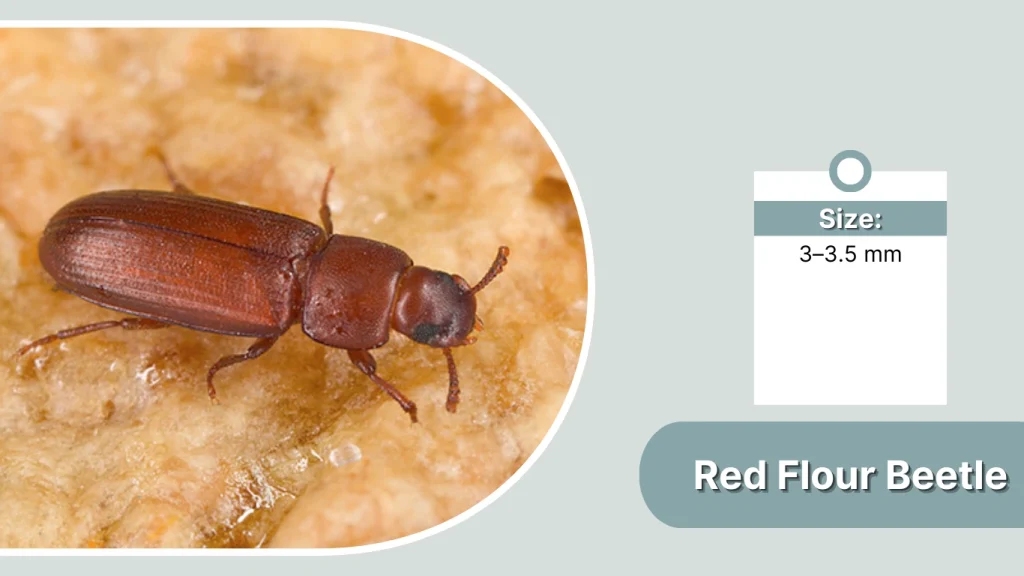
The red flour beetle is another pantry pest that appears as a tiny reddish brown beetle in house. They are very similar to the confused flour beetle but can fly, which often makes them more noticeable.
Identification
- Size: 3–3.5 mm
- Color: Reddish brown, shinier than the confused flour beetle
- Shape: Narrow, flat body
- Wings: Capable of flying, sometimes seen as tiny flying brown beetles in house
Behavior and Habitat
Red flour beetles prefer stored food products like flour, cereals, spices, dried fruits, and even pet food. They are most commonly found in pantries or cupboards where dry food is kept. Unlike some other beetles, they do not attack whole grains but infest processed foods.
Lifecycle and Infestation Signs
- Females lay hundreds of eggs in food sources
- Larvae feed on flour or dried goods until maturity
- Infested food has a foul odor and clumped texture
- Presence of tiny reddish brown beetles in pantry areas indicates an active infestation
7. Sawtoothed Grain Beetle

Sawtoothed grain beetles are another type of tiny brown beetle in house pantries, well known for infesting packaged food.
Identification
- Size: 2.5–3 mm
- Color: Dark brown
- Shape: Long, slender body with six saw-like projections on the thorax
- Wings: Cannot fly, only crawls
Behavior and Habitat
These beetles are common in kitchens, grocery stores, and food storage areas. They feed on cereals, flour, dried fruit, candy, pasta, nuts, and almost any packaged grain product. Their flattened bodies allow them to crawl into tightly sealed packages, making them persistent pests.
Lifecycle and Infestation Signs
- Eggs are laid inside or near packaged food
- Larvae develop inside products like pasta or cereal
- Infestation signs include:
- Tiny brown beetles in house kitchens or cupboards
- Damaged packaging with powdery residue
- Spoiled food with small beetles crawling inside
- Tiny brown beetles in house kitchens or cupboards
8. Biscuit Beetle
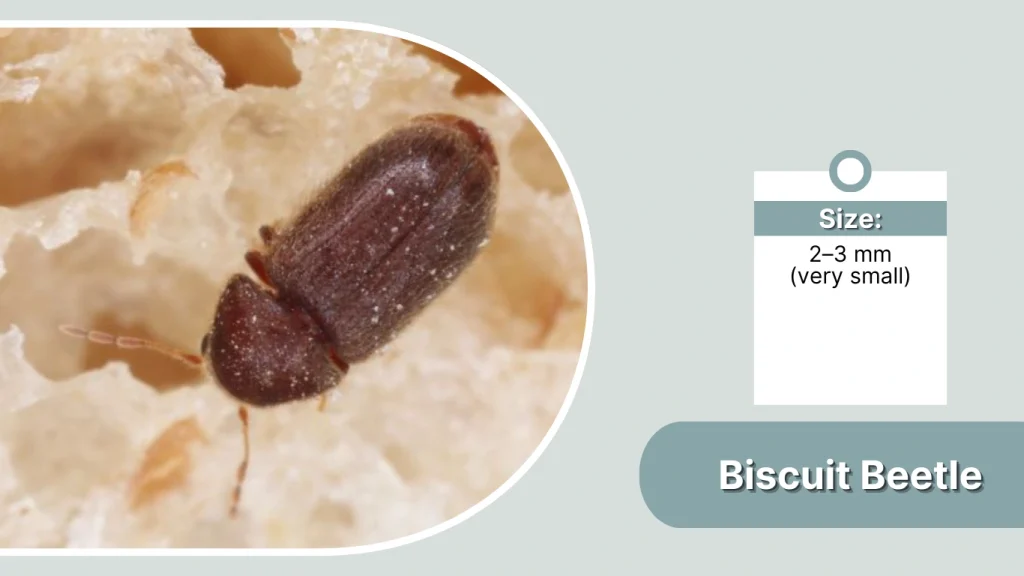
The biscuit beetle, also known as the bread beetle, is a common household pest often mistaken for the cigarette beetle. It appears as a tiny brown beetle in house and is especially known for infesting stored dry food items.
Identification
- Size: 2–3 mm (very small)
- Color: Reddish brown to dark brown
- Shape: Oval body with a distinct humped back
- Wings: Capable of flying, sometimes seen as tiny flying brown beetles in house
Behavior and Habitat
Biscuit beetles are commonly found in pantries, kitchens, and food storage areas. They feed on a wide variety of dry goods, including bread, biscuits, pasta, pet food, spices, and even non-food items such as leather, books, and paper. This makes them one of the most adaptable tiny beetle bugs in house pantries.
Lifecycle and Infestation Signs
- Females lay eggs directly in food sources.
- Larvae bore through food items and packaging while feeding.
- Infestation signs include:
- Small holes in food packaging
- Presence of tiny brown beetles crawling in cupboards
- Damaged stored foods with a powdery residue
- Small holes in food packaging
9. Khapra Beetle
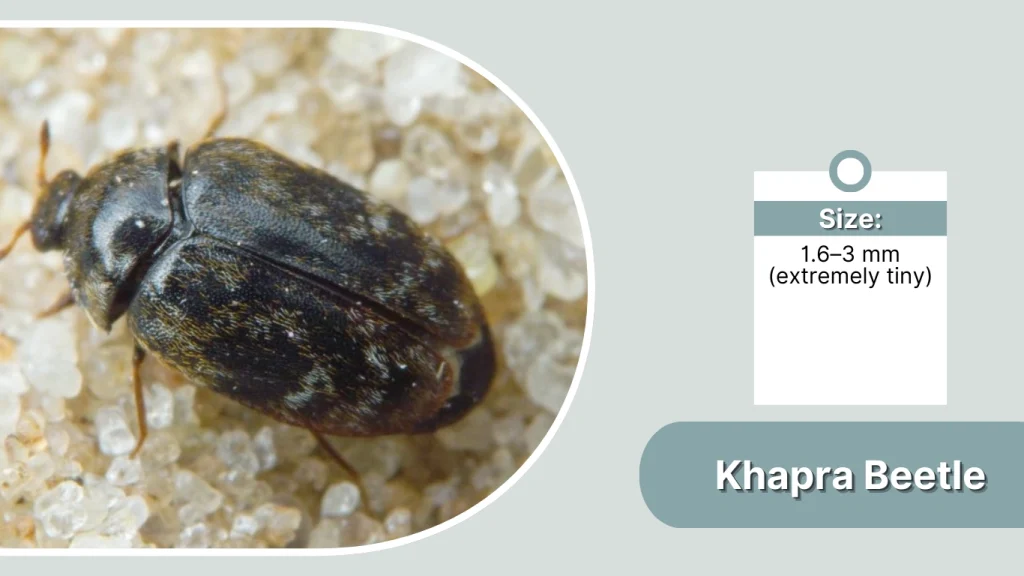
The khapra beetle is considered one of the world’s most destructive stored-product pests. It is usually noticed as a tiny brown beetle in house but is more commonly associated with warehouses and food storage facilities.
Identification
- Size: 1.6–3 mm (extremely tiny)
- Color: Brown with fine hairs giving a mottled look
- Shape: Oval, compact body
- Wings: Adults rarely fly, mostly crawl indoors
Behavior and Habitat
Khapra beetles infest grains, seeds, cereals, and processed foods. They are highly resilient and can survive for long periods without food. Because of their persistence, they are regarded as one of the toughest tiny brown beetles in house storage areas to control.
Lifecycle and Infestation Signs
- Females lay eggs in cracks or on food materials.
- Larvae cause the most damage, feeding on dry grains and leaving behind cast skins and frass (powdery residue).
- Infestation signs include:
- Contaminated or spoiled food with powdery deposits
- Tiny brown beetles crawling near stored grains
- Heavy presence of shed larval skins in cupboards or storage rooms
- Contaminated or spoiled food with powdery deposits
10. Larder Beetle

The larder beetle is a common pest often seen as a tiny black and brown beetle in house. While slightly larger than some pantry beetles, they are still small enough to be mistaken for other household pests.
Identification
- Size: 7–9 mm (bigger than flour beetles but still small)
- Color: Dark brown to black with a pale yellow band across the wing covers, often with black spots
- Shape: Elongated oval body
- Wings: Can fly but often crawl indoors
Behavior and Habitat
Larder beetles prefer protein-rich food sources such as cured meats, pet food, cheese, dead insects, and animal products like hides or feathers. They are often found in kitchens, basements, or storage areas where such food sources are present. They can also infest rodent nests or dead animal remains inside walls, making them harder to detect.
Lifecycle and Infestation Signs
- Females lay eggs in food materials or cracks near food storage
- Larvae bore into food, wood, or insulation while feeding
- Signs include:
- Tiny black and brown beetles crawling indoors
- Damage to leather, fur, or preserved meats
- Cast larval skins and powdery residue near food sources
- Tiny black and brown beetles crawling indoors
11. Varied Carpet Beetle

Varied carpet beetles are among the most recognizable household beetles, often seen as tiny round black beetles in house or tiny spotted beetles in house. They are common around windowsills, carpets, and stored clothing.
Identification
- Size: 1.7–3.5 mm
- Color: Black body with mottled white, brown, and yellow scales that form spotted or patterned markings
- Shape: Round, compact body
- Wings: Can fly, often seen as tiny flying beetles in house near windows
Behavior and Habitat
Adults feed on pollen outdoors but enter homes to lay eggs. Indoors, larvae cause the most damage by feeding on wool, silk, feathers, fur, and other natural fibers. They are commonly found in carpets, furniture, and closets, making them a destructive pest in homes.
Lifecycle and Infestation Signs
- Eggs are laid in fabrics or crevices
- Larvae, known as “woolly bears,” feed for months before pupating
- Infestation signs include:
- Tiny round beetles in house windowsills
- Shed larval skins in corners, under furniture, or in clothing
- Damage to carpets, upholstery, and clothing
- Tiny round beetles in house windowsills
12. Furniture Beetle
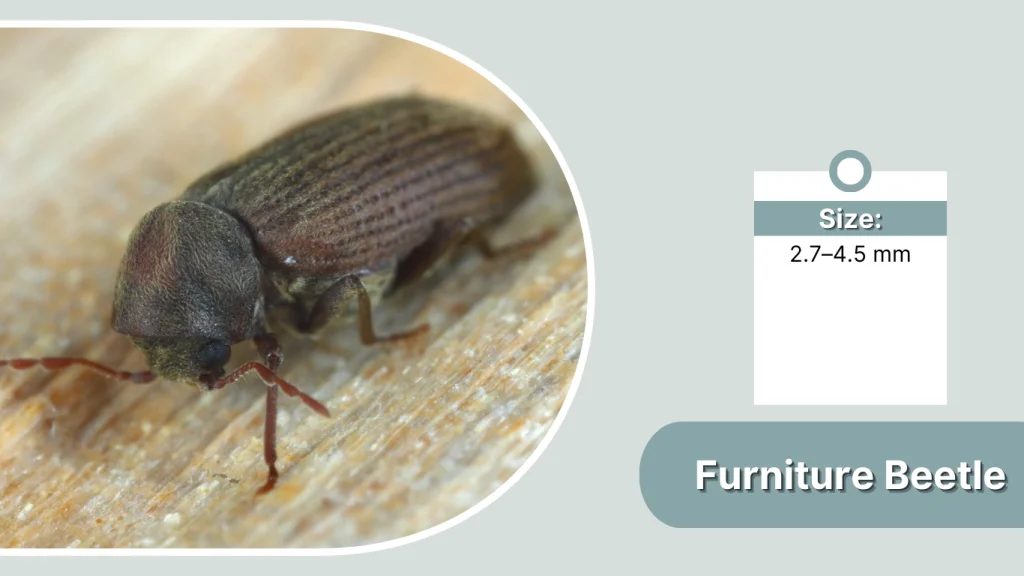
The furniture beetle, often referred to as the woodworm beetle, is a small pest that can appear as a tiny brown beetle in house. Unlike pantry pests, it targets wooden structures and furniture.
Identification
- Size: 2.7–4.5 mm
- Color: Reddish to dark brown
- Shape: Cylindrical with a rounded pronotum that hides the head
- Wings: Can fly but are more often found crawling near infested wood
Behavior and Habitat
Furniture beetles infest seasoned hardwood and softwood, boring deep into wooden beams, flooring, and furniture. Their presence is usually detected through exit holes left by emerging adults. Indoors, they are common in old houses or wooden structures where untreated timber exists.
Lifecycle and Infestation Signs
- Eggs are laid in cracks or crevices of wood
- Larvae tunnel through timber for years, weakening structures
- Signs include:
- Tiny brown beetles emerging from wood surfaces
- Small round exit holes with fine powder (frass)
- Damaged, weakened furniture or flooring
- Tiny brown beetles emerging from wood surfaces
13. Powderpost Beetle

Powderpost beetles are destructive wood-boring pests that can be seen as tiny reddish brown beetles in house. They are often mistaken for other small brown beetles but are specifically linked to wood damage.
Identification
- Size: 2–5 mm
- Color: Reddish brown to dark brown
- Shape: Elongated and narrow body
- Wings: Capable of flying, sometimes spotted near wooden windows or beams
Behavior and Habitat
They infest unfinished or unsealed hardwoods such as flooring, furniture, cabinets, and wooden tools. The larvae are the most damaging, tunneling through wood and reducing it to powder over time.
Lifecycle and Infestation Signs
- Eggs are deposited on bare or unfinished wood
- Larvae feed inside wood for months to years before adulthood
- Infestation signs include:
- Tiny round holes in wood surfaces
- Fine powdery dust (frass) beneath infested timber
- Structural weakening of wooden furniture or flooring
- Tiny round holes in wood surfaces
14. Cigarette Furniture Beetle

The cigarette furniture beetle is a relative of the carpet beetle and is often confused with it. It can appear as a tiny black or brown beetle in house, usually found near furniture, carpets, and stored fabrics.
Identification
- Size: 2–4 mm
- Color: Dark brown to black with subtle scale-like patterns
- Shape: Oval, compact body, similar to carpet beetles
- Wings: Can fly indoors, sometimes seen as tiny flying black beetles in house
Behavior and Habitat
This beetle prefers feeding on animal-based materials such as wool, fur, feathers, silk, and leather, but it can also infest plant-based materials. It is commonly found in upholstered furniture, closets, and carpeted areas, which makes it a persistent pest in homes.
Lifecycle and Infestation Signs
- Eggs are laid in hidden crevices or directly on natural fibers
- Larvae cause the main damage, feeding on fabrics and leaving behind cast skins
- Infestation signs include:
- Tiny beetles near windows or carpets
- Damage to upholstered furniture or clothing
- Shed larval skins and fine debris under fabric items
- Tiny beetles near windows or carpets
15. Spider Beetle

Spider beetles are unusual-looking household pests that are sometimes mistaken for spiders because of their round body shape. They are typically seen as tiny reddish brown beetles in house or tiny round beetles in house pantries.
Identification
- Size: 1.5–3.5 mm
- Color: Reddish brown to black
- Shape: Globe-shaped abdomen with long legs, resembling a spider
- Wings: Winged but rarely fly indoors
Behavior and Habitat
Spider beetles feed on a wide variety of organic materials including flour, cereals, dried fruit, wool, feathers, and even animal droppings. They prefer dark, undisturbed places like basements, attics, and cupboards, making them one of the harder tiny beetle-like bugs in house to notice.
Lifecycle and Infestation Signs
- Females lay eggs inside food materials or debris
- Larvae feed on stored food, nesting materials, or organic waste
- Signs include:
- Tiny round beetles crawling in cupboards
- Infested food with powdery residue
- Clusters of beetles in hidden, dark corners
- Tiny round beetles crawling in cupboards
16. Rove Beetle

Rove beetles are small, slender insects that sometimes enter homes, showing up as tiny black beetles in house. While they are not typical pantry pests, they may wander indoors searching for food or moisture.
Identification
- Size: 1–7 mm (many are very tiny)
- Color: Usually black or dark brown
- Shape: Slender with short wing covers exposing much of the abdomen
- Wings: Can fly, though often crawl quickly indoors
Behavior and Habitat
Rove beetles are predators rather than food pests. They feed on mites, larvae, and other small insects. Outdoors, they are common in soil, leaf litter, or decaying matter. Indoors, they may appear around damp areas like bathrooms, basements, or kitchens, which is why they are sometimes noticed as tiny black beetle bugs in house near sinks.
Lifecycle and Infestation Signs
- Females lay eggs in moist soil or organic debris
- Larvae are predatory, feeding on smaller insects
- Infestation signs are rare, but homeowners may spot:
- Tiny fast-moving black beetles indoors
- Presence near damp or moldy areas
- Occasional beetles flying toward lights at night
- Tiny fast-moving black beetles indoors
17. Ladybird Beetle (Ladybug)

Ladybird beetles, often called ladybugs, are well-known beneficial insects but can become a nuisance indoors when they gather in large numbers. They may appear as tiny spotted beetles in house or tiny red beetles in house near windows.
Identification
- Size: 2–5 mm (depending on species)
- Color: Bright red, orange, or yellow with black spots; some are black with white or yellow spots
- Shape: Dome-shaped, round beetle
- Wings: Strong fliers, often seen as tiny flying beetles in house near windows
Behavior and Habitat
Ladybird beetles feed on aphids and other plant pests outdoors, making them helpful in gardens. However, in colder months, they may enter homes in search of warmth, clustering near windows, attics, or wall voids.
Lifecycle and Infestation Signs
- Eggs are laid on plants outdoors, larvae feed on aphids
- Adults may overwinter in homes, forming groups in hidden spaces
- Signs include:
- Tiny red beetles near windows or light sources
- Clusters of beetles inside attics or wall cracks
- Spotting tiny black and white beetles (variations of ladybird species) indoors
- Tiny red beetles near windows or light sources
How to Get Rid of Tiny Beetles in Your House: Step-by-Step
Now that you can identify the most common beetles, here’s a clear guide to remove them and prevent future infestations.
Step 1: Identify the Source
- Pantry beetles → Check food storage areas.
- Fabric beetles → Inspect carpets, clothes, and furniture.
- Wood beetles → Look for exit holes in wood or fine powdery dust.
Step 2: Deep Clean the Area
- Vacuum carpets, rugs, shelves, and cracks thoroughly.
- Empty pantries and wipe shelves with hot, soapy water or vinegar.
- Discard vacuum bags immediately.
Step 3: Remove Infested Items
- Throw away contaminated flour, cereals, or spices.
- Wash fabrics in hot water and dry them on high heat.
- Inspect and treat wooden furniture for exit holes or frass.
- Store replacements in airtight containers.
Step 4: Apply Treatments
- Pantry → Use food-safe sprays or diatomaceous earth in cracks.
- Carpets/Furniture → Apply beetle-control sprays or powders.
- Wood → Seal, treat, or replace infested timber.
Step 5: Prevent Future Infestations
- Fix leaks and keep the house dry.
- Seal windows and doors to block tiny flying beetles in house.
- Rotate stored food and avoid expired products.
- Clean and vacuum regularly to remove hidden eggs or larvae.
Step 6: Natural & Heat Methods
- Freeze small infested items for 72 hours to kill eggs.
- Use a dryer on high heat to destroy carpet beetle larvae.
- Cedar blocks or lavender sachets can help repel beetles naturally.
Step 7: Call a Professional if Severe
Persistent infestations may indicate hidden problems such as deep wood damage or rodent nests. A pest control expert can detect and treat these hard-to-reach sources.
