

Beetles are some of the most diverse and fascinating insects, but a few species stand out for their incredible size and strength. From the Amazon’s Titan Beetle to Africa’s colorful Goliath Beetle, these giants showcase the extremes of insect evolution. Some are admired for their beauty, while others are feared for their massive jaws and horns. Below is a list of the 12 biggest beetles in the world, ranked from the largest to smaller giants.
1. Titan Beetle (Titanus giganteus)

The Titan Beetle is the longest beetle in the world, reaching up to 6.5 inches in length. Found in the Amazon rainforest, this beetle is known for its intimidating mandibles and massive body structure. Despite its fearsome look, it plays a quiet role in the rainforest ecosystem.
Identification
- Scientific Name: Titanus giganteus
- Length: Up to 6.5 inches (16.7 cm)
- Color: Dark brown to black with smooth, hard wing covers
- Distinct Feature: Huge mandibles strong enough to snap wood and pencils
- Habitat Range: Brazil, Peru, Ecuador, Colombia, French Guiana
Behavior and Habitat
Titan Beetles are nocturnal and spend most of their active time at night, often attracted to lights in rainforest areas. They are powerful fliers despite their size, though they tend to stay within dense, humid forest regions. Adults do not feed much, relying instead on the reserves gained during their long larval period. Their main behaviors include mating searches, territorial defense, and self-defense using their crushing jaws and loud hissing sounds when threatened.
Their habitat is strictly tied to tropical rainforests, particularly lowland Amazonian forests with abundant decaying wood, which provides shelter and possible food sources for larvae. Adults are usually found resting on tree trunks or flying near the canopy.
Size Comparison with Hercules Beetle
The Titan Beetle is longer overall, while the Hercules Beetle (Dynastes hercules) is bulkier and heavier. The Hercules Beetle males also carry horns for combat, unlike the hornless Titan Beetle.
- Titan Beetle: Up to 6.5 inches, sleeker build, massive mandibles.
- Hercules Beetle: Around 6.2 inches, heavier body, horned males for fighting.
Lifecycle and Lifespan
The larval stage of Titan Beetles is believed to last for several years underground, possibly feeding on rotting wood. However, larvae are so elusive that no live specimens have been documented in detail. Adult beetles live only a few weeks to a couple of months, with reproduction as their main focus.
2. Hercules Beetle (Dynastes hercules)
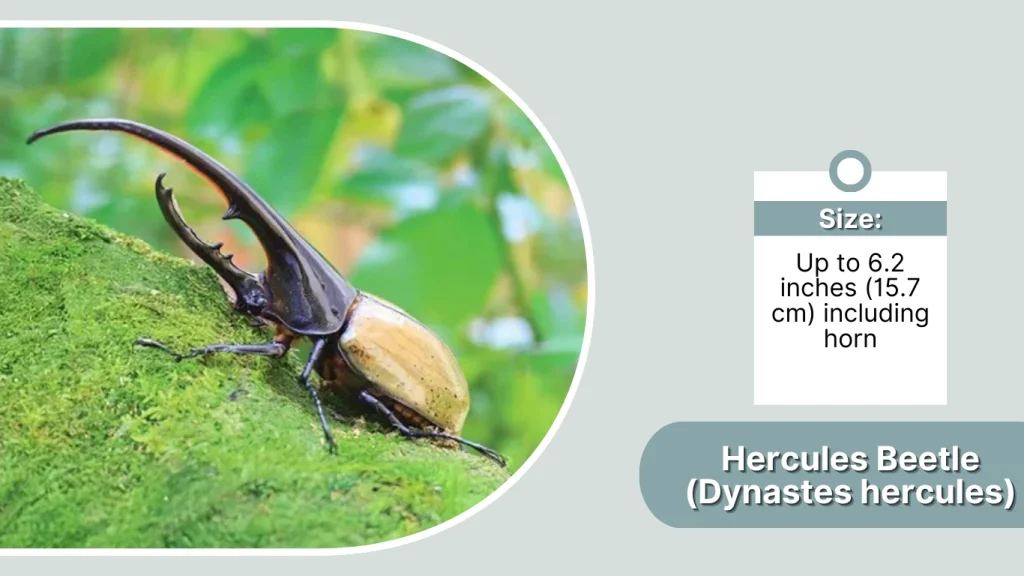
The Hercules Beetle is one of the heaviest beetles in the world and is famous for the enormous horn carried by males. Native to Central and South America, it is considered a symbol of strength, capable of lifting many times its body weight.
Identification
- Scientific Name: Dynastes hercules
- Length: Up to 6.2 inches (15.7 cm) including horn
- Color: Greenish-yellow to olive with black spots on hardened forewings
- Distinct Feature: Long horn in males used for fighting and defense
- Habitat Range: Central America, South America, Caribbean rainforests
Behavior and Habitat
Hercules Beetles live in tropical rainforests, preferring warm, humid climates. They are mostly nocturnal, spending the day hidden under logs or leaf litter. Males use their long horns to battle rivals for mating rights, flipping opponents in dramatic duels. Despite their fearsome appearance, they feed mainly on rotting fruit, sap, and decaying plant matter. Their strong legs and tough body make them skilled climbers on tree trunks.
Size Comparison with Goliath Beetle
The Hercules Beetle is longer when the horn is included, while the Goliath Beetle (Goliathus goliatus) is bulkier and heavier overall.
- Hercules Beetle: Up to 6.2 inches, males with long horn, strong but lighter body.
- Goliath Beetle: Around 4.3 inches, but much heavier and stockier, with broader wing covers.
Lifecycle and Lifespan
The Hercules Beetle undergoes complete metamorphosis: egg, larva, pupa, and adult. The larval stage can last up to two years, during which it feeds on rotting wood and organic matter, growing extremely large. Pupation lasts a few weeks, after which adults emerge. Adult lifespan is relatively short, usually 3–6 months, focusing on reproduction and feeding.
3. Goliath Beetle (Goliathus goliatus)

The Goliath Beetle is among the heaviest beetles on Earth, capable of weighing more than 100 grams. Native to African tropical forests, it is admired for its striking patterns and powerful build.
Identification
- Scientific Name: Goliathus goliatus
- Length: Up to 4.3 inches (11 cm)
- Weight: Up to 3.5 ounces (100 g)
- Color: Black and white patterned wing covers with reddish-brown tones
- Distinct Feature: Strong, bulky body with clubbed antennae
- Habitat Range: Tropical forests of central Africa
Behavior and Habitat
Goliath Beetles thrive in African rainforests where they feed on tree sap, fruit, and other plant material. They are diurnal, often seen during the day searching for food. Strong wings allow them to fly despite their heavy weight, though they usually stay close to trees. Their powerful forelegs help them dig and cling to bark, while males use their horns to push and battle rivals.
Size Comparison with Elephant Beetle
The Goliath Beetle is shorter in length than the Elephant Beetle (Megasoma elephas) but is heavier and bulkier in body mass.
- Goliath Beetle: Up to 4.3 inches, extremely heavy and stocky build.
- Elephant Beetle: Around 4.7 inches, longer in size, with distinct horns, but lighter in body weight.
Lifecycle and Lifespan
The larval stage of Goliath Beetles can last up to 1 year, during which larvae feed heavily on decaying wood and soil nutrients. Pupation occurs in an underground chamber, leading to adult emergence after several weeks. Adults typically live 3–6 months, focusing on reproduction and constant feeding to maintain their energy needs.
4. Elephant Beetle (Megasoma elephas)

The Elephant Beetle is a large rhinoceros beetle found in Central and South America. Its name comes from the massive horns of the males, which resemble an elephant’s trunk in shape. It is one of the strongest beetles, capable of carrying objects much heavier than its body.
Identification
- Scientific Name: Megasoma elephas
- Length: Up to 4.7 inches (12 cm)
- Color: Dark brown to black, with a velvety coating of fine hairs
- Distinct Feature: Three large horns in males (one on the head and two on the thorax)
- Habitat Range: Central and South American tropical forests
Behavior and Habitat
Elephant Beetles are nocturnal and prefer moist rainforests. Adults feed mainly on rotting fruit and tree sap. Males use their horns for combat, grappling and flipping rivals to gain access to females. They spend most of their time on tree trunks or hidden in forest litter. Larvae thrive in decaying wood, helping recycle nutrients back into the ecosystem.
Size Comparison with Atlas Beetle
The Elephant Beetle is slightly longer on average than the Atlas Beetle (Chalcosoma atlas), though both are massive rhinoceros beetles.
- Elephant Beetle: Around 4.7 inches, with three distinct horns and robust body.
- Atlas Beetle: Around 4.5 inches, with equally large horns but usually more aggressive behavior.
Lifecycle and Lifespan
The larval stage lasts around 2–3 years, during which the grubs can grow impressively large, feeding on rotting wood. Pupation occurs in underground chambers, and adults live 3–6 months, with their main purpose being reproduction and feeding on fruit.
5. Atlas Beetle (Chalcosoma atlas)
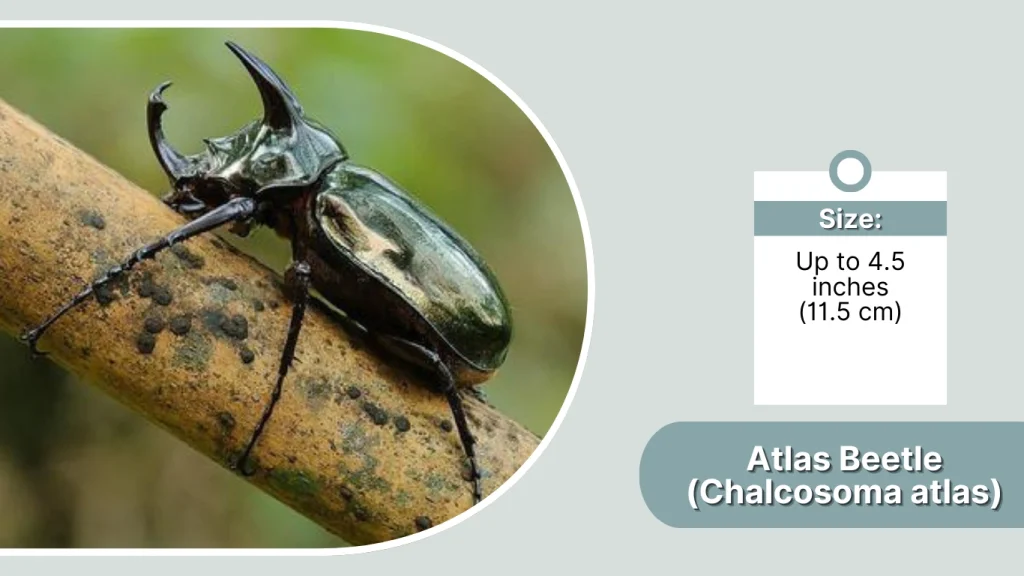
The Atlas Beetle is one of the largest rhinoceros beetles in Asia, known for its incredible horn structure and aggressive behavior. Its name comes from the Titan Atlas of Greek mythology, reflecting its strength and size.
Identification
- Scientific Name: Chalcosoma atlas
- Length: Up to 4.5 inches (11.5 cm)
- Color: Shiny black to dark brown with smooth wing covers
- Distinct Feature: Males have three prominent horns; females are hornless and smaller
- Habitat Range: Southeast Asia, especially Malaysia, Thailand, and Indonesia
Behavior and Habitat
Atlas Beetles inhabit tropical forests, where they hide under logs, leaf litter, and dense vegetation. Males are highly territorial and use their horns to fight, often flipping opponents during battles for mates. Adults feed on fruit, sap, and decaying plant matter, while larvae live in rotting wood, contributing to nutrient recycling in the forest ecosystem.
Size Comparison with Actaeon Beetle
The Atlas Beetle is slightly shorter in length compared to the Actaeon Beetle (Megasoma actaeon), but both species are massive and powerful.
- Atlas Beetle: Up to 4.5 inches, slimmer but more aggressive, with three large horns.
- Actaeon Beetle: Up to 5.1 inches, stockier, with thick and blunt horns.
Lifecycle and Lifespan
The larval stage can last 1–2 years, with grubs feeding on decaying wood until pupation. Adults generally live for 3–5 months, focusing mainly on reproduction and feeding.
6. Actaeon Beetle (Megasoma actaeon)

The Actaeon Beetle is one of the largest rhinoceros beetles in the world, notable for its bulk and powerful horn structure. It is among the heaviest beetles, with males appearing stocky and armored compared to other species.
Identification
- Scientific Name: Megasoma actaeon
- Length: Up to 5.1 inches (13 cm)
- Color: Dark brown to black, often with a matte or velvety finish
- Distinct Feature: Thick, blunt horns on males, giving them a robust appearance
- Habitat Range: Tropical forests of South America, especially in Venezuela, Ecuador, Colombia, and Peru
Behavior and Habitat
Actaeon Beetles are nocturnal and typically stay hidden during the day under logs or dense vegetation. Males use their thick horns in combat, wrestling rivals for access to females. Adults feed on rotting fruit, tree sap, and decaying organic matter, while larvae inhabit decomposing wood deep within rainforest floors.
Size Comparison with Giant Flower Beetle
The Actaeon Beetle is larger and more robust than the Giant Flower Beetle (Mecynorrhina torquata).
- Actaeon Beetle: Up to 5.1 inches, heavy-bodied with thick horns.
- Giant Flower Beetle: Around 3.1 inches, smaller but brightly colored and lighter in build.
Lifecycle and Lifespan
The larval stage lasts 2–3 years, during which grubs grow large while feeding on decaying wood. Pupation occurs underground, and adults typically survive 4–6 months. Their main role as adults is reproduction, with limited feeding activity compared to their larval stage.
7. Giant Flower Beetle (Mecynorrhina torquata)

The Giant Flower Beetle is one of the largest beetles in Africa and is admired for its striking, colorful appearance. Unlike the heavier rhinoceros beetles, this species is slimmer and more vibrant, often kept as an exotic pet due to its beauty.
Identification
- Scientific Name: Mecynorrhina torquata
- Length: Up to 3.1 inches (8 cm)
- Color: Metallic green, gold, or blue with white or yellow markings on the wing covers
- Distinct Feature: Bright coloration and large body size, with males having a small “T”-shaped horn
- Habitat Range: Tropical forests of central and western Africa
Behavior and Habitat
Giant Flower Beetles are diurnal and are most active during the day, often found feeding on nectar, fruit, and tree sap. Their bright colors help them blend into flowers and foliage. They are strong fliers and can travel quickly between food sources. Larvae feed on rotting wood and soil organic matter, playing a role in forest nutrient cycling.
Size Comparison with Eastern Hercules Beetle
The Giant Flower Beetle is smaller and lighter compared to the Eastern Hercules Beetle (Dynastes tityus).
- Giant Flower Beetle: Up to 3.1 inches, slim, colorful, and flower-associated.
- Eastern Hercules Beetle: Up to 2.5 inches, shorter but bulkier and stronger, with long horns in males.
Lifecycle and Lifespan
Larvae develop for about 1–2 years, feeding heavily on decaying matter before pupating. Adult beetles usually live for 3–5 months, during which they feed frequently and are often seen flying during the daytime.
8. Eastern Hercules Beetle (Dynastes tityus)

The Eastern Hercules Beetle is one of the largest beetles native to North America. It is closely related to the Hercules Beetle of South America but is smaller in size. Known for its long horns in males, it is a powerful and striking insect of U.S. forests.
Identification
- Scientific Name: Dynastes tityus
- Length: Up to 2.5 inches (6.5 cm) without horns; males can reach 4–5 inches with horns
- Color: Greenish or yellowish wing covers with dark spots, black legs and head
- Distinct Feature: Males have two long horns used for combat, females lack horns
- Habitat Range: Southeastern United States, from Florida to New York and as far west as Texas
Behavior and Habitat
Eastern Hercules Beetles live in hardwood forests, often found in rotting logs or near decaying trees. They are nocturnal and feed on rotting fruit, tree sap, and decaying organic material. Males are aggressive during mating season, using their horns to wrestle rivals. They are capable of strong flight despite their size.
Size Comparison with Megasoma occidentalis
The Eastern Hercules Beetle is slightly smaller and lighter compared to the Megasoma occidentalis.
- Eastern Hercules Beetle: Up to 2.5 inches (body), males 4–5 inches with horns.
- Megasoma occidentalis: Around 3 inches, bulkier with shorter horns.
Lifecycle and Lifespan
The larval stage lasts 1–2 years, with grubs feeding on rotting wood and organic matter. Pupation occurs in soil chambers, and adults usually live 3–6 months. Their primary role as adults is reproduction, though they continue feeding on sap and fruit.
9. Megasoma occidentalis
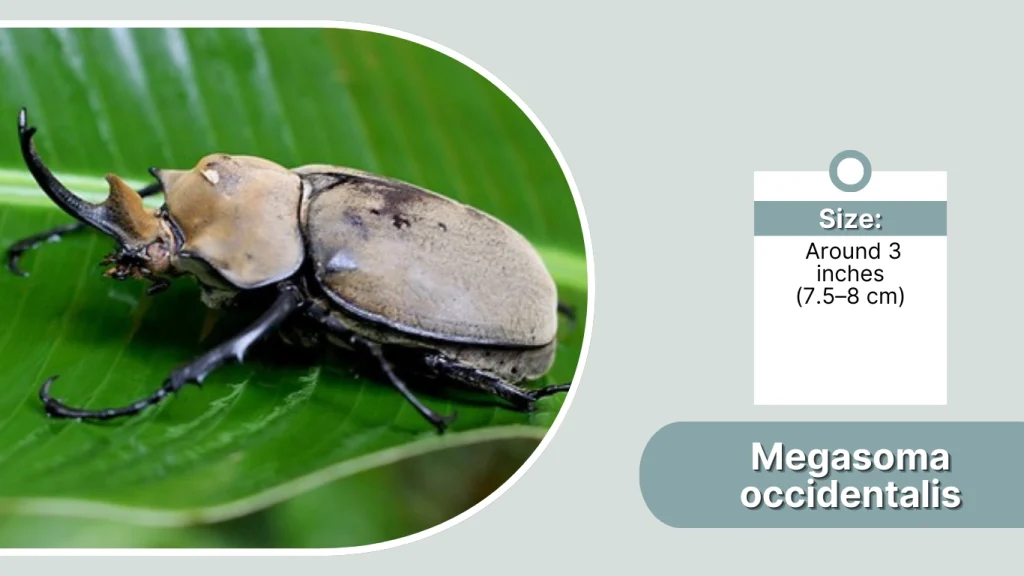
Megasoma occidentalis is a lesser-known rhinoceros beetle species, closely related to the Elephant and Actaeon beetles. Though not as long as the Titan or Hercules beetles, it is still considered one of the giants of the beetle world.
Identification
- Scientific Name: Megasoma occidentalis
- Length: Around 3 inches (7.5–8 cm)
- Color: Matte dark brown to black with a dense velvety surface
- Distinct Feature: Short, thick horns on males; females lack horns
- Habitat Range: Central and northern South America, in warm rainforest regions
Behavior and Habitat
These beetles are nocturnal and spend the day hidden under logs or dense ground cover. Adults feed on fruit and sap, while larvae depend on decaying wood and organic matter in forest soil. Males use their horns in short grappling battles during the breeding season, though they are less aggressive than Atlas or Hercules beetles.
Size Comparison with Giraffe Stag Beetle
Megasoma occidentalis is stockier but shorter compared to the Giraffe Stag Beetle (Prosopocoilus giraffa).
- Megasoma occidentalis: About 3 inches, heavy-bodied with thick, short horns.
- Giraffe Stag Beetle: Up to 4.3 inches including mandibles, longer but slimmer.
Lifecycle and Lifespan
The larval stage lasts 1–2 years, with larvae feeding on rotting wood. After pupation, adults live for 3–5 months, focusing on reproduction. Their relatively short adult life is offset by their long larval development underground.
10. Giraffe Stag Beetle (Prosopocoilus giraffa)
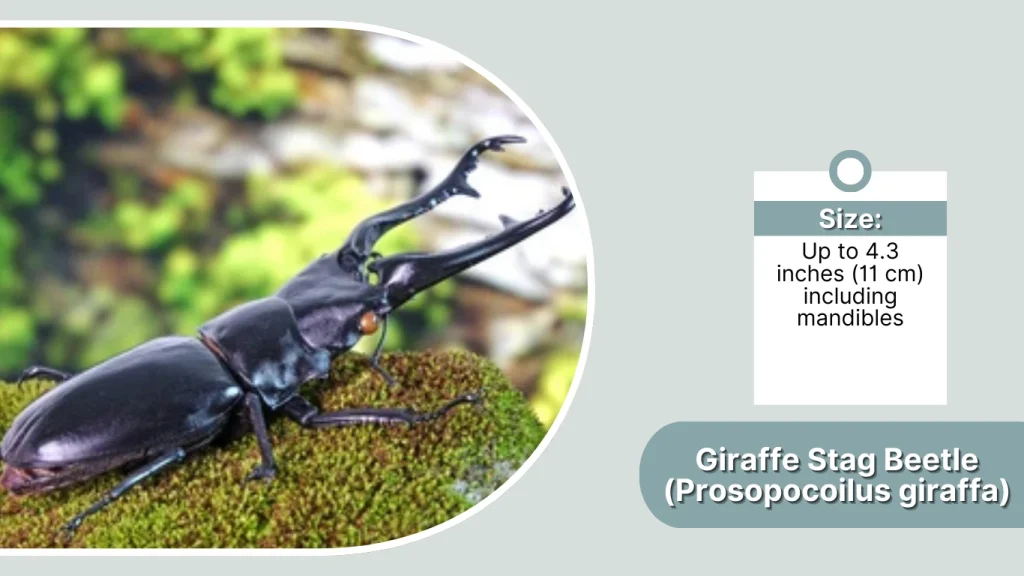
The Giraffe Stag Beetle is the longest stag beetle species in the world, famous for its oversized mandibles that resemble the neck of a giraffe. It is slender but impressive in size, making it a standout among stag beetles.
Identification
- Scientific Name: Prosopocoilus giraffa
- Length: Up to 4.3 inches (11 cm) including mandibles
- Color: Shiny black with elongated, curved jaws in males
- Distinct Feature: Extremely long mandibles used for fighting; females have smaller jaws
- Habitat Range: Southeast Asia, particularly India, Nepal, Malaysia, and Indonesia
Behavior and Habitat
Giraffe Stag Beetles inhabit tropical and subtropical forests, usually found around decaying wood and tree trunks. Males are highly territorial, using their long mandibles to wrestle rivals by lifting and throwing them off branches. Adults feed on tree sap and fruit, while larvae live in rotting wood, aiding in decomposition.
Size Comparison with European Stag Beetle
The Giraffe Stag Beetle is longer than the European Stag Beetle (Lucanus cervus), mainly due to its oversized mandibles.
- Giraffe Stag Beetle: Up to 4.3 inches, slender with very long jaws.
- European Stag Beetle: Around 3 inches, heavier in build with shorter mandibles.
Lifecycle and Lifespan
The larval stage can last 1–2 years, with grubs feeding on decayed wood. After pupation, adults emerge and live for about 3–6 months. During this time, males spend much of their energy in combat for mates, while females concentrate on laying eggs in rotting logs.
11. European Stag Beetle (Lucanus cervus)

The European Stag Beetle is one of the largest beetles in Europe and is well known for its massive mandibles, which resemble the antlers of a stag. It is often seen during summer evenings, flying clumsily in search of mates.
Identification
- Scientific Name: Lucanus cervus
- Length: Up to 3 inches (7.5 cm) in males, smaller in females
- Color: Dark brown to black body with reddish-brown wing covers
- Distinct Feature: Large antler-like mandibles in males, used for combat
- Habitat Range: Woodlands, parks, and gardens across Europe, especially southern and central regions
Behavior and Habitat
European Stag Beetles thrive in temperate forests where decaying wood is abundant. Males are often seen fighting with their mandibles to establish dominance and secure mates. They are mostly nocturnal and are attracted to lights during warm summer nights. Adults feed on tree sap and rotting fruit, while larvae develop in dead wood for several years.
Size Comparison with Longhorn Beetle
The European Stag Beetle is shorter and stockier compared to the Longhorn Beetle (Macrodontia cervicornis).
- European Stag Beetle: Up to 3 inches, strong mandibles but compact body.
- Longhorn Beetle: Can reach over 5 inches, with extremely long antennae giving it a larger overall appearance.
Lifecycle and Lifespan
The larval stage can last 3–5 years, during which grubs feed on decaying hardwood. Pupation occurs underground, and adults live only a few weeks to 2 months, mainly during the summer breeding season. Their short adult life is focused on reproduction and spreading to new habitats.
12. Longhorn Beetle (Macrodontia cervicornis)
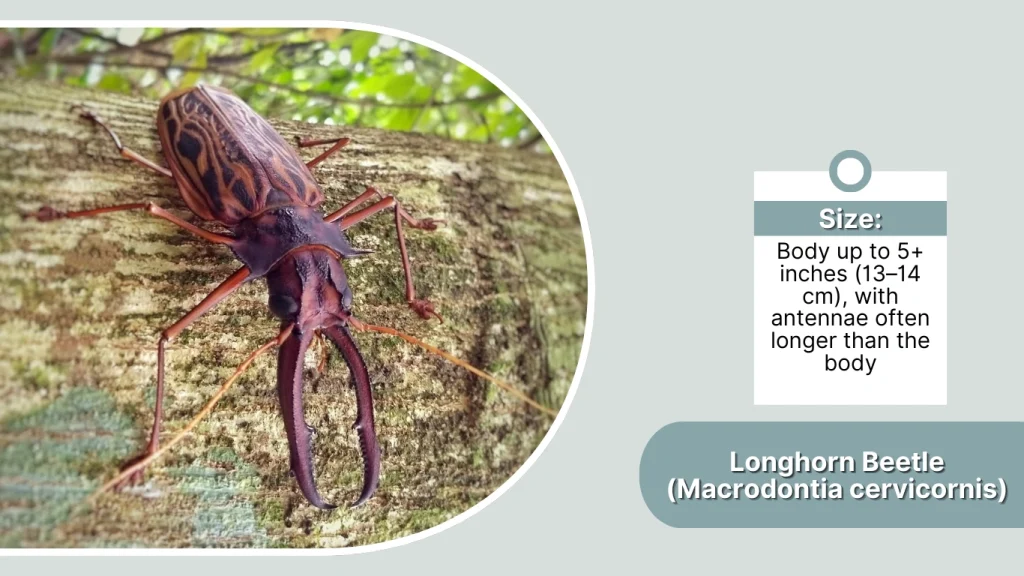
The Longhorn Beetle is one of the largest beetles in the world, especially when considering its extremely long antennae. Found in South America, it is impressive both in length and strength, making it a remarkable member of the Cerambycidae family.
Identification
- Scientific Name: Macrodontia cervicornis
- Length: Body up to 5+ inches (13–14 cm), with antennae often longer than the body
- Color: Brown to orange with black markings on wing covers
- Distinct Feature: Exceptionally long antennae and strong mandibles
- Habitat Range: Tropical rainforests of South America, especially in Brazil, Ecuador, Peru, and Bolivia
Behavior and Habitat
Longhorn Beetles are nocturnal and are most active at night. Adults are strong fliers and are often attracted to lights in forested regions. They prefer dense, humid rainforests with plenty of rotting wood for their larvae. Adults feed on fruit and sap, while the larvae bore deep into decaying logs, contributing to forest decomposition cycles.
Size Comparison with Titan Beetle
The Longhorn Beetle is nearly as long as the Titan Beetle (Titanus giganteus), but its length is exaggerated by its antennae rather than body size.
- Longhorn Beetle: Body around 5 inches, but overall appearance larger due to antennae.
- Titan Beetle: Body up to 6.5 inches, heavier and bulkier with massive mandibles.
Lifecycle and Lifespan
The larval stage of Longhorn Beetles can last several years, with larvae boring into rotting wood and growing to impressive sizes. Adults live only a few months, spending most of their time reproducing and searching for food sources like sap and fruit.
FAQs
1. What is the largest beetle in the world?
The Titan Beetle (Titanus giganteus) holds the record as the longest beetle, reaching up to 6.5 inches. However, the Hercules Beetle is considered heavier and bulkier, making both species contenders for the “largest” title depending on measurement.
2. How strong are Hercules Beetles?
Hercules Beetles can lift objects over 850 times their body weight, making them one of the strongest insects relative to size. Males use this strength mainly in battles for mates.
3. Where are Goliath Beetles found?
Goliath Beetles are native to the tropical forests of central Africa. They are extremely heavy, with some adults weighing more than 100 grams, making them one of the heaviest insects on Earth.
4. Do giant beetles bite or harm humans?
Most giant beetles are harmless to humans. While species like the Titan Beetle have powerful mandibles capable of snapping wood, they rarely bite unless provoked. Their main focus is defense and reproduction, not attacking humans.
5. How long do giant beetles live?
The larval stage of most giant beetles can last 1–5 years, feeding on decaying wood. However, the adult stage is short, typically lasting only a few weeks to several months, with reproduction as their primary purpose.
