
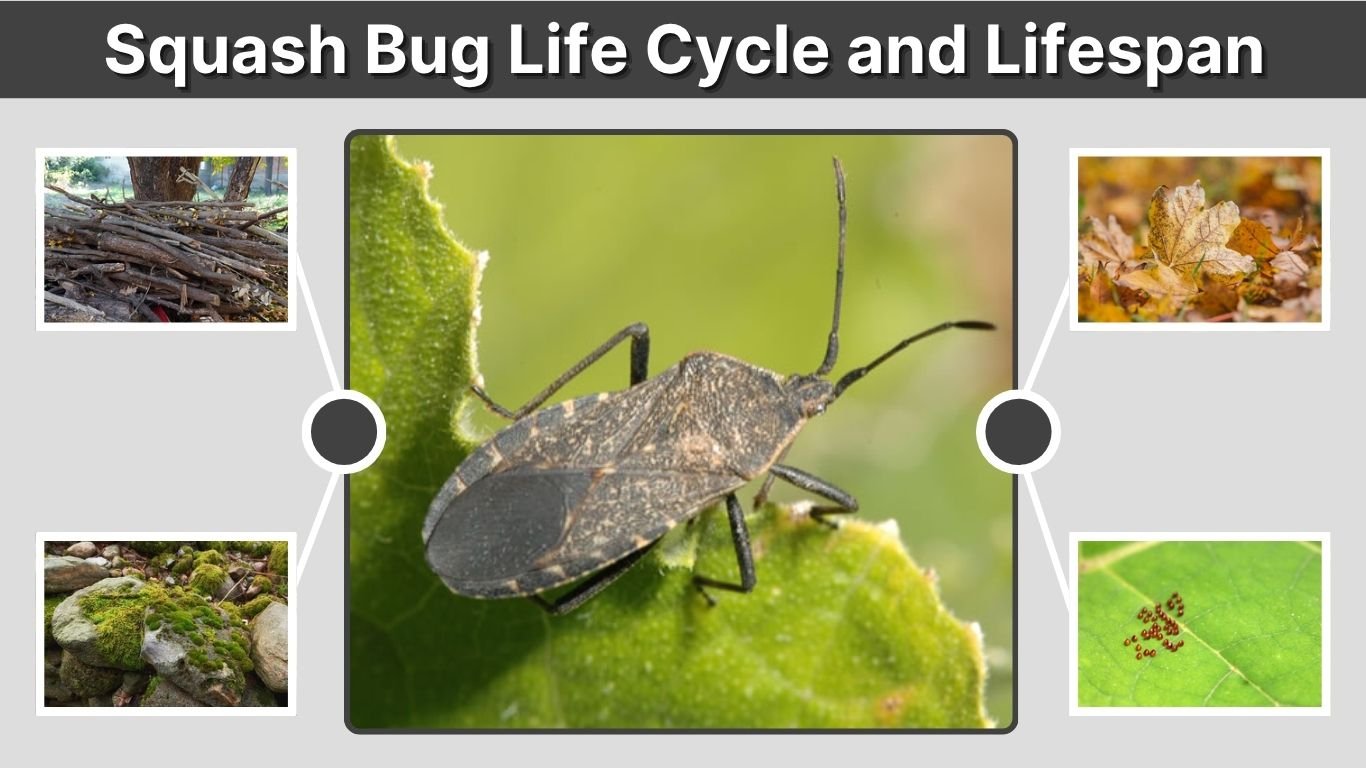
The squash bug, scientifically known as Anasa tristis, is a common garden pest that attacks pumpkins, zucchini, gourds, and other squash plants. Understanding its life cycle makes it easier to control because eggs and newly hatched nymphs are much more vulnerable than mature adults.
Squash bugs undergo incomplete metamorphosis, passing through three main stages: egg, nymph, and adult. Under warm conditions, development from egg to adult usually takes about six to eight weeks. Adults can survive for several months because the final generation shelters through winter and becomes active again in spring.
Squash Bug Life Cycle at a Glance
| Life stage | Typical duration | Main characteristics |
| Egg | About 5–10 days | Bronze or reddish eggs laid in clusters |
| Nymph | About 4–6 weeks | Five growing stages, called instars |
| New adult | Appears after 6–8 weeks total | Winged, grayish-brown, and reproductive |
| Overwintering adult | Several months | Shelters through fall and winter |
| Generations | Usually 1–3 annually | Number depends on climate |
Development speeds up during warm weather and may take longer when temperatures are cooler. Northern regions commonly have one generation per year, while warmer areas may support a partial second generation or two to three complete generations.
Stage 1: Squash Bug Eggs
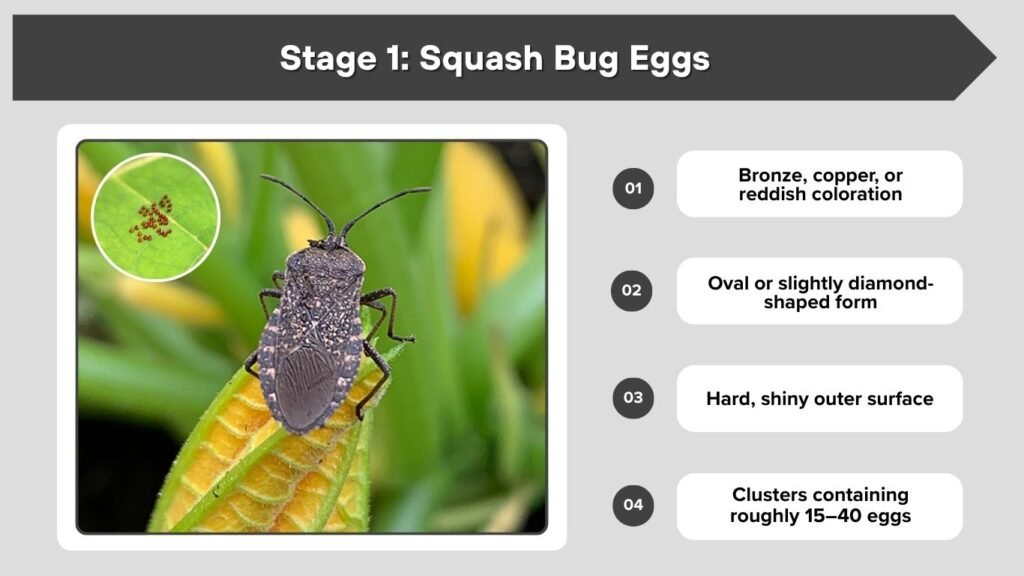
The life cycle begins when adult females lay eggs on suitable host plants. Egg-laying normally begins after overwintered adults emerge, locate young cucurbit plants, feed, and mate.
What Squash Bug Eggs Look Like
Squash bug eggs are small, oval, shiny, and usually bronze, copper, or reddish-brown. Females commonly attach them in organized groups to the undersides of leaves, often where two leaf veins meet.
Typical egg characteristics include:
- Bronze, copper, or reddish coloration
- Oval or slightly diamond-shaped form
- Hard, shiny outer surface
- Clusters containing roughly 15–40 eggs
- Placement beneath leaves and along veins
- Occasional placement on stems or upper leaf surfaces
A single female may produce around 250 eggs during her reproductive period, although the total varies with environmental conditions and available host plants.
How Long Do Squash Bug Eggs Take to Hatch?
Eggs usually hatch within about five to ten days. Some extension sources give a broader period of approximately one to two weeks because temperature influences development. Warm conditions generally lead to faster hatching.
The egg stage is the easiest point at which gardeners can interrupt the life cycle. Removing one cluster may prevent dozens of hungry nymphs from appearing.
When Are Eggs Laid?
Egg-laying typically begins in late spring or early summer after overwintering adults move into squash plantings. In warmer regions, adults may become active in April, while those in colder locations may not appear until May or later.
Females can continue depositing eggs over several weeks, so plants must be checked repeatedly rather than inspected only once.
Stage 2: Squash Bug Nymphs
Squash bugs do not have a caterpillar-like larval stage or an inactive pupal stage. Instead, an immature squash bug is called a nymph. It resembles a small, wingless adult and grows by shedding its outer skin.
Newly Hatched Nymphs
First-stage nymphs are approximately 1/10 inch long. They may have pale green or whitish-gray bodies with dark or reddish heads, legs, and antennae.
Newly hatched nymphs often remain grouped near the empty egg shells. They insert their piercing-sucking mouthparts into leaves and remove plant fluids. Their feeding can cause small yellow spots that later turn brown.
The Five Nymphal Instars
Squash bugs pass through five nymphal stages, known as instars. They molt between each stage, becoming larger and more adult-like each time.
During these five instars:
- The first nymph is small, pale, and wingless.
- The second develops a grayer body and dark appendages.
- The third becomes larger and begins dispersing from its siblings.
- The fourth develops noticeable wing pads.
- The fifth strongly resembles an adult but lacks fully developed wings.
Later nymphs may reach approximately 1/2 inch long. Their bodies become darker, less hairy, and more flattened as the wings and thorax develop.
How Long Does the Nymph Stage Last?
The five nymphal stages usually require about four to six weeks. Research summarized by the University of Florida gives approximately 33 days for complete nymphal development under suitable conditions.
Temperature, plant quality, crowding, and weather can affect the timing. Nymphs develop more quickly during consistently warm weather but may mature slowly when temperatures decline.
Why Nymphs Cause Serious Damage
Nymphs and adults feed by piercing plant tissue and extracting fluids. Groups of young nymphs may concentrate their feeding on one leaf or vine, producing yellow spots, browning, wilting, and brittle tissue.
Young seedlings are particularly vulnerable. Large, established plants can tolerate limited feeding, but a heavy population may cause vines to wilt and fruit production to decline.
Stage 3: Adult Squash Bugs
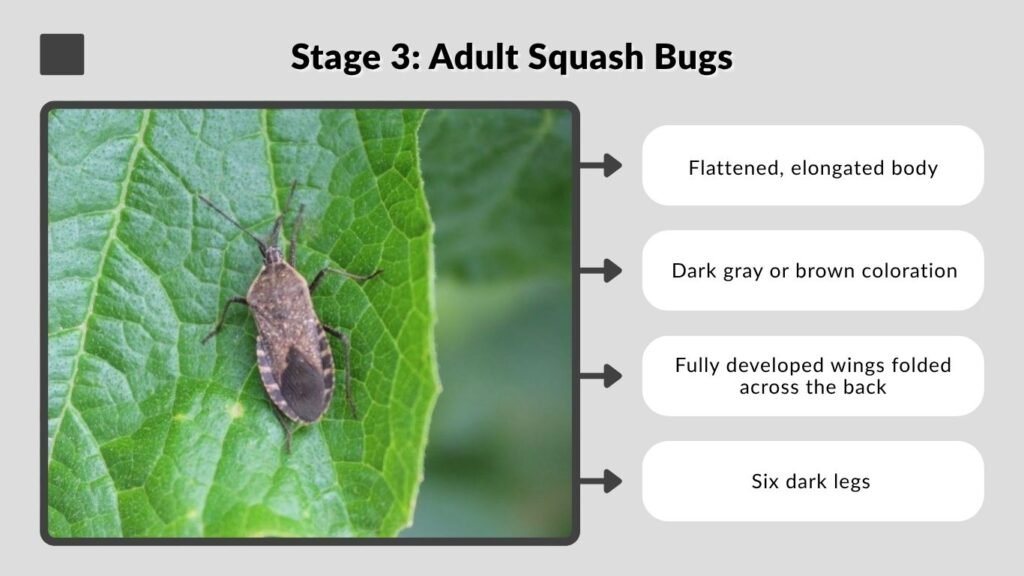
After completing the fifth instar, the nymph molts into a winged adult. Adult squash bugs are flattened, grayish-brown insects measuring approximately 5/8 inch long.
Adult Identification
Adult squash bugs have several recognizable features:
- Flattened, elongated body
- Dark gray or brown coloration
- Fully developed wings folded across the back
- Alternating orange and brown markings along the abdomen
- Six dark legs
- Long antennae
- Unpleasant odor when disturbed or crushed
Although they are sometimes mistaken for stink bugs, squash bugs belong to the leaf-footed bug family, Coreidae.
When New Adults Appear
New adults may begin appearing in early or midsummer. In northern Utah, for example, the new generation commonly appears from June into July; warmer southern locations may see adults several weeks earlier.
Where the growing season is long, these adults may mate and produce another generation. In colder regions, they often feed until late summer or fall and then search for winter shelter.
How Long Do Squash Bugs Live?
There is no single lifespan that applies to every squash bug. Temperature, season, food, location, and whether the adult must overwinter all affect longevity.
Development from a newly laid egg to a winged adult normally takes around six to eight weeks. However, this is the development period—not the insect’s entire lifespan.
Adults produced late in the season can live for several additional months. They shelter during fall and winter, survive in a dormant or inactive condition, and emerge the following spring to reproduce. Consequently, the complete lifespan of a successful overwintering individual can extend across much of a year.
Not every adult survives winter. Exposure, predators, disease, insufficient shelter, and freezing conditions may kill many of them before spring.
How Squash Bugs Survive Winter
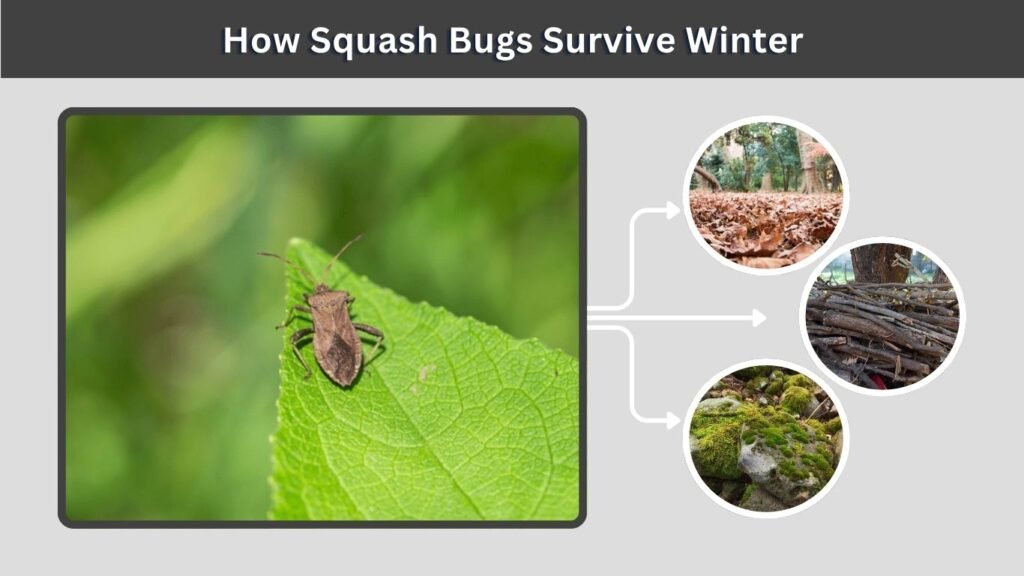
Squash bugs overwinter as adults rather than eggs or nymphs. As plants die and temperatures fall, adults leave their host plants and seek dark, protected locations.
Common overwintering sites include:
- Beneath dead leaves
- Under boards and logs
- Inside piles of garden debris
- Under rocks
- Within thick mulch
- Beneath dead vines
- Around buildings or protected structures
They remain sheltered until temperatures rise and cucurbit plants become available again.
Removing vines, fallen leaves, unused boards, and other debris after harvest reduces the number of protected places where adults can survive.
How Many Generations Occur Each Year?
The number of annual generations depends largely on climate.
Cooler Northern Areas
Squash bugs usually produce one generation per year in colder regions. Adults survive winter, reproduce in spring, and produce offspring that mature during summer. The new adults then prepare to overwinter.
Minnesota and northern Utah commonly experience one annual generation.
Warmer Southern Areas
Warmer climates provide a longer feeding and breeding season. A partial second generation may occur in southern Utah, while parts of California may have two or three generations annually.
Multiple generations can overlap, meaning eggs, nymphs, and adults may all be present on the same plants.
Best Time to Break the Life Cycle
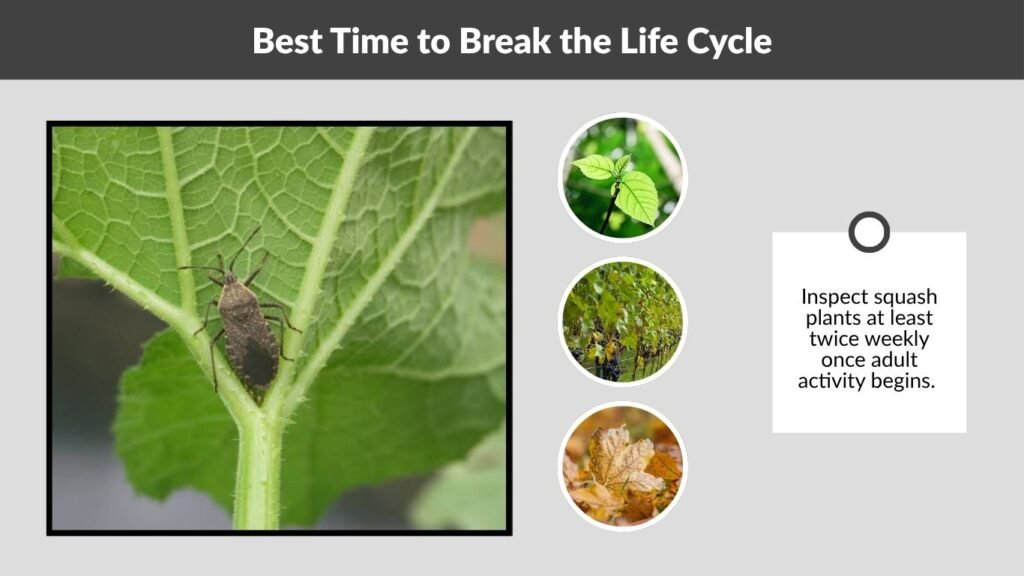
The egg and early nymph stages provide the best opportunities for control. Mature adults have harder bodies, fly between plants, and hide around plant crowns, making them more difficult to eliminate.
Inspect squash plants at least twice weekly once adult activity begins. Focus on:
- Undersides of leaves
- Areas beside major leaf veins
- Plant crowns
- Beneath vines and fruit
- Dead foliage near the soil
- Boards, mulch, and nearby debris
Destroying egg clusters before they hatch and removing grouped young nymphs can prevent a small problem from becoming a major infestation.
FAQs
How long is the complete squash bug life cycle?
The development period from egg to adult generally takes about six to eight weeks. Eggs hatch in roughly five to ten days, followed by approximately four to six weeks of nymphal development through five instars.
How long do adult squash bugs live?
Adult longevity varies considerably. Summer adults may live for weeks or months, while late-season adults can survive through winter and emerge the following spring. Their ability to overwinter makes their total adult life much longer than the six-to-eight-week development period.
Do squash bugs die during winter?
Some die, but many adults survive by sheltering under leaves, boards, rocks, mulch, dead vines, and other debris. They remain protected during cold weather and become active again when temperatures rise.
Do squash bug eggs survive winter?
Squash bugs normally overwinter as adults, not eggs. Adult insects seek protected shelters in fall and return to cucurbit plants in spring, where they mate and lay a new generation of eggs.
How many times do squash bugs reproduce each year?
They commonly produce one generation annually in colder northern areas. Warmer climates may support a partial second generation or two to three complete generations because the longer growing season allows more time for reproduction.
