
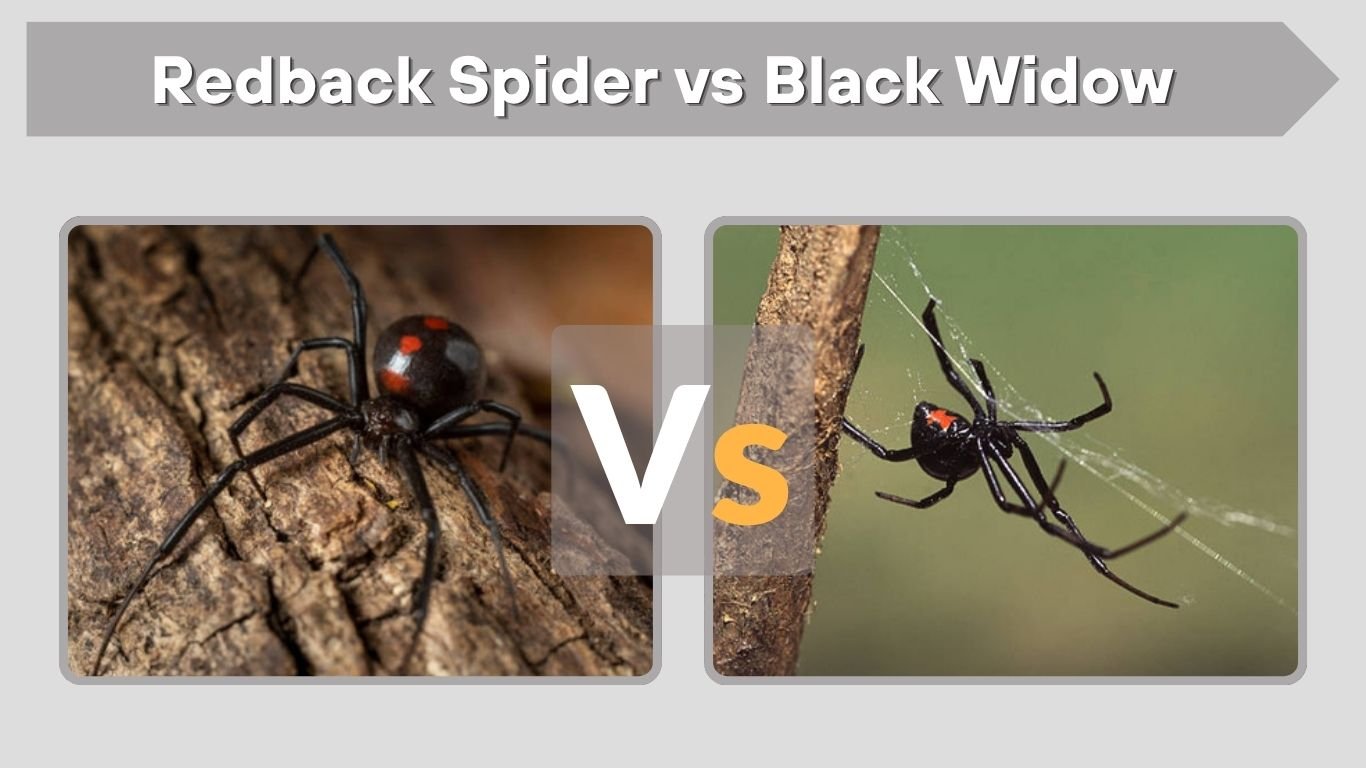
The redback spider vs black widow comparison is common because these two spiders look similar, belong to the same spider group, and both have medically significant venom. However, they are not exactly the same. Redbacks are strongly associated with Australia, while black widows are more commonly discussed in North America. Understanding their differences can help with identification, safety, and prevention around homes.
Redback Spider vs Black Widow: Quick Comparison
The redback spider and black widow are close relatives. Both belong to the genus Latrodectus, a group of spiders known for potent neurotoxic venom. They also share a similar body shape, dark coloring, and a reputation for painful bites.
However, the main differences are location, markings, size details, and the way people commonly encounter them. Redbacks are most famous in Australia, while black widows are found in several regions, especially parts of the United States.
| Feature | Redback Spider | Black Widow Spider |
| Scientific group | Latrodectus | Latrodectus |
| Common location | Australia, with some introduced populations elsewhere | North America and other regions, depending on species |
| Main marking | Red stripe on top of abdomen | Red hourglass, usually underneath abdomen |
| Web type | Messy tangle web | Messy tangle web |
| Venom concern | Medically significant | Medically significant |
| Behavior | Shy, stays hidden | Shy, stays hidden |
| Main risk | Accidental contact in hidden areas | Accidental contact in hidden areas |
Why They Are Often Confused
Redbacks and black widows are often confused because both are small, dark, shiny spiders with red markings. Both also build messy webs in sheltered places instead of neat circular webs.
The confusion is even stronger because the Australian redback spider is closely related to widow spiders. In simple terms, a redback is part of the same broader widow-spider group, but it is usually treated as a distinct spider with its own common name.
The Biggest Difference at a Glance
The easiest visual difference is the red marking. A redback spider usually has a red stripe or mark on the upper side of the abdomen. A female black widow is best known for a red hourglass marking on the underside of the abdomen.
That detail matters because a quick top-down view may show the redback’s red stripe more clearly, while the black widow’s hourglass may not be visible unless the spider is upside down.
What Is a Redback Spider?

The redback spider is a venomous spider strongly associated with Australia. It is one of the most recognized spiders in the country because of its dark body and red marking. The female redback is the one most people worry about because she is larger and capable of delivering a more serious bite.
Redbacks often live close to human activity. They may hide in outdoor furniture, sheds, garages, mailboxes, garden equipment, and stored materials. Like black widows, they usually avoid people and bite mainly when disturbed or pressed.
Redback Spider Appearance
A female redback spider is usually black or dark brown with a noticeable red or orange-red stripe on the back of the abdomen. Some may also have an hourglass-like marking underneath, which adds to the confusion with black widows.
Males are much smaller and less often noticed. Juvenile spiders may have lighter patterns and may not look exactly like the adult female.
Redback Spider Habitat
Redbacks prefer dry, sheltered areas. They are often found in human-made structures because these areas provide protection and attract insects.
Common hiding spots include:
- Sheds and garages
- Outdoor toilets and storage areas
- Under patio furniture
- Around plant pots and garden tools
- Inside cluttered corners
- Under ledges, steps, or equipment
Redback Spider Behavior
Redback spiders are not aggressive hunters that chase people. They usually remain in or near their webs. Their webs are irregular, sticky, and built to catch insects and other small prey.
Most bites happen when a person accidentally touches the spider, reaches into a hidden space, or presses the spider against skin.
What Is a Black Widow Spider?
The black widow spider is one of the best-known venomous spiders in North America. Several species are called black widows, including the southern black widow, northern black widow, and western black widow.
When people search for black widow vs redback spider, they are usually thinking of the shiny black female black widow with the red hourglass marking. Like the redback, the female is larger and more medically important than the male.
Black Widow Spider Appearance
A female black widow usually has a shiny black, rounded abdomen and a red hourglass marking on the underside. Some species or individuals may also have red spots, broken markings, or other variations.
The southern black widow is especially known for the classic red hourglass. This is why the keyword redback spider vs southern black widow is useful for readers who want a more specific comparison.
Black Widow Spider Habitat
Black widows prefer quiet, dark, protected places. They are commonly found in garages, sheds, basements, crawl spaces, woodpiles, outdoor clutter, and corners around buildings.
They often build webs close to the ground where insects are likely to travel.
Black Widow Spider Behavior
Black widows are shy and defensive rather than aggressive. They usually stay hidden in their webs and wait for prey. They bite humans mainly when trapped, squeezed, or disturbed.
This means the risk is highest when someone reaches blindly into a storage box, picks up firewood, moves outdoor items, or puts on gloves or shoes that were stored outside.
Redback Spider vs Black Widow Difference
The main redback spider vs black widow difference comes down to geography, markings, and species identity. They are closely related, but they are not usually the same spider in everyday identification.
A redback is most strongly linked with Australia. A black widow is most strongly linked with North America, although widow spiders exist in many regions.
| Difference | Redback Spider | Black Widow Spider |
| Best-known region | Australia | United States and North America |
| Main red marking | Red stripe on upper abdomen | Red hourglass under abdomen |
| Body appearance | Dark body, often with visible back stripe | Shiny black body, rounded abdomen |
| Common search concern | Australian redback spider vs black widow | Black widow spider vs redback |
| Identification challenge | Can also have underside marking | Top marking may be limited or absent |
| Web location | Sheltered outdoor and indoor spaces | Sheltered outdoor and indoor spaces |
Difference in Markings
The redback’s red marking is usually seen on the top of the abdomen. This makes it easier to notice from above. The black widow’s most famous marking is underneath, so it may be harder to see unless the spider is positioned in a way that exposes the underside.
However, markings can vary. Some spiders may have broken red marks, pale markings, or less obvious patterns. That is why location and body shape should also be considered.
Difference in Location
If you are in Australia, a dark spider with a red back stripe is more likely to be a redback. If you are in the United States, a shiny black spider with a red hourglass is more likely to be a black widow.
Location is not the only factor, but it is one of the most useful clues for everyday identification.
Difference in Common Encounters
Redbacks are often discussed in relation to Australian homes, sheds, outdoor toilets, and garden areas. Black widows are commonly associated with garages, woodpiles, crawl spaces, sheds, and cluttered storage areas in North America.
Both spiders prefer places where they can remain undisturbed.
Redback Spider vs Black Widow Size
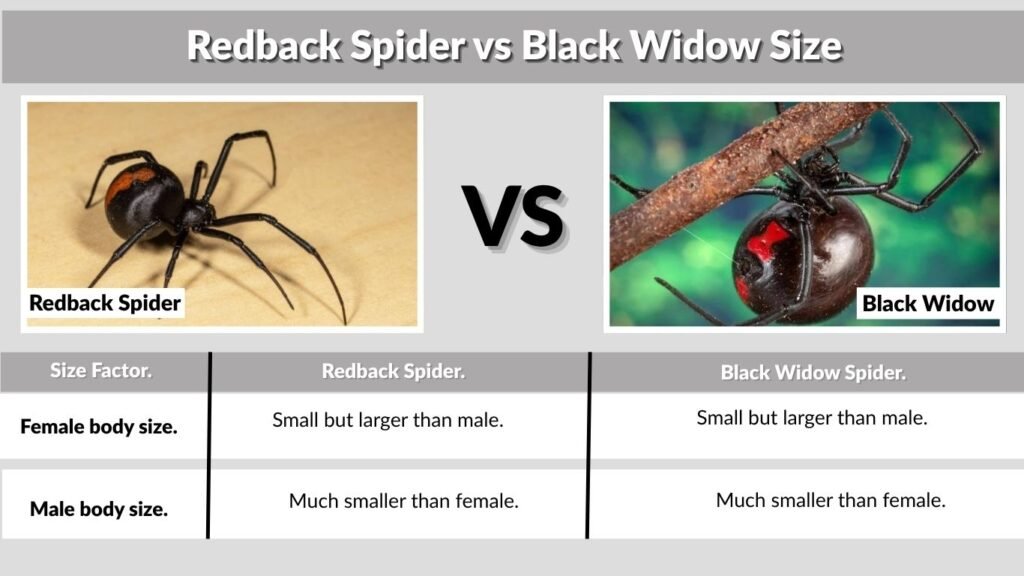
The redback spider vs black widow size comparison is not always simple because males and females are very different in both groups. Female spiders are much larger and more recognizable, while males are smaller and less dangerous.
In both cases, the body may be small, but the legs make the spider appear larger.
| Size Factor | Redback Spider | Black Widow Spider |
| Female body size | Small but larger than male | Small but larger than male |
| Male body size | Much smaller than female | Much smaller than female |
| Overall appearance | Compact body with thin legs | Rounded abdomen with thin legs |
| Most noticed spider | Adult female | Adult female |
| Identification note | Red upper stripe helps | Red underside hourglass helps |
Female Size Comparison
Female redbacks and female black widows are broadly similar in size. Both have rounded abdomens and thin legs. A female black widow may look slightly more rounded and glossy, while a redback may be recognized by the red stripe across the upper abdomen.
Because both are small spiders, people should not rely only on size for identification.
Male Size Comparison
Male redbacks and male black widows are much smaller than females. They are also less commonly seen and may look very different from the classic image people have in mind.
Most serious identification concerns involve adult females because they are easier to recognize and are more medically significant.
Why Size Alone Is Not Enough
Many harmless spiders can be similar in size to redbacks or black widows. Size should be combined with body shape, markings, web type, and location.
A dark spider in a messy web near the ground should be treated carefully, especially if it has red markings.
Redback Spider vs Black Widow Venom
The redback spider vs black widow venom comparison is one of the most important parts of this topic. Both spiders have venom that affects the nervous system. Their bites can be painful and may cause symptoms beyond the bite area.
Both are considered medically significant spiders. However, deaths are very rare when medical care is available. Most bites can be managed, but suspected bites should still be taken seriously.
How the Venom Affects Humans
Redback and black widow venom can cause pain, sweating, muscle cramps, nausea, and other symptoms. The severity depends on the person, the amount of venom injected, the bite location, and the spider involved.
Some bites may be mild, while others can become more serious. Children, older adults, and people with health conditions may be at higher risk of complications.
Is One More Venomous Than the Other?
Both spiders have potent venom, and comparing which one is “more venomous” can be misleading. Venom strength in a lab does not always equal real-world danger. The actual risk depends on bite frequency, venom dose, access to medical care, and how the body reacts.
A practical answer is that both should be treated as potentially dangerous, and neither should be handled.
Black Widow vs Redback Spider Dangerous to Humans
Both redback spiders and black widow spiders can be dangerous to humans, but they are not usually aggressive. The danger comes from accidental contact.
A bite may require medical advice, especially if symptoms spread or become intense. Anyone bitten by a suspected redback or black widow should seek professional medical guidance.
Redback Spider vs Black Widow: Web and Habitat
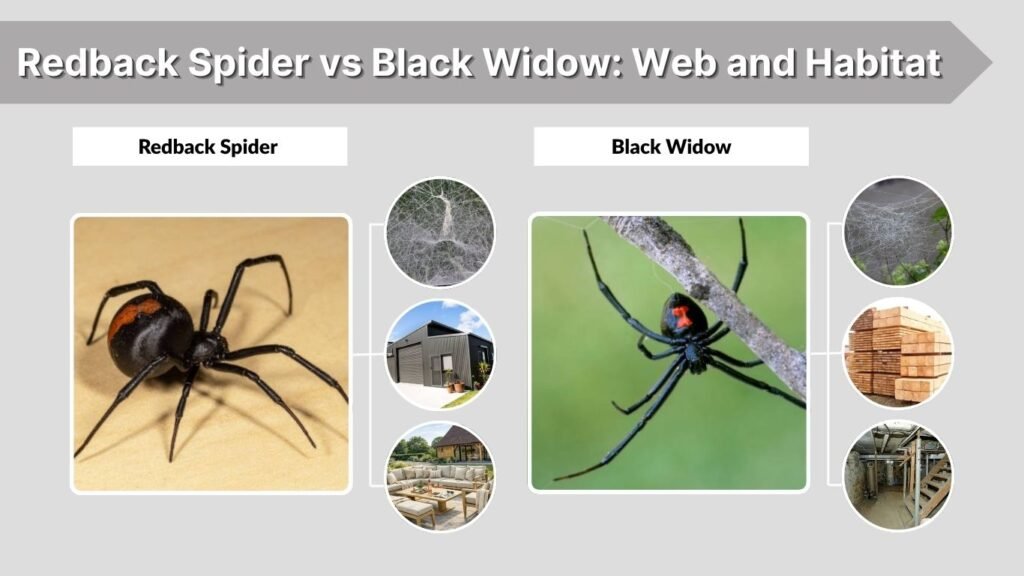
Both spiders build irregular tangle webs. These webs look messy rather than round and symmetrical. They are usually placed in protected areas where insects travel.
A web alone may not confirm the spider species, but it can warn you to be cautious.
Web Shape
Redback and black widow webs are both messy, sticky, and three-dimensional. They are not the classic circular webs many people associate with garden spiders.
The web may look abandoned, but it can still be active. A spider may hide in a retreat area connected to the web.
Common Hiding Areas
Both spiders may hide in:
- Garages and sheds
- Woodpiles and stored boards
- Outdoor furniture
- Crawl spaces
- Basements
- Garden tools and plant pots
- Corners near foundations
- Cluttered storage spaces
Prevention Around the Home
The same prevention methods help reduce both redbacks and black widows. Keep storage areas clean, remove clutter, seal gaps, reduce insect activity, and wear gloves when handling outdoor items.
Avoid reaching blindly into dark spaces where spiders may be hiding.
Redback Spider vs Black Widow: Who Would Win?
The keyword redback spider vs black widow who would win appears in searches, but it is not a useful real-world question. These spiders live in different regions and do not normally meet in nature.
If placed together artificially, the result would depend on size, sex, condition, environment, and chance. Since both are related widow spiders with similar hunting styles, there is no simple guaranteed winner.
The more helpful answer is that both spiders should be respected, not handled, and not placed together.
How to Identify Which Spider You Found
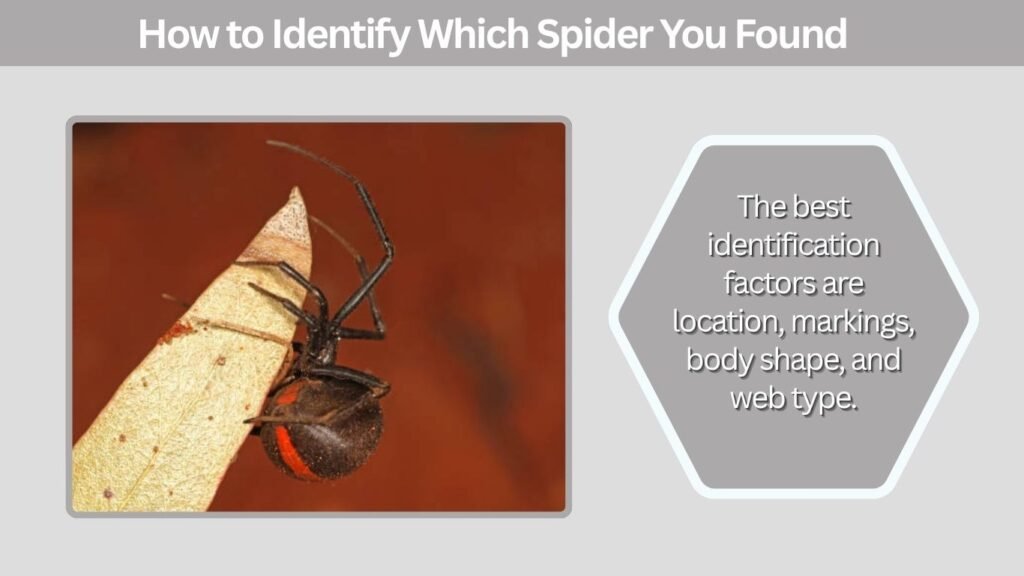
If you find a spider that looks like a redback or black widow, do not touch it. Instead, observe from a safe distance and look at the key clues.
The best identification factors are location, markings, body shape, and web type.
Check the Location
If you are in Australia, a redback is more likely. If you are in North America, a black widow is more likely.
However, introduced species and lookalikes can complicate identification, so location should not be the only clue.
Look for the Red Marking
A red stripe on the upper abdomen points more toward a redback. A red hourglass underneath points more toward a black widow, especially a southern black widow.
Do not flip or handle the spider to check markings. A clear photo from a safe distance is better.
Consider the Web
A messy tangle web in a dark, hidden spot supports the possibility of a widow-type spider. A perfect circular web is more likely from an orb-weaver, not a redback or black widow.
What to Do If You Find One
If you find a suspected redback or black widow, stay calm and avoid direct contact. These spiders usually do not want to interact with people, but they may bite if trapped or disturbed.
Use caution before moving stored items, firewood, shoes, gloves, or outdoor furniture.
Safe Steps to Take
You can reduce risk by following these steps:
- Keep children and pets away from the area.
- Wear thick gloves when moving stored items.
- Avoid touching webs or egg sacs.
- Use a flashlight to inspect dark corners.
- Remove clutter where spiders can hide.
- Contact pest control if you find multiple spiders or webs.
When to Get Medical Help
If someone is bitten by a suspected redback or black widow, seek medical advice. Serious symptoms can include severe pain, muscle cramps, sweating, nausea, weakness, or spreading discomfort.
Do not rely only on home remedies if symptoms are significant.
FAQs
Is a redback spider the same as a black widow?
A redback spider is not usually called the same spider as a black widow, but they are close relatives in the same spider genus. Both are widow-type spiders with medically significant venom, similar body shapes, and messy tangle webs.
What is the main difference between a redback spider and a black widow?
The main difference is usually the marking and location. A redback spider is strongly associated with Australia and often has a red stripe on top of the abdomen. A black widow is commonly associated with North America and often has a red hourglass underneath.
Which is bigger, a redback spider or a black widow?
Female redbacks and female black widows are broadly similar in size. Males are much smaller in both groups. Size alone is not the best way to identify them because many spiders can look similar in body length and leg span.
Is redback spider venom worse than black widow venom?
Both have potent neurotoxic venom and can cause painful symptoms. It is better to treat both as medically significant rather than trying to rank one as worse. Bite severity depends on the person, venom amount, and how quickly medical care is received.
Are redback spiders and black widows dangerous to humans?
Yes, both can be dangerous to humans, but they are not usually aggressive. Most bites happen when a spider is accidentally touched, squeezed, or disturbed. Avoid handling them and seek medical advice if a suspected bite causes strong or spreading symptoms.
