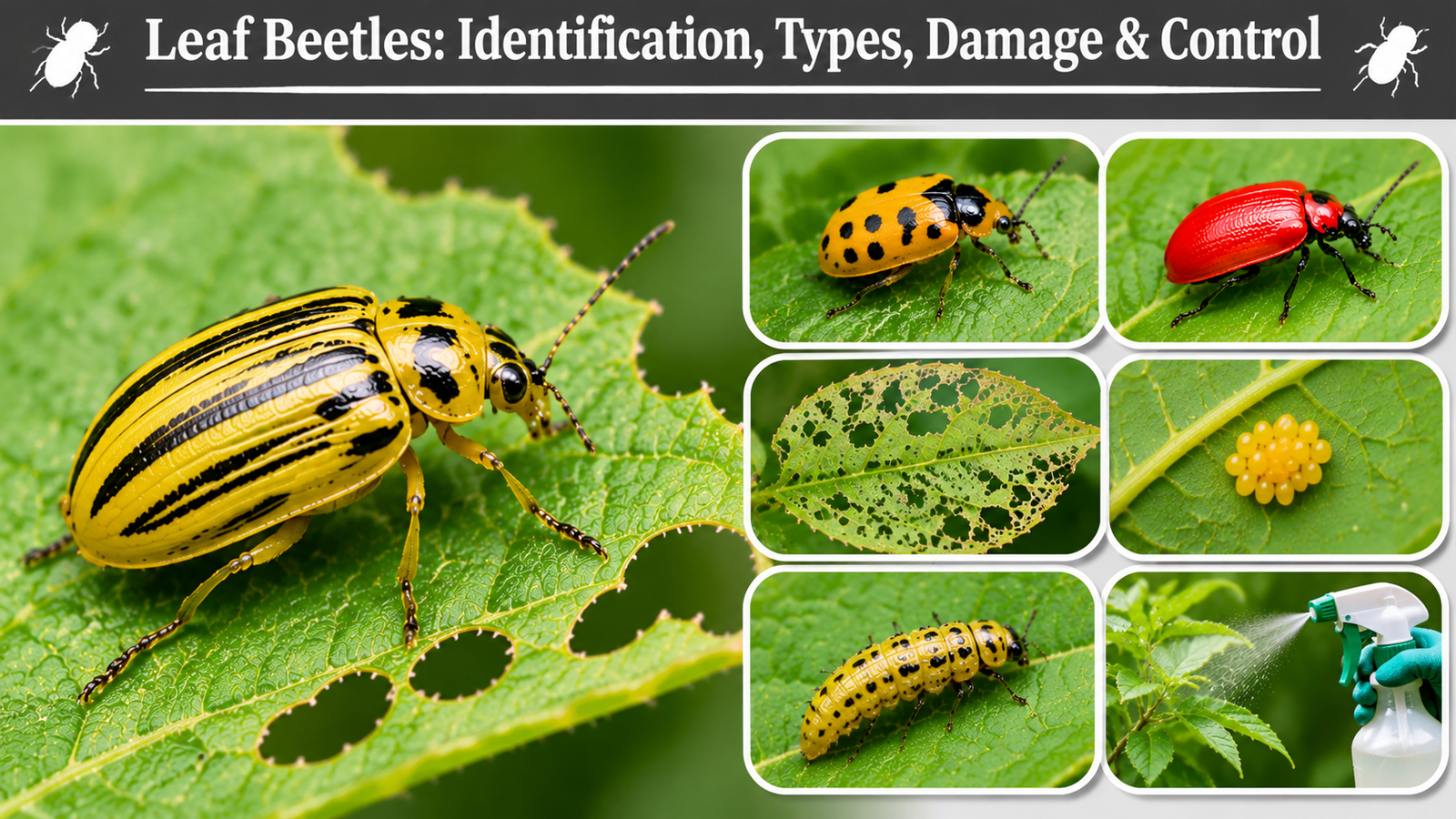
Leaf beetles are a diverse group of small insects commonly found on trees, shrubs, flowers, and garden plants. Belonging to the family Chrysomelidae, these beetles are recognized for their colorful bodies and plant-feeding habits. Some species are harmless visitors, while others can cause significant damage by chewing holes in leaves or destroying young plants. Leaf beetles occur worldwide and include familiar species such as elm leaf beetles, bean leaf beetles, and lily leaf beetles. Understanding their appearance, life cycle, feeding habits, and control methods can help gardeners identify and manage them effectively.
What Are Leaf Beetles?
Leaf beetles are plant-feeding insects belonging to the family Chrysomelidae within the order Coleoptera. Scientists have described more than 35,000 species worldwide, making this one of the largest beetle families. Although their appearance varies considerably, most have relatively small bodies and strong mouthparts designed for chewing plant material.
Leaf Beetle Identification
Most adult leaf beetles have compact, oval, or elongated bodies. Some resemble ladybugs, while others have more cylindrical shapes.
Common identification features include:
- Size: Most species measure approximately 2–12 mm long.
- Color: Green, yellow, red, orange, black, or metallic blue.
- Body shape: Oval, rounded, or elongated.
- Antennae: Usually short to moderately long and threadlike.
- Wings: Hardened wing covers called elytra protect the flying wings.
- Legs: Six legs, sometimes modified for jumping.
What Do Leaf Beetle Larvae Look Like?
Leaf beetle larvae vary depending on the species. Many have soft, elongated bodies with visible segments and three pairs of legs near the head.
Their colors range from yellow and green to brown or black. Some larvae possess spots, spines, or protective secretions.
They are commonly found feeding on leaves, although certain species develop within roots, stems, or leaf tissue.
Common Types of Leaf Beetles
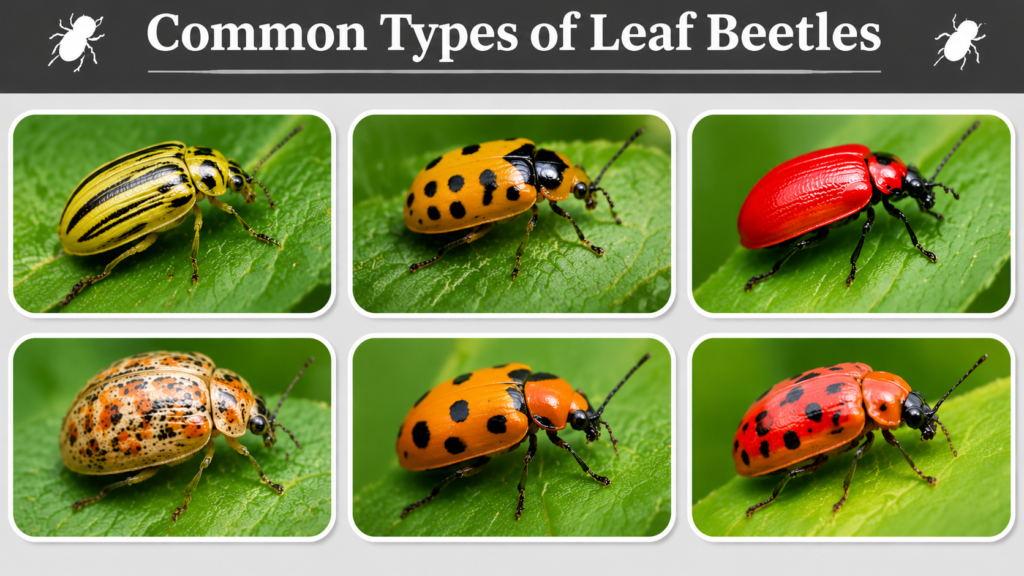
The leaf beetle family includes thousands of species living in forests, agricultural fields, gardens, and wetlands. Some are colorful insects valued for their appearance, while others are agricultural pests. Recognizing common species helps gardeners identify which plants are at risk and determine whether control measures are necessary.
1. Elm Leaf Beetle (Xanthogaleruca luteola)
The elm leaf beetle is a yellowish-green insect with dark stripes along its wing covers.
Both adults and larvae feed on elm trees. Heavy infestations cause skeletonized leaves, browning foliage, and premature leaf drop.
2. Bean Leaf Beetle (Cerotoma trifurcata)
Bean leaf beetles are small insects that vary from yellowish-green to reddish-orange.
They often have dark spots and a black triangular marking behind the head. Adults chew rounded holes in bean and soybean leaves and may damage developing pods.
3. Lily Leaf Beetle (Lilioceris lilii)
The lily leaf beetle is easily recognized by its bright scarlet-red wing covers and black head.
It feeds on true lilies and can severely damage foliage, flowers, and buds. Its larvae often cover themselves with dark, sticky excrement for protection.
4. Dotted Paropsine Leaf Beetle (Paropsis atomaria)
The dotted paropsine leaf beetle is an Australian species that feeds on eucalyptus trees.
Adults have tan or yellowish wing covers decorated with orange and dark markings. This beetle has become an invasive pest in parts of California, where larvae and adults damage eucalyptus foliage.
5. Milkweed Leaf Beetle (Labidomera clivicollis)
The milkweed leaf beetle has orange or yellow wing covers with dark markings.
It feeds on milkweed plants, particularly swamp milkweed. Both adults and larvae consume foliage, although small populations usually cause limited damage.
6. Air Potato Leaf Beetle (Lilioceris cheni)
The air potato leaf beetle is a specialized leaf-feeding insect introduced to control invasive air potato vines.
Its larvae and adults consume the vine’s leaves and growing tips. Unlike many other leaf beetles, this species is deliberately used for biological weed control.
Where Do Leaf Beetles Live and What Do They Eat?
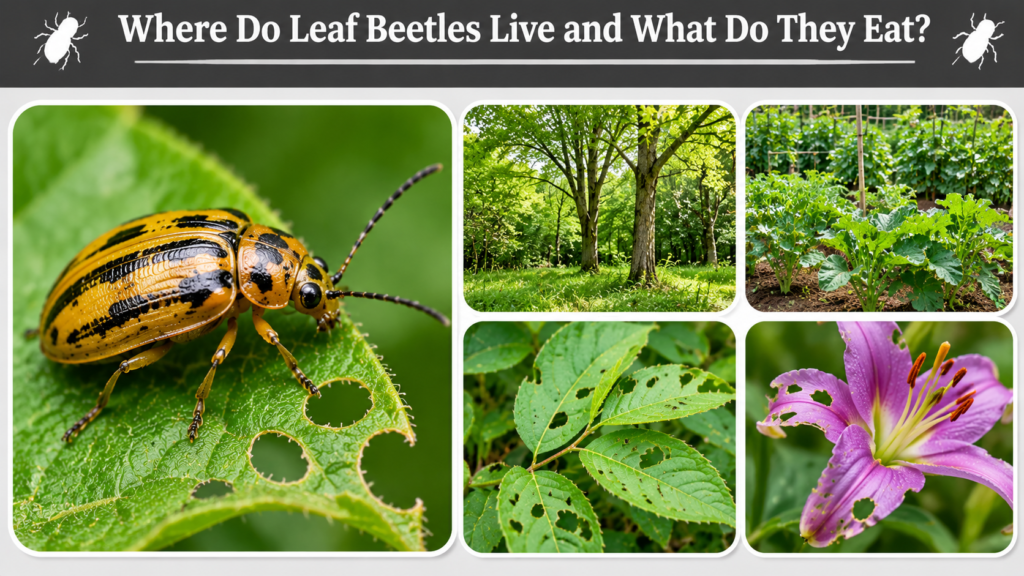
Leaf beetles occur in many habitats, including tropical forests, temperate woodlands, grasslands, agricultural fields, and home gardens. Their distribution depends largely on the availability of suitable host plants. Some species feed on numerous plants, while others specialize in particular trees, shrubs, or herbaceous vegetation.
Leaf Beetle Habitat
Leaf beetles commonly inhabit places with abundant vegetation.
Adults may rest on leaves, stems, flowers, or beneath plant debris. Some species spend colder months hidden in soil, fallen leaves, or protected crevices.
They are especially noticeable during the growing season when temperatures support feeding and reproduction.
What Do Leaf Beetles Eat?
Most leaf beetles consume plant material, although their feeding preferences differ.
Common food sources include:
- Leaves: Elm, willow, eucalyptus, and other trees.
- Vegetable crops: Beans, potatoes, and certain leafy vegetables.
- Flowers: Lilies and ornamental plants.
- Roots: Underground plant tissues eaten by some larvae.
- Stems: Tender plant growth consumed by certain species.
Many leaf beetles feed on only a limited selection of host plants.
Leaf Beetle Life Cycle
Leaf beetles undergo complete metamorphosis, developing through four stages: egg, larva, pupa, and adult. The duration of each stage depends on the species, temperature, and food availability. Some species produce one generation annually, while others complete several generations during favorable growing conditions.
1. Egg Stage
Female leaf beetles lay eggs on or near suitable host plants. Eggs may be deposited individually or in groups, often on the underside of leaves.
2. Larval Stage
Newly hatched larvae begin feeding and grow through several molts. Leaf-feeding larvae may cause extensive damage when populations are high.
3. Pupal Stage
Mature larvae become pupae, often in soil or sheltered locations. During this stage, their bodies transform into adult beetles.
4. Adult Stage
Adults emerge, feed, mate, and reproduce. Depending on the species, they may survive unfavorable seasons in protected places.
What Damage Do Leaf Beetles Cause?
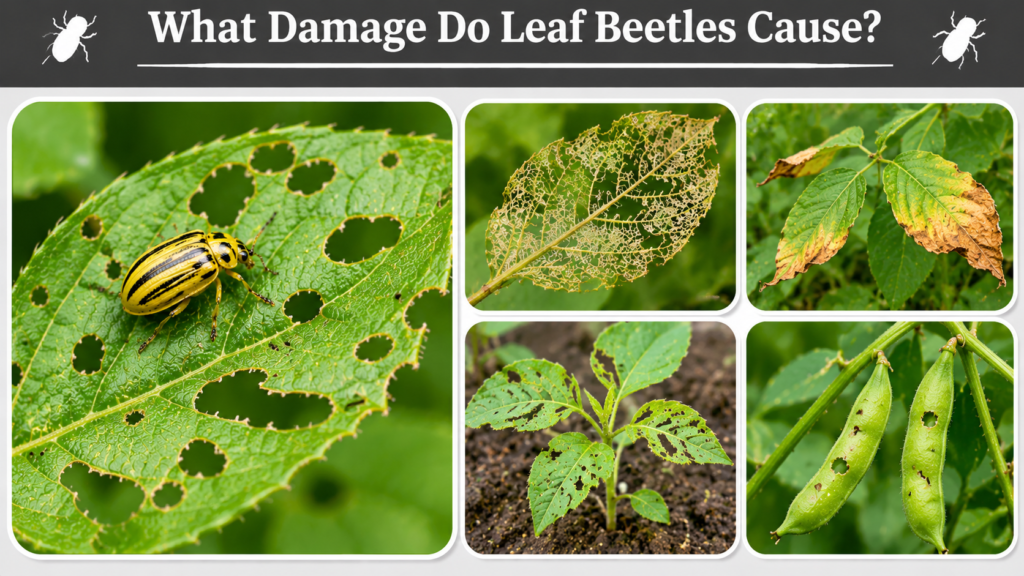
Leaf beetle damage occurs when adults or larvae consume plant tissues. Small populations usually cause limited problems, but heavy feeding can weaken young plants and reduce crop productivity. The severity depends on the beetle species, plant health, and number of insects present.
Common Signs of Leaf Beetle Damage
Typical symptoms include:
- Holes in leaves: Small, rounded, or irregular feeding holes.
- Skeletonized leaves: Tissue removed between leaf veins.
- Brown foliage: Discolored or drying leaves after heavy feeding.
- Damaged seedlings: Young plants weakened by extensive leaf loss.
- Reduced growth: Slower development caused by repeated defoliation.
- Damaged pods: Feeding marks on beans and other susceptible crops.
Are Leaf Beetles Dangerous to Plants?
Some leaf beetles are serious pests, particularly when large populations attack seedlings or young trees.
However, many established plants tolerate minor feeding without significant harm.
Proper species identification is important because not every leaf beetle requires treatment. Certain species are even beneficial when used to control invasive weeds.
How to Get Rid of Leaf Beetles Naturally

Managing leaf beetles requires identifying the species and monitoring the extent of plant damage. Small infestations can often be controlled without chemical pesticides. Early action is especially useful when larvae begin feeding or young plants are at risk. A combination of physical removal, plant protection, and regular monitoring is generally most effective.
Effective Leaf Beetle Control Methods
- Handpick beetles: Remove visible adults and larvae from affected plants.
- Remove egg clusters: Check leaf undersides and destroy pest eggs where appropriate.
- Use row covers: Protect vulnerable seedlings before beetles arrive.
- Inspect plants regularly: Look for early feeding holes and emerging larvae.
- Keep plants healthy: Maintain appropriate watering, soil conditions, and nutrition.
- Manage nearby weeds: Remove alternative host plants when they support pest populations.
- Use targeted treatment: If damage becomes serious, choose a product labeled for the identified pest and plant.
How to Prevent Leaf Beetle Infestations
Preventive care begins with regular plant inspection.
Check new plants for beetles, larvae, and eggs before introducing them into a garden.
Protect susceptible seedlings with fine insect netting when appropriate. Encourage natural predators and avoid unnecessary broad-spectrum insecticides.
Healthy plants are often better able to tolerate minor feeding damage without requiring treatment.
FAQs
1. Do leaf beetles bite humans?
Leaf beetles are primarily plant-feeding insects and generally do not bite humans. Their mouthparts are adapted for chewing vegetation rather than attacking people. Most species are harmless when encountered in gardens. However, some may release unpleasant defensive substances when disturbed, so handling unidentified beetles unnecessarily is best avoided.
2. Are leaf beetles good or bad for gardens?
Leaf beetles can be either harmless visitors or damaging plant pests. Certain species feed heavily on vegetables, flowers, and trees, while others cause only minor cosmetic damage. Some specialized species are beneficial because they help control invasive plants. Their impact depends on the species and population size.
3. What is the difference between leaf beetles and ladybugs?
Leaf beetles and ladybugs belong to different beetle families. Leaf beetles are members of Chrysomelidae and primarily feed on plants. Ladybugs belong to Coccinellidae, and many species feed on aphids and other small insects. Their similar rounded shapes sometimes make identification difficult.
4. Can leaf beetles fly?
Yes, many adult leaf beetles can fly using their membranous hindwings, which remain protected beneath hardened wing covers when not in use. Some species fly between plants to locate food or mates, while others move mainly by crawling or jumping. Flight ability varies among species.
5. How long do leaf beetles live?
The lifespan of leaf beetles varies considerably among species. Some complete their development in several weeks, while others have longer seasonal life cycles. Adult beetles may survive for weeks or months, and certain species overwinter as adults. Temperature, food availability, and environmental conditions influence their survival.