
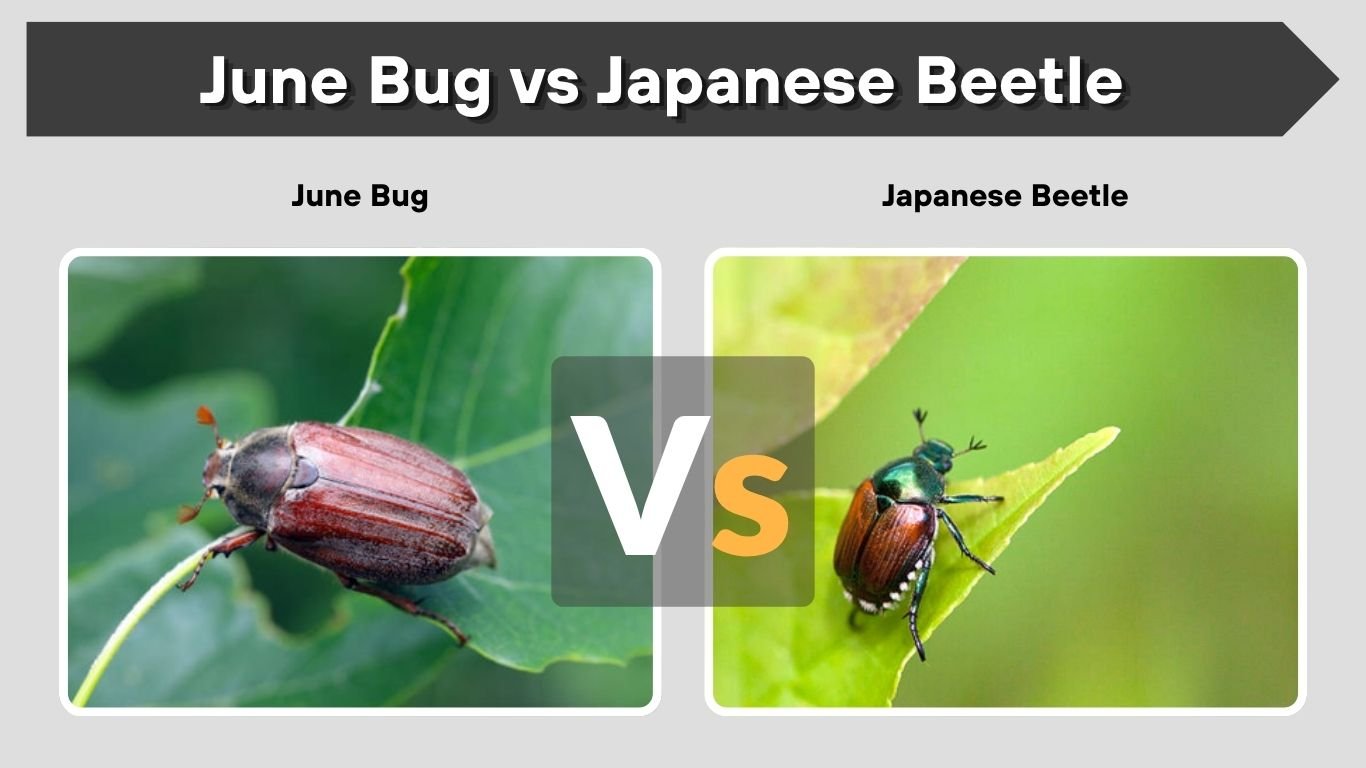
June bugs and Japanese beetles are often confused because both are shiny beetles that appear in warm months and can damage plants. However, they are not the same insect. June bugs are a broad group of scarab beetles, while Japanese beetles are a specific invasive beetle species in North America. The easiest way to tell them apart is by size, color, behavior, and the type of plant damage they cause.
June Bug vs Japanese Beetle: Quick Comparison
June bugs are usually larger, rounder, and active at night. Japanese beetles are smaller, metallic green and copper, and feed during the day. Both can damage plants, but Japanese beetles often cause more visible leaf skeletonizing.
| Feature | June Bug | Japanese Beetle |
|---|---|---|
| Size | Usually larger, about ½–1 inch | Smaller, about ⅜ inch |
| Color | Brown, reddish-brown, or green | Metallic green body with copper wings |
| Activity | Mostly night | Mostly day |
| Light attraction | Strongly attracted to lights | Less attracted to lights |
| Plant damage | Chews leaves, flowers, fruit | Skeletonizes leaves and flowers |
| Larvae | White grubs in soil | White grubs in soil |
| Main concern | Lawn/root damage and night nuisance | Garden and ornamental plant damage |
What Is a June Bug?
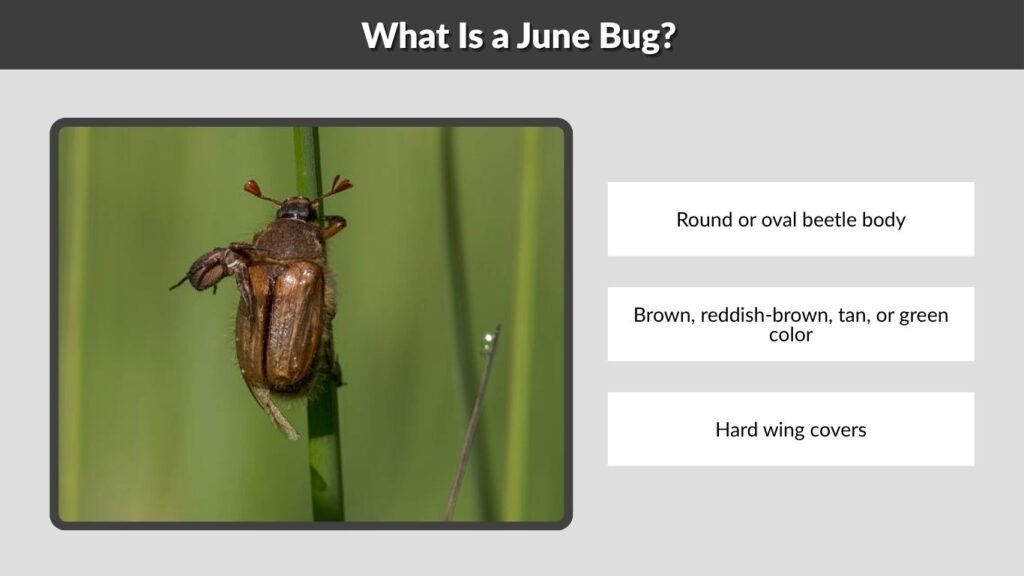
June bug is a common name used for several beetles, especially May beetles, June beetles, and green June beetles. They belong to the scarab beetle family and often appear in late spring or early summer.
Adult June bugs are known for their clumsy flying. They often hit windows, porch lights, doors, and screens at night. They may look scary because of their buzzing flight, but they do not sting and are not dangerous to people.
June Bug Identification
You can identify many June bugs by these features:
- Round or oval beetle body
- Brown, reddish-brown, tan, or green color
- Hard wing covers
- Strong, spiny legs
- Nocturnal activity
- Attraction to porch lights
- Often ½ inch to 1 inch long
- Loud, clumsy flying at night
Brown June bugs are usually duller, while green June bugs are larger and shiny green. Both may be called June bugs depending on the region.
June Bug Damage
Adult June bugs feed on leaves, flowers, and fruit. Their larvae, called white grubs, live underground and feed on grass roots and plant roots. This can cause brown lawn patches and weak turf.
June bug damage may include chewed leaves, damaged roses, injured fruit, and lawn areas that pull up easily because the roots have been eaten.
What Is a Japanese Beetle?
The Japanese beetle is a small metallic beetle known for serious garden and landscape damage. It is easy to recognize because of its shiny green head and copper-colored wing covers.
Unlike June bugs, Japanese beetles usually feed in groups during the day. They often gather on roses, grapes, fruit trees, beans, and many ornamental plants.
Japanese Beetle Identification
Japanese beetles have a very distinct appearance:
- Metallic green head and body
- Copper or bronze wing covers
- Small oval body
- White hair tufts along the sides
- Usually about ⅜ inch long
- Active during the day
- Often found feeding in groups
- Common on roses, grapes, fruit trees, and garden plants
The white hair tufts along the sides are one of the best identification clues.
Japanese Beetle Damage
Japanese beetles often skeletonize leaves. This means they eat the soft tissue between leaf veins, leaving behind a lace-like pattern. They also damage flowers and fruit.
They can feed on many types of plants, including roses, grapes, apple trees, beans, linden trees, birch, and ornamental shrubs.
June Bug Grub vs Japanese Beetle Grub
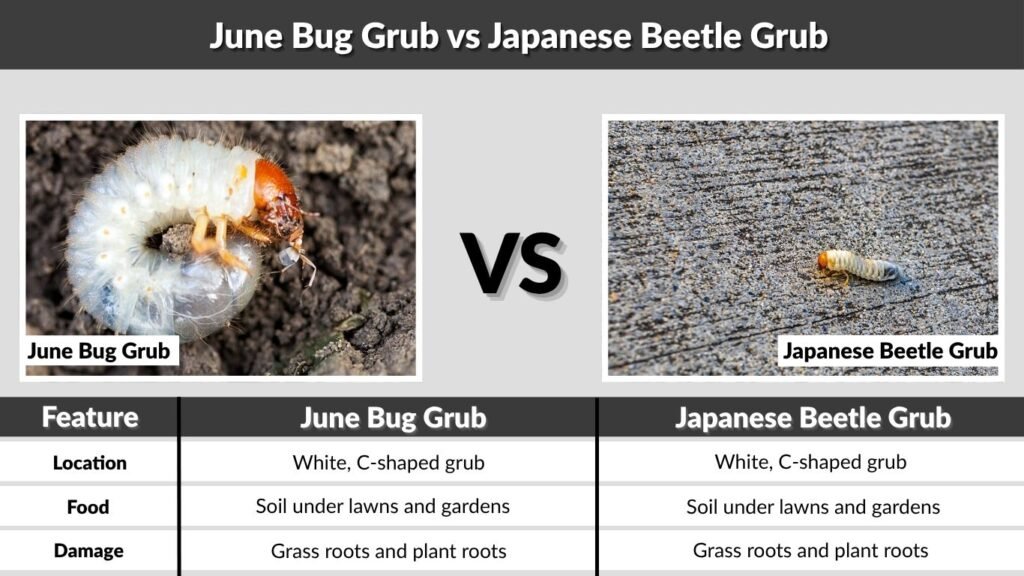
Both June bugs and Japanese beetles have white grub larvae that live in soil. They look similar, so identification can be difficult without close inspection. Both types may damage lawns by feeding on roots.
| Feature | June Bug Grub | Japanese Beetle Grub |
|---|---|---|
| Appearance | White, C-shaped grub | White, C-shaped grub |
| Location | Soil under lawns and gardens | Soil under lawns and gardens |
| Food | Grass roots and plant roots | Grass roots and plant roots |
| Damage | Brown lawn patches, weak grass | Brown lawn patches, weak grass |
| Identification | Hard to confirm without raster pattern | Hard to confirm without raster pattern |
| Control | Grub treatment, nematodes, lawn care | Grub treatment, nematodes, lawn care |
Why Grub Identification Matters
Grub identification matters because different beetles may have slightly different life cycles. However, the damage is often similar. If your lawn has brown patches, loose turf, and animals digging for grubs, you may have a grub problem.
The best approach is to inspect the soil and treat young grubs at the correct time, often late summer or early fall.
June Bug vs May Beetle
June bug and May beetle are often names for the same or closely related beetles. In many places, people use “May beetle” for beetles that appear in May and “June bug” for those seen in June.
There is no single insect called only a June bug. The name can refer to several beetles in the scarab family. This is why June bugs can look brown, reddish-brown, or green depending on the species.
May Bug vs June Bug
A May bug and a June bug may be the same type of beetle in many regions. The name usually depends on when the beetle appears. If it shows up in May, people may call it a May bug. If it is common in June, they call it a June bug.
June Bug vs Cockroach
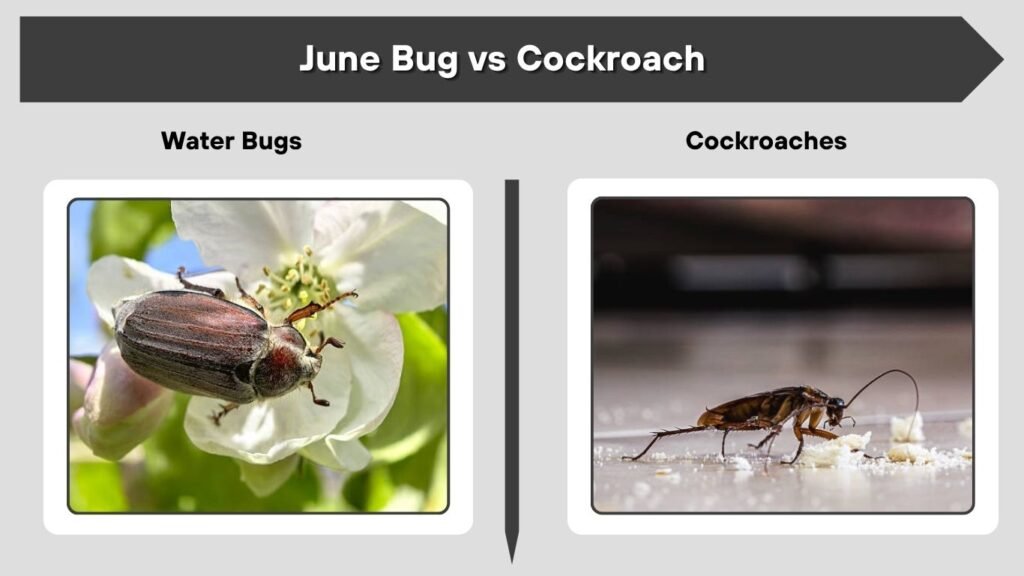
June bugs and cockroaches can both be brown and may appear around homes, but they are very different insects. June bugs are beetles, while cockroaches are household or outdoor scavenging insects.
| Feature | June Bug | Cockroach |
|---|---|---|
| Insect type | Beetle | Roach |
| Body shape | Round, hard, oval | Flatter, longer body |
| Wings | Hard wing covers | Leathery wings in many species |
| Behavior | Flies clumsily at night | Runs quickly, hides in cracks |
| Food | Leaves, flowers, roots, fruit | Food scraps, waste, decaying matter |
| Indoor problem | Accidental visitor | Can infest homes |
| Light behavior | Attracted to lights | Usually avoids light |
June Bug vs Roach Identification
A June bug has a hard, rounded body and often flies toward lights. A cockroach is flatter, faster, and more likely to run into dark spaces when exposed.
If you see one brown insect flying into your porch light, it is more likely a June bug. If you see several fast brown insects in the kitchen, bathroom, or cabinets, they are more likely cockroaches.
June Bug vs Cicada
June bugs and cicadas are both noisy summer insects, but they are not closely related. A June bug is a beetle. A cicada is a true bug with large wings and a loud call.
Cicadas are famous for their buzzing sound, while June bugs are mostly known for flying into lights. June bugs chew plants as adults, while cicadas feed on plant fluids using piercing mouthparts.
June Bug Shell vs Cicada Shell
Cicada shells are empty exoskeletons left behind when cicada nymphs molt. They are usually found attached to tree trunks, fences, or walls. June bugs do not leave the same type of large, visible shell on trees.
If you find a dry, hollow insect shell gripping bark, it is probably from a cicada, not a June bug.
June Bug vs Figeater Beetle
Figeater beetles are large green scarab beetles often confused with green June bugs. In some regions, people may call them June bugs because they look similar.
Figeater beetles are usually shiny green and are strongly attracted to ripe or fermenting fruit. They are common around figs, peaches, grapes, and other soft fruits.
Fig Beetle vs Green June Bug
Fig beetles and green June bugs can be hard to separate because both are large green beetles. In everyday gardening, the difference may not matter much because both can visit ripe fruit.
If you see a large green beetle around fruit trees, fallen fruit, or compost, it may be a figeater beetle or green June beetle.
Brown June Bug vs Green June Bug
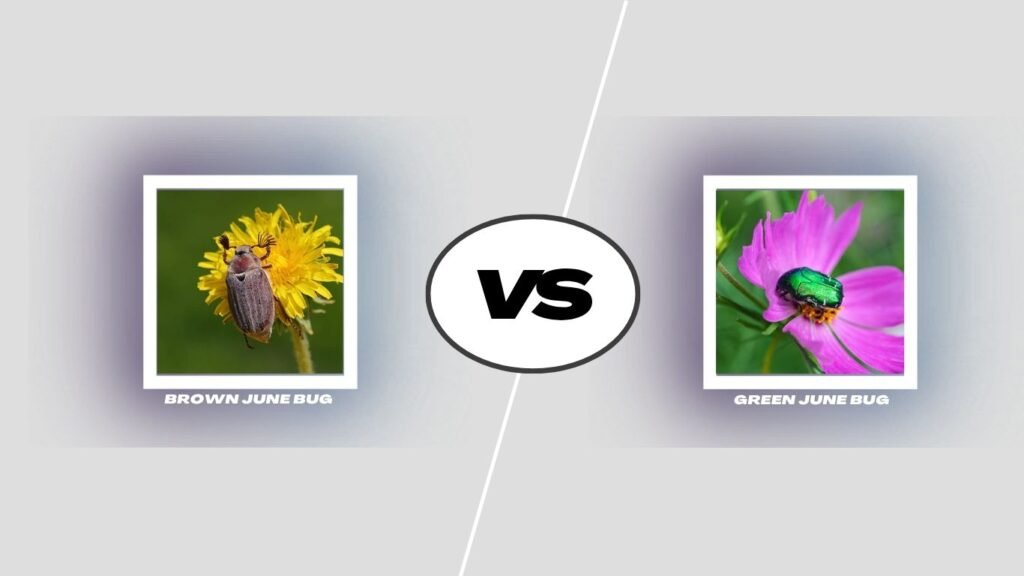
Brown June bugs and green June bugs are both scarab beetles, but they look different. Brown June bugs are usually reddish-brown or dark brown and are very common around lights at night. Green June bugs are larger, shiny, and more often seen around fruit.
Brown vs Green June Bug Differences
Brown June bugs are usually more common around porch lights. Green June bugs are more noticeable during the day and may fly loudly around lawns, orchards, and fruit trees.
Both can have grubs in the soil, but green June beetle larvae may also feed on decaying organic material.
June Bug vs Stink Bug
June bugs and stink bugs are easy to separate if you look at body shape. June bugs are beetles with hard wing covers and rounded bodies. Stink bugs have a shield-shaped body and can release a strong odor when disturbed.
Stink bugs use piercing mouthparts to suck plant juices. June bugs chew leaves and plant parts with beetle mouthparts.
June Bug vs Scarab Beetle
A June bug is actually a type of scarab beetle. Scarab beetle is the larger family group, while June bug is a common name for certain scarabs.
This means the comparison is not like comparing two completely different insects. It is more like comparing a specific common-name group to the larger beetle family it belongs to.
June Bug vs Other Look-Alike Bugs
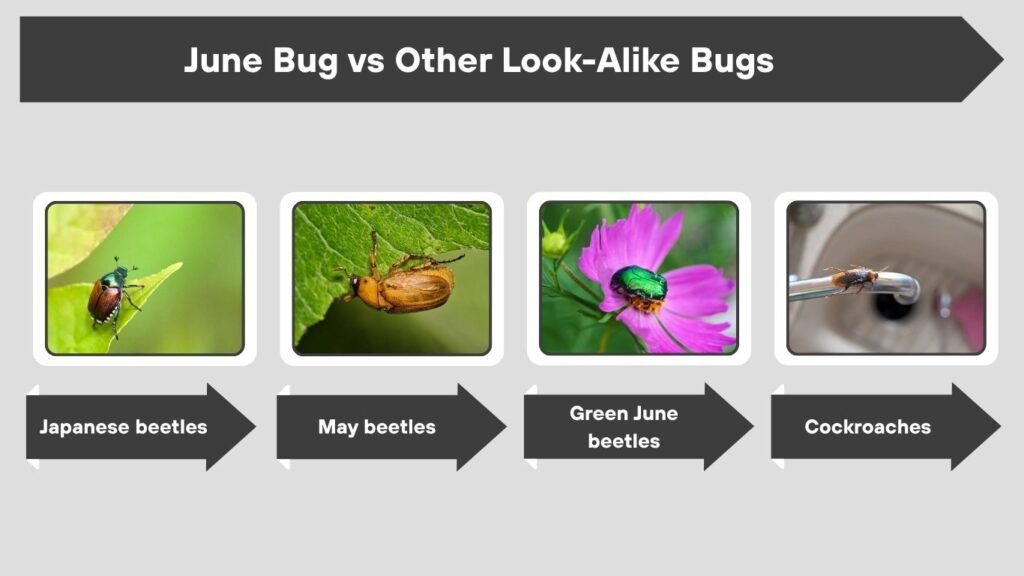
Many insects get compared with June bugs because they appear in summer, fly around lights, or have similar body shapes.
Common look-alikes include:
- Japanese beetles
- May beetles
- Figeater beetles
- Green June beetles
- Cockroaches
- Cicadas
- Stink bugs
- Scarab beetles
- Ladybugs
- Fireflies
- Mayflies
- Stag beetles
- Potato bugs
- Ticks
Most of these can be separated by body shape, color, behavior, and whether they chew plants, fly at lights, or live indoors.
Which Beetle Is Worse for Gardens?
Japanese beetles are usually worse for visible garden damage because they feed in groups and skeletonize leaves quickly. They can heavily damage roses, grapes, fruit trees, and ornamentals.
June bugs can also damage plants, but their biggest hidden problem is often the grub stage. June bug grubs may damage lawns and plant roots underground.
If your leaves look lace-like, Japanese beetles may be the cause. If your lawn has brown patches and loose grass, June bug or Japanese beetle grubs may be involved.
FAQs
Is a June bug the same as a Japanese beetle?
No, a June bug is not the same as a Japanese beetle. June bug is a broad common name for several scarab beetles, while the Japanese beetle is a specific metallic green and copper beetle known for damaging garden plants.
How can I tell a June bug from a Japanese beetle?
June bugs are usually larger, brown or green, and active at night. Japanese beetles are smaller, metallic green with copper wing covers, and active during the day. Japanese beetles also have white hair tufts along their sides.
Are June bug grubs and Japanese beetle grubs the same?
They are not the same species, but they look very similar. Both are white, C-shaped grubs that live in soil and eat grass roots. Close identification often requires examining small features on the grub’s underside.
Is a June bug a cockroach?
No, a June bug is a beetle, not a cockroach. June bugs have hard wing covers and often fly toward lights. Cockroaches are flatter, faster, and more likely to hide indoors near food, moisture, or dark spaces.
Is a June bug the same as a May beetle?
In many places, June bug and May beetle are common names for the same or closely related beetles. The name often depends on when the beetles appear, such as May, June, or early summer.
