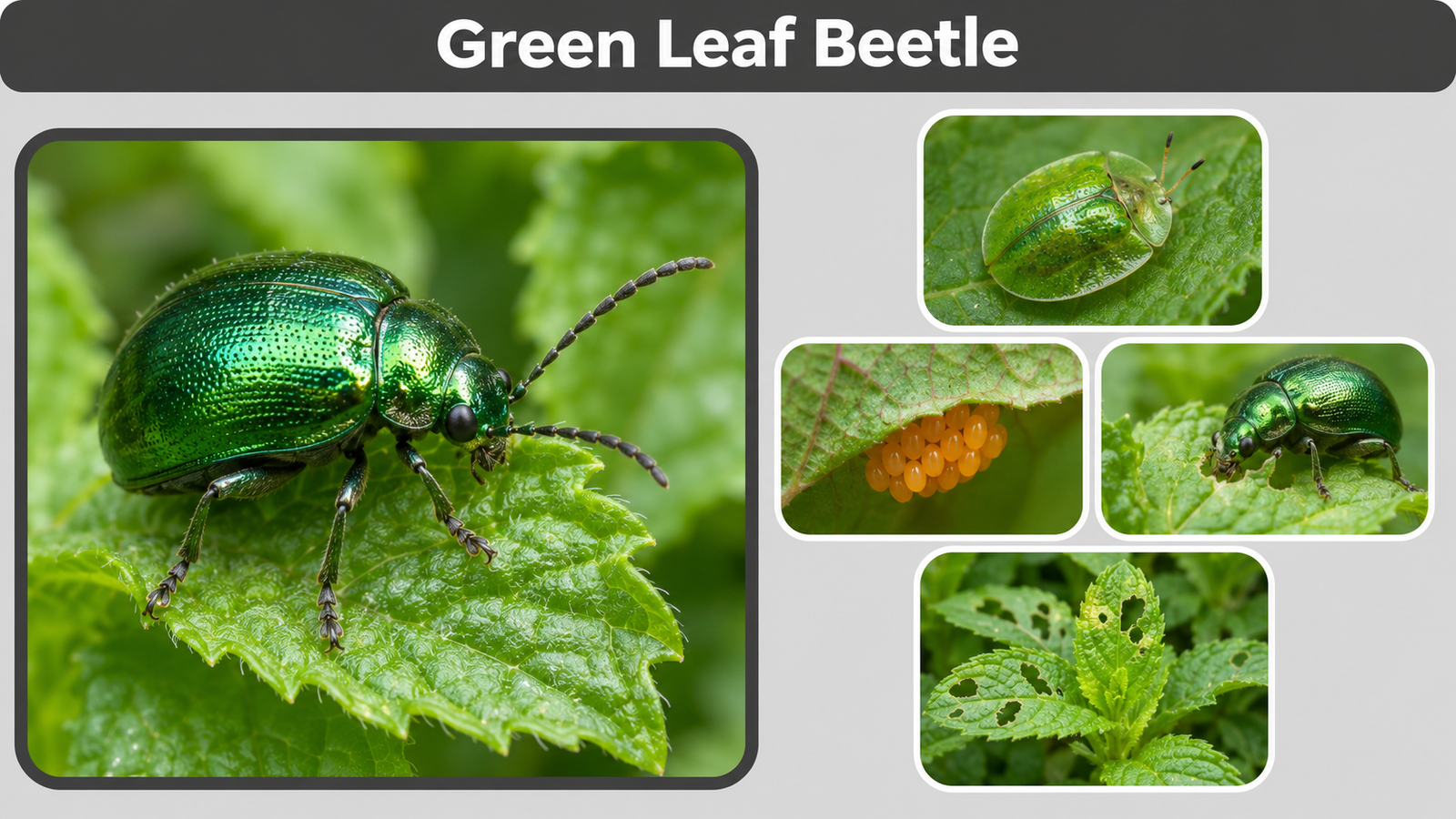
A green leaf beetle on your mint, dock, or garden plants can look like a tiny emerald. Several species fit that description, and the plant you find the beetle on often tells you more than its color. A shiny, rounded beetle eating mint could be a green mint beetle, while a smaller metallic beetle on dock may be a green dock beetle. A flat, lime-green beetle with a shield-like outline suggests a tortoise beetle. Here’s how to tell them apart, recognize their feeding damage, and decide whether your plants need protection.
What Is a Green Leaf Beetle?
“Green leaf beetle” is a descriptive name for several green species in the leaf beetle family, Chrysomelidae. Some have glossy, domed bodies that reflect gold, copper, or blue in the light. Others are flat and pale green, blending into the leaves they feed on. Many leaf beetles are closely associated with particular plants, which makes the host plant one of the most useful clues for identification. If you find a beetle sitting on a leaf, watch to see whether it is actually feeding and check nearby leaves for more adults or larvae.
How to Identify a Green Leaf Beetle
Start with the beetle’s size, shape, and the plant it was feeding on. Look at it from above and from the side. A domed mint beetle and a flattened tortoise beetle can both look bright green from above, but their profiles are quite different. A clear photograph of the whole plant, along with a close-up of the beetle, can help you narrow down the identification later.
| Beetle | What it looks like | Where to look |
|---|---|---|
| Green mint beetle (Chrysolina herbacea) | Shiny emerald green, rounded, usually about 8–9 mm long | Mint leaves and stems |
| Green dock beetle (Gastrophysa viridula) | Metallic green, oval, about 4–6 mm long | Dock and related plants |
| Green tortoise beetle (Cassida viridis) | Flat, rounded, lime green, about 8–10 mm long | White dead-nettle, hedge woundwort, and water mint |
| Dogbane beetle (Chrysochus auratus) | Strongly iridescent, with green, gold, or copper reflections | Dogbane in North America |
These are examples from different regions. Use the plant and the beetle’s body shape to narrow the list, then check which species occur near you.
Check the Wing Covers and Body Shape
The hard covers over a beetle’s back are called elytra. On a green mint beetle, they form a rounded back and have tiny pits you may see in a close-up photograph. The color can show gold or purple reflections, and some individuals look darker or bluer than the name suggests. Green tortoise beetles have a much flatter outline, with broad edges that partly conceal the head and legs when viewed from above.
Common Types of Green Leaf Beetles
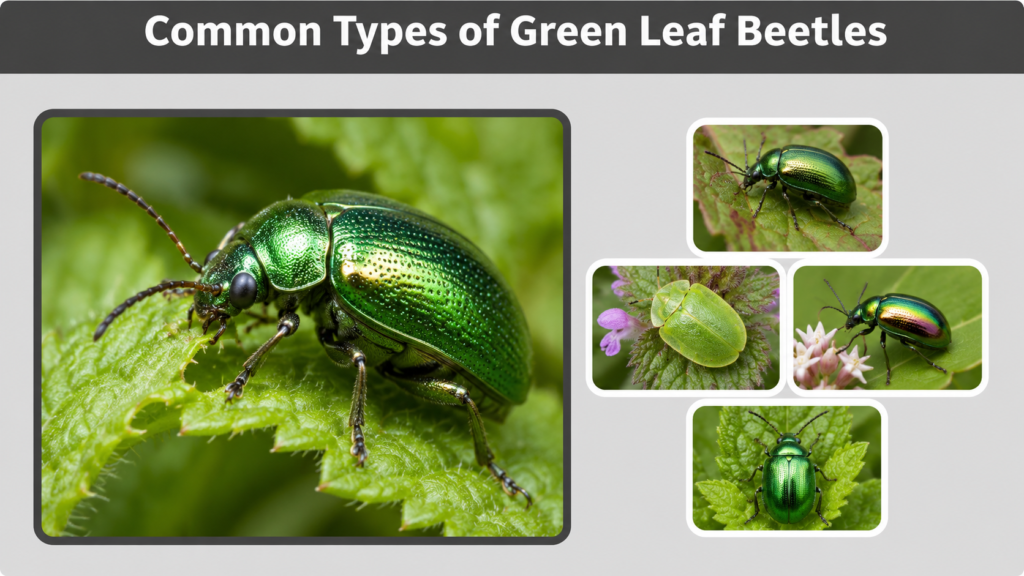
The same metallic green color turns up in beetles that eat very different plants. The following examples show how body shape, feeding habits, and location can help you tell them apart.
Green Mint Beetle
The green mint beetle, also called the mint leaf beetle, is usually easiest to recognize when you find it feeding on mint. Adults are glossy and rounded, and both adults and dark larvae eat the leaves. If you see a shiny beetle and several black larvae on the same chewed mint plant, photograph both. Britain also has a blue mint beetle whose larvae look similar, so an adult is more useful for telling the two species apart.
Green Dock Beetle
At around 4–6 mm long, the green dock beetle is smaller than the green mint beetle. Look for it on dock leaves, including the undersides, where females lay clusters of eggs. The eggs change from cream or yellow toward orange before hatching, and the larvae range from greenish gray to dark brown. Finding adults, eggs, and larvae together on dock gives you a much stronger identification than finding one shiny adult on nearby vegetation.
Green Tortoise Beetle
The green tortoise beetle looks like a flattened green shield. When disturbed, it pulls its legs and antennae beneath the edges of its body and grips the leaf. Its spiny larvae have a different defense. They carry a covering of shed skins and droppings on their backs. White dead-nettle, hedge woundwort, and water mint are good places to look for this species in Britain. Several related tortoise beetles look alike, so a flat green outline identifies the group more readily than the exact species.
Dogbane Beetle
If you’re in North America and find a jewel-colored beetle on dogbane, consider the dogbane beetle. Its back can appear green, coppery, or golden depending on the viewing angle. A Japanese beetle can also have a metallic green head and body, but its copper-brown wing covers and conspicuous white hair tufts along the sides and rear are useful distinguishing features. Check the entire back and abdomen before making an identification.
What Do Green Leaf Beetles Eat?
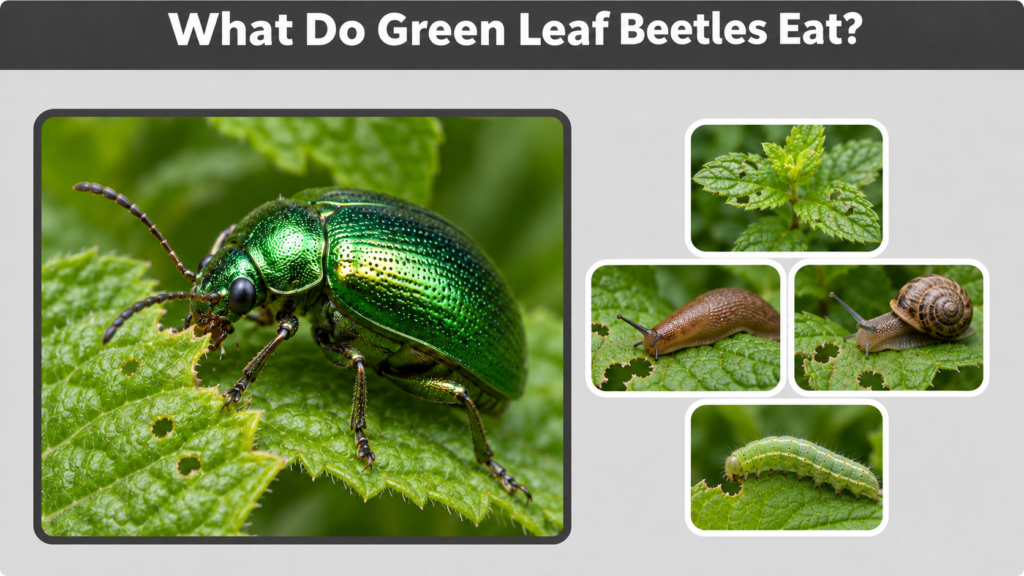
The diet depends on the species. Green mint beetles feed on mint, green dock beetles are associated with dock, and green tortoise beetles use plants such as dead-nettle, woundwort, and water mint. Adults and larvae often chew foliage, although in some leaf beetle species, larvae feed on roots or stems. If you see green beetles on several adjacent plants, look for fresh chewing and repeated activity on the same plant before deciding what they’re eating.
What Does Their Feeding Damage Look Like?
Leaf beetle feeding can leave irregular holes, ragged edges, or scraped patches. Some species eat enough soft tissue to leave a network of veins, a pattern called skeletonization. Small, round holes scattered across a leaf are typical of flea beetle feeding. If tiny beetles jump when disturbed, that’s another clue to look for flea beetles. Holes in mint can also come from slugs, snails, or caterpillars, so examine both sides of damaged leaves for the insects themselves.
Where Do Green Leaf Beetles Live?
Look for green leaf beetles where their food plants grow. In Britain, mint leaf beetles are found mainly in southern areas and into the Midlands, with some records farther north. Green tortoise beetles occur in habitats including gardens, hedgerows, grassland, and wetlands. In a garden, start with a patch of the suspected host plant. Check the upper leaves for adults, then turn over several leaves to look for eggs or larvae. A beetle resting on a window or fence offers fewer clues than one found among several chewed leaves on its host.
Green Leaf Beetle Life Cycle
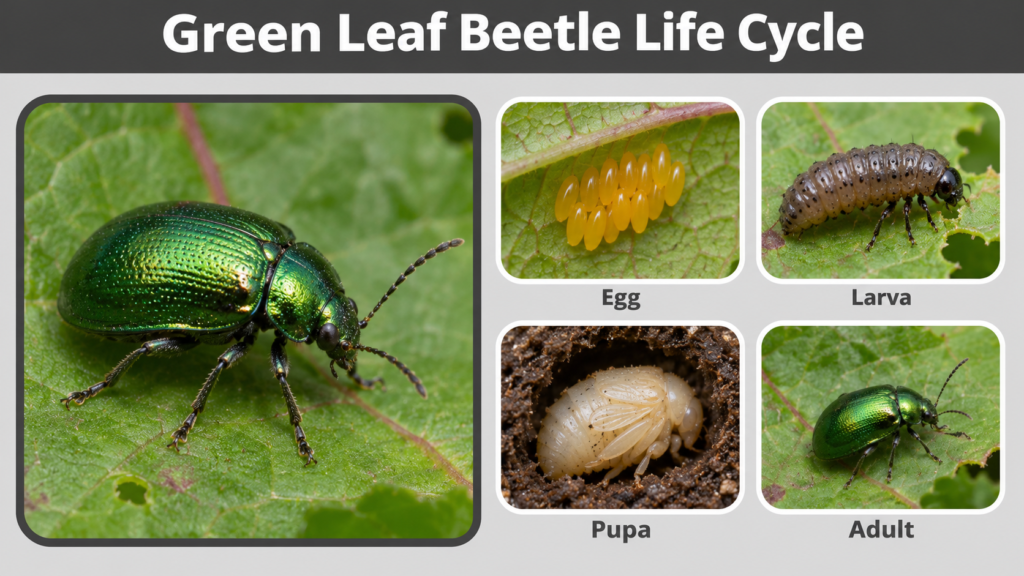
Leaf beetles develop through four stages: egg, larva, pupa, and adult. The details vary by species. Green dock beetles, for example, lay egg clusters beneath host leaves, and their larvae usually hatch within several days. The larvae feed and grow before pupating, and the adults emerge with hardened wing covers. Green dock beetles can produce multiple generations in a year, with the final generation overwintering as adults. If fresh feeding continues after you remove the adults from a plant, check the foliage again for eggs and newly hatched larvae.
Are Green Leaf Beetles Bad for Your Garden?
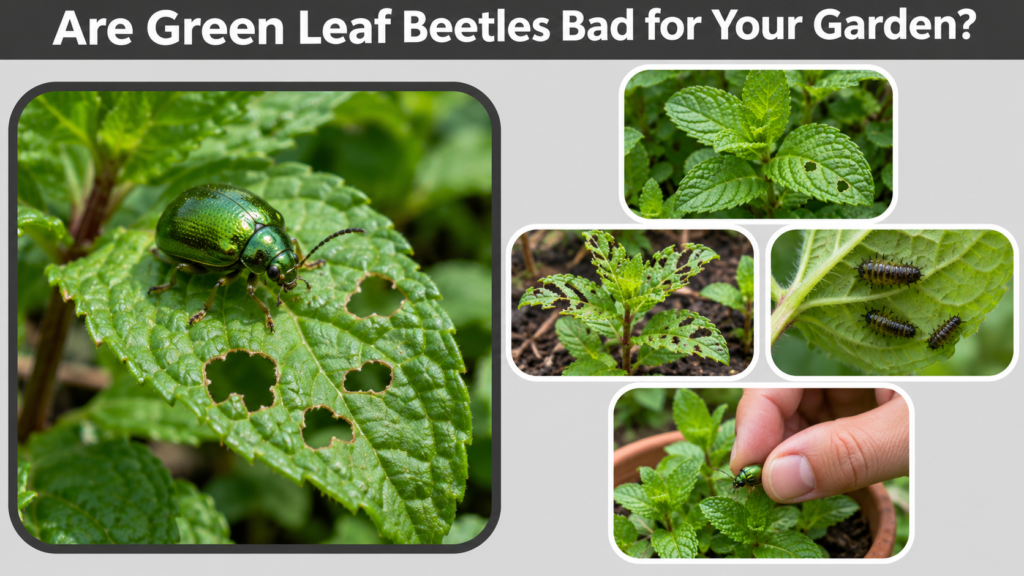
A few holes on a healthy, established plant usually call for observation. On young plants, heavy feeding can remove a substantial share of the available leaf area. Damage also matters when the leaves are what you intend to harvest, as with mint. Compare fresh leaves with older ones over several days. If the newest growth looks healthy and you see only an occasional beetle, the plant may already be outgrowing the damage.
How to Protect Plants From Heavy Feeding
For a small patch of mint or a few pots, start by handpicking visible adults and larvae. Turn over the leaves, especially those next to fresh feeding holes, and remove egg clusters once you’ve identified them as belonging to the beetles. Recheck the plants over the following days. Focus on the plants you want to protect. A beetle feeding on wild dock at the edge of the yard gives you little reason to treat a nearby herb bed, especially if the herbs show no fresh damage.
Frequently Asked Questions
What is the shiny green beetle on my mint?
In Britain, a rounded, emerald-green beetle feeding on mint may be the green mint beetle (Chrysolina herbacea). Look for its finely pitted back and check nearby leaves for dark larvae. Your location and a clear photo of the adult can help confirm the species.
Do green leaf beetles bite people?
Green mint, dock, and tortoise beetles use their chewing mouthparts to feed on plants. They are generally encountered as foliage feeders, and the damage you are most likely to notice is on their host leaves.
Why are there orange eggs under a dock leaf?
Green dock beetle eggs are laid in clusters beneath the leaves and can turn orange as they develop. Look for small metallic green adults or dark, segmented larvae on the same dock plant to help confirm the identification.
Is a green leaf beetle the same as a Japanese beetle?
A Japanese beetle is a scarab beetle. It has a metallic green head and body, copper-brown wing covers, and small tufts of white hair along the sides and rear of the abdomen. Those white tufts are particularly helpful when checking a photograph.
Should I remove a green leaf beetle from my plants?
If you find one beetle and a few holes on a vigorous plant, watch the new growth for fresh damage. If adults and larvae are repeatedly chewing through young leaves or the mint you plan to harvest, handpick them and check the undersides of leaves for more.