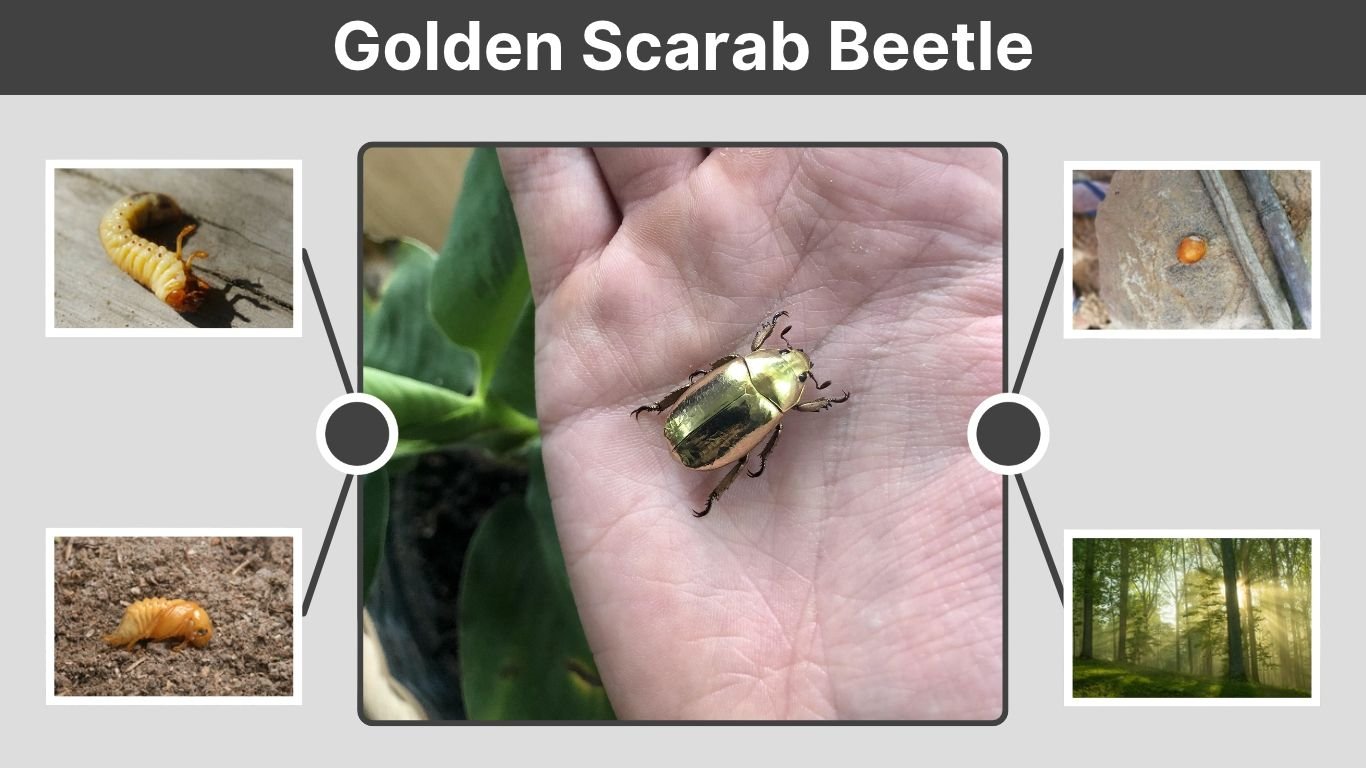
The golden scarab beetle is a real insect famous for its brilliant, mirror-like golden shell. One remarkable example, Chrysina resplendens, lives in Central American forests and reflects light so strongly that it can resemble polished metal. Golden scarabs also have symbolic connections to ancient Egypt, where beetle-shaped amulets represented renewal and protection. They appear in modern movies and video games, creating confusion between real insects and fictional objects. This guide explains their appearance, habitat, diet, life cycle, cultural meaning, and popular fictional versions.
What Is a Golden Scarab Beetle?
A golden scarab beetle is a member of the Scarabaeidae family with a metallic golden appearance. The term describes several beetles rather than one species. However, Chrysina resplendens, commonly called the Golden Jewel Scarab, is among the most recognizable examples.
This fascinating insect belongs to the Chrysina genus, which contains jewel scarabs displaying metallic green, silver, blue, and gold coloration.
Golden Scarab Beetle Facts
- Scientific name: Chrysina resplendens
- Common name: Golden Jewel Scarab
- Family: Scarabaeidae
- Order: Coleoptera
- Body length: Approximately 25–29 mm
- Color: Brilliant metallic gold
- Distribution: Costa Rica and Panama
- Habitat: Tropical and mountain forests
- Adult food: Tree foliage
- Larval food: Decaying wood
Golden Scarab Beetle Identification
Golden scarab beetles are recognizable by their shiny exoskeletons, compact bodies, and distinctive metallic reflections. Their appearance can resemble polished gold jewelry, making them particularly attractive to insect collectors and wildlife photographers. However, other jewel scarabs may display similar colors, so identification should consider multiple physical characteristics.
What Does a Golden Scarab Beetle Look Like?
The Golden Jewel Scarab has a rounded, oval body covered by smooth, reflective wing cases called elytra.
Its head and thorax also display golden coloration. Dark eyes, segmented legs, and club-shaped antennae provide additional identification features.
Unlike ordinary brown scarabs, its reflective surface produces unusually bright highlights when exposed to sunlight.
Why Are Golden Scarab Beetles Gold?
Their golden appearance results from structural coloration rather than actual gold.
Microscopic layers within the beetle’s exoskeleton reflect a broad range of visible light. These specialized structures manipulate reflected light, producing the appearance of shiny metal.
Researchers have discovered that Chrysina resplendens can reflect both left-handed and right-handed circularly polarized light, an unusual optical characteristic.
Golden Scarab Beetle Habitat and Distribution
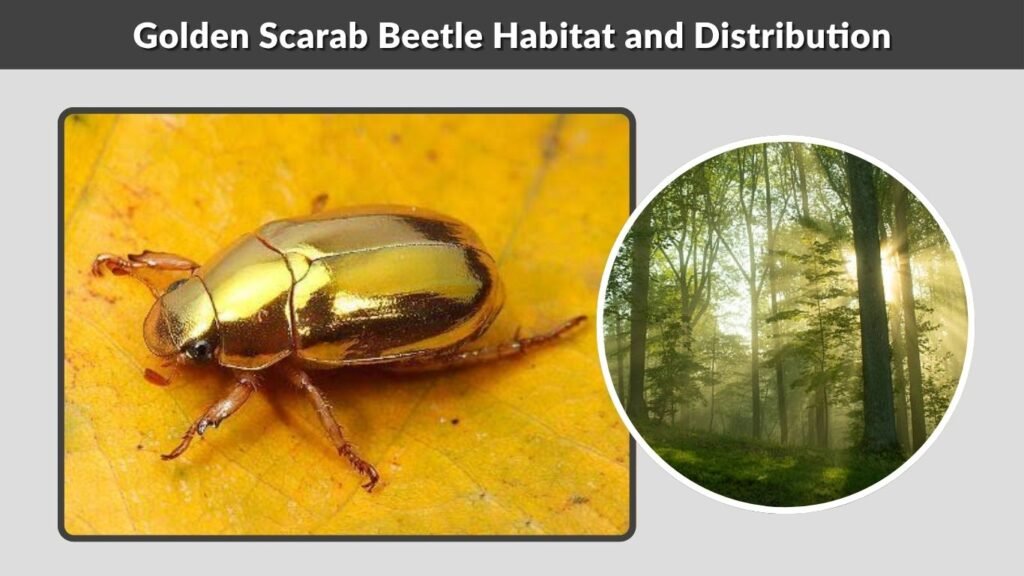
Golden jewel scarabs inhabit forest ecosystems with suitable temperatures, moisture, and decaying wood. They are especially associated with mountainous environments in Central America. Unlike common garden beetles, some golden scarab species have relatively restricted geographic distributions.
Where Do Golden Scarab Beetles Live?
Chrysina resplendens occurs naturally in Costa Rica and Panama.
In Costa Rica, specimens have been documented in mountain forests at elevations of approximately 800–1,550 meters.
Adults inhabit forest vegetation, while developing larvae live inside decaying wood. Other Chrysina species occur across Mexico, Central America, and parts of northern South America.
What Do Golden Scarab Beetles Eat?
Golden scarab beetles have different feeding habits during their adult and larval stages. Adult jewel scarabs generally consume foliage, while their larvae develop inside decomposing wood. Their feeding activities contribute to natural forest ecosystems and nutrient recycling.
Golden Scarab Beetle Diet
Adult Chrysina beetles feed on leaves from suitable trees. Their specific food preferences vary among species.
Larvae consume decaying wood and associated organic material, obtaining nutrients while developing inside rotting logs.
Unlike some dung beetles, Golden Jewel Scarabs are not primarily known for collecting or rolling animal dung.
Golden Scarab Beetle Life Cycle
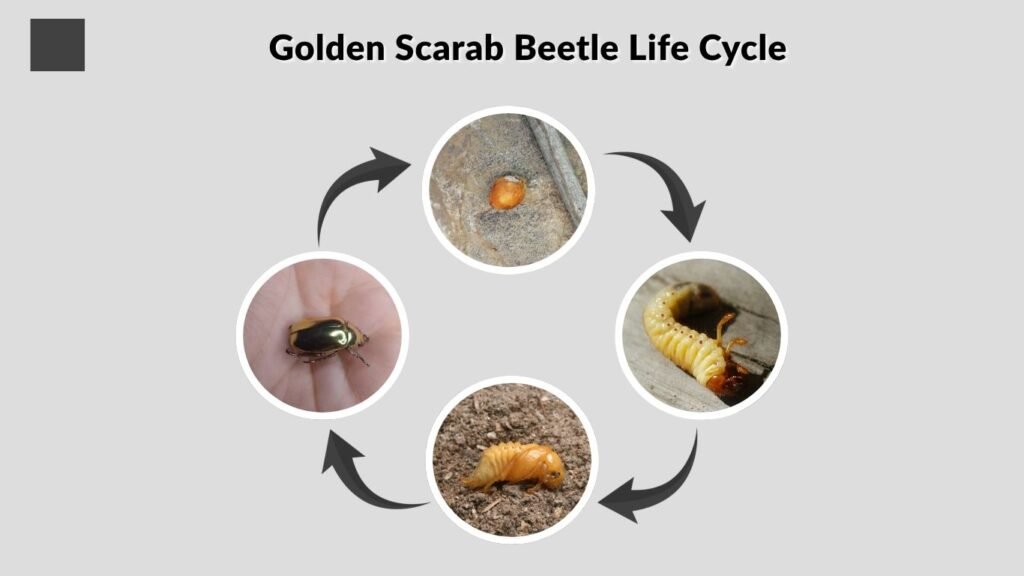
Golden scarab beetles undergo complete metamorphosis, transforming through four developmental stages. Their growth depends on temperature, food quality, and environmental conditions. Like other scarabs, they spend much of their early lives as larvae before emerging as winged adults.
Four Stages of the Golden Scarab Beetle Life Cycle
- Egg: Females deposit eggs in suitable decaying wood or nearby protected substrates where larvae can develop.
- Larva: Newly hatched grubs feed on decomposing wood and grow through successive molts. This stage may last several months or longer.
- Pupa: Mature larvae stop feeding and transform into pupae. During this stage, their adult body structures develop.
- Adult: Fully developed beetles emerge with hardened wing covers and begin searching for food and mates.
Are Golden Scarab Beetles Rare or Dangerous?
Golden scarab beetles attract attention because of their unusual metallic appearance. Some jewel scarabs have limited geographic distributions, while others occur more widely. Their rarity depends on the particular species and habitat rather than their golden coloration alone.
Are Golden Scarab Beetles Rare?
Chrysina resplendens has a relatively restricted distribution in Central America.
Its reflective appearance makes it desirable to collectors, but high collector interest does not automatically establish that a species is endangered.
Habitat destruction and unsustainable collection can threaten insect populations, making responsible conservation important.
Are Golden Scarab Beetles Poisonous?
Golden Jewel Scarabs are not known to be poisonous or venomous to humans.
They do not sting, and their primary defenses include their protective exoskeleton and natural behavior.
However, unnecessary handling should be avoided because beetles can be easily injured.
Golden Scarab Beetle Meaning in Ancient Egypt
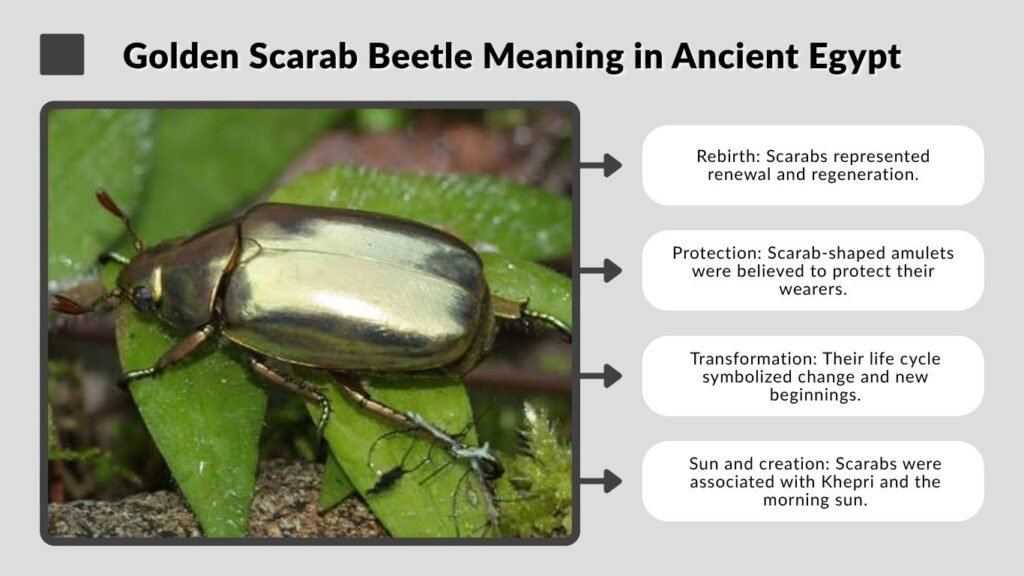
Scarab beetles held an important position in ancient Egyptian religion and artistic traditions. They were closely associated with the sun god Khepri, who represented the rising sun and renewal. Egyptians observed dung beetles rolling balls across the ground and connected this behavior with the sun’s daily journey.
Golden Scarab Beetle Symbolism
- Rebirth: Scarabs represented renewal and regeneration.
- Protection: Scarab-shaped amulets were believed to protect their wearers.
- Transformation: Their life cycle symbolized change and new beginnings.
- Sun and creation: Scarabs were associated with Khepri and the morning sun.
- Eternal life: Scarab amulets were sometimes included in burial practices.
Egyptian Gold Scarab Jewelry
Ancient Egyptians created scarab ornaments from gold, gemstones, glazed materials, and carved stones.
Today, gold scarab necklaces, pendants, rings, and bracelets remain popular Egyptian-inspired jewelry designs.
However, the scarabs represented in ancient Egyptian art were primarily inspired by dung beetles, not the Central American Golden Jewel Scarab.
Golden Scarab Beetles in Movies and Games
Golden scarabs also appear in popular entertainment, including Disney films and fantasy video games. These fictional scarabs often possess magical abilities or represent valuable collectibles. They should not be confused with living beetles, which have no supernatural powers.
Golden Scarab Beetle in Aladdin
In Disney’s 1992 animated movie Aladdin, a magical golden scarab helps Jafar locate the Cave of Wonders.
The scarab consists of two separate pieces that become animated when joined together.
It flies across the desert and reveals the hidden cave entrance, playing an important role in the movie’s opening events.
Gold Scarab in Elden Ring
In Elden Ring, the Gold Scarab is a talisman that increases the number of runes players earn from defeated enemies by approximately 20%.
Players obtain it by defeating two Cleanrot Knights inside the Abandoned Cave in Caelid.
The item is especially useful for collecting additional runes while progressing through the game.
Golden Scarab in Adopt Me
In Roblox Adopt Me!, the Giant Gold Scarab is a legendary pet associated with the Desert Shop.
Players can obtain it through the Mud Ball mechanic when the shop is available.
The fictional pet differs completely from real Golden Jewel Scarabs in its appearance, behavior, and abilities.
FAQs
1. Are Golden Scarab Beetles Real?
Yes. Golden scarab beetles are real insects. One famous example is Chrysina resplendens, a metallic-gold scarab native to Costa Rica and Panama. Its remarkable appearance comes from microscopic structures within its exoskeleton that reflect light.
2. What Does a Golden Scarab Beetle Symbolize?
Golden scarabs commonly symbolize rebirth, protection, transformation, and renewal in Egyptian-inspired traditions. Ancient Egyptians associated scarab beetles with Khepri, the rising sun, and the cycle of life. Modern spiritual interpretations may also connect them with prosperity.
3. How Much Does a Golden Scarab Beetle Cost?
The price of a golden scarab beetle depends on its species, condition, source, and whether it is alive or preserved. Collector specimens may be expensive, while decorative replicas vary widely in price. Wildlife collection and trade regulations should always be considered.
4. Where Can You Find Golden Scarab Beetles?
Chrysina resplendens occur naturally in Costa Rica and Panama, particularly in suitable mountain forests. Other metallic-colored scarabs inhabit different parts of the Americas. Their distribution depends on climate, forest conditions, and the availability of suitable larval habitats.
5. Why Did Ancient Egyptians Worship Scarab Beetles?
Ancient Egyptians associated scarab beetles with Khepri, a deity representing the morning sun. The beetles’ habit of rolling dung balls resembled the sun’s movement across the sky. Scarab-shaped amulets became important symbols of protection, renewal, and life after death.