
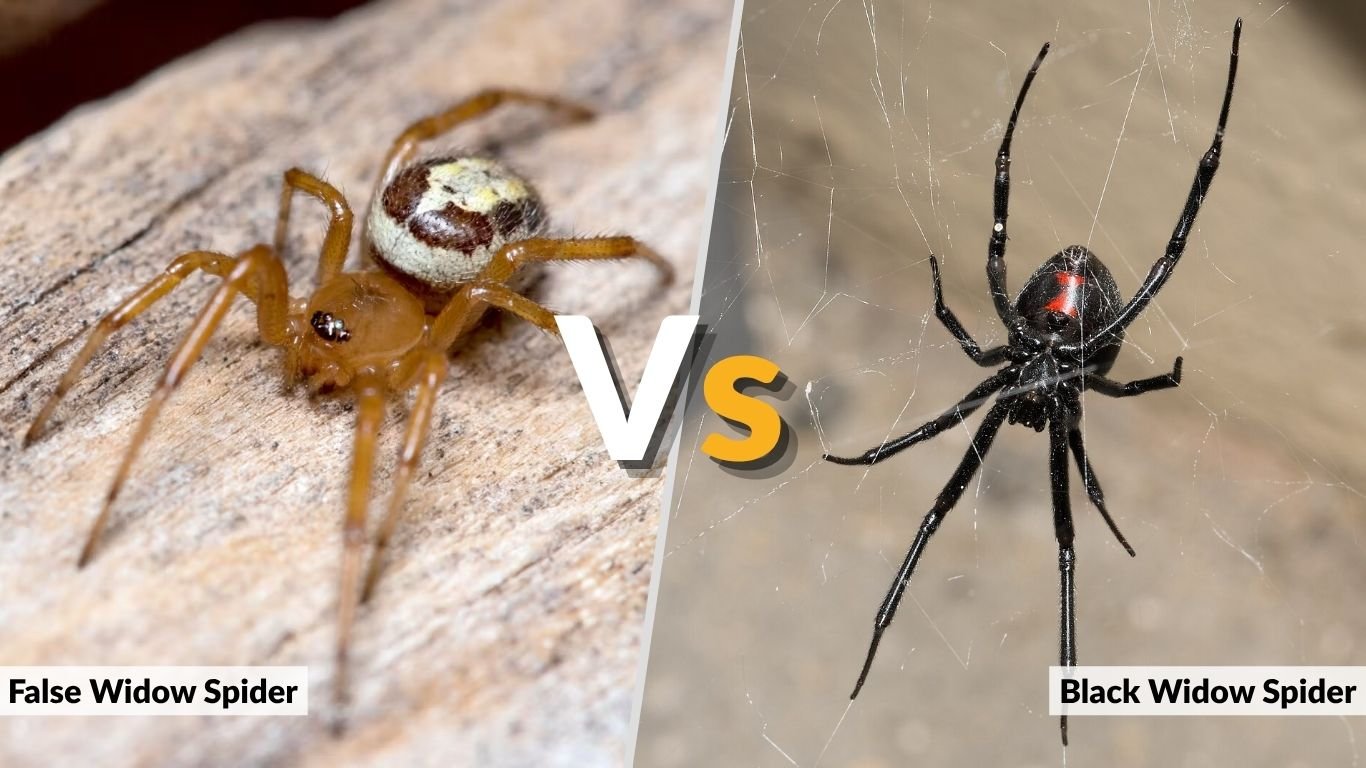
False widow spiders and black widow spiders are often confused because both can have shiny, rounded bodies and messy webs. However, they are not the same spider. False widows belong to the Steatoda group, while true black widows belong to Latrodectus. The easiest difference is the red hourglass marking, which is typical of many female black widows but absent in false widows.
False Widow Spider vs Black Widow Overview
False widow spiders are named for their resemblance to true widow spiders. They can look dark, glossy, and round-bodied, especially when seen quickly in a corner, shed, garage, or web. This is why many people worry when they see one indoors.
Black widow spiders are more medically significant and are best known for the red or orange hourglass marking on the underside of the female abdomen. False widows do not have this classic hourglass marking. Their bodies are usually brown, dark brown, purplish brown, or almost black, often with pale cream or beige markings.
Both spiders prefer sheltered places and may build irregular webs. The difference is easier to see when you compare body colour, markings, location, web style, and bite risk together.
Main Identification Differences
False widows and black widows can appear similar from a distance, but close features make them easier to separate. A true black widow is usually more uniformly glossy black, while a false widow is often brownish with lighter patterns.
Quick Identification Clues
Use these signs before making a guess:
- Black widows often have a red hourglass mark underneath.
- False widows do not have the red hourglass marking.
- False widows may show cream, beige, or pale abdominal markings.
- Black widows are usually more jet black and glossy.
- False widows may look brown, reddish brown, or purplish.
- Both can have rounded abdomens.
- Both may make messy, irregular webs.
- False widows are common around UK buildings and gardens.
- Black widows are more associated with warmer regions, especially parts of North America.
- A clear photo from above and below helps identification.
Never pick up a suspected widow spider to check its underside. Use a photo, container, or expert help if identification matters.
False Widow vs Black Widow Comparison Table
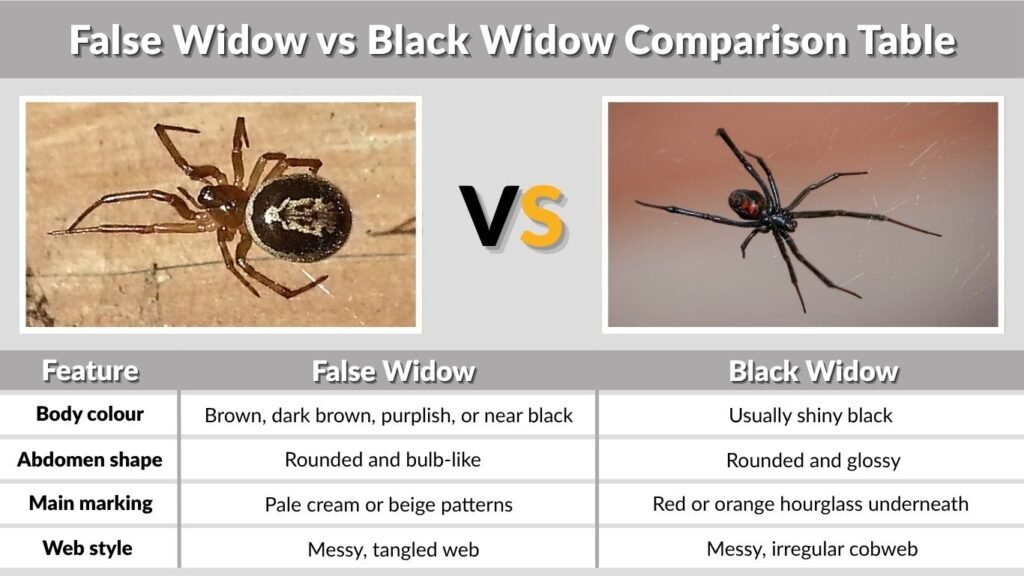
This table shows the most useful differences between the two spiders.
| Feature | False Widow Spider | Black Widow Spider |
| Scientific group | Steatoda | Latrodectus |
| Body colour | Brown, dark brown, purplish, or near black | Usually shiny black |
| Abdomen shape | Rounded and bulb-like | Rounded and glossy |
| Main marking | Pale cream or beige patterns | Red or orange hourglass underneath |
| Web style | Messy, tangled web | Messy, irregular cobweb |
| Bite risk | Usually mild to moderate | More medically significant |
| Temperament | Shy, bites if trapped | Shy, bites if disturbed |
| Common places | Homes, sheds, garages, gardens | Garages, woodpiles, sheds, dark spaces |
| UK presence | Several species established | True black widows are not normally established |
| Identification difficulty | Often confused with house spiders | Easier if hourglass is visible |
The red hourglass is the strongest visual clue for many female black widows. However, because it is on the underside, you should not handle the spider to check it.
Body Shape and Colour
Both spiders can have a rounded abdomen, which is the main reason for confusion. A false widow’s abdomen may look smooth and glossy, but it is usually not as deep black as a black widow. It may be chocolate brown, reddish brown, purple-brown, or dark brown.
Black widow females are usually more striking. Their bodies are often shiny black with long, thin legs and a round abdomen. The red hourglass underneath the abdomen is the most famous feature, though the exact shape can vary between species.
Male black widows and young spiders may not look like the classic female. This can make identification harder. False widow males are also slimmer than females, with longer-looking legs and a smaller abdomen.
Markings on the Abdomen
Markings are one of the best ways to separate false widows from black widows. False widows often have pale markings on the top of the abdomen. These markings may look like a skull, shield, leaf shape, broken patches, or cream-coloured pattern.
Marking Differences
False widow spiders may show:
- Cream or beige patterns
- Pale lines or patches
- Skull-like markings in noble false widows
- Faded markings in older females
- Brown or reddish body tones
Black widow spiders may show:
- Red hourglass underneath the abdomen
- Red or orange marks on some species
- Glossy black body
- Fewer pale patterns on the top
- Stronger contrast between body and marking
Do not rely on one mark alone. Some false widows have faded patterns, and some black widow species may have markings that vary.
Web Differences
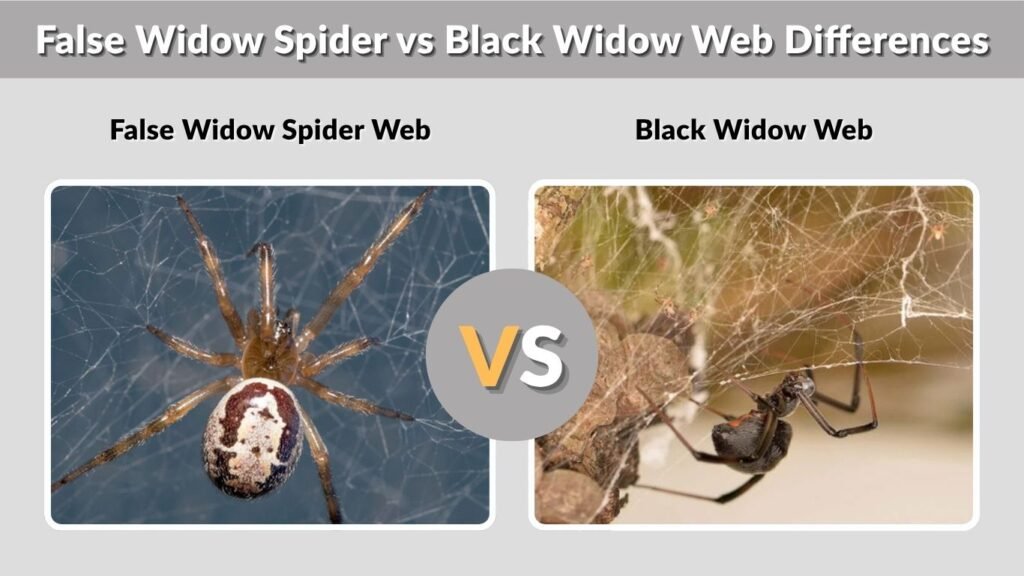
False widows and black widows both make messy webs, not neat circular orb webs. This can make web identification difficult. Their webs are usually irregular, tangled, and placed in quiet areas where insects pass by.
A false widow web is often seen in window frames, sheds, garages, fences, outdoor furniture, bins, wall cracks, and roof spaces. The spider may hide in a retreat near the web and come out when prey is caught.
Black widow webs are also irregular and strong. They are often found in dark, undisturbed areas such as woodpiles, outdoor toilets, garages, basements, crawl spaces, and cluttered storage areas.
Web Clues to Notice
Look at these details:
- Messy web instead of circular web
- Hidden corner or sheltered space
- Spider staying close to a retreat
- Web near insects or outdoor lights
- Low-disturbance area
- Strong, tangled silk
Web shape alone cannot confirm the spider. Use the web as one clue along with body markings and location.
Bite Risk and Venom Strength
Both spiders can bite, but their medical risk is different. False widow bites are usually compared to a bee or wasp sting. A bite may cause pain, redness, swelling, itching, and tenderness. Some people can have stronger reactions, and infection can make any bite worse.
Black widow bites are more serious. Their venom can cause strong pain, muscle cramps, sweating, nausea, headache, and abdominal discomfort. Fatal cases are rare with modern care, but black widow bites should be treated more seriously than false widow bites.
False widows should still be respected. Do not handle them with bare hands. If bitten and symptoms worsen, seek medical advice. If you suspect a black widow bite, contact medical help promptly.
False Widow vs Black Widow Bite Symptoms
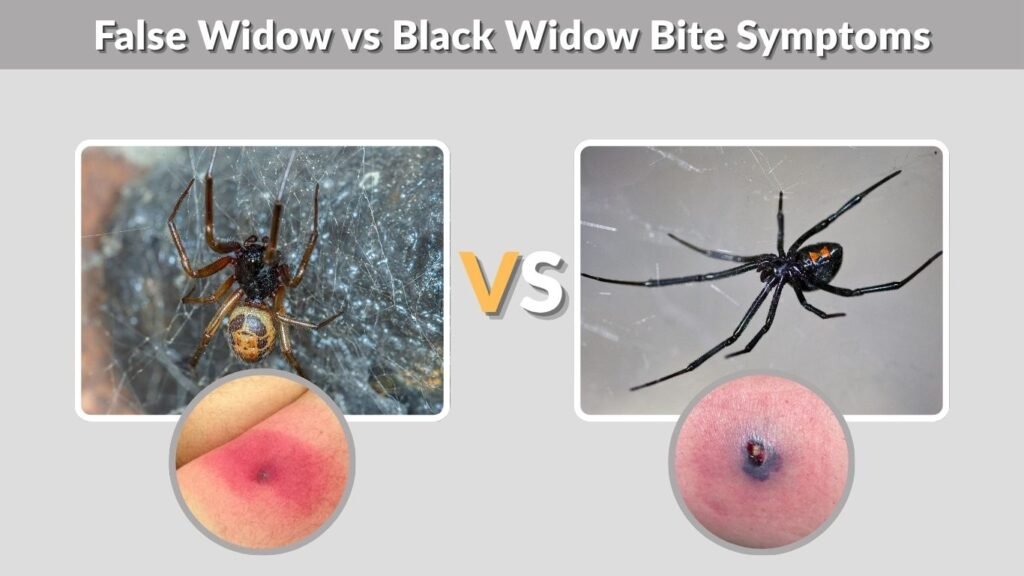
A bite mark alone cannot reliably identify the spider. Many insect bites, skin infections, allergic reactions, and irritated follicles look similar. Identification is more likely if you saw the spider bite you or found it trapped against the skin.
Symptom Comparison
A false widow bite may cause:
- Sharp sting or pinch
- Redness
- Local swelling
- Itching
- Tenderness
- Small blister in some cases
- Mild unwell feeling in stronger reactions
A black widow bite may cause:
- Immediate or delayed pain
- Muscle cramps
- Sweating
- Nausea
- Headache
- Abdominal or back pain
- Restlessness
- More intense body-wide symptoms
Seek urgent help for breathing trouble, severe pain, spreading redness, fever, fainting, or signs of allergic reaction.
Cupboard Spider vs False Widow
The cupboard spider is actually one of the spiders often called a false widow. Its scientific name is Steatoda grossa. This means the comparison can be confusing because a cupboard spider is a type of false widow, not a completely separate group.
The cupboard spider usually has a dark rounded abdomen, long slim legs, and a messy web. It may be brown, purplish, or nearly black. Its markings are often less bold than the noble false widow, and some individuals look plain dark.
Cupboard spiders commonly live inside houses, cupboards, basements, sheds, and quiet corners. Like other false widows, they prefer hidden spaces and usually bite only if trapped or handled.
House Spider vs False Widow
Common house spiders are often mistaken for false widows because they appear indoors and move quickly across walls, floors, and bathtubs. However, house spiders usually look hairier, longer-legged, and less glossy.
False widows tend to have a smoother, rounder abdomen. They often stay close to messy webs rather than running openly across the floor. House spiders may build sheet-like or funnel-like webs and often have a more stretched body shape.
House Spider Differences
A common house spider usually has:
- Longer, hairier legs
- Brown or grey body
- Less glossy abdomen
- Faster running movement
- More obvious body patterns
- Sheet or funnel-style web
- Less rounded body shape
A false widow usually looks more compact, rounded, and shiny.
Cellar Spider vs False Widow
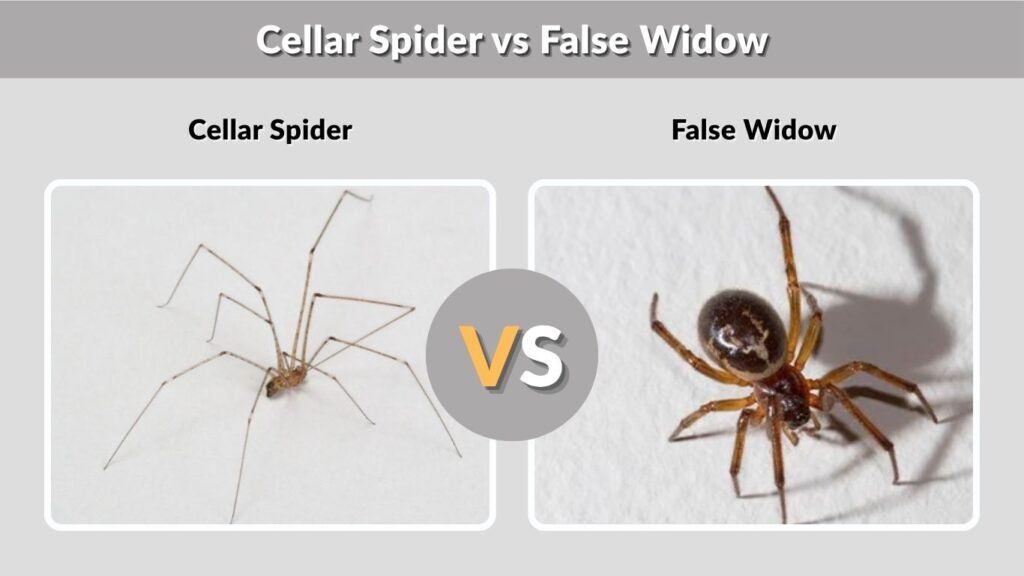
Cellar spiders are easy to separate from false widows once you notice the legs. Cellar spiders have extremely long, thin legs and a tiny body. They are often called daddy longlegs spiders in some places, although that name can refer to different animals.
False widows have a rounder, heavier abdomen and shorter-looking legs compared with cellar spiders. Cellar spiders often hang upside down in loose webs in ceiling corners, basements, bathrooms, and garages.
Cellar spiders are not built like widow spiders. Their small bodies and very long legs make them look delicate. False widows look more compact and bulb-bodied.
Lace-Web Spider vs False Widow
Lace-web spiders can be confused with false widows because they are found around walls, windows, and buildings. They often live in cracks and holes, where they build silk retreats. Their bodies are usually darker and more robust, with a different shape from the rounded false widow.
A lace-web spider may appear hairier and flatter than a false widow. Its web is often built around a hole or crevice rather than as a suspended messy tangle. Some lace-web spiders can bite if handled, but they are not the same as false widows.
Look at the abdomen: false widows have a smoother, rounded, glossy abdomen. Lace-web spiders usually look more textured and less bulb-like.
Rabbit Hutch Spider vs False Widow
The rabbit hutch spider is another name linked to Steatoda bipunctata, a false widow species. Like the cupboard spider, it belongs to the false widow group. It is smaller than the noble false widow and often has a neat pale line or markings on the abdomen.
This spider is often found around sheds, hutches, garages, fences, and outdoor structures. It makes a messy web and prefers quiet sheltered places.
Because it is a false widow species, the difference is not “rabbit hutch spider or false widow.” It is more accurate to say the rabbit hutch spider is one type of false widow.
Noble False Widow vs Other False Widows
The noble false widow is usually larger and more noticeable than some other false widow species. It often has a rounded abdomen with pale markings that may look like a skull or shield. It is the species most often discussed in relation to bites in the UK.
Other false widows, such as cupboard spiders and rabbit hutch spiders, may be smaller or less boldly marked. Some are darker and plainer. They still share the rounded abdomen, messy web, and hidden lifestyle typical of the group.
Noble False Widow Clues
A noble false widow may show:
- Larger rounded abdomen
- Cream skull-like or shield-like pattern
- Brown to dark brown colour
- Reddish-brown legs
- Messy web near buildings
- Stronger public concern due to bite reports
Use several features together, because individual markings can vary.
Male vs Female False Widow Spider
Female false widows are usually larger, rounder, and more likely to be noticed sitting in a web. Their abdomen is fuller and more bulb-shaped. They may stay close to one web for a long time.
Males are usually slimmer, with smaller abdomens and longer-looking legs. They may wander more when looking for females. Because of this, males may be seen walking across walls or floors more often than females.
Females are easier to confuse with black widows because of the rounded abdomen. Males often look less widow-like because their body is narrower.
Missing Sector Orb-Web Spider vs False Widow
The missing sector orb-web spider may be mistaken for a false widow when seen indoors near windows. However, it builds an orb web, which is a major difference. Orb webs are circular or wheel-shaped, while false widow webs are messy and tangled.
Missing sector orb-web spiders often sit near window frames and make webs with a visible missing wedge or open section. Their bodies are not as glossy and bulb-like as a false widow.
If the web is neat, circular, and wheel-shaped, it is probably not a false widow web.
Garden Spider vs False Widow
Garden spiders are easier to identify because they usually build large circular orb webs outdoors. They often have patterned abdomens with cross-like markings and a more colourful body. False widows build messy webs and prefer hidden corners.
Garden spiders sit in the centre of their orb web or nearby. False widows often hide in a retreat and wait for prey to get trapped in tangled silk. Garden spiders are generally not confused with black widows when seen clearly, but quick sightings can cause mistakes.
How to Identify Them Safely
Never handle an unknown spider with bare hands, especially if it might be a widow spider. Identification should be done safely from a distance.
Safe Identification Steps
Use these steps:
- Take a clear photo from above.
- Do not touch the spider.
- Look for a red hourglass underneath only if visible safely.
- Check the abdomen shape and colour.
- Note whether the web is messy or circular.
- Check where the spider was found.
- Use a glass and card if removal is needed.
- Ask a local expert if unsure.
- Seek medical advice after a concerning bite.
A clear photo is often better than trying to inspect the spider directly.
FAQs
What is the main difference between a false widow and black widow?
The main difference is the red hourglass marking. Many female black widows have a red or orange hourglass on the underside of the abdomen. False widows do not have this marking. False widows are usually brown or dark brown with pale cream markings, while black widows are often glossy black.
Is a false widow as dangerous as a black widow?
No, a false widow is not usually as dangerous as a black widow. False widow bites are often compared to a bee or wasp sting, although stronger reactions can happen. Black widow bites are more medically serious and can cause muscle cramps, nausea, sweating, and intense pain.
Is a cupboard spider the same as a false widow?
Yes, the cupboard spider, Steatoda grossa, is one type of false widow spider. It has a rounded dark abdomen, slim legs, and a messy web. It is often found in cupboards, sheds, basements, and quiet indoor corners. It is not the same as a true black widow.
How can I tell a house spider from a false widow?
A house spider is usually hairier, longer-legged, faster-moving, and less glossy. A false widow has a smoother, rounded abdomen and often stays near a messy web. House spiders may build sheet-like or funnel-like webs, while false widows usually make irregular tangled webs.
Should I remove a spider if I cannot tell whether it is a black widow?
Yes, remove it safely without touching it. Use a glass and card, a spider catcher, or professional help if needed. Do not handle it to check markings. If you live in an area where black widows occur and the spider has a glossy black body, treat it with caution.
