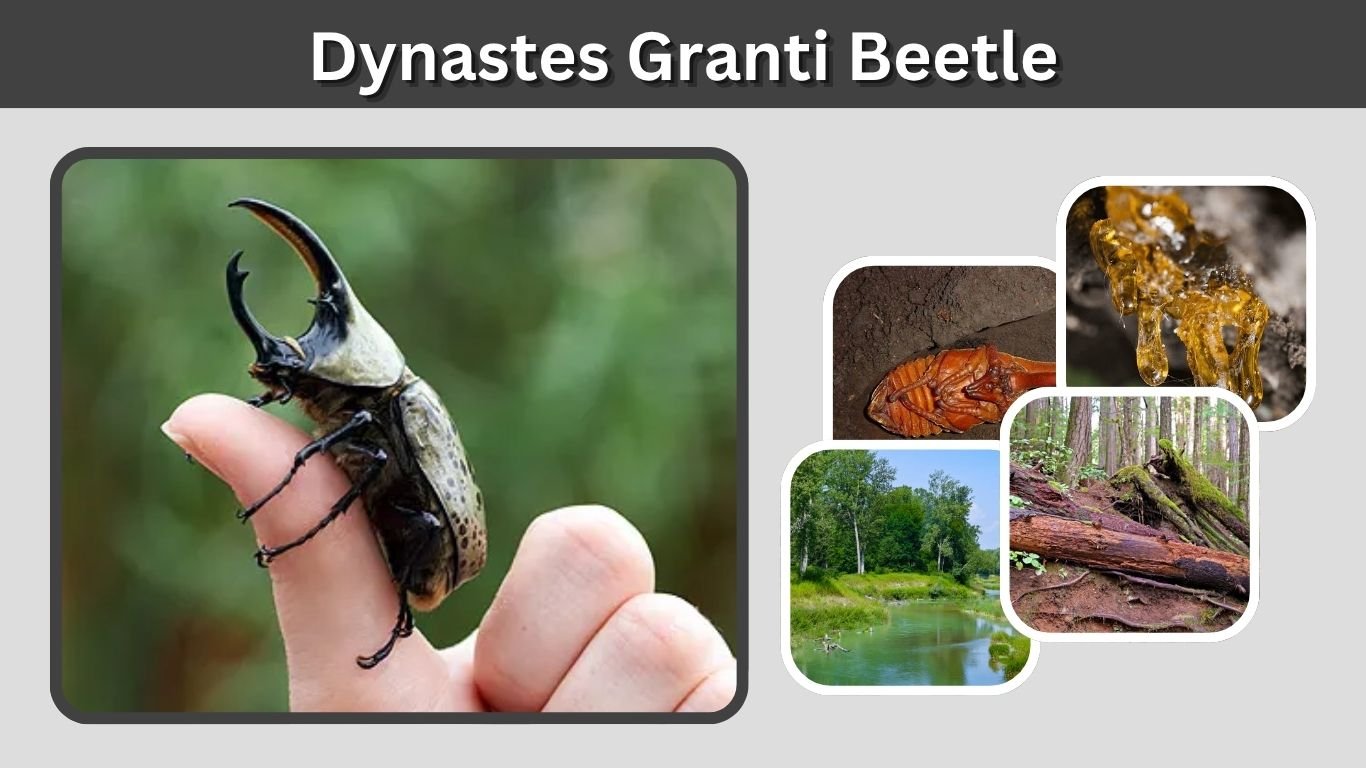
The Dynastes granti beetle, commonly known as the Western Hercules Beetle or Grant’s Hercules Beetle, is one of the largest and most fascinating beetles in North America. Scientifically named Dynastes grantii, this impressive insect is recognized by its pale gray body, dark spots, and large horns in males. Native to the southwestern United States and northern Mexico, it inhabits wooded mountain regions and feeds primarily on tree sap as an adult. Understanding its identification, habitat, size, lifespan, life cycle, and care requirements reveals what makes this rhinoceros beetle unique.
What Is a Dynastes Granti Beetle?
The Dynastes granti beetle belongs to the rhinoceros beetle subfamily Dynastinae within the scarab beetle family Scarabaeidae.
It is also called Grant’s Hercules Beetle or the Western Hercules Beetle because of its remarkable strength, large body, and distinctive horns.
Unlike many agricultural pest beetles, this species mainly depends on decaying wood during its larval stage and tree sap during adulthood.
Dynastes Granti Beetle Facts
| Characteristic | Description |
| Scientific name | Dynastes grantii |
| Common name | Western Hercules Beetle |
| Family | Scarabaeidae |
| Subfamily | Dynastinae |
| Adult size | About 35–85 mm, including horns |
| Body color | Pale gray or whitish with dark spots |
| Habitat | Southwestern mountain forests |
| Distribution | Southwestern USA and northern Mexico |
| Larval food | Decomposing hardwood |
| Adult food | Tree sap and soft fruits |
| Activity | Primarily nocturnal |
| Adult lifespan | Commonly several months |
The Western Hercules Beetle is among the largest scarab beetles native to the United States.
Dynastes Granti Identification and Size
The Dynastes granti beetle has a strong, oval body covered by smooth, hardened wing cases called elytra.
Its coloration usually ranges from pale gray to whitish, with irregular dark spots scattered across the back. Color intensity can change with moisture, and the beetle may appear considerably darker when wet.
Male and Female Identification
Male Dynastes granti beetles possess two prominent opposing horns. One extends from the head, while the other projects forward from the thorax. These horns help males compete during mating encounters.
Females lack the large horns and generally have a more rounded appearance.
Both sexes have six strong legs with claws that help them grip tree bark and other surfaces.
How Big Is Dynastes Granti?
Wild individuals commonly measure approximately 35–60 mm, although large males may exceed this range when their horns are included.
Well-developed captive males can reach around 80–85 mm.
Size varies with sex, genetics, and nutrition during larval development.
Dynastes Granti Habitat and Geographic Range
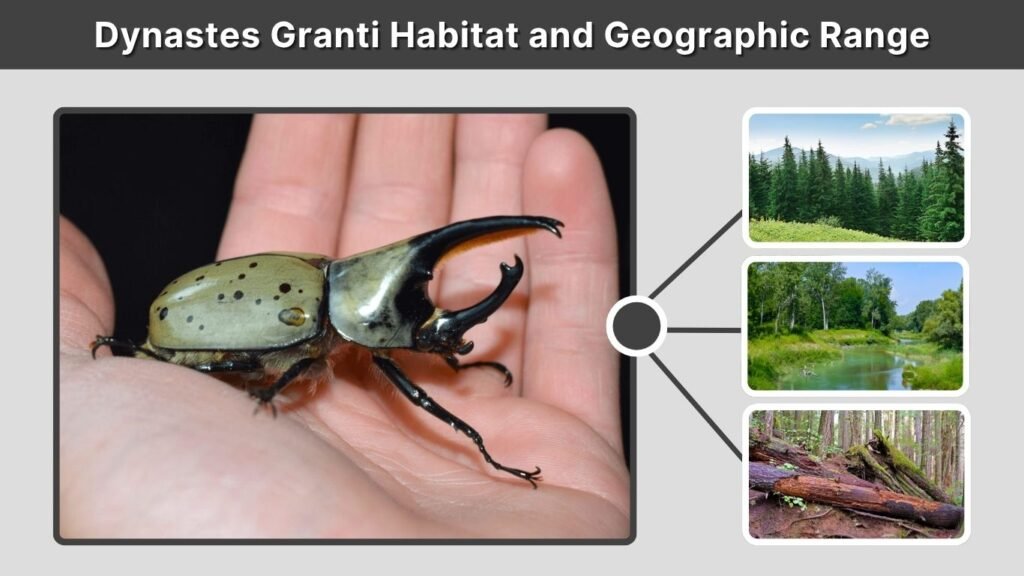
Dynastes granti naturally inhabits mountainous and wooded regions of the southwestern United States.
Its distribution includes Arizona, New Mexico, southern Utah, and parts of northern Mexico, particularly Sonora and Chihuahua.
These beetles are frequently associated with highland forests, especially areas with mature trees and decomposing woody material.
Important habitat features include:
- Wooded mountains: Provide suitable trees for adults and larvae.
- Riparian forests: Support ash and other hardwood trees.
- Rotting logs: Supply food and shelter for developing larvae.
- Tree trunks: Provide feeding and resting locations for adults.
In Arizona, adults are often associated with Arizona ash trees and may be observed around Flagstaff, Prescott, Payson, and the Verde Valley.
Adults are particularly visible during late summer, often between August and September.
Dynastes Granti Life Cycle
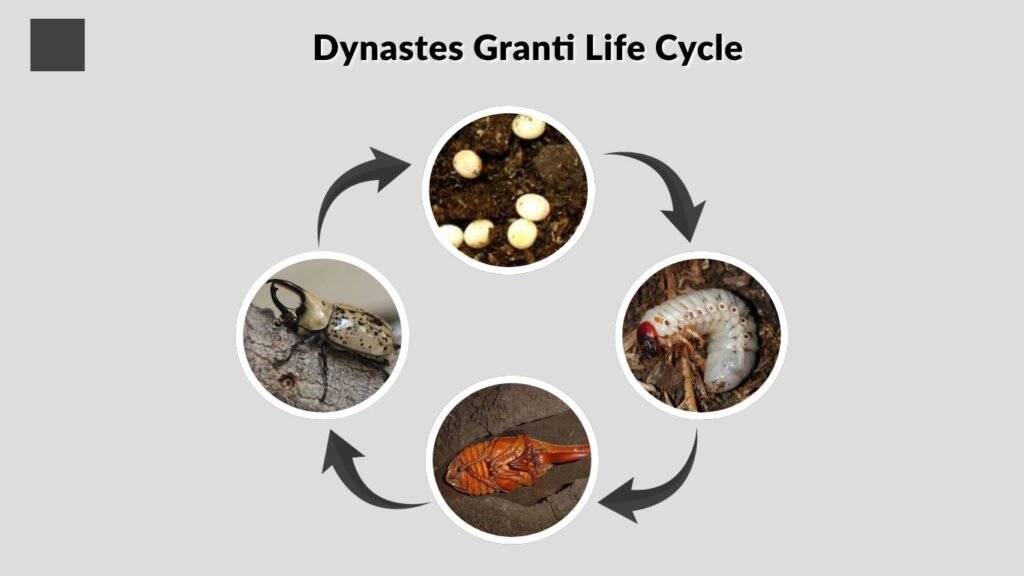
The Dynastes granti beetle undergoes complete metamorphosis through four stages: egg, larva, pupa, and adult.
Most of its life is spent developing inside decomposing wood rather than living as a recognizable horned beetle.
Egg Stage
After mating, female beetles deposit eggs inside suitable decaying hardwood material.
These locations provide moisture, shelter, and an immediate food source for emerging larvae.
Larval Stage
Dynastes granti larvae are large, creamy-white grubs with brown heads and curved bodies.
They feed on decomposing hardwood and gradually grow through three larval instars.
Larval development can take roughly one to two years in captivity and may last around two years in natural conditions, depending on temperature and nutrition.
Pupal Stage
Mature larvae construct protective chambers using surrounding substrate and waste material.
Inside these chambers, they develop into pupae before transforming into adult beetles. Pupation generally takes several weeks.
Adult Stage
Adult beetles emerge during the warmer months and become active around trees.
Males search for females and may use their horns to compete with rivals. The adult stage typically lasts a few months.
What Do Dynastes Granti Beetles Eat?
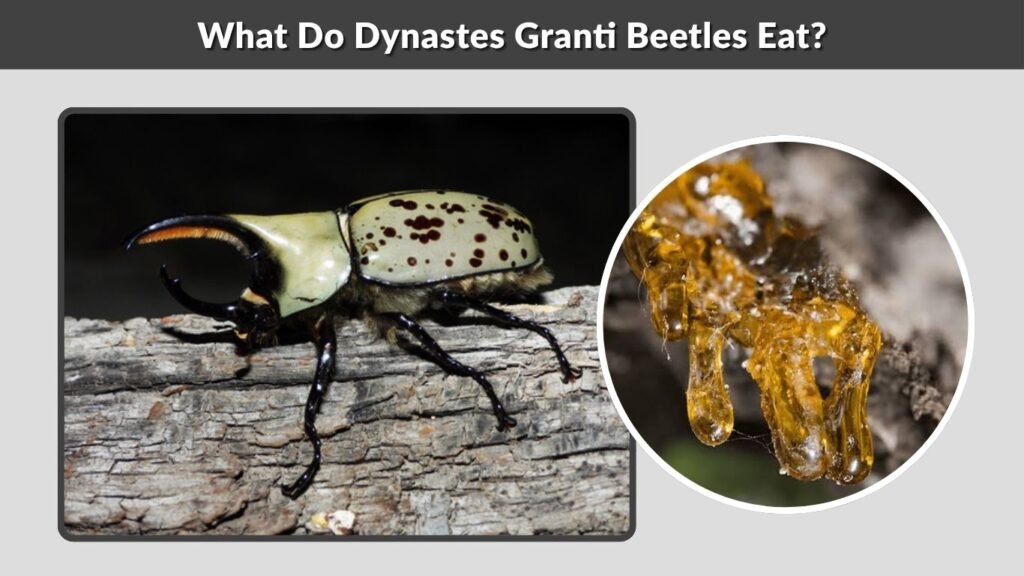
The diet of Dynastes granti changes significantly throughout its life cycle.
Larvae feed on decomposing wood, helping break down dead organic material and recycle nutrients into forest ecosystems.
Adults primarily consume tree sap and other available sugary substances.
Arizona ash trees are particularly important feeding sites for wild adults.
In captivity, adult beetles can be offered commercially prepared beetle jelly or suitable soft fruits.
Bananas are commonly used by beetle keepers, but uneaten fruit should be removed regularly to prevent mold and fermentation.
Dynastes Granti Lifespan
The total lifespan of Dynastes granti is substantially longer than its adult lifespan.
In natural environments, much of its development occurs during the larval stage, which can last approximately two years.
After becoming active adults, individuals commonly survive around two to four months, although captive conditions may extend their lives.
Temperature, moisture, food quality, and breeding activity influence longevity.
Providing suitable food and a stable environment can help prevent unnecessary stress during captive care.
How to Care for Dynastes Granti Beetles
Keeping Dynastes granti beetles requires an understanding of their different needs as adults and larvae.
Adult beetles require climbing surfaces, ventilation, and food, while larvae need appropriate decomposed hardwood substrates.
Adult Beetle Care
An adult enclosure should provide enough space for walking and climbing.
Maintain moderate temperatures around 20–25°C (68–77°F), with suitable humidity and good ventilation.
Include bark or branches to help beetles grip surfaces and right themselves if overturned.
Offer beetle jelly or fresh fruit and remove uneaten food regularly.
Dynastes Granti Larvae Care
Larvae require a deep layer of properly prepared decayed hardwood substrate, often called flake soil.
The substrate should remain lightly moist without becoming waterlogged.
Suitable containers should provide sufficient space for growth and ventilation.
Avoid frequently disturbing mature larvae, particularly when they begin constructing pupal chambers.
These recommendations reflect commonly used captive-rearing practices rather than a universal standard for every beetle.
Dynastes Granti vs. Dynastes Tityus
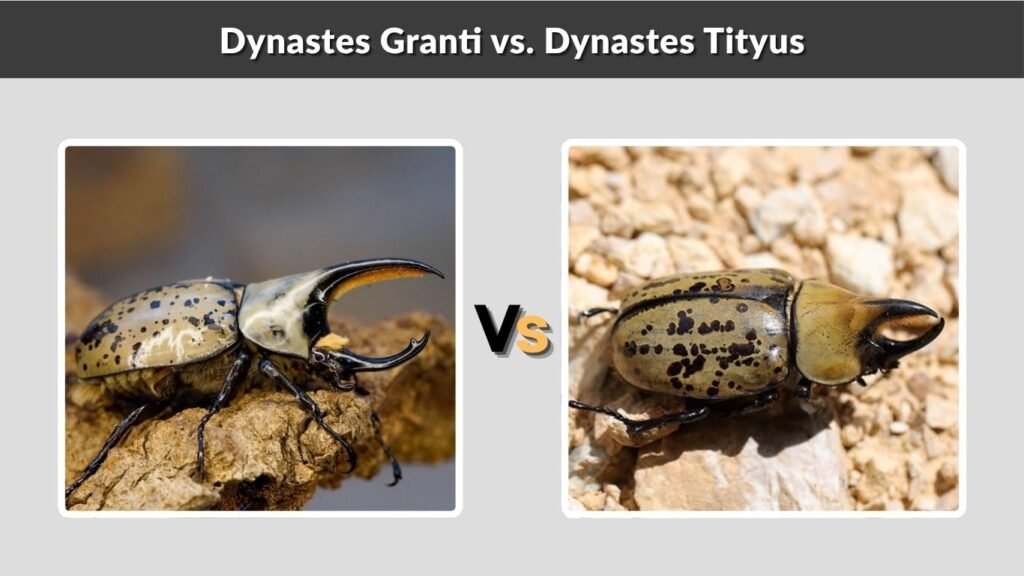
Dynastes granti and Dynastes tityus, the Eastern Hercules Beetle, are closely related North American rhinoceros beetles.
Although their body shapes are similar, their geographic ranges and physical features differ.
| Feature | Dynastes granti | Dynastes tityus |
| Common name | Western Hercules Beetle | Eastern Hercules Beetle |
| Distribution | Southwestern USA | Eastern USA |
| Color | Usually pale gray or whitish | Often greenish-yellow or olive |
| Male horns | Often long and relatively slender | Generally shorter and stout |
| Larval habitat | Decaying wood | Decaying wood |
| Activity | Mostly nocturnal | Mostly nocturnal |
Both species have spotted wing cases and prominent horns in males. However, their different horn shapes and geographic distributions are particularly useful for identification.
Dynastes Granti Conservation and Protection
Dynastes granti contributes to forest ecosystems by helping decompose dead hardwood during its larval stage.
Habitat loss, removal of decaying trees, and declining hardwood resources may affect local populations.
A published genetic study highlighted the importance of conserving southwestern highland forests for this species.
In New Mexico, the beetle has been identified as a species of conservation concern, although that does not automatically mean it is legally classified as endangered.
Protecting woodland habitats and avoiding unnecessary collection can help sustain populations.
FAQs
1. Are Dynastes granti beetles dangerous?
No. Western Hercules Beetles are not venomous and are generally harmless to humans. Their claws can grip firmly, but their horns are mainly used during competition between males.
2. Where can you find Dynastes granti in Arizona?
These beetles inhabit wooded mountain regions, including areas around Flagstaff, Prescott, Payson, and the Verde Valley. Adults are often associated with ash trees during late summer.
3. How long do Dynastes granti larvae take to grow?
Larvae often spend approximately one to two years developing, depending on their environment, temperature, and available nutrition. Development may take longer under natural conditions.
4. Can Dynastes granti beetles fly?
Yes. Adult beetles have functional wings beneath their hardened wing cases. They are strong fliers and are often attracted to artificial lights at night.
5. Can Dynastes granti beetles be kept as pets?
Yes. They can be maintained in suitable captive environments with appropriate food, humidity, temperature, and substrate. Obtain captive-bred specimens legally and never release captive insects into the wild.