
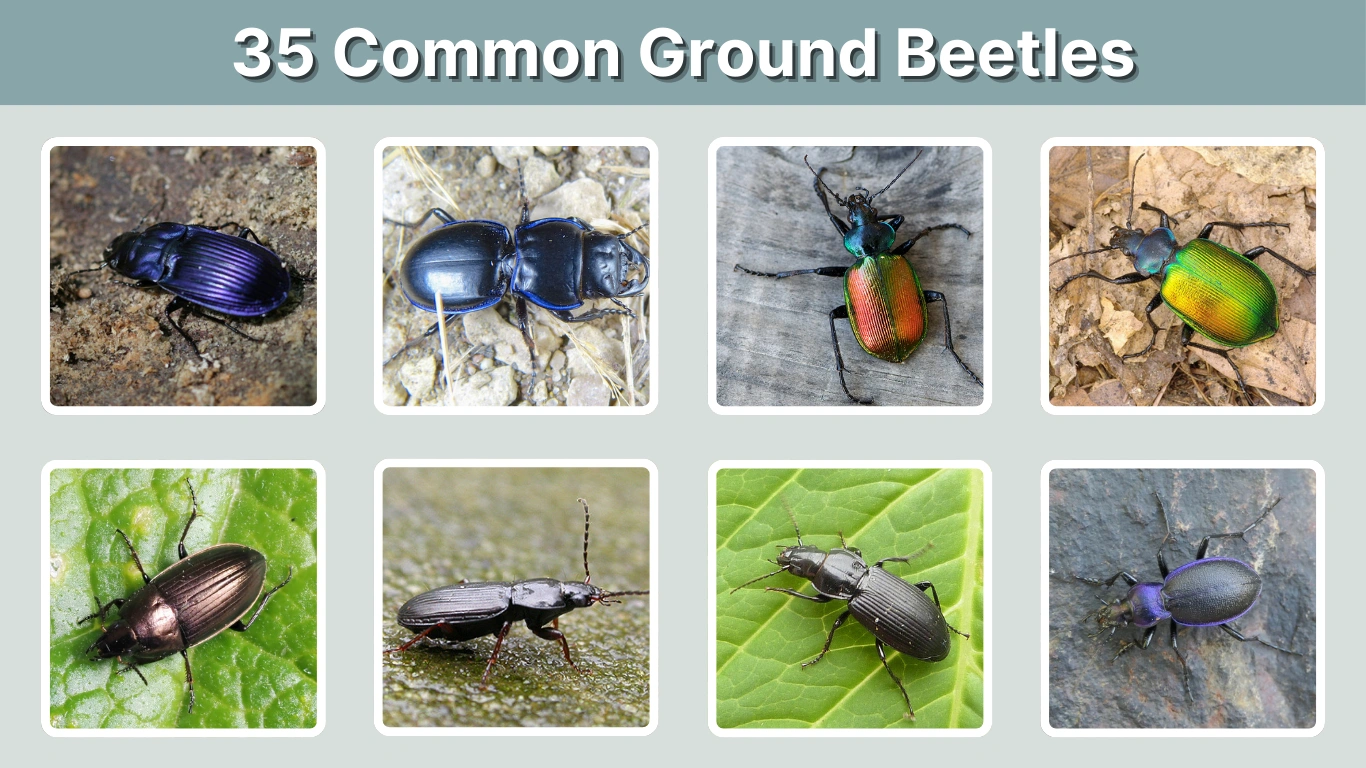
Ground beetles, belonging to the Carabidae family, are one of the most diverse and beneficial groups of insects found worldwide. With thousands of species, they play a crucial role in natural pest control, feeding on slugs, caterpillars, snails, and other harmful invertebrates. In this guide, we’ll explore 35 common ground beetles—from the Bronze Ground Beetle to the Purple Dicaelus Beetle—covering their identification, habitats, diets, nesting habits, and unique behaviors. This list highlights both their diversity and their importance to ecosystems and agriculture.
1. Carabus nemoralis (Bronze Ground Beetle)
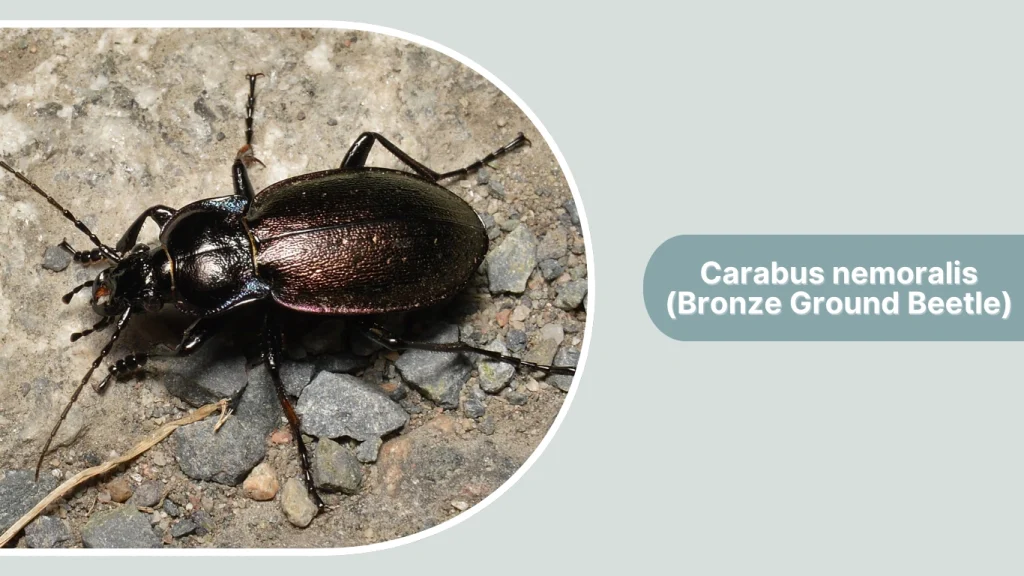
Carabus nemoralis, known as the Bronze Ground Beetle, is a member of the ground beetle group (Carabidae family). This species is widespread across Europe and North America and is easily recognized by its shiny bronze or copper-colored body. As a ground beetle, it is an active predator that plays a vital role in controlling harmful garden pests.
Identification
- Size: 18–28 mm long
- Color: Metallic bronze or coppery sheen on body and elytra
- Shape: Elongated, flattened body with ridged wing covers
- Legs: Long, adapted for fast running
- Antennae: Thin, thread-like and forward pointing
- Special Trait: Cannot fly, relies on speed to capture prey
Habitat
The Bronze Ground Beetle prefers moist environments, often hiding under stones, logs, bark, and leaf litter. They are commonly found in gardens, farmlands, forests, and hedgerows. During the daytime, they remain concealed, becoming active hunters at night.
Diet and Nesting
Bronze Ground Beetles are carnivorous predators, feeding on a wide range of insects and invertebrates. Their diet includes slugs, caterpillars, earthworms, and insect larvae, making them highly beneficial for pest control in gardens and crops.
For nesting, females lay eggs in soil crevices or under leaf litter. The larvae, like adults, are also predatory and live underground, where they continue feeding on soil-dwelling pests until they pupate and develop into adults.
Behavior
This beetle is nocturnal, emerging at night to actively hunt prey. Unlike many other beetles, Carabus nemoralis rarely flies and instead relies on its speed and strong jaws to overpower its victims. It is considered a beneficial insect for agriculture and home gardens because of its natural pest-control role.
2. Carabus granulatus (Granulate Ground Beetle)
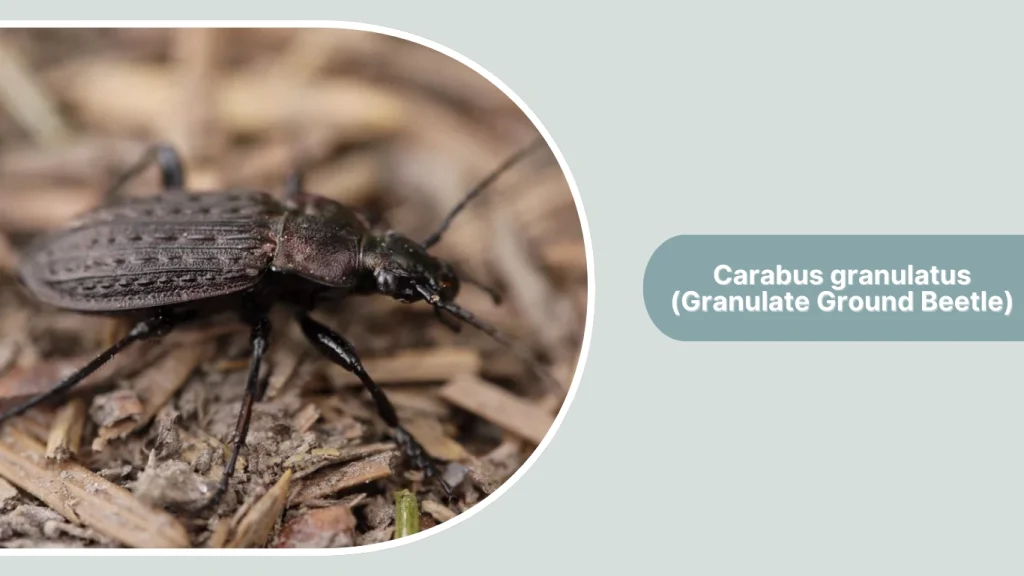
Carabus granulatus, called the Granulate Ground Beetle, is part of the ground beetle group (Carabidae family). It is a widespread species across Europe and Asia, known for its rough-textured wing covers. This beetle is an active predator that helps maintain balance in natural ecosystems.
Identification
- Size: 20–28 mm long
- Color: Dark brown to bronze with a metallic reflection
- Body: Distinctly granulated (rough, bumpy) surface on elytra
- Legs: Long and strong, built for running
- Antennae: Long and segmented
- Wings: Functional, capable of flight unlike some other Carabus species
Habitat
The Granulate Ground Beetle inhabits damp environments such as meadows, forests, marsh edges, and agricultural fields. It is often found hiding beneath stones, logs, and leaf litter during the day. This species adapts well to both natural and cultivated landscapes.
Diet and Nesting
This beetle’s diet mainly includes slugs, worms, insect larvae, and soft-bodied pests, making it valuable for natural pest control. It actively hunts at night, using speed and strong mandibles.
Females lay eggs in moist soil. The larvae live underground, where they continue the predatory lifestyle, feeding on soil-dwelling invertebrates before pupating.
Behavior
Carabus granulatus is a nocturnal hunter and one of the few Carabus species capable of flight, allowing it to disperse widely. It is considered beneficial for agriculture and is often seen after rain when prey is more active.
3. Carabus auratus (Golden Ground Beetle)
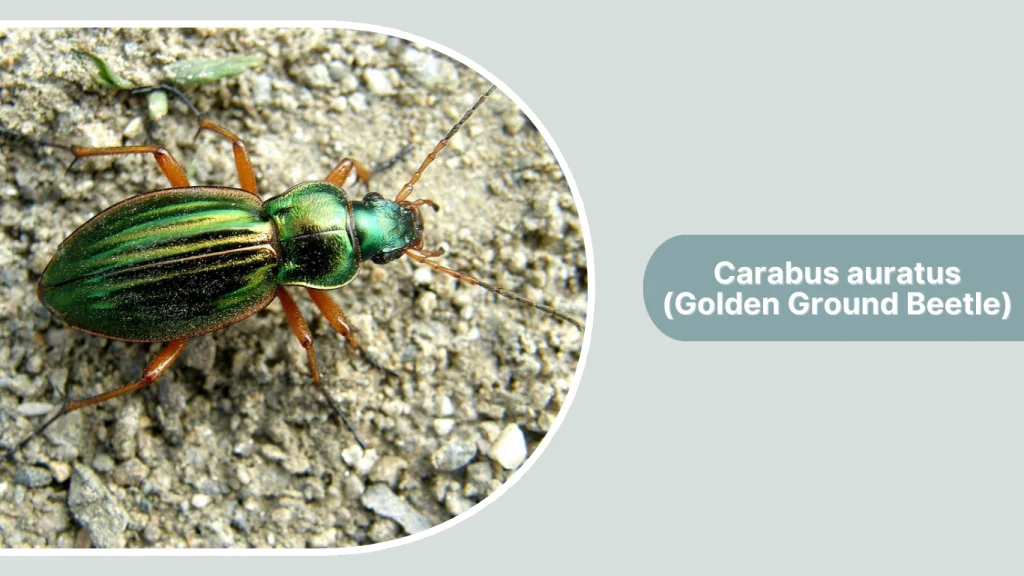
Carabus auratus, widely known as the Golden Ground Beetle, is a striking member of the ground beetle group (Carabidae family). Native to Europe, it is admired for its shiny green-golden metallic body and is considered one of the most beautiful ground beetles.
Identification
- Size: 20–30 mm long
- Color: Bright metallic green with golden reflections on elytra
- Body: Elongated with ridged wing covers
- Legs: Long, slender, and reddish in color
- Antennae: Orange to reddish, thread-like
- Distinctive Feature: Shiny iridescent sheen across entire body
Habitat
This beetle thrives in gardens, fields, and forests, preferring sunny open areas with loose soil. It often hides under stones and vegetation during the day and becomes active at dusk.
Diet and Nesting
The Golden Ground Beetle feeds on slugs, caterpillars, snails, and insect larvae. Its sharp mandibles make it an efficient predator.
Nesting occurs in soil, where eggs are laid in small burrows. Larvae are also predatory, continuing the same diet as adults until they pupate.
Behavior
Carabus auratus is diurnal, unlike many other ground beetles, and can be observed hunting during the day. Its shiny metallic body also provides camouflage among plants. It is highly valued for pest control in crops and gardens.
4. Carabus violaceus (Violet Ground Beetle)
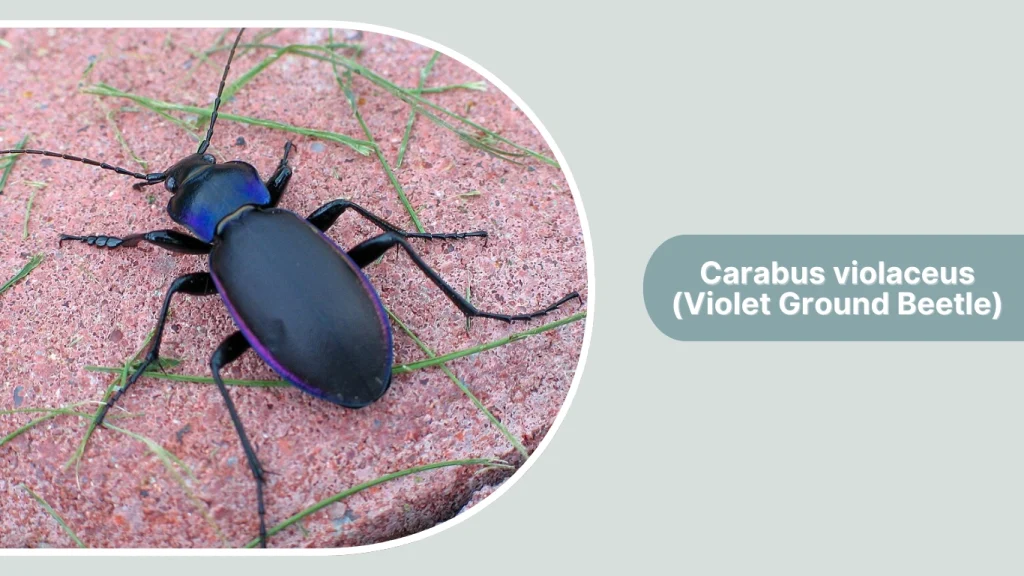
Carabus violaceus, known as the Violet Ground Beetle, belongs to the ground beetle group (Carabidae family). This species is common across Europe and North America and is easily recognized by its deep violet or purple edges.
Identification
- Size: 25–35 mm long
- Color: Black body with violet or purple margins on elytra and thorax
- Body: Smooth and shiny with finely striated wing covers
- Legs: Strong and long, adapted for running
- Antennae: Dark and segmented
- Special Trait: Large mandibles for overpowering prey
Habitat
The Violet Ground Beetle prefers woodlands, gardens, and meadows with damp soil. It is typically found under stones, logs, and leaf litter during the daytime.
Diet and Nesting
This beetle is a voracious predator, feeding on slugs, snails, earthworms, and insects. Its strong jaws allow it to consume even hard-shelled prey.
Females deposit eggs in soil or leaf litter. The larvae, like adults, are predatory and remain in moist habitats until development is complete.
Behavior
Carabus violaceus is a nocturnal hunter, emerging at night to search for food. It does not fly but runs quickly. Its bright violet sheen acts as a deterrent to predators and makes it one of the most recognizable ground beetles.
5. Carabus coriaceus (Leather Beetle)
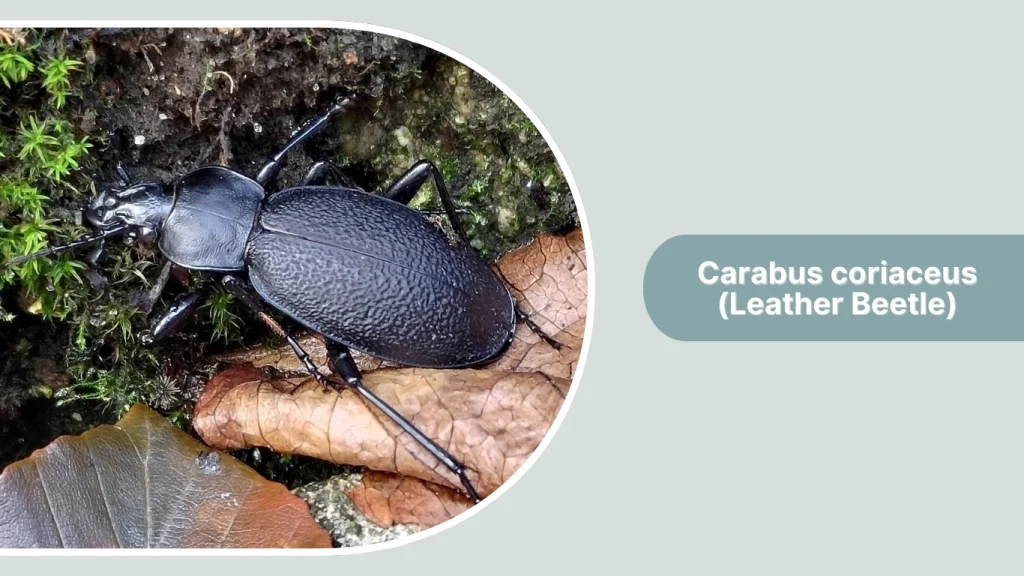
Carabus coriaceus, often called the Leather Beetle, is the largest member of the ground beetle group (Carabidae family) in Europe. Its name comes from the leathery appearance of its rough wing covers.
Identification
- Size: 30–40 mm long (largest Carabus species in Europe)
- Color: Matte black with rough-textured elytra
- Body: Heavy, robust, and elongated
- Legs: Thick and powerful, adapted for running
- Antennae: Long, thread-like
- Distinctive Feature: Leathery, wrinkled wing covers
Habitat
This beetle inhabits deciduous forests, meadows, and gardens, often hiding under rotting logs, stones, or dense vegetation. It prefers shady, damp areas with rich soil.
Diet and Nesting
Carabus coriaceus preys on slugs, snails, worms, and insect larvae. Its strong jaws allow it to crush hard-bodied prey.
Females lay eggs in soil cavities, and the larvae grow underground as active hunters until they pupate into adults.
Behavior
It is a nocturnal species, hunting at night while hiding during the day. Its large size and strong mandibles make it an effective predator and a valuable ally in natural pest control.
6. Carabus hortensis (Garden Carabus)
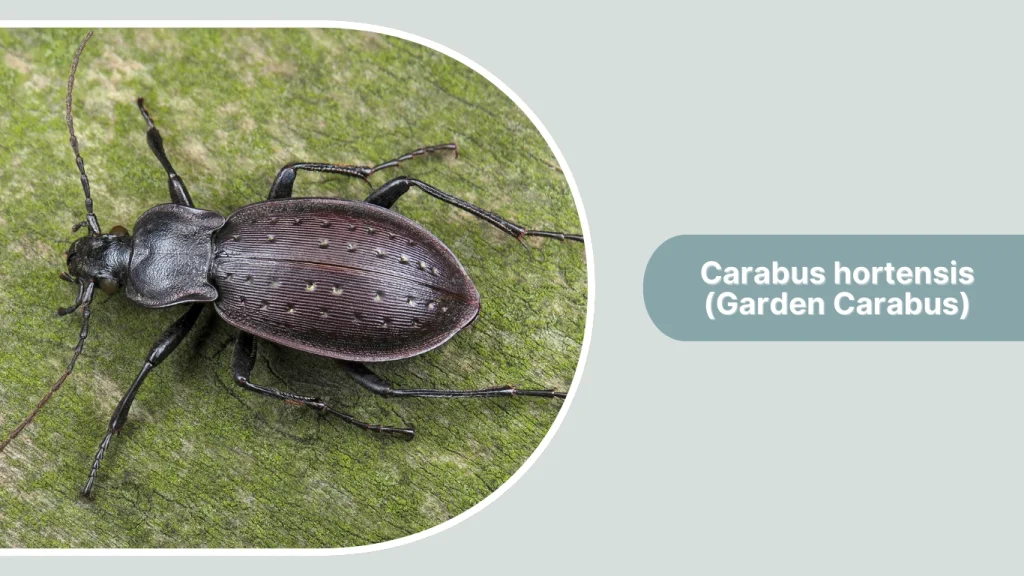
Carabus hortensis, known as the Garden Carabus, is a widespread beetle of the ground beetle group (Carabidae family). It is commonly encountered in woodlands, farmlands, and gardens, where it helps control pests.
Identification
- Size: 20–28 mm long
- Color: Dark bronze or black with a metallic sheen
- Body: Elongated and slightly ridged wing covers
- Legs: Long and agile, built for quick movement
- Antennae: Thin, jointed, and forward-pointing
- Distinctive Feature: Subtle metallic highlights on thorax and elytra
Habitat
This beetle lives in gardens, hedgerows, woodlands, and fields. It is usually found under stones, bark, and leaf litter in moist environments.
Diet and Nesting
The Garden Carabus feeds on caterpillars, beetle larvae, slugs, and soft-bodied invertebrates.
For nesting, females deposit eggs in soil, and larvae continue the predatory lifestyle, feeding underground before pupating.
Behavior
Carabus hortensis is nocturnal, becoming active after dusk. It avoids open sunlight and prefers cool, shaded areas. This species is regarded as a helpful natural pest regulator in cultivated lands and gardens.
7. Carabus problematicus (Iridescent Ground Beetle)
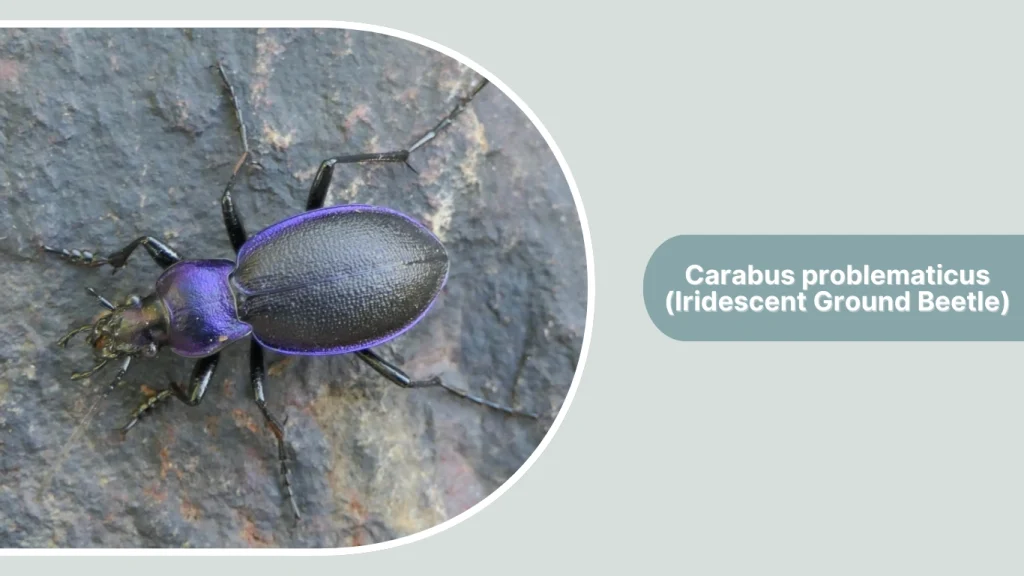
Carabus problematicus, commonly called the Iridescent Ground Beetle, is a member of the ground beetle group (Carabidae family). It is well known for its dark body with metallic blue, green, or violet reflections.
Identification
- Size: 22–30 mm long
- Color: Black with iridescent blue, green, or violet sheen
- Body: Elongated with striated wing covers (elytra)
- Legs: Long and slender, adapted for quick movement
- Antennae: Segmented, slightly curved forward
- Distinctive Feature: Shimmering metallic reflection under light
Habitat
This beetle prefers moist woodland, heathland, and upland areas. It hides under stones, bark, or moss during the day and is especially common in shaded, damp habitats.
Diet and Nesting
Carabus problematicus feeds on slugs, caterpillars, worms, and other insects.
Females lay eggs in moist soil. The larvae are also predatory, living underground and hunting smaller soil-dwelling invertebrates.
Behavior
It is a nocturnal predator, most active during damp nights. Its shiny iridescent body is not only attractive but also helps in blending with its surroundings.
8. Carabus cancellatus (Lattice Ground Beetle)
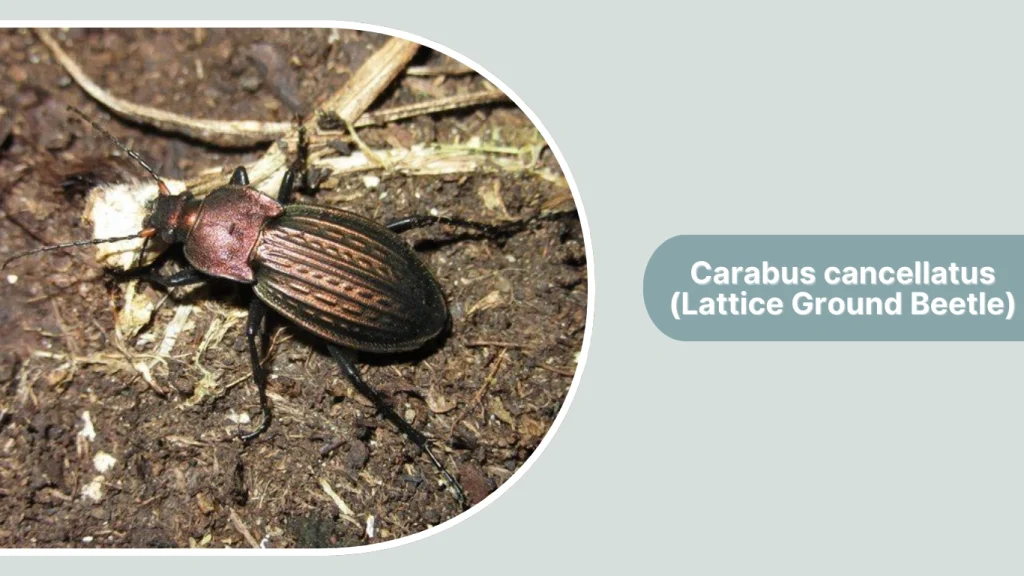
Carabus cancellatus, known as the Lattice Ground Beetle, is one of the most widely distributed species in the ground beetle group (Carabidae family) across Europe and Asia. Its lattice-patterned elytra make it unique among Carabus beetles.
Identification
- Size: 20–28 mm long
- Color: Bronze or copper with lattice-like ridges on wing covers
- Body: Elongated and slightly flattened
- Legs: Long and reddish-brown
- Antennae: Orange to brown, slender
- Distinctive Feature: Elytra with strong, net-like ridges
Habitat
The Lattice Ground Beetle lives in farmlands, meadows, grasslands, and woodland edges. It is commonly found in agricultural fields, where it helps reduce pest populations.
Diet and Nesting
Its diet consists of insect larvae, caterpillars, worms, and small slugs. It is a beneficial predator for crops, especially against agricultural pests.
Females lay eggs in the soil, and larvae develop underground, feeding actively until they transform into adults.
Behavior
Carabus cancellatus is mostly nocturnal but may also be active in the evening. It is a strong runner and rarely flies. Farmers often welcome its presence due to its role in natural pest control.
9. Carabus arvensis (Field Ground Beetle)
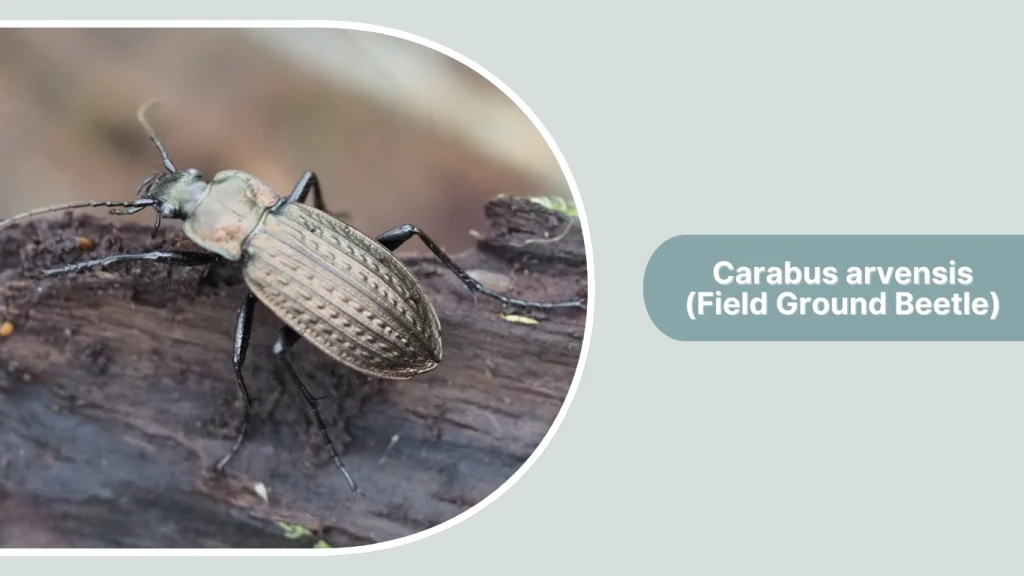
Carabus arvensis, known as the Field Ground Beetle, belongs to the ground beetle group (Carabidae family). It is widespread across Europe and Asia and is often found in open habitats, especially grasslands and farmlands.
Identification
- Size: 18–26 mm long
- Color: Bronze to greenish with a metallic sheen
- Body: Elongated with distinct ridges on elytra
- Legs: Long and agile for running
- Antennae: Long, slender, and reddish brown
- Distinctive Feature: Subtle metallic shades across body and wings
Habitat
This beetle prefers open fields, meadows, and grasslands, though it can also be found in forest edges and cultivated lands. It hides under stones and leaf litter during the day.
Diet and Nesting
Carabus arvensis mainly feeds on caterpillars, beetle larvae, slugs, and other soft-bodied pests.
Nesting occurs in soil cavities where females deposit eggs. The larvae live underground and feed actively before pupating.
Behavior
It is a nocturnal predator and very active after rainfall. Its adaptability to farmland makes it an important natural pest controller.
10. Harpalus rufipes (Strawberry Seed Beetle)
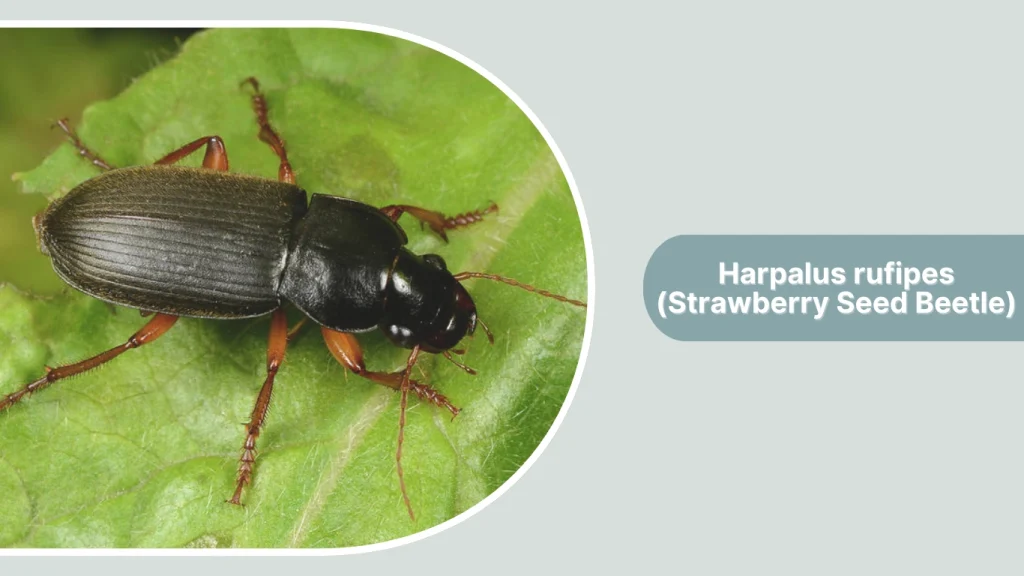
Harpalus rufipes, commonly called the Strawberry Seed Beetle, is a well-known member of the ground beetle group (Carabidae family). Unlike many predatory ground beetles, it is partly omnivorous, feeding on both insects and seeds.
Identification
- Size: 10–14 mm long
- Color: Shiny black body with reddish legs
- Body: Smooth, oval-shaped with fine striations on elytra
- Legs: Reddish-brown, fairly long
- Antennae: Dark brown, thin, and segmented
- Distinctive Feature: Small size and seed-eating habit
Habitat
This beetle is common in farmlands, gardens, hedgerows, and meadows. It thrives in cultivated land, especially in areas rich in plants and seeds.
Diet and Nesting
Harpalus rufipes feeds on a mix of insects, larvae, and seeds, including strawberry seeds—hence its common name. It plays a role in controlling both insect pests and weed seeds.
Females lay eggs in soil, and larvae feed on soil invertebrates as well as plant material before maturing.
Behavior
It is mainly nocturnal, running actively at night in search of food. Its dual feeding habit makes it unique among ground beetles and useful in both pest and weed seed control.
11. Harpalus affinis (Common Harpalus Beetle)
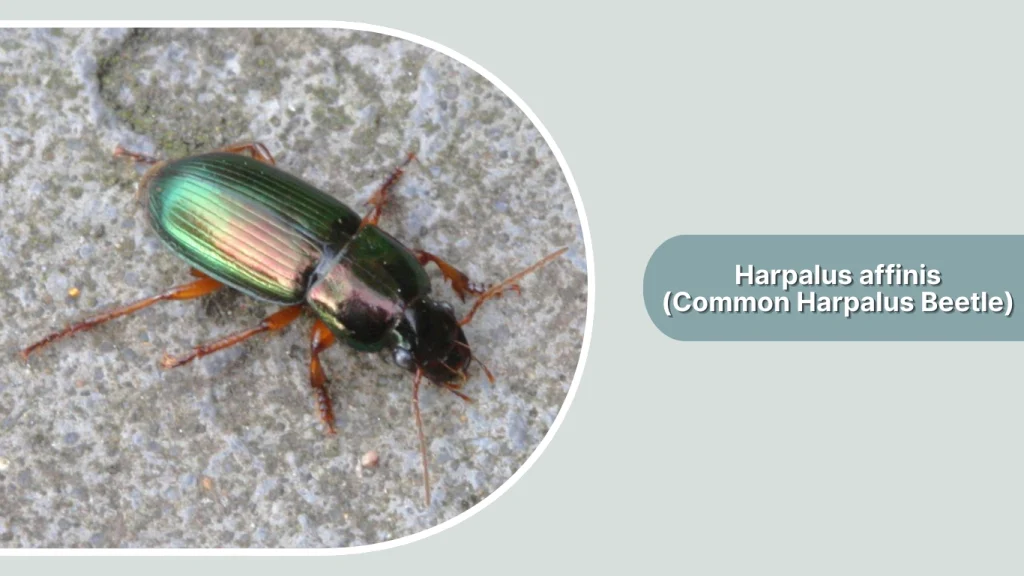
Harpalus affinis, also known as the Common Harpalus Beetle, is a widely distributed species within the ground beetle group (Carabidae family). It is often seen in grasslands and cultivated fields, where it serves as both a predator and seed feeder.
Identification
- Size: 8–12 mm long
- Color: Shiny black body with metallic green or bronze reflections
- Body: Oval, smooth with fine striations on elytra
- Legs: Reddish-brown, built for quick running
- Antennae: Segmented and slender
- Distinctive Feature: Combination of insectivorous and granivorous feeding
Habitat
This beetle inhabits farmlands, gardens, grasslands, and woodland edges. It prefers sunny, open areas with loose soil where it can hide under vegetation or stones.
Diet and Nesting
Harpalus affinis feeds on a variety of small insects, caterpillars, and seeds, contributing to pest reduction and natural weed control.
Nesting takes place in the soil, where females deposit eggs. Larvae also consume both insects and plant matter during their development.
Behavior
It is a nocturnal species, actively foraging at night. Its adaptability to agricultural land makes it important for maintaining ecological balance in crop areas.
12. Harpalus pensylvanicus (Pennsylvania Ground Beetle)
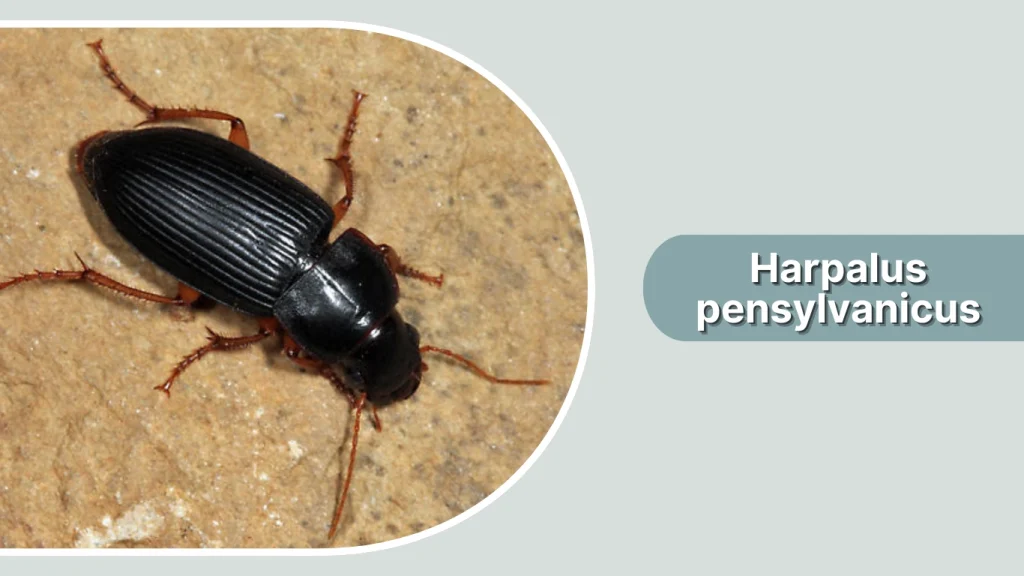
Harpalus pensylvanicus, commonly known as the Pennsylvania Ground Beetle, is a North American member of the ground beetle group (Carabidae family). It is especially valued in agriculture for its dual role as a pest and weed seed predator.
Identification
- Size: 12–18 mm long
- Color: Black to dark brown body with shiny elytra
- Body: Oval, slightly flattened with distinct striations on wing covers
- Legs: Long, reddish-brown
- Antennae: Thin, reddish, and jointed
- Distinctive Feature: Larger size compared to other Harpalus species
Habitat
This species is abundant in agricultural fields, gardens, meadows, and roadsides. It thrives in disturbed soils and open fields where prey and seeds are plentiful.
Diet and Nesting
Harpalus pensylvanicus feeds on insects, caterpillars, and a wide range of weed seeds. It plays an important role in reducing seed banks of invasive weeds in farmlands.
Eggs are laid in soil, and larvae, like adults, are predatory as well as seed-feeding.
Behavior
This beetle is nocturnal and highly mobile, actively running at night in search of food. Farmers consider it beneficial due to its ability to suppress weeds and insect pests naturally.
13. Harpalus anxius (Shiny Black Harpalus)
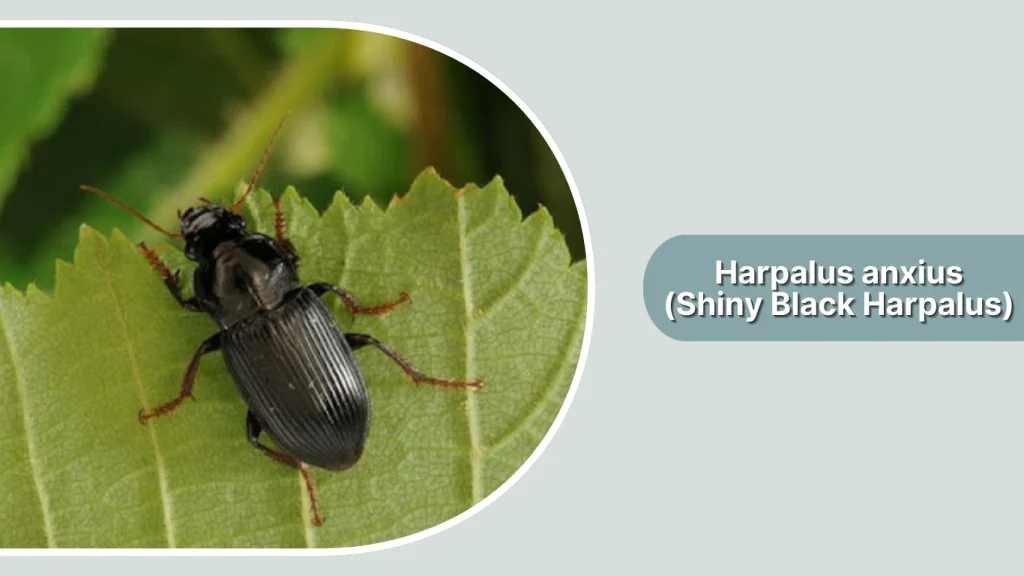
Harpalus anxius, often referred to as the Shiny Black Harpalus, is a small but active predator in the ground beetle group (Carabidae family). Its glossy black body and fast movements make it easy to identify in the field.
Identification
- Size: 7–10 mm long
- Color: Glossy black, sometimes with faint bronze tint
- Body: Oval, smooth, slightly flattened
- Legs: Dark brown to black, moderately long
- Antennae: Slender, dark-colored
- Distinctive Feature: Polished, shiny elytra with minimal ridges
Habitat
This beetle prefers dry soils, grasslands, heaths, and cultivated fields. It is commonly found beneath stones, leaf litter, and soil cracks where it hides during the day.
Diet and Nesting
Harpalus anxius feeds mainly on small insects, larvae, and plant seeds. It is both predatory and granivorous, contributing to the control of pests and weeds.
Nesting occurs underground, where females deposit eggs. Larvae, like adults, feed on a mixed diet of soil invertebrates and seeds.
Behavior
It is a nocturnal runner, emerging at night to forage. Although small, it plays an important role in maintaining the balance of insect and seed populations in open habitats.
14. Harpalus atratus (Black Ground Beetle)
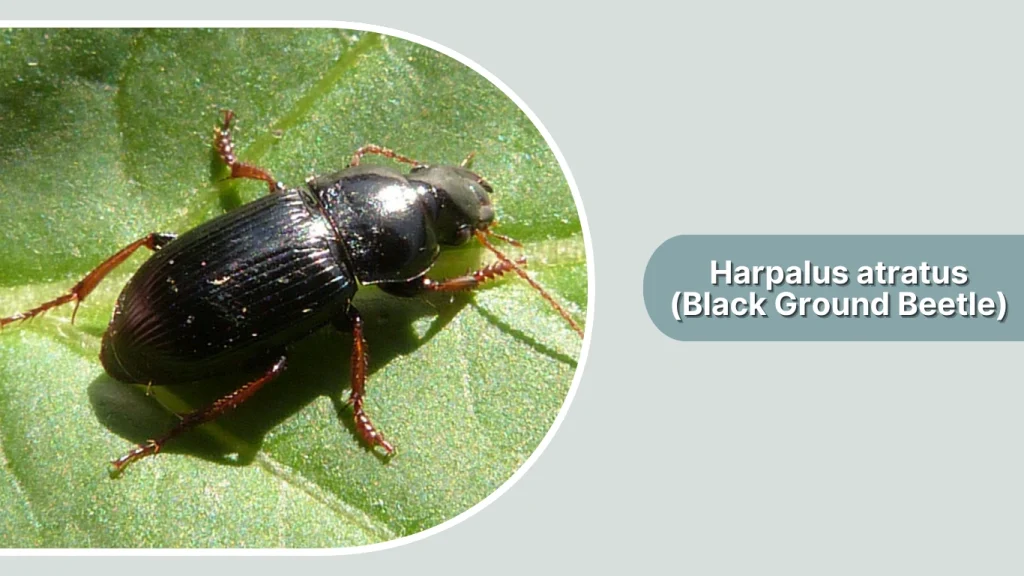
Harpalus atratus, known as the Black Ground Beetle, is a widespread species of the ground beetle group (Carabidae family). It is recognized for its uniform dark body and its adaptability to a range of environments.
Identification
- Size: 10–15 mm long
- Color: Jet black body with matte finish
- Body: Oval and elongated with faint striations on elytra
- Legs: Black and relatively long
- Antennae: Dark, slender, and jointed
- Distinctive Feature: Entirely black appearance without metallic reflections
Habitat
This species occurs in farmlands, forests, heaths, and grasslands. It tolerates both moist and dry conditions, hiding under logs, stones, and vegetation during the day.
Diet and Nesting
Harpalus atratus feeds on insects, larvae, slugs, and weed seeds. Its mixed diet makes it useful for natural pest and weed seed control.
Eggs are laid in soil, and larvae develop underground, feeding actively on soil invertebrates.
Behavior
It is mainly nocturnal, hunting after dusk. Its adaptability and feeding habits allow it to thrive in both natural and cultivated landscapes.
15. Pterostichus melanarius (Black Clock Beetle)
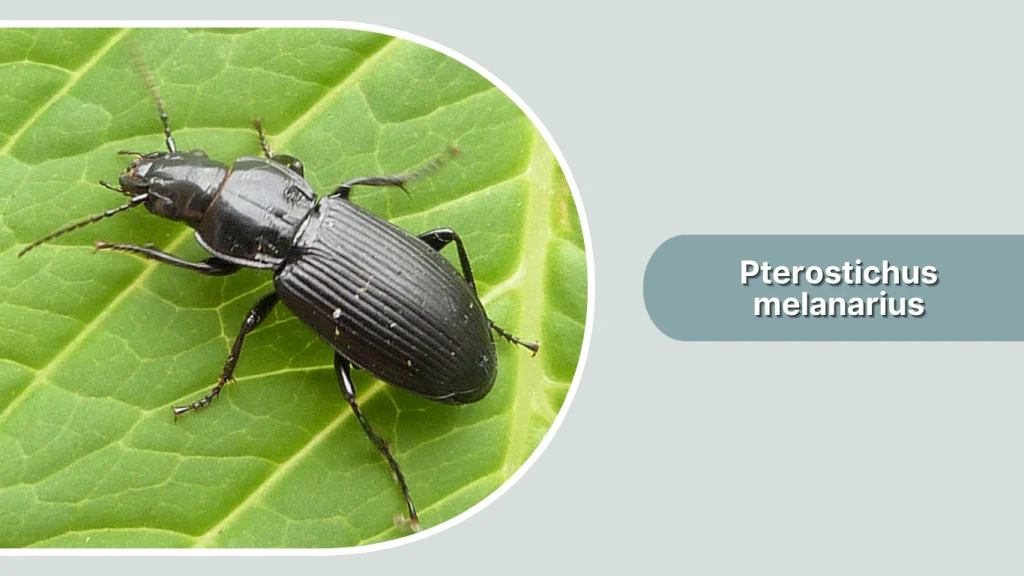
Pterostichus melanarius, commonly called the Black Clock Beetle, is one of the most widespread members of the ground beetle group (Carabidae family). It is especially abundant in agricultural fields across Europe and North America.
Identification
- Size: 12–18 mm long
- Color: Shiny black body
- Body: Oval and elongated with finely ridged elytra
- Legs: Long, dark brown to black
- Antennae: Long, slender, black
- Distinctive Feature: Uniform black coloration, smooth body
Habitat
This beetle is very common in farmlands, grasslands, gardens, and woodland edges. It adapts well to disturbed soils and is frequently found under stones, debris, or leaf litter.
Diet and Nesting
The Black Clock Beetle preys on slugs, caterpillars, cutworms, insect larvae, and seeds. Its presence in farmland makes it a valuable ally for natural pest control.
Females lay eggs in soil, and the larvae also act as predators underground before pupation.
Behavior
It is mostly nocturnal, emerging at night to hunt. During the day, it hides in soil cracks or under vegetation. Its strong running ability allows it to capture prey efficiently.
16. Pterostichus nigrita (Marsh Ground Beetle)
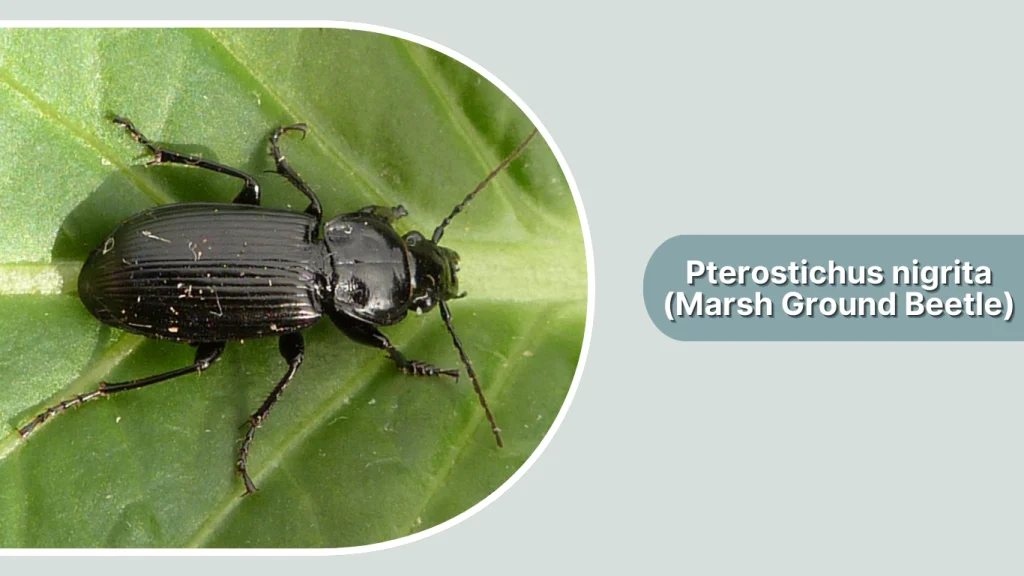
Pterostichus nigrita, known as the Marsh Ground Beetle, is another member of the ground beetle group (Carabidae family). It thrives in damp habitats and plays an important role in reducing slug populations.
Identification
- Size: 9–14 mm long
- Color: Shiny black with slight brownish tint
- Body: Oval, elongated, finely striated elytra
- Legs: Dark reddish-brown
- Antennae: Slender, reddish-brown
- Distinctive Feature: Smaller and slimmer than other Pterostichus species
Habitat
The Marsh Ground Beetle prefers wetlands, marshes, damp meadows, and woodland edges. It shelters under moss, stones, and wet leaf litter during the day.
Diet and Nesting
This beetle feeds on slugs, snails, worms, and soft-bodied insects. It is highly beneficial in damp farmlands where slugs are common pests.
Nesting occurs in moist soil, where eggs are laid. Larvae continue the predatory lifestyle underground before maturing.
Behavior
It is a nocturnal predator, often active in humid conditions. Its preference for moist environments makes it a key species in regulating slug populations in wet habitats.
17. Pterostichus vernalis (Spring Ground Beetle)
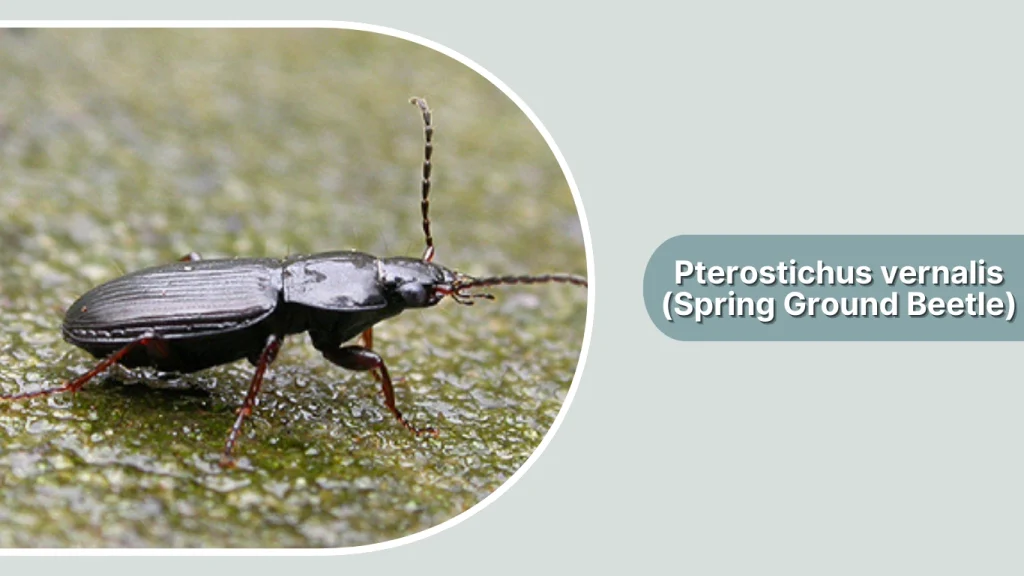
Pterostichus vernalis, called the Spring Ground Beetle, is a small but active member of the ground beetle group (Carabidae family). It is particularly common in early spring, which gives it its name.
Identification
- Size: 7–10 mm long
- Color: Black to dark brown body with a faint metallic tint
- Body: Oval, elongated, with fine striations on elytra
- Legs: Reddish-brown, slim and quick-moving
- Antennae: Brownish, slender
- Distinctive Feature: Small size compared to other Pterostichus beetles
Habitat
The Spring Ground Beetle prefers woodlands, hedgerows, meadows, and agricultural fields. It hides beneath logs, stones, and plant debris during the day and becomes active in cool, damp conditions.
Diet and Nesting
This species feeds on insect larvae, worms, and soft-bodied invertebrates, contributing to pest reduction in soil ecosystems.
Eggs are laid in soil, and larvae remain predatory underground until they pupate into adults.
Behavior
It is primarily nocturnal, but it can also be seen in shaded areas during the day in early spring. Its activity begins earlier in the year than many other ground beetles.
18. Pterostichus oblongopunctatus (Oblong Ground Beetle)
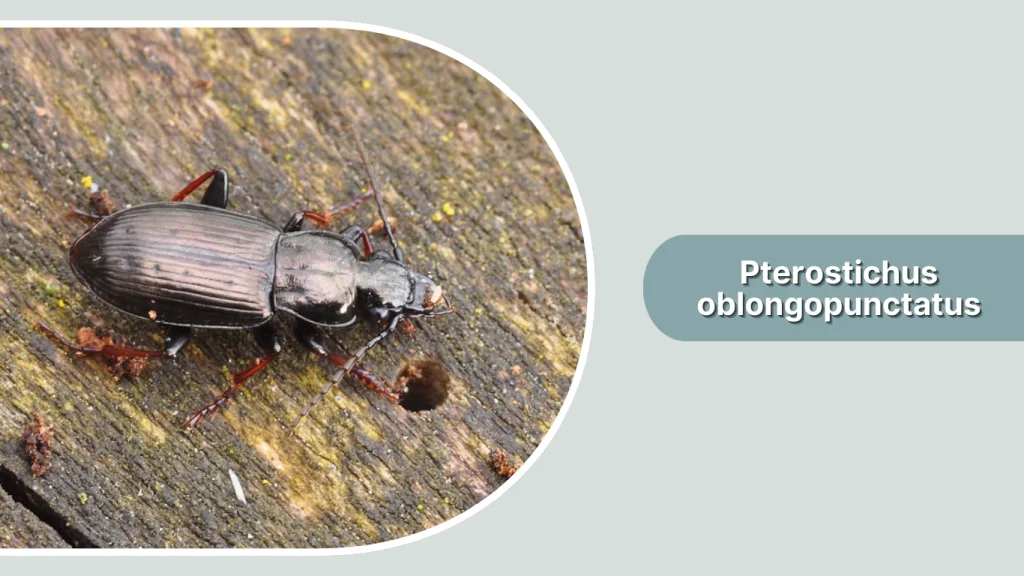
Pterostichus oblongopunctatus, known as the Oblong Ground Beetle, is a forest-dwelling member of the ground beetle group (Carabidae family). It is recognized by its elongated body and distinct punctured markings on the wing covers.
Identification
- Size: 10–14 mm long
- Color: Black or dark brown with a matte sheen
- Body: Elongated oval shape with punctured rows on elytra
- Legs: Brownish-black, moderately long
- Antennae: Segmented, dark brown
- Distinctive Feature: Oblong body with clearly punctured wing cases
Habitat
This species is common in coniferous and mixed forests, often hiding under bark, moss, and fallen leaves. It prefers moist woodland soil and shaded areas.
Diet and Nesting
The Oblong Ground Beetle preys on small insects, larvae, mites, and worms. It is particularly important in controlling tiny soil-dwelling pests.
Eggs are deposited in soil, and the larvae continue as active predators underground before transforming into adults.
Behavior
It is mainly nocturnal, emerging at night to forage. This beetle is more specialized to forest environments than many other Pterostichus species.
19. Amara familiaris (Familiar Sun Beetle)
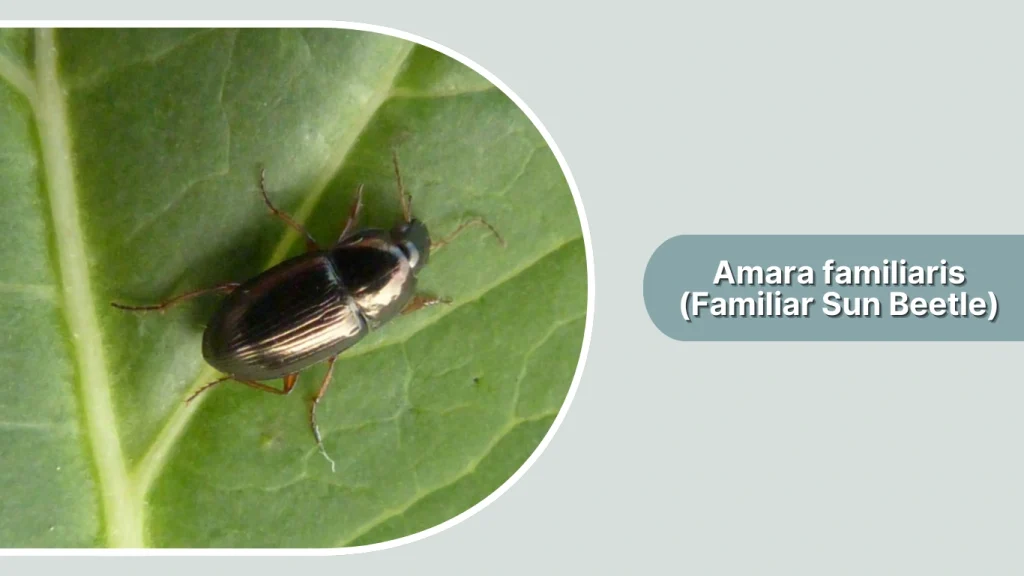
Amara familiaris, called the Familiar Sun Beetle, is a widespread member of the ground beetle group (Carabidae family). It is commonly seen in open fields and sunny habitats, where it feeds on both insects and seeds.
Identification
- Size: 6–9 mm long
- Color: Bronze to metallic brown with a glossy sheen
- Body: Small, oval, and smooth with faint striations
- Legs: Yellowish-brown and slender
- Antennae: Light brown, thin and segmented
- Distinctive Feature: Smaller, shinier, and seed-feeding compared to many ground beetles
Habitat
This beetle is abundant in grasslands, meadows, roadsides, and farmlands. It thrives in sunny, dry areas and is often found hiding under stones or within low vegetation.
Diet and Nesting
Amara familiaris feeds on grass seeds, weed seeds, and small insects, making it both granivorous and insectivorous.
For nesting, females lay eggs in soil. Larvae are also active feeders, consuming both seeds and small soil invertebrates before pupating.
Behavior
It is mainly nocturnal, although it can be observed during the day in warm, sunny spots. Its role as both a seed consumer and insect predator makes it valuable in agriculture.
20. Amara aenea (Bronzed Sun Beetle)
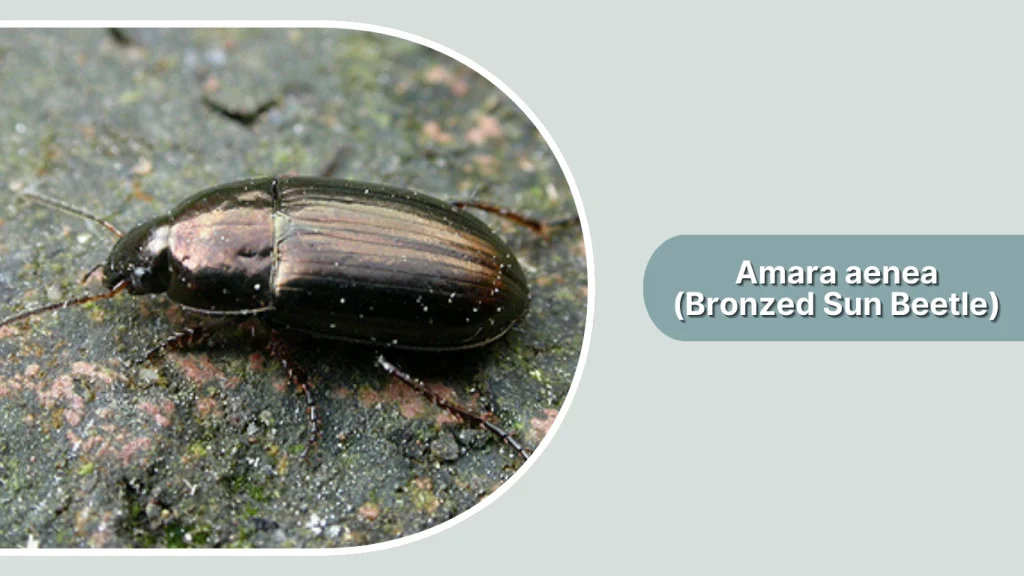
Amara aenea, known as the Bronzed Sun Beetle, is a shiny, metallic species within the ground beetle group (Carabidae family). It is widespread across Europe and often found in sunny, open environments.
Identification
- Size: 7–10 mm long
- Color: Metallic bronze or copper-green with glossy sheen
- Body: Oval and smooth, finely striated elytra
- Legs: Reddish-brown, agile and quick-moving
- Antennae: Brown, thin, and elongated
- Distinctive Feature: Striking bronze or coppery shine under sunlight
Habitat
This beetle prefers open grasslands, gardens, farmland, and field edges. It is commonly found in dry, sandy soils and sunny meadows.
Diet and Nesting
Amara aenea feeds on weed seeds, grass seeds, and occasional insect prey. Its seed-eating habit helps reduce unwanted weeds in farmland.
Eggs are laid in soil, and larvae develop underground, consuming a mixture of seeds and soil invertebrates.
Behavior
This species is active both day and night, especially in warm weather. Its bronzed sheen makes it one of the most attractive members of the Amara group.
21. Amara communis (Common Sun Beetle)
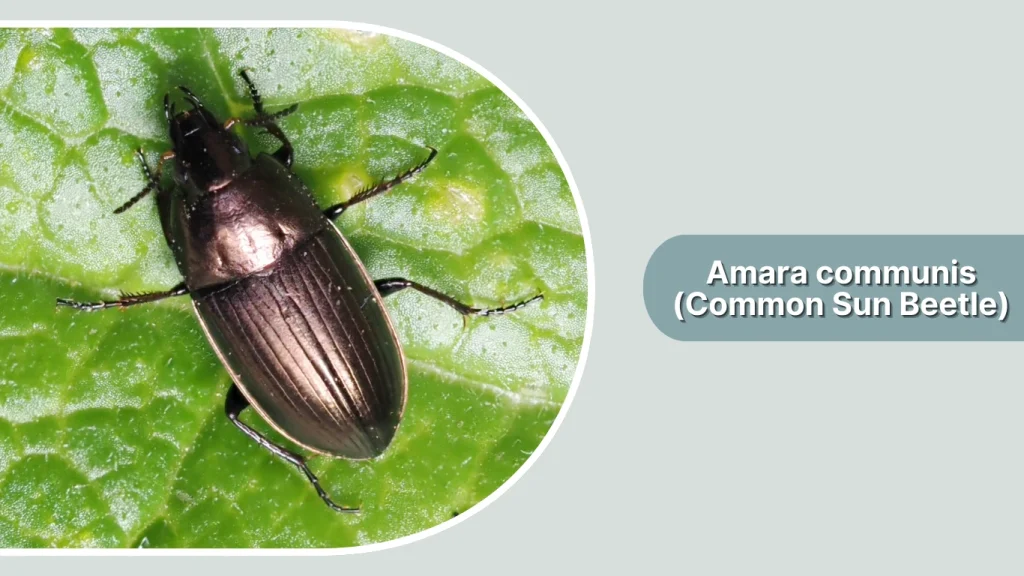
Amara communis, widely known as the Common Sun Beetle, is one of the most familiar species in the ground beetle group (Carabidae family). It is common across Europe and Asia and thrives in sunny, dry habitats.
Identification
- Size: 8–11 mm long
- Color: Bronze to metallic green-brown with a glossy finish
- Body: Oval, smooth, with fine parallel striations on elytra
- Legs: Reddish-brown, slender, and fast-moving
- Antennae: Brown and thin
- Distinctive Feature: Classic oval shape with consistent bronze sheen
Habitat
This beetle is abundant in meadows, pastures, dry grasslands, and farmland edges. It hides under stones and plant debris during the day and becomes active in the evening.
Diet and Nesting
Amara communis primarily feeds on grass and weed seeds, though it occasionally consumes small insects. Its seed-feeding role is helpful in reducing weed populations in agricultural land.
Nesting takes place in dry soil, where females lay eggs. The larvae continue as granivores and occasional predators.
Behavior
It is mostly nocturnal but is also active in warm daylight. Its adaptability to farmland makes it one of the most widespread Amara beetles.
22. Amara ovata (Oval Sun Beetle)
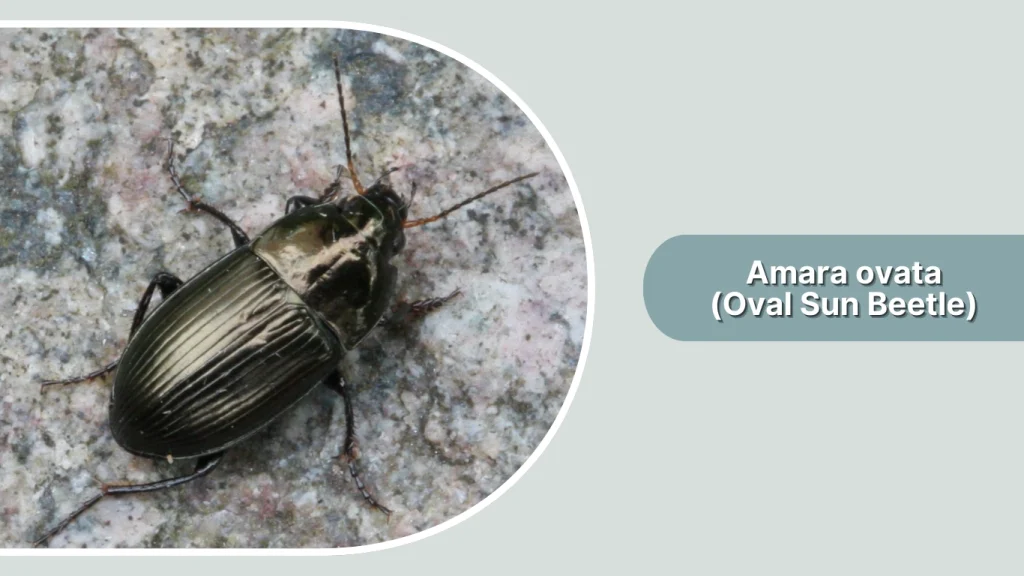
Amara ovata, called the Oval Sun Beetle, is another seed-eating species within the ground beetle group (Carabidae family). It is widespread in Europe and commonly found in open, sunny landscapes.
Identification
- Size: 7–9 mm long
- Color: Metallic bronze-brown or greenish with glossy surface
- Body: Distinct oval shape, smooth with fine striations
- Legs: Yellowish-brown and moderately long
- Antennae: Light brown, slim, and segmented
- Distinctive Feature: Noticeably oval body, more rounded than other Amara species
Habitat
The Oval Sun Beetle lives in fields, gardens, meadows, and roadside verges. It prefers dry, sandy soils and is often seen in disturbed ground.
Diet and Nesting
Its diet consists mainly of grass seeds, weed seeds, and small invertebrates. This makes it important for controlling unwanted plant growth.
Eggs are laid in soil, and larvae develop underground, feeding on seeds and soil organisms.
Behavior
Amara ovata is active both day and night. It runs quickly across open ground and is often spotted during warm evenings in grassy areas.
23. Nebria brevicollis (Short-Necked Ground Beetle)
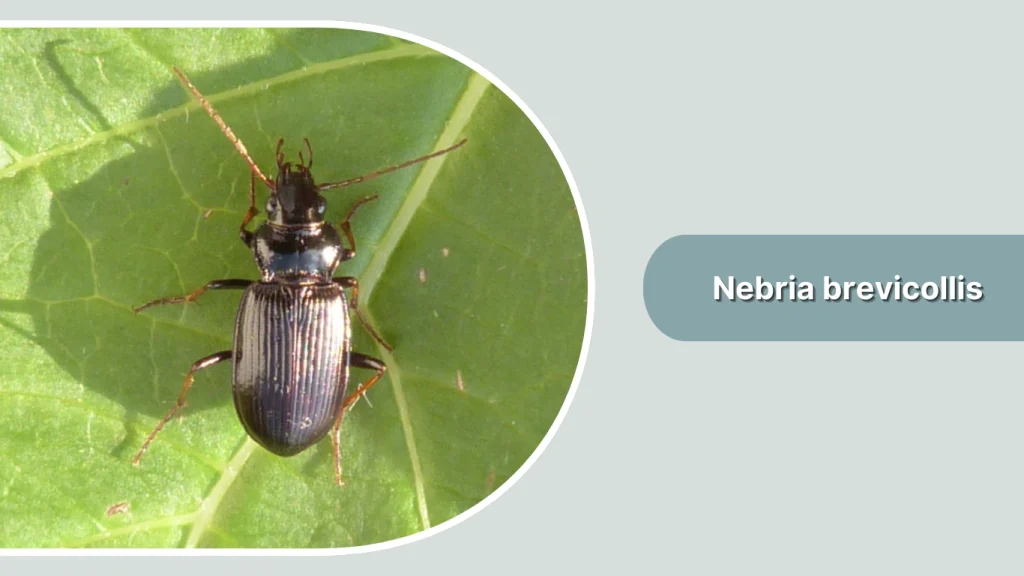
Nebria brevicollis, commonly called the Short-Necked Ground Beetle, is a well-known member of the ground beetle group (Carabidae family). It is widespread across Europe and has also spread to North America, where it is often seen in gardens and woodlands.
Identification
- Size: 10–15 mm long
- Color: Shiny black or dark brown with slight metallic sheen
- Body: Elongated with a relatively short, narrow thorax (“short-necked”)
- Legs: Long, reddish-brown
- Antennae: Reddish-brown, thin, and jointed
- Distinctive Feature: Narrow thorax compared to the rest of the body
Habitat
This beetle inhabits gardens, woodlands, farmlands, and grasslands. It hides under stones, bark, and leaf litter during the day, preferring moist but not waterlogged soil.
Diet and Nesting
Nebria brevicollis feeds mainly on insect larvae, caterpillars, and small invertebrates. It is an effective predator for pest species in both natural and cultivated habitats.
Nesting takes place in soil, where females deposit eggs. Larvae remain underground, continuing the predatory diet until pupation.
Behavior
It is nocturnal, becoming highly active after dark. Its adaptability allows it to thrive in both rural and urban areas.
24. Nebria salina (Salt Marsh Ground Beetle)
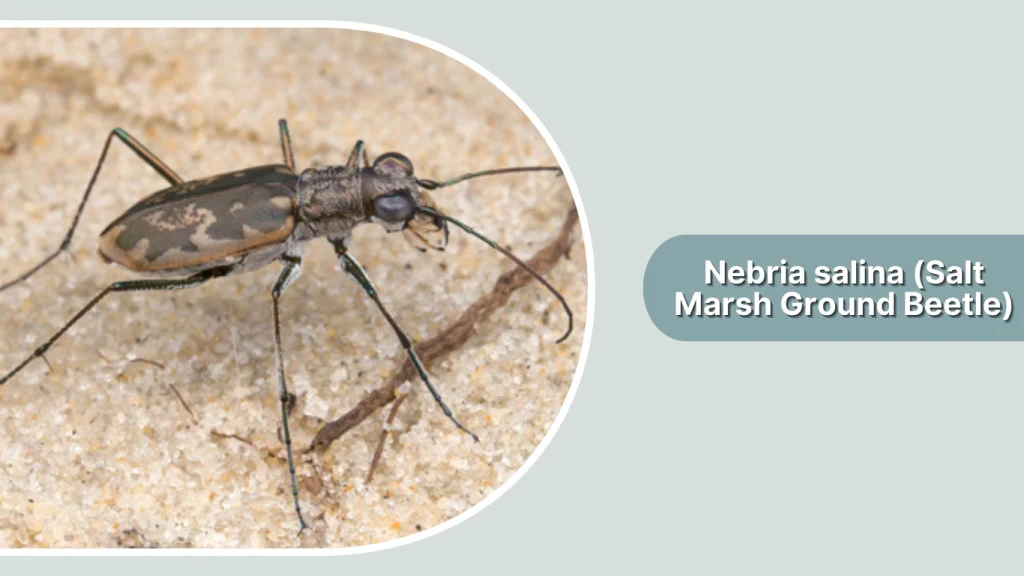
Nebria salina, known as the Salt Marsh Ground Beetle, is a specialized member of the ground beetle group (Carabidae family). As its name suggests, it prefers saline habitats and coastal areas.
Identification
- Size: 8–11 mm long
- Color: Dark brown to black with faint bronze reflections
- Body: Slender, elongated with fine striations on elytra
- Legs: Pale brown and relatively long
- Antennae: Slender, pale brown
- Distinctive Feature: Adapted to salty or brackish habitats
Habitat
The Salt Marsh Ground Beetle is typically found in salt marshes, coastal dunes, estuaries, and brackish wetlands. It hides in damp soil, plant debris, or under stones.
Diet and Nesting
This beetle feeds on small invertebrates such as mites, springtails, and insect larvae. Its diet helps regulate tiny soil organisms in coastal ecosystems.
Eggs are laid in moist, saline soil, and larvae live underground where they also act as predators.
Behavior
Nebria salina is a nocturnal beetle, emerging after dusk to hunt. Its ability to tolerate saline conditions makes it unique among ground beetles.
25. Bembidion properans (Active Bembidion Beetle)
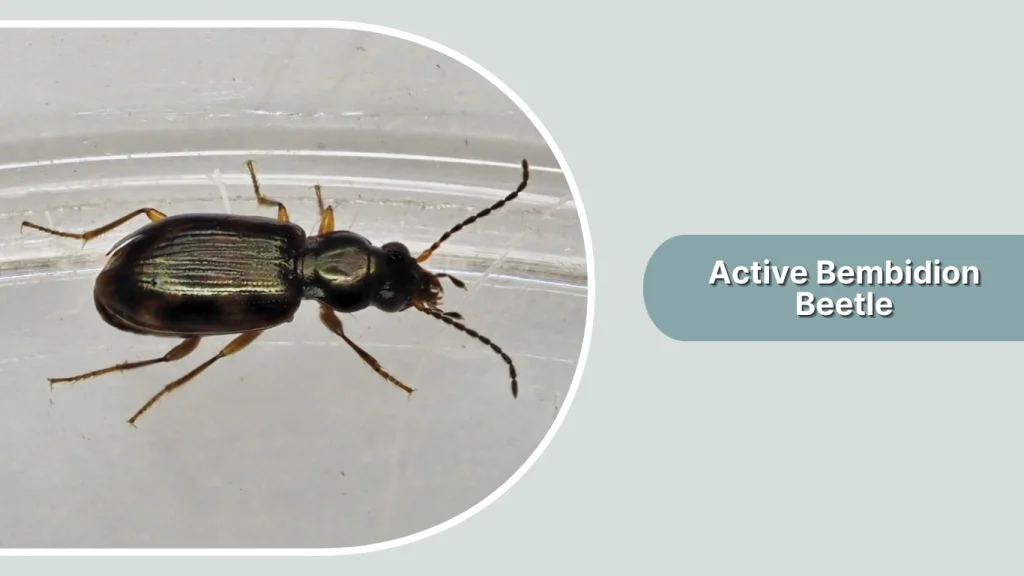
Bembidion properans, known as the Active Bembidion Beetle, is a small but fast-moving species of the ground beetle group (Carabidae family). It is common across Europe and Asia and is often spotted running quickly on open ground.
Identification
- Size: 4–6 mm long
- Color: Dark bronze or black with metallic sheen
- Body: Small, narrow, and oval with grooved elytra
- Legs: Yellowish-brown and slender
- Antennae: Pale brown, segmented and thin
- Distinctive Feature: Very small size and rapid movement across bare soil
Habitat
This beetle prefers open fields, farmland, riverbanks, and sandy areas. It is usually found in exposed soil habitats where it hunts on the surface.
Diet and Nesting
Bembidion properans feeds on tiny insects, mites, and soil invertebrates. Despite its size, it plays an important role in controlling populations of small pests.
Eggs are laid in soil, and larvae remain underground, continuing the same predatory feeding habits.
Behavior
It is diurnal and nocturnal, actively running during the day and night. Its quick movements make it difficult for predators to capture.
26. Bembidion lampros (Shining Bembidion Beetle)
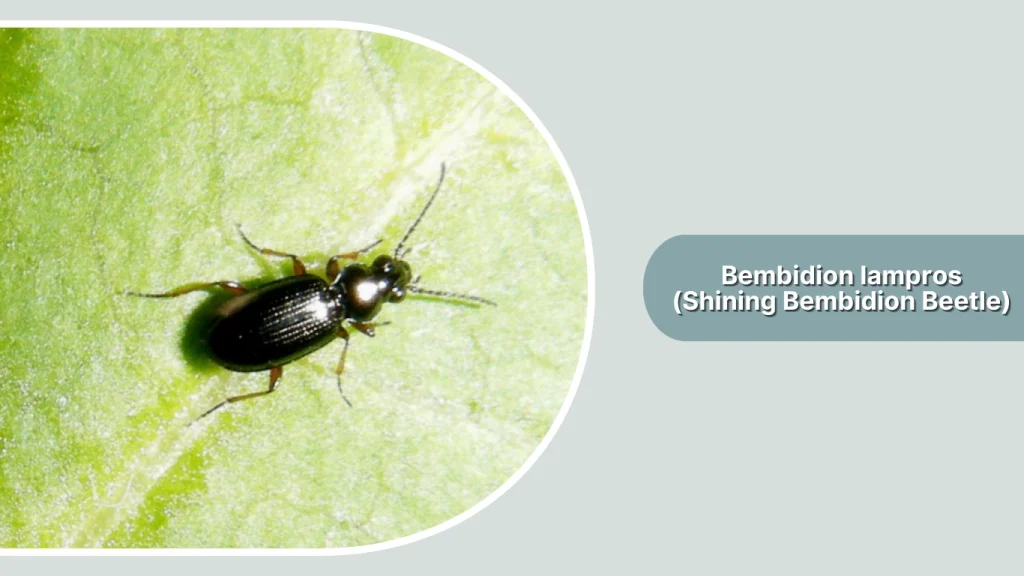
Bembidion lampros, called the Shining Bembidion Beetle, is another small-sized member of the ground beetle group (Carabidae family). It is a very common species in farmland and is highly regarded for its pest-control role.
Identification
- Size: 4–6 mm long
- Color: Shiny bronze to metallic green
- Body: Narrow, oval, with smooth and glossy elytra
- Legs: Yellowish-brown, fast-moving
- Antennae: Thin, pale brown
- Distinctive Feature: Glossy, reflective elytra compared to other Bembidion species
Habitat
This beetle inhabits cultivated land, meadows, field margins, and open ground. It is especially abundant in farmland, hiding under soil clods and vegetation.
Diet and Nesting
Bembidion lampros feeds on aphids, mites, springtails, and other tiny insects, making it beneficial in agriculture.
Nesting occurs in soil, where eggs hatch into predatory larvae that continue to feed on soil organisms.
Behavior
It is active both day and night, running rapidly across bare soil and crop fields. Farmers value it as a natural ally in integrated pest management.
27. Bembidion quadrimaculatum (Four-Spotted Bembidion)
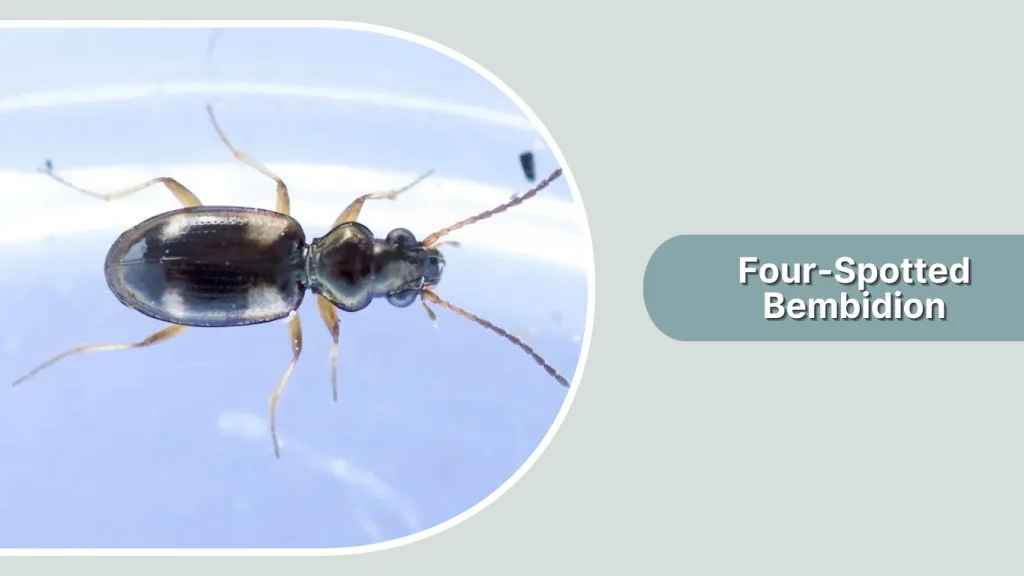
Bembidion quadrimaculatum, known as the Four-Spotted Bembidion, is a distinctive species of the ground beetle group (Carabidae family). Its name comes from the four pale yellow spots on its wing covers.
Identification
- Size: 4–5 mm long
- Color: Dark brown to black with yellow spots on elytra
- Body: Small, oval, and narrow
- Legs: Pale yellowish-brown, agile
- Antennae: Pale brown and slender
- Distinctive Feature: Two pairs of yellowish spots on each wing cover
Habitat
This beetle is commonly found in riverbanks, lakeshores, sandy soils, and farmland edges. It prefers moist but open habitats, often running actively on bare ground.
Diet and Nesting
The Four-Spotted Bembidion feeds on tiny insects, larvae, mites, and soil-dwelling arthropods.
Eggs are laid in soil close to water margins or moist ground, and larvae remain predatory underground until pupation.
Behavior
It is an active runner, foraging both day and night. Its spotted appearance makes it one of the most easily recognized Bembidion beetles.
28. Poecilus cupreus (Copper Green Beetle)
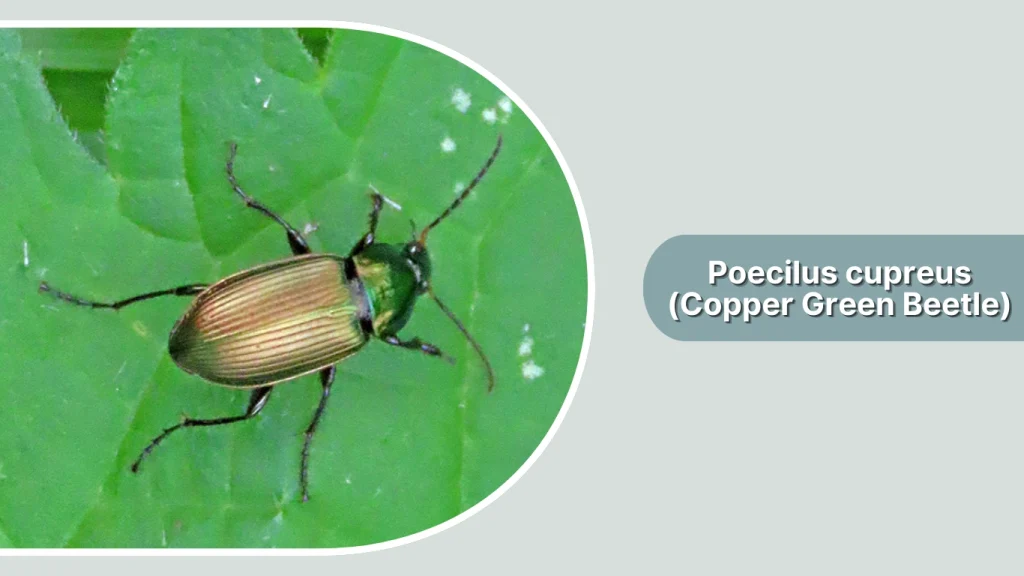
Poecilus cupreus, commonly called the Copper Green Beetle, is a large and colorful member of the ground beetle group (Carabidae family). It is highly beneficial for pest control in agricultural fields.
Identification
- Size: 12–17 mm long
- Color: Metallic green or coppery with shiny elytra
- Body: Elongated oval, smooth with faint ridges
- Legs: Reddish-brown and long
- Antennae: Slender, reddish-brown
- Distinctive Feature: Bright metallic copper-green sheen
Habitat
This beetle thrives in farmlands, meadows, gardens, and open grasslands. It is one of the most abundant beetles in cultivated land across Europe.
Diet and Nesting
Poecilus cupreus feeds on caterpillars, aphids, fly larvae, and slugs, making it a natural pest controller.
Eggs are laid in soil, and larvae also act as predators underground, consuming harmful insects.
Behavior
It is mainly nocturnal, emerging at dusk to hunt. Its large population in farmland makes it one of the most important natural allies for farmers.
29. Poecilus versicolor (Rainbow Ground Beetle)
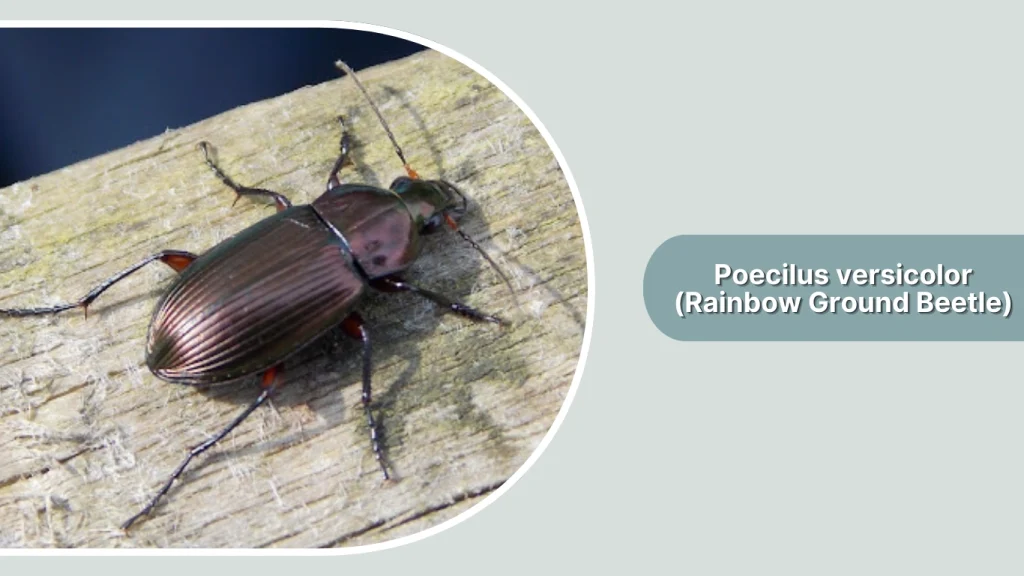
Poecilus versicolor, called the Rainbow Ground Beetle, is a striking species of the ground beetle group (Carabidae family). Its metallic body reflects different colors depending on the light, giving it a rainbow-like appearance.
Identification
- Size: 11–15 mm long
- Color: Metallic green, bronze, or reddish with iridescent sheen
- Body: Elongated oval with smooth, shiny elytra
- Legs: Reddish-brown, long and agile
- Antennae: Brownish-red, slender, and segmented
- Distinctive Feature: Multicolored, iridescent body surface
Habitat
This beetle prefers open meadows, farmland, grassy edges, and gardens. It hides under stones, plant debris, and soil cracks during the day.
Diet and Nesting
Poecilus versicolor feeds on insect larvae, caterpillars, worms, and slugs. It is an effective predator of agricultural pests.
Nesting occurs in soil, where eggs hatch into predatory larvae that continue to hunt underground until pupation.
Behavior
It is mainly nocturnal, emerging in the evening to hunt. Its shimmering rainbow-like colors make it one of the most attractive ground beetles.
30. Poecilus lepidus (Elegant Ground Beetle)
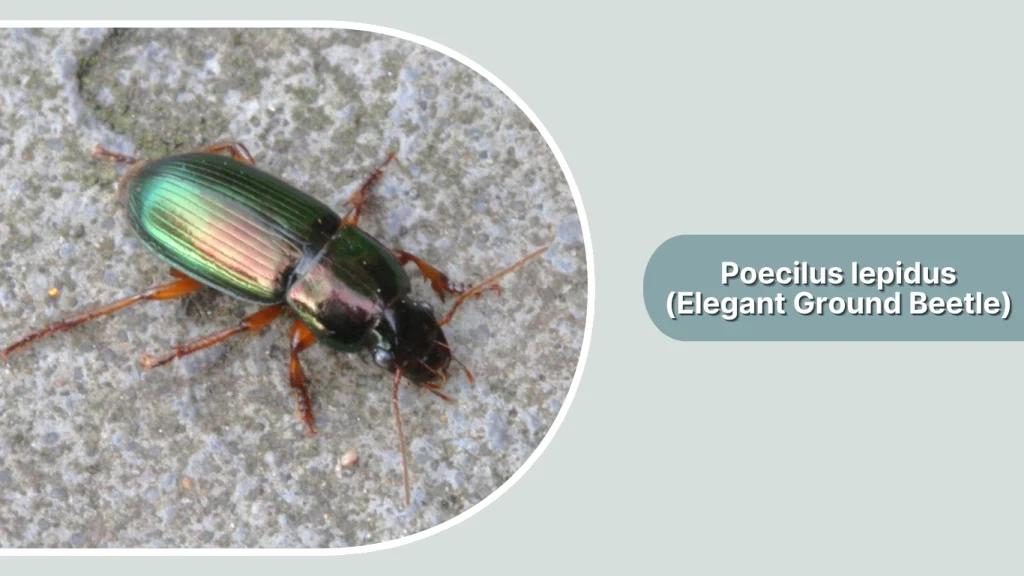
Poecilus lepidus, known as the Elegant Ground Beetle, is a smaller but eye-catching species within the ground beetle group (Carabidae family). It is admired for its metallic blue or green reflections.
Identification
- Size: 8–11 mm long
- Color: Metallic blue, green, or bronze with glossy shine
- Body: Small, oval, and smooth with faint striations
- Legs: Brownish-red, moderately long
- Antennae: Reddish-brown and slender
- Distinctive Feature: Shiny metallic body, elegant appearance
Habitat
This beetle is typically found in grasslands, heathlands, forest edges, and sandy soils. It prefers open sunny habitats with loose soil.
Diet and Nesting
Poecilus lepidus preys on small insects, larvae, worms, and slugs. Though smaller than some relatives, it plays an important role in natural pest control.
Eggs are laid in soil, and larvae develop underground as active predators until adulthood.
Behavior
It is a nocturnal species, running quickly across open soil at night. Its elegant metallic sheen makes it easily recognizable in the field.
31. Calosoma sycophanta (Caterpillar Hunter)
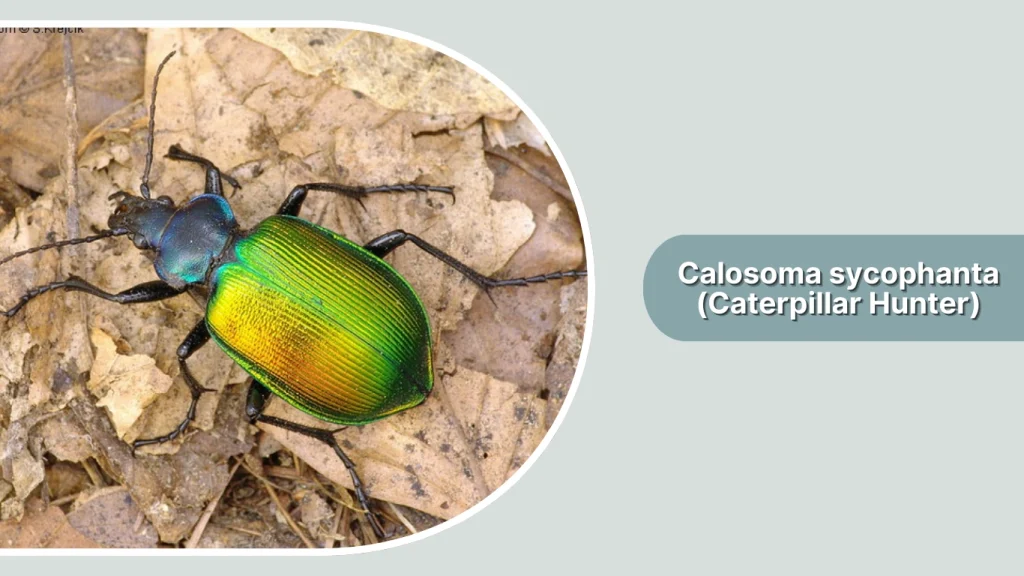
Calosoma sycophanta, famously known as the Caterpillar Hunter, is a large and colorful member of the ground beetle group (Carabidae family). It is one of the best-known beneficial beetles due to its appetite for caterpillars that damage crops and trees.
Identification
- Size: 25–35 mm long
- Color: Metallic green or blue with golden reflections
- Body: Elongated, robust with shiny ridged elytra
- Legs: Long and powerful, black or greenish
- Antennae: Black, segmented, slightly thickened
- Distinctive Feature: Bright iridescent body and larger size compared to many ground beetles
Habitat
This beetle is commonly found in woodlands, orchards, and farmlands where caterpillars are abundant. It hides under bark, leaf litter, and logs during the daytime.
Diet and Nesting
The Caterpillar Hunter specializes in eating caterpillars, moth larvae, and other leaf-feeding insects. It is highly beneficial in controlling forest and agricultural pests.
Eggs are laid in soil, and the larvae are also predatory, feeding on caterpillars underground before pupating.
Behavior
It is mostly nocturnal but can also be active during the day when prey is abundant. Its strong running and climbing ability allow it to chase caterpillars even on trees.
32. Calosoma inquisitor (Forest Caterpillar Hunter)
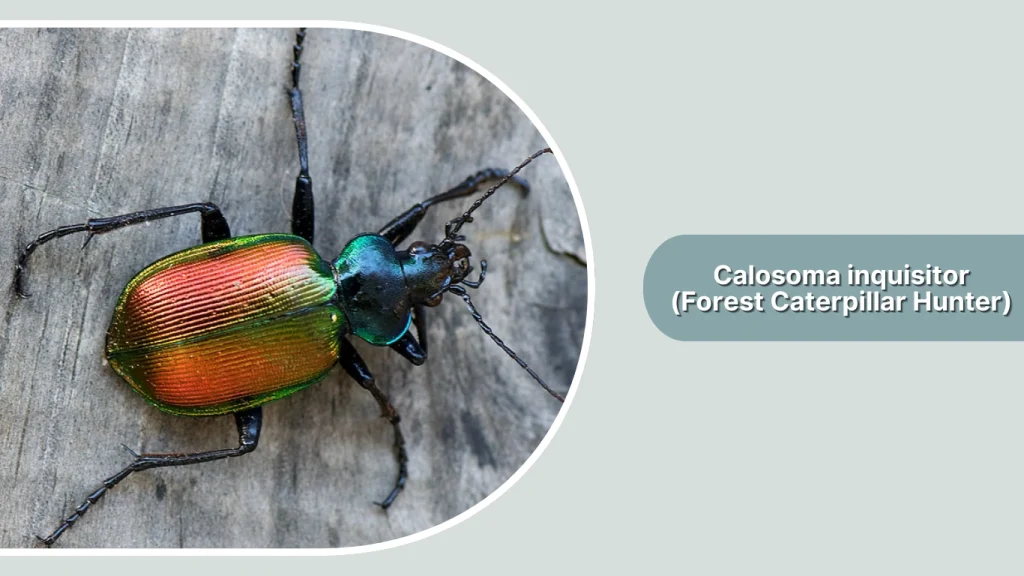
Calosoma inquisitor, called the Forest Caterpillar Hunter, is another predatory species in the ground beetle group (Carabidae family). It is common in woodlands and forests, where it actively reduces caterpillar populations.
Identification
- Size: 18–24 mm long
- Color: Metallic bronze, green, or blue sheen
- Body: Oval, shiny, with ridged wing covers
- Legs: Dark, long, and built for running
- Antennae: Long, dark, and segmented
- Distinctive Feature: Slightly smaller than Calosoma sycophanta but equally iridescent
Habitat
This beetle lives mainly in deciduous and mixed forests, preferring areas with dense vegetation and caterpillar activity.
Diet and Nesting
As its name suggests, it feeds on forest caterpillars, moth larvae, and soft-bodied insects. Its diet makes it a natural pest controller in woodland ecosystems.
Eggs are deposited in the forest soil, where larvae continue the predatory lifestyle until adulthood.
Behavior
It is a nocturnal hunter, emerging after dusk to forage. Like other Calosoma beetles, it is capable of climbing shrubs and trees to locate caterpillars.
33. Scarites subterraneus (Big-Headed Ground Beetle)
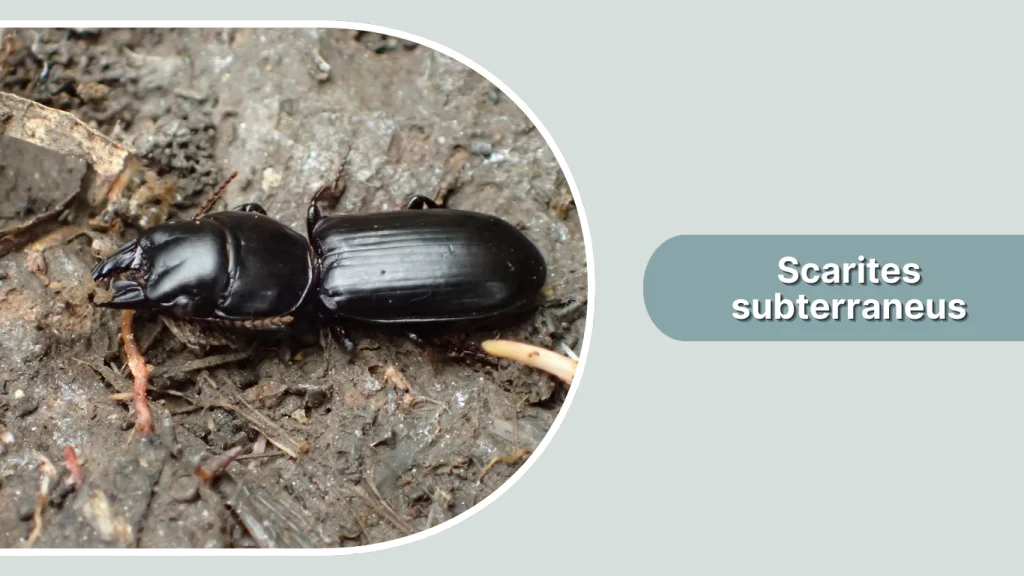
Scarites subterraneus, called the Big-Headed Ground Beetle, is a burrowing predator within the ground beetle group (Carabidae family). Its enlarged head and strong mandibles make it an effective hunter of soil-dwelling pests.
Identification
- Size: 15–25 mm long
- Color: Matte black, robust body
- Body: Elongated and heavy with deep ridges on elytra
- Head: Large, broad with strong jaws
- Legs: Short, powerful, adapted for digging
- Antennae: Shorter than many other ground beetles
- Distinctive Feature: Enlarged head and burrowing ability
Habitat
This beetle prefers sandy soils, farmland edges, gardens, and grassy fields. It is usually found in burrows or under stones and logs during the day.
Diet and Nesting
Scarites subterraneus feeds on insects, larvae, worms, and small soil invertebrates. Its strong jaws allow it to overpower prey underground.
It constructs burrows in loose soil, where females also lay eggs. Larvae grow in the safety of these burrows while hunting smaller prey.
Behavior
It is primarily nocturnal, emerging from burrows at night to hunt. Its digging ability helps it avoid predators and survive in dry habitats.
34. Pasimachus elongatus (Long Pasimachus Beetle)
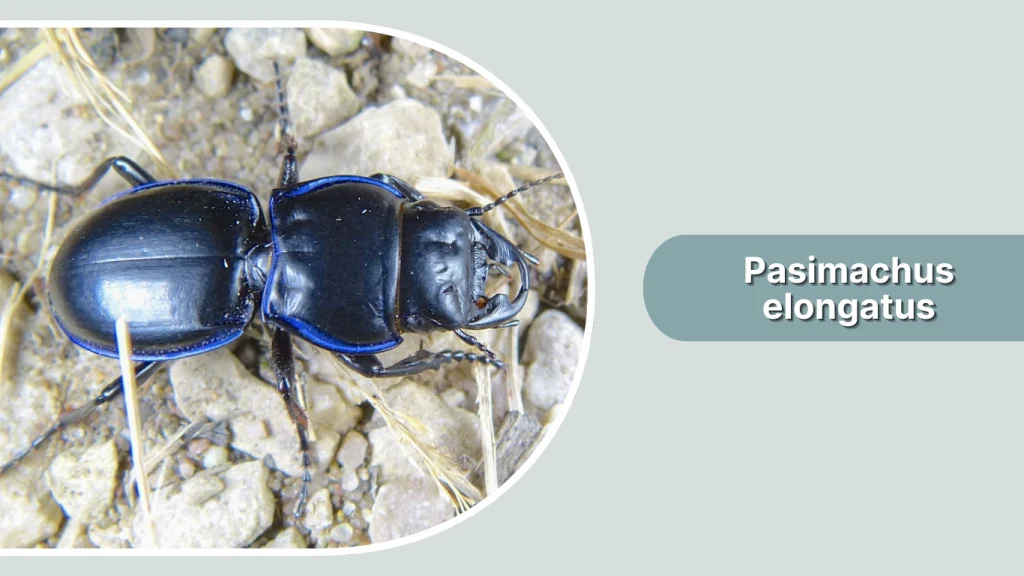
Pasimachus elongatus, known as the Long Pasimachus Beetle, is a striking, predatory insect from the ground beetle group (Carabidae family). Its shiny black body with blue or violet edges makes it easily recognizable.
Identification
- Size: 20–30 mm long
- Color: Glossy black with bluish or violet margins
- Body: Large, elongated, and strongly built
- Legs: Strong and long, adapted for running
- Antennae: Thick, dark, and segmented
- Distinctive Feature: Dark glossy body with contrasting colored edges
Habitat
This beetle inhabits woodlands, grasslands, and sandy soils, often sheltering beneath stones, logs, or leaf litter. It prefers warm and dry regions.
Diet and Nesting
Pasimachus elongatus feeds on caterpillars, beetle larvae, and other insects. It is an aggressive predator and plays a role in reducing harmful species.
Nesting occurs in soil burrows, where females lay eggs. The larvae are predatory and develop underground.
Behavior
It is a nocturnal beetle, emerging at night to actively hunt prey. Its strong mandibles and quick movements make it one of the more formidable ground beetles.
35. Dicaelus purpuratus (Purple Dicaelus Beetle)
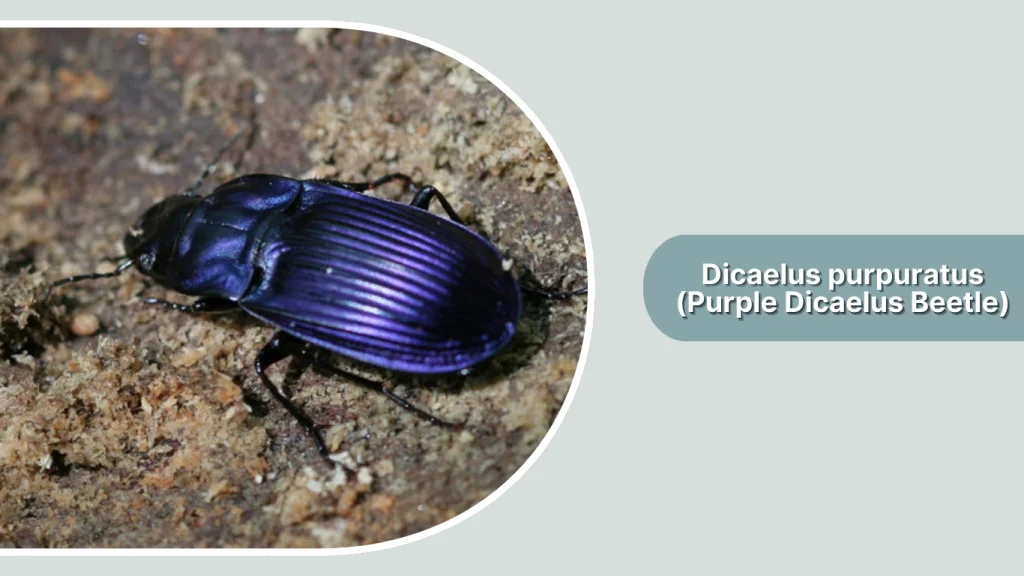
Dicaelus purpuratus, commonly called the Purple Dicaelus Beetle, is a distinctive species of the ground beetle group (Carabidae family). Its flattened body and strong jaws are specially adapted for hunting snails.
Identification
- Size: 15–20 mm long
- Color: Dark black with a purple or violet metallic sheen
- Body: Flattened, elongated with ridged elytra
- Legs: Strong and dark, adapted for running
- Antennae: Slender, dark brown to black
- Distinctive Feature: Mandibles designed to extract snails from their shells
Habitat
This beetle is commonly found in woodlands, gardens, and moist fields. It hides beneath logs, rocks, and leaf litter during the daytime and emerges at night.
Diet and Nesting
The Purple Dicaelus Beetle specializes in feeding on snails and slugs, though it also consumes worms and other soft-bodied invertebrates. Its jaws are adapted to reach inside snail shells, making it a unique predator.
Females lay eggs in soil or under plant litter. The larvae also feed on small invertebrates until they pupate.
Behavior
It is a nocturnal hunter, moving actively at night in search of prey. Its specialization in snail predation makes it especially valuable in ecosystems where mollusks are abundant.
