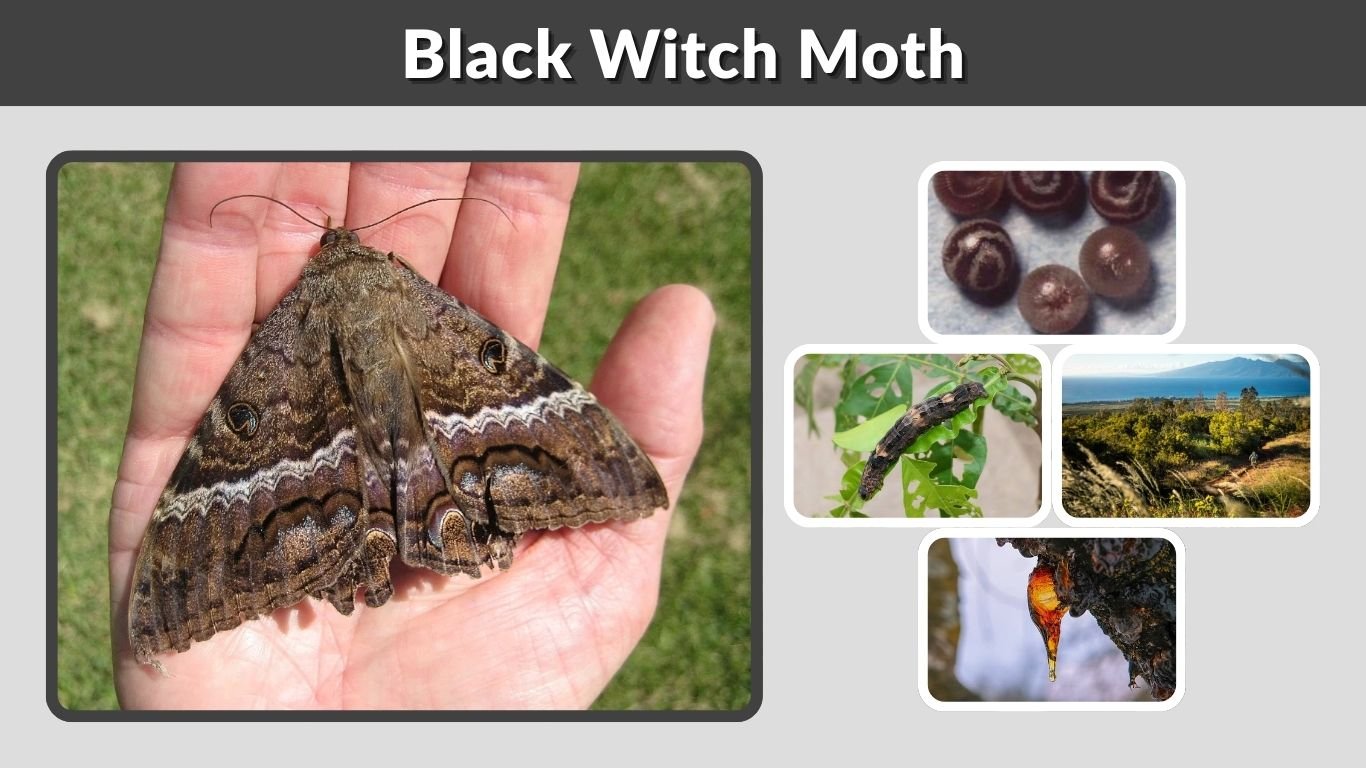
The black witch moth (Ascalapha odorata) is one of the largest and most striking moths found in the Americas. Its dark, bat-like wings, impressive size, and nocturnal behavior have inspired myths, spiritual meanings, and superstitions for generations. Despite names such as “butterfly of death,” the black witch moth is harmless to people. It is also a powerful migrant that can travel far beyond its tropical range. Below, learn about its identification, caterpillar, size, diet, life cycle, habitat, male and female differences, and fascinating symbolism.
What Is a Black Witch Moth?
The black witch moth is a large nocturnal moth belonging to the family Erebidae. Its scientific name is Ascalapha odorata. Adults have broad, dark wings covered with intricate brown, gray, black, pink, and sometimes purple markings. Their large size and irregular flight occasionally cause people to mistake them for bats, especially around dusk.
Black Witch Moth Identification
Look for these distinguishing characteristics:
- Scientific name: Ascalapha odorata
- Family: Erebidae
- Wingspan: Commonly about 11–15 cm (4.3–5.9 inches)
- Color: Dark brown to nearly black
- Forewings: Long and somewhat pointed
- Wing markings: Complex wavy lines and eye-like markings
- Activity: Primarily nocturnal
- Adult food: Tree sap and overripe fruit
- Range: Tropical Americas, with long-distance migrants farther north
Females typically have noticeable pale or pinkish-white bands crossing their wings, while males generally lack these bands.
Black Witch Moth Size and Wingspan
The black witch is an exceptionally large moth. Butterflies and Moths of North America reports a wingspan of approximately 11–15 cm, although some individuals may vary.
Its broad wings make it look even larger when resting with them spread flat against a wall or tree. This impressive appearance explains why people sometimes describe it as a giant black witch moth or compare its flight to that of a small bat.
Is the Black Witch Moth Poisonous?
No. The black witch moth is not considered poisonous or dangerous to humans, and it does not have a venomous sting.
Adult moths are mainly interested in finding food, resting places, and mates. If one enters your house, its frightening appearance does not mean it poses a physical threat. It can usually be allowed to leave through an open door or window.
Black Witch Moth Male vs. Female
Male and female black witch moths look similar at first, but their wing patterns can help distinguish them. Females are generally lighter and more visibly patterned, whereas males tend to have a darker overall appearance. Sex identification is easiest when an adult is resting with its wings visible.
Male Black Witch Moth
Male black witch moths generally have darker, more uniform wings. They usually lack the pale transverse bands that are conspicuous on females.
Males can still show complicated wavy markings, spots, and subtle purple or brown tones. Their camouflage allows them to blend effectively against tree bark and shaded surfaces.
Female Black Witch Moth
Female black witch moths normally show a clearer pinkish-white or pale band extending across the wings. This is one of the most useful characteristics for distinguishing a female from a male.
Females can also appear slightly larger and lighter overall. The difference is easiest to see when males and females are compared side by side.
Black Witch Moth Caterpillar
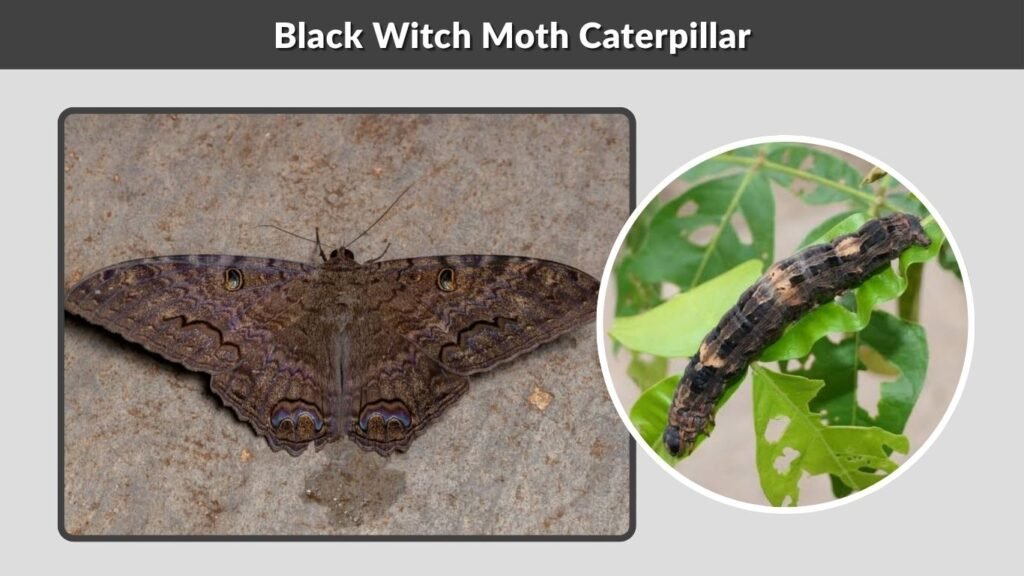
The black witch moth caterpillar looks dramatically different from the adult. Mature larvae can become large, elongated caterpillars with complex gray, brown, black, and greenish markings that provide camouflage. They mainly feed on the foliage of trees and shrubs, especially plants belonging to the legume family.
Caterpillar Identification
Typical characteristics include:
- Can reach roughly 7 cm in length
- Long, relatively smooth body
- Brown, gray, black, and greenish markings
- Striped or mottled appearance
- Primarily feeds on leaves
- Often associated with woody legumes
- Becomes less visible when resting against bark or vegetation
Their natural pattern helps protect them from predators by making them difficult to notice.
Black Witch Moth Caterpillar Host Plants
Known host plants include Cassia and catclaw, while larvae are also associated with other legumes such as acacias, mesquite, Inga, and related plants. In Hawaii, larvae are among the caterpillars known to feed on monkeypod trees.
The caterpillar stage is dedicated primarily to feeding and growth before pupation begins.
Black Witch Moth Life Cycle
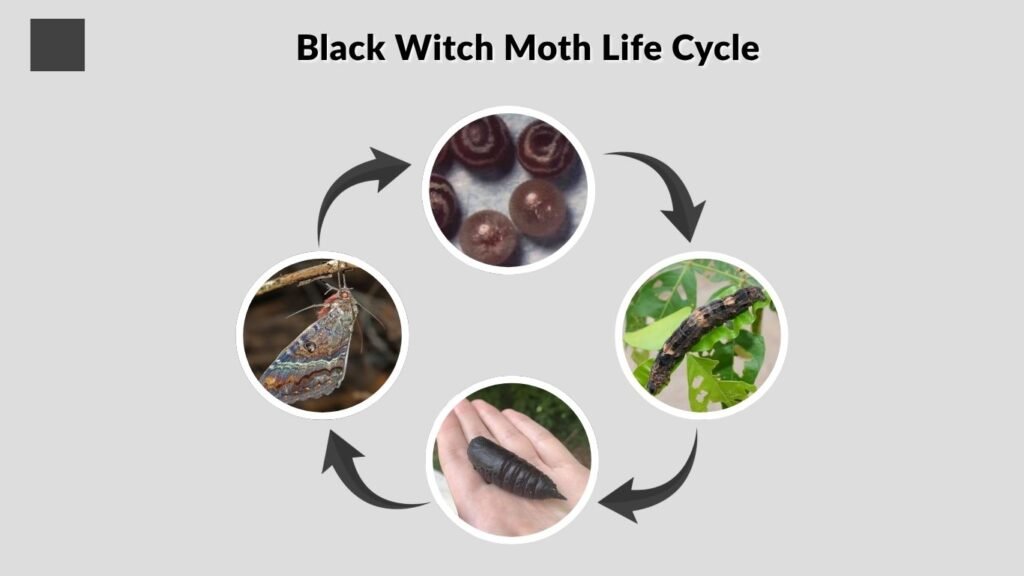
Like other moths, the black witch undergoes complete metamorphosis. Its development progresses through egg, larva, pupa, and adult stages. Environmental conditions such as temperature, rainfall, host plant availability, and season can influence development and activity.
Four Life Cycle Stages
- Egg: Females deposit eggs on or near suitable host plants.
- Larva: Caterpillars hatch and feed heavily on foliage.
- Pupa: Mature larvae move into protected material near the ground and pupate.
- Adult: The large winged moth emerges, expands its wings, feeds, mates, and disperses.
Field observations in Costa Rica indicate that larvae can reach their final stage after approximately 30–35 days of feeding, followed by around three weeks in the pupal stage under those particular conditions. Development time can vary.
Black Witch Moth Cocoon and Pupa
When ready to pupate, a mature caterpillar may move down toward leaf litter and find a protected location.
It incorporates leaves and silk around its pupation site rather than creating the dense, obvious cocoon associated with some silk moth species. Eventually, the adult emerges, expands and hardens its wings, and begins its nocturnal life.
Black Witch Moth Diet and Habitat
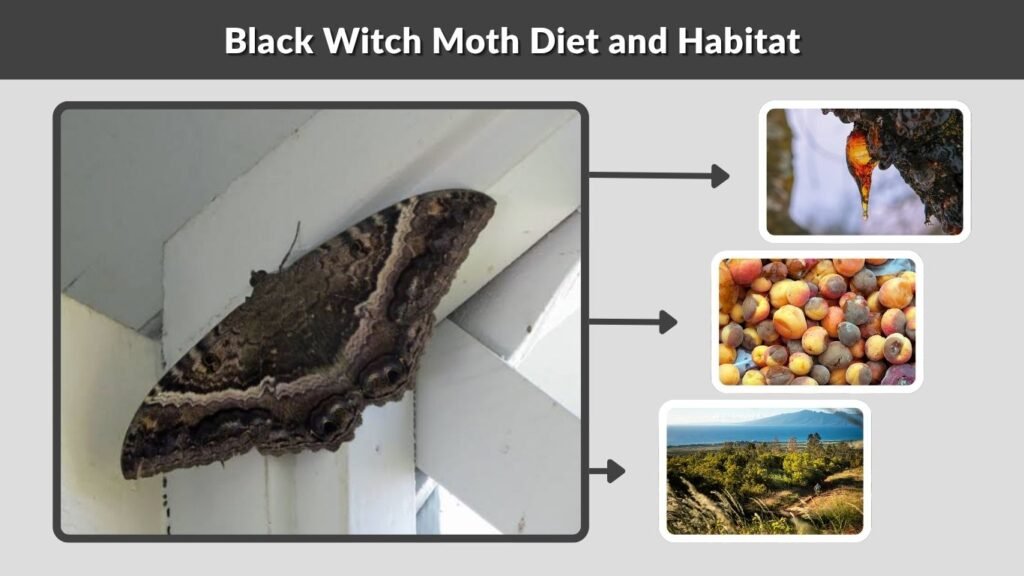
Black witch moths use different foods during their larval and adult stages. Caterpillars consume plant leaves for growth, whereas adults obtain sugary liquids. They are especially associated with warm climates but are famous for appearing surprisingly far outside their usual tropical habitat.
What Do Black Witch Moths Eat?
Their food sources include:
- Tree sap
- Overripe or damaged fruit
- Fermenting fruit juices
- Plant foliage during the caterpillar stage
- Leaves of several leguminous host plants
Adults are particularly known for visiting overripe fruit and tree sap.
Range and Migration
The black witch is fundamentally a tropical species, but it is an excellent long-distance flier.
It occurs regularly in southern Florida and southern Texas and may migrate far north during warmer months. Verified range information shows migrants reaching areas as far north as Minnesota and Newfoundland, usually during summer and early fall.
This explains occasional reports from Colorado, California, Arizona, Illinois, Georgia, Virginia, and other locations where permanent populations may not be established.
Black Witch Moth in Texas and Arizona
Texas is one of the best-known U.S. areas for black witch sightings. Southern Texas can support the species regularly, while migrants can occur elsewhere in the state.
Arizona also receives black witches, particularly because the desert Southwest contains woody legumes that can serve as larval hosts. Their presence may become more noticeable during periods favorable for northward movement.
Black Witch Moth in Hawaii
The species also occurs throughout Hawaii. Historical records indicate sightings there by the early 20th century, and caterpillars can feed on monkeypod and related plants.
In Hawaii, however, the moth has become particularly famous because of the cultural stories associated with seeing one.
Black Witch Moth Meaning and Symbolism
Few moths have accumulated as much folklore as the black witch. Because it is extremely large, dark-colored, active at night, and sometimes unexpectedly enters houses, different cultures have developed supernatural interpretations of its appearance. These stories are cultural traditions rather than scientific indications of future events.
Spiritual Meaning and Superstition
The black witch moth has been associated with:
- Death and mortality
- Departed souls
- Transformation
- Mystery and darkness
- Change or transition
- Good or bad luck
- Money and prosperity in some traditions
- Messages from deceased loved ones
The interpretation varies dramatically depending on location.
Is a Black Witch Moth Good Luck?
It can be, according to some folklore.
In parts of Latin America, the moth has traditionally been interpreted as an omen of death or misfortune. In contrast, traditions in the Bahamas have associated the moth with money, while a South Texas superstition links one resting above a doorway with potential financial luck.
None of these beliefs predicts actual events—they are examples of cultural folklore surrounding an unusually dramatic insect.
Black Witch Moth Meaning in Hawaii
Hawaiian folklore gives the black witch a more comforting interpretation. A black witch appearing after someone has died is sometimes said to represent the departed person’s spirit returning to say goodbye.
For this reason, encountering one may be interpreted as remembrance or a final visit rather than a bad omen.
Why Is It Called the Butterfly of Death?
In Mexico, the black witch has traditionally been associated with the name “mariposa de la muerte,” or “butterfly of death.”
Stories have linked a black witch entering a house—particularly where someone was already ill—with death or misfortune. Its enormous size, nighttime activity, dark coloring, and habit of sheltering inside buildings probably helped reinforce these legends over generations.
What to Do If a Black Witch Moth Is in Your House
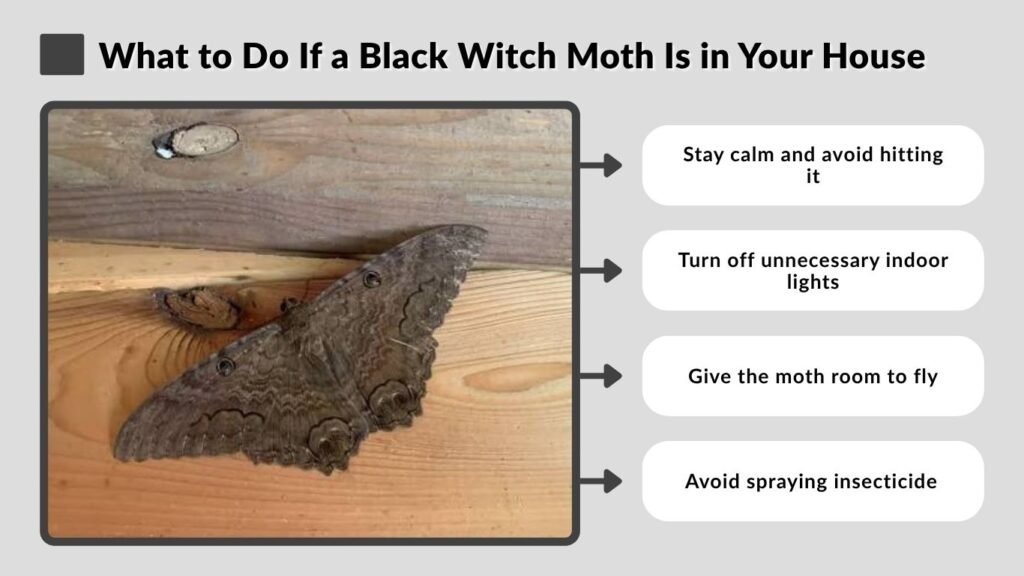
Finding a giant dark moth indoors can be surprising, but there is generally no reason to kill it. Black witches often seek dark, protected places where they can rest during daylight hours.
How to Get Rid of a Black Witch Moth
If one enters your home:
- Stay calm and avoid hitting it
- Turn off unnecessary indoor lights
- Open a nearby exterior door or large window
- Give the moth room to fly
- Avoid spraying insecticide
- If necessary, gently guide it toward the exit
It may simply remain motionless for hours before becoming active around dusk. Once given an escape route, it can usually leave on its own.
FAQs
The black witch’s giant size and mysterious reputation make it easy to misunderstand. Despite its intimidating appearance, it is primarily a harmless nocturnal moth whose ecology is far more interesting than the frightening legends surrounding it.
What is the scientific name of the black witch moth?
Its scientific name is Ascalapha odorata, and it belongs to the moth family Erebidae.
How big is a black witch moth?
Its wingspan commonly measures approximately 11–15 cm, or about 4.3–5.9 inches, making it one of the more impressive moths encountered in North America.
Does a black witch moth bite?
Black witch moths are not known for biting people. Their feeding structures are adapted for consuming liquids such as tree sap and juices from overripe fruit.
What does seeing a black witch moth mean?
Scientifically, it simply means a moth has found its way into your area. Symbolically, interpretations range from death and transformation to good fortune or a departed loved one’s visit, depending on cultural tradition.
Are black witch moths rare?
They are common within parts of their tropical range but can be unusual farther north. Their strong migratory ability means individual moths sometimes appear hundreds or thousands of miles beyond areas where they regularly reproduce.