
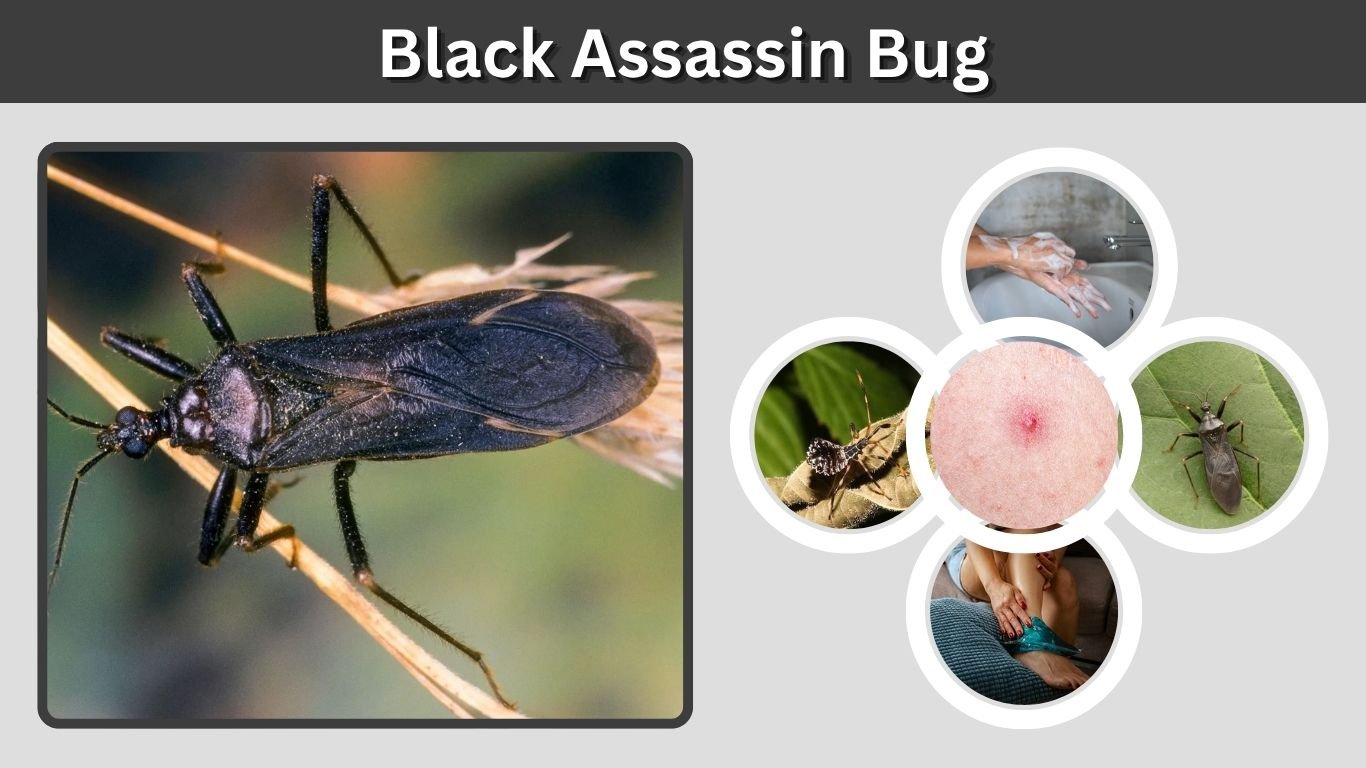
A black assassin bug may be found on garden plants, beneath logs, near outdoor lights, or occasionally inside a house. The name does not describe one particular species. Several assassin bugs can appear dark brown or completely black, including the masked hunter, black corsair, and adult wheel bug. These insects are valuable predators, but they should never be handled with bare hands. Although they do not normally attack people, their strong piercing beak can deliver a surprisingly painful defensive bite.
What Is a Black Assassin Bug?
Black assassin bugs belong to the family Reduviidae, a large group of predatory true bugs. Most use a stout, pointed beak to pierce caterpillars, beetles, flies, and other insects. They then inject digestive saliva and consume the liquefied tissues of their prey.
Blackish and brownish colors are common among adult assassin bugs, although some species or immature stages may be red, orange, green, or patterned. A typical assassin bug has an elongated head, a narrow neck behind the eyes, long legs, thin antennae, and a beak folded beneath its body.
“Black assassin bug” may refer to several different insects:
| Possible identity | Typical appearance | Distinctive clue |
| Masked hunter | Dark brown to black with full wings | Nymph covers itself with dust and lint |
| Black corsair | Glossy black with a strong, narrow body | Enlarged gripping pads on the front and middle legs |
| Adult wheel bug | Grayish-black or dark brown | Raised, toothed wheel on the back |
| Other assassin bug species | Black with red, orange, white, or yellow markings | Long head and thick piercing beak |
Because many unrelated insects are also black, color alone is not enough for a dependable identification.
How to Identify a Black Assassin Bug
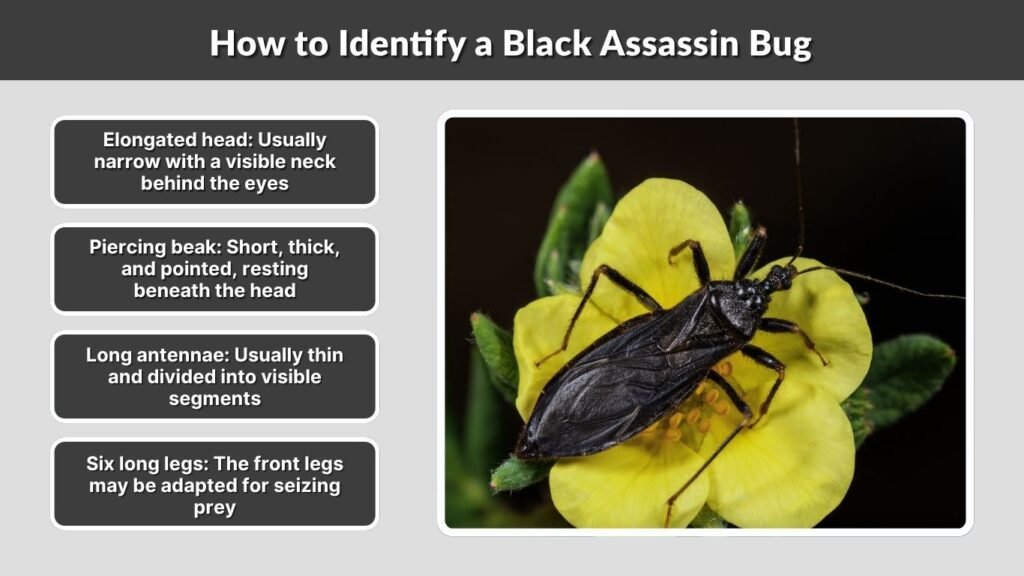
Look at the insect’s shape and mouthparts before focusing on its color. Assassin bugs generally have a longer, more angular form than beetles, stink bugs, or cockroaches.
Key Identification Features
- Elongated head: Usually narrow with a visible neck behind the eyes
- Piercing beak: Short, thick, and pointed, resting beneath the head
- Long antennae: Usually thin and divided into visible segments
- Six long legs: The front legs may be adapted for seizing prey
- Exposed abdomen edges: The sides of the abdomen may extend beyond the wings
- Predatory behavior: Often seen holding or feeding on another insect
- Adult wings: Most adults have overlapping wings covering the abdomen
Assassin bugs vary considerably in size. Many North American species are approximately 1.3–3.7 centimetres long, although the exact size depends on the species and life stage.
Common Types of Black Assassin Bugs
Several species account for many reports of large or small black assassin bugs.
Masked Hunter
The masked hunter, Reduvius personatus, is one of the black assassin bugs most frequently discovered indoors. The adult is dark brown to black, elongated and oval, with wings covering the body. A mature adult is approximately three-quarters of an inch long.
The nymph looks completely different. Its sticky body collects dust, hair, lint, sand, and other debris, giving it the appearance of a moving clump of dirt. Underneath this camouflage, an immature masked hunter is light brown and wingless.
Masked hunters live outdoors in wooded habitats but may enter buildings after being attracted to lights. They eat small arthropods, including sowbugs, earwigs, lacewings, and sometimes bed bugs. Finding one does not necessarily mean the house has a bed bug infestation.
Black Corsair Assassin Bug
The black corsair, Melanolestes picipes, is a glossy black assassin bug sometimes mistaken for a ground beetle. Adults may be around 16–17 millimetres long. Black corsairs have distinctive expanded, spongy gripping areas on their front and middle legs, which help them hold slippery prey.
Males generally have developed wings and may fly to lights. Some females have reduced wings and are unable to fly. Black corsairs are fast-moving predators and may hide beneath logs, stones, leaf litter, or other ground cover.
They should be observed without touching. Like other assassin bugs, they may use their beak defensively when grabbed, pressed against the skin, or mistaken for a harmless beetle.
Adult Wheel Bug
Wheel bugs are large assassin bugs found across much of the eastern United States. Adults are normally grayish-brown, charcoal, or nearly black. Their clearest feature is a raised semicircular structure behind the head with several tooth-like projections.
Young wheel bugs are usually bright red and black. Therefore, a red-and-black assassin bug nymph and a dark adult wheel bug may be the same species at different stages of development. Wheel bugs prey on caterpillars and other insects but can inflict a painful bite if mishandled.
Black Assassin Bug Nymph
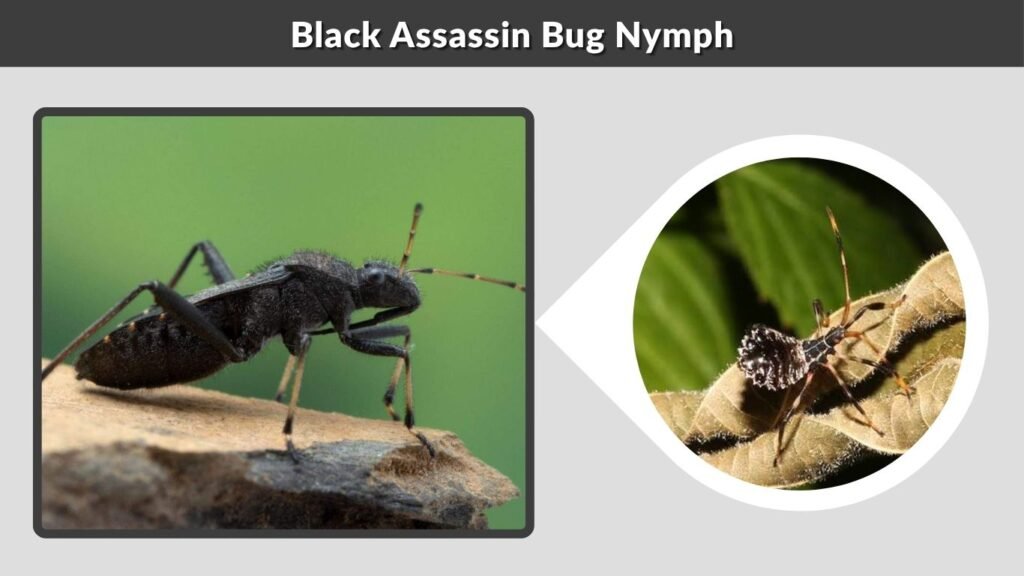
A black assassin bug nymph is an immature insect that has not developed functional adult wings. It normally resembles a smaller version of the adult, although its color and body covering may be very different.
Assassin bugs generally pass through five nymphal stages before adulthood. Their immature forms may be red, orange, tan, black, or a combination of several colors.
How Nymphs Differ from Adults
| Feature | Nymph | Adult |
| Wings | Missing or present only as small wing pads | Normally fully developed |
| Size | Smaller | Full species size |
| Color | Often brighter or more strongly patterned | Frequently darker |
| Reproduction | Cannot reproduce | Sexually mature |
| Feeding | Predatory | Predatory |
A black nymph with orange or red markings may become a mostly brown, gray, or black adult. Photos taken from above and from the side are therefore more useful for identification than a description based only on color.
Black, Red, Orange and Yellow Markings
Dark assassin bugs may display contrasting colors along the abdomen, legs, antennae, or wing margins.
Red and Black Assassin Bugs
A red-and-black individual is often an immature wheel bug or another assassin bug nymph. Some adults also retain red markings. Check whether the insect has wings, a raised wheel-like crest, and a visible piercing beak.
Orange and Black Assassin Bugs
Orange-and-black species can resemble milkweed bugs, leaf-footed bugs, or boxelder bugs. Assassin bugs usually have a noticeably narrow head and a heavy beak. Milkweed and leaf-footed bugs have mouthparts designed primarily for feeding on plants rather than capturing insect prey.
Black and White Assassin Bugs
White markings may be part of the insect’s natural pattern, but dust can also make a masked hunter nymph appear gray or white. A dusty nymph often looks irregular and fuzzy rather than cleanly patterned.
Black and Yellow Assassin Bugs
Some assassin bugs have yellow spots or bands. However, many plant-feeding true bugs share this coloration. A clear view of the head, beak, hind legs, and wings is needed before identifying the insect as an assassin bug.
Are Black Assassin Bugs Dangerous?
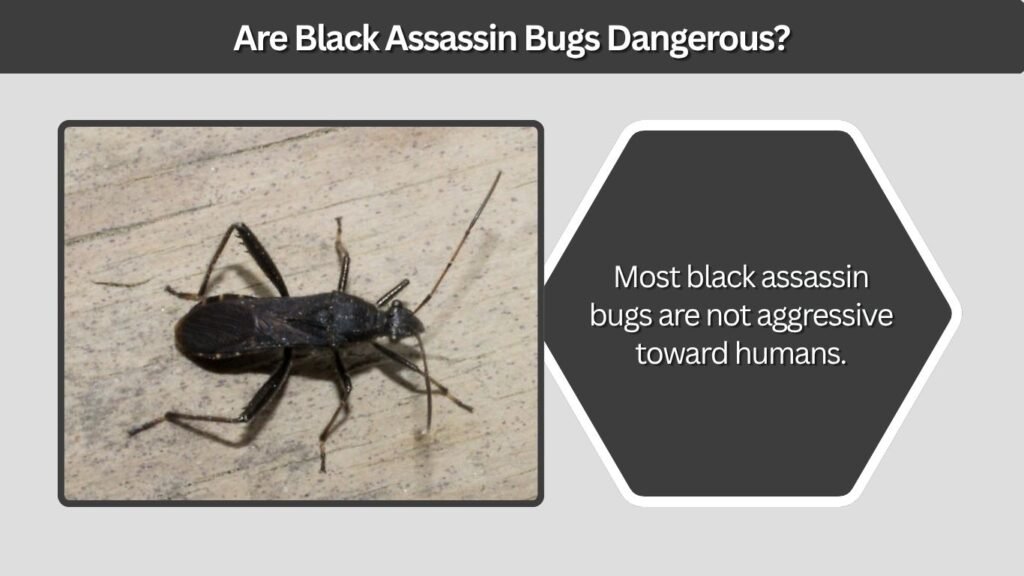
Most black assassin bugs are not aggressive toward humans. They hunt insects and do not seek people as prey. However, they may bite when trapped in clothing, stepped on, swatted, squeezed, or picked up.
A masked hunter bite may feel similar to a bee sting and can be followed by numbness and localized swelling. Masked hunters do not feed on human blood and are not known to transmit diseases.
Black Assassin Bug vs. Kissing Bug
Kissing bugs are blood-feeding relatives within the assassin bug family. Some can be associated with the parasite that causes Chagas disease. Ordinary predatory assassin bugs, including masked hunters, black corsairs, and wheel bugs, do not feed on human blood.
| Feature | Predatory black assassin bug | Kissing bug |
| Main food | Insects and other arthropods | Blood from vertebrates |
| Body shape | Variable; often narrow or robust | Usually broad and flattened |
| Abdomen | May be plain black | Often has colored side bands |
| Human contact | Usually accidental | May feed while a person sleeps |
| Disease concern | Generally not a vector | Some species can carry the Chagas parasite |
Do not identify either insect solely by its color. Place a suspected kissing bug in a secure container without touching it and consult a local public-health or insect-identification service.
What to Do After a Black Assassin Bug Bite
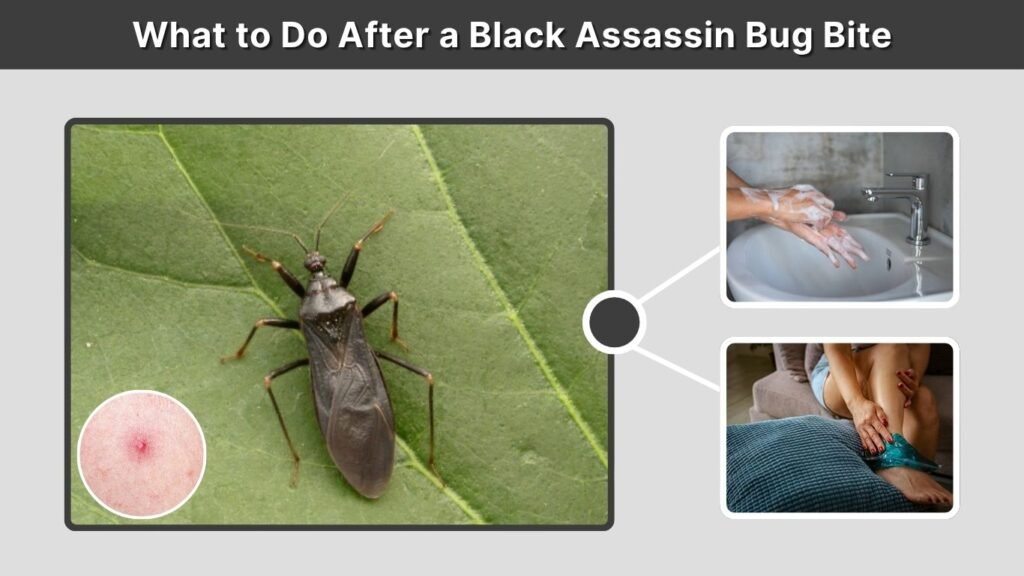
Wash the affected area with soap and water. Apply a cold pack wrapped in cloth for 10–20 minutes to help reduce pain and swelling. Avoid scratching, because damaged skin can become infected.
Seek immediate medical help if the bite is followed by difficulty breathing, facial or throat swelling, dizziness, faintness, or rapidly worsening symptoms. Medical advice is also appropriate when redness spreads, pain becomes severe, or the area develops pus or other signs of infection.
How to Remove One Safely
A single black assassin bug does not normally require pesticide treatment. Avoid striking or crushing it against your skin.
Place a cup or jar over the insect, slide a piece of firm paper underneath, and release it outdoors away from doors. A vacuum can also remove an indoor masked hunter, although the contents should be emptied carefully. Sealing gaps around windows, screens, pipes, and doors can help prevent additional insects from entering.
Masked hunters usually appear indoors only as isolated individuals, do not damage fabrics or stored food, and normally do not reproduce inside buildings.
FAQs
Is a black assassin bug poisonous?
A black assassin bug is not poisonous to touch or eat in the usual sense. However, it has a piercing beak and can deliver a painful defensive bite. Avoid handling it directly, particularly if the species has not been accurately identified.
Can a black assassin bug fly?
Many adult assassin bugs can fly. Male black corsairs and adult masked hunters have developed wings, while nymphs cannot fly. Some female black corsairs may have reduced wings, so flight ability varies by species and sex.
Why did I find a black assassin bug in my house?
It may have entered through an open door, damaged screen, or gap around a window after being attracted to light. Masked hunters are especially likely to appear indoors during summer, but they are generally accidental visitors rather than household pests.
Are black assassin bugs beneficial?
Yes. Most are predators that consume caterpillars, flies, beetles, and other arthropods. They can help control garden pests naturally. However, they are general predators and may occasionally capture beneficial insects as well.
Are black assassin bugs found in Australia?
Australia has numerous assassin bug species, including dark-colored forms, but “black assassin bug” is not precise enough to establish a species. Identification requires clear photographs, approximate size, location, wing development, markings, and a visible side view of the head and beak.
