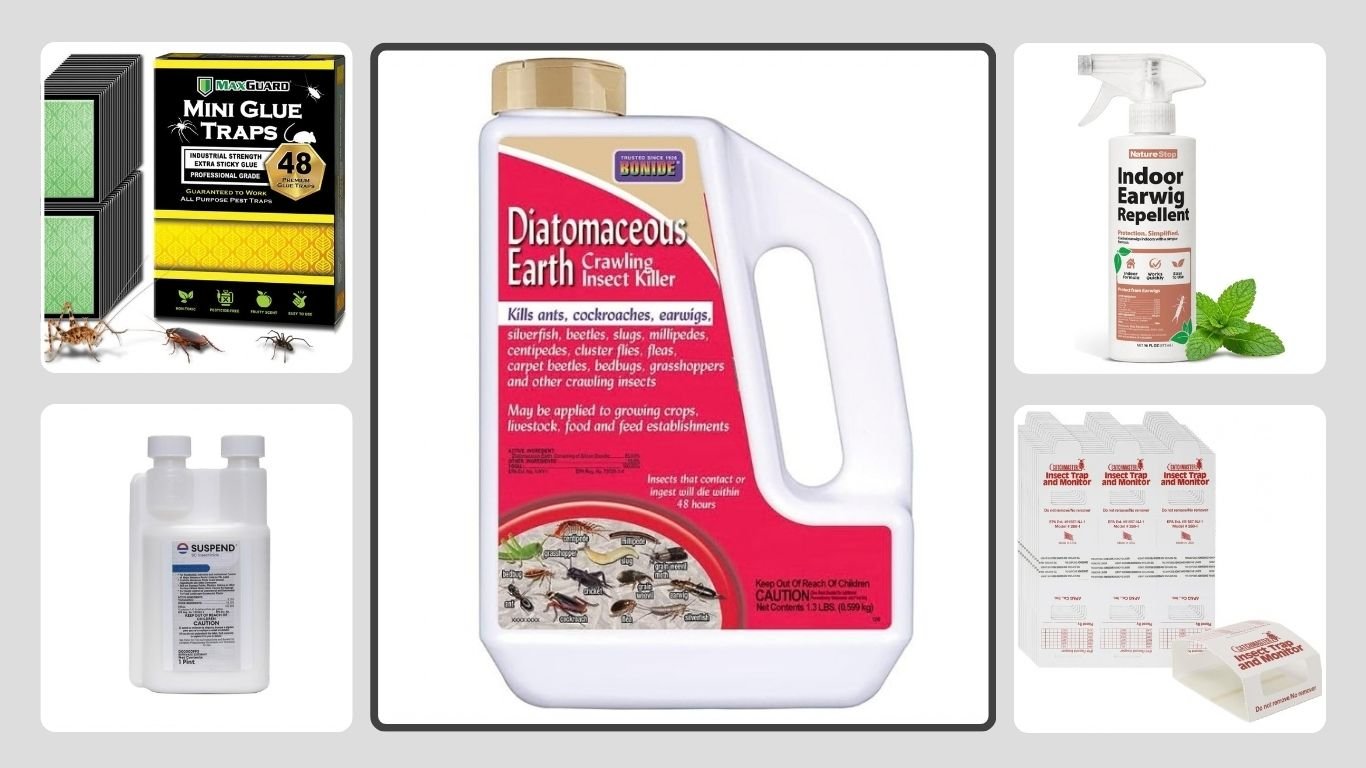
Earwigs can quickly become a nuisance around basements, bathrooms, kitchens, garages, gardens, and other damp areas. The right combination of traps, sprays, repellents, and crawling-insect treatments can help reduce their activity and prevent repeated infestations. In this guide, we reviewed 10 of the best earwig insect killer traps and sprays for indoor and outdoor use. These options include sticky traps, residual insecticides, natural powders, and targeted sprays, giving homeowners several practical ways to control earwigs based on the location, severity, and type of infestation.
1. Catchmaster Spider, Roach & Insect Glue Traps
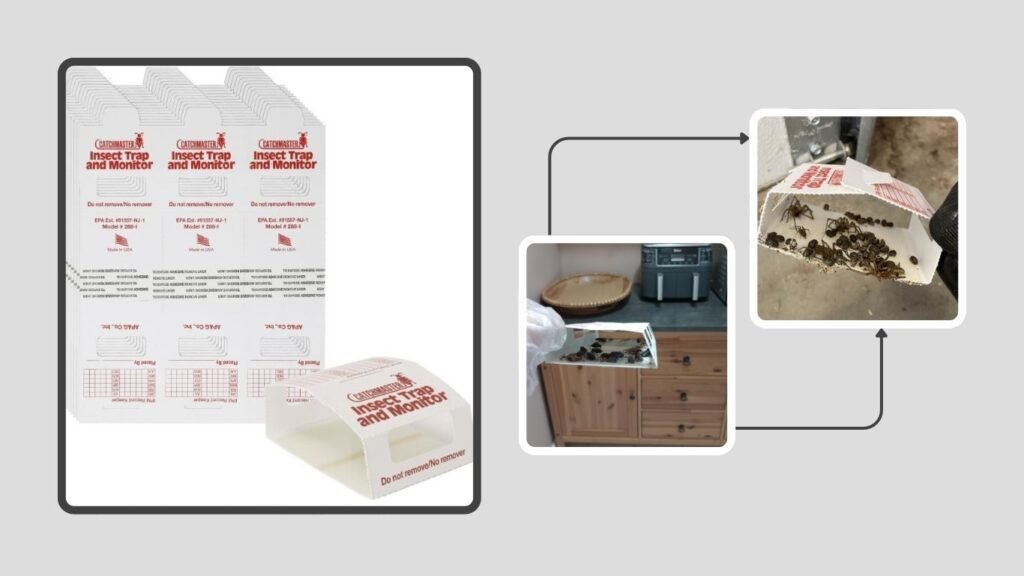
The Catchmaster Spider, Roach & Insect Glue Traps offer a chemical-free way to monitor and capture earwigs and other crawling pests around indoor spaces. This pack includes multiple adhesive traps that can be placed along baseboards, behind furniture, inside garages, or near suspected insect routes. The strong glue surface is designed to trap crawling insects once they cross the board, making it especially useful where sprays are not preferred.
Key Features
- Strong adhesive glue-board design
- Designed for crawling insects
- Can catch earwigs, spiders, roaches, crickets, and silverfish
- Chemical-free trapping method
- Suitable for homes, garages, and sheds
- Can be positioned flat or folded into a tunnel
- Large multi-trap pack for wider coverage
- Useful for both monitoring and reducing pest activity
Why It’s Best for Chemical-Free Earwig Control
The biggest advantage of these Catchmaster traps is their simple mechanical approach. There is no liquid spray to mix, no residue to apply across floors, and no insecticide treatment required on the trap itself. Earwigs tend to travel along walls, dark corners, and sheltered edges, so strategically placing glue boards in these areas can intercept them during normal movement.
The traps are also useful for figuring out where earwig activity is concentrated before deciding whether additional treatment is necessary.
Performance & Placement Flexibility
Catchmaster glue boards use a durable adhesive surface designed to hold crawling pests after contact. The boards can be placed flat for maximum exposed surface or folded into a covered tunnel, which can help protect the glue from dust in garages, storage rooms, or similar spaces.
For earwigs, placement matters considerably. Positioning traps near baseboards, utility rooms, damp basement areas, doorways, and other likely travel paths can produce better results than placing them randomly in open rooms.
Overall Verdict
The Catchmaster Spider, Roach & Insect Glue Traps are a practical option for households looking for a low-maintenance, non-spray method of controlling occasional earwig activity. Their versatile placement, strong adhesive, and ability to catch several crawling pest species make them especially useful for monitoring problem areas while physically removing insects from indoor spaces.
2. TERRO T3206SR Indoor Crawling Insect Traps
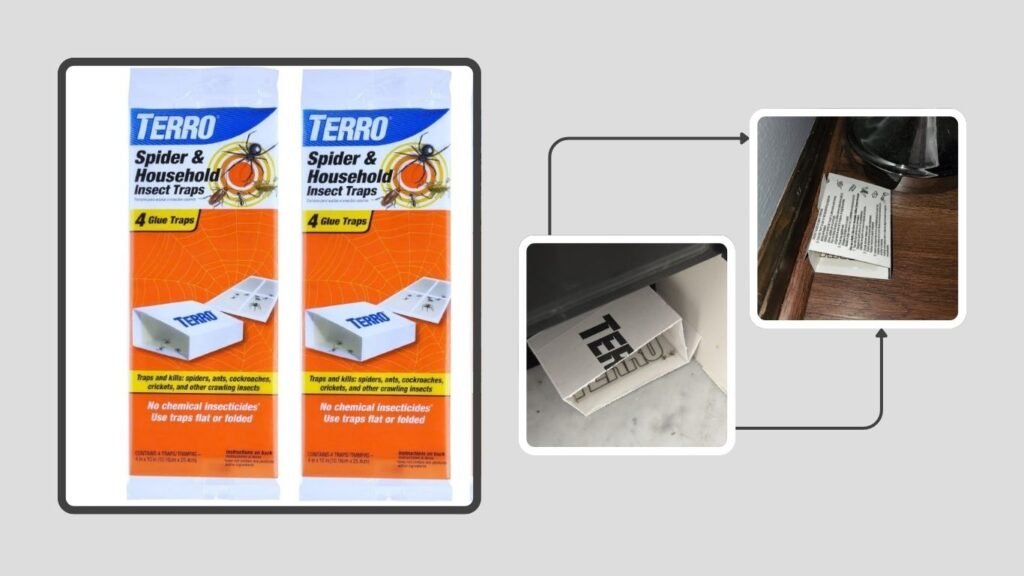
The TERRO T3206SR Indoor Crawling Insect Traps provide a simple, non-toxic way to capture earwigs and other crawling insects without spraying pesticides around living spaces. The pack contains 12 adhesive traps that can be positioned flat for maximum catching area or folded into enclosed traps. They are especially useful along baseboards, beneath furniture, and in bathrooms, basements, kitchens, and garages where earwigs commonly travel.
Key Features
- Includes 12 adhesive insect traps
- Non-toxic and odorless design
- No insecticide or bait required
- Can be used flat or folded
- Suitable for crawling insects
- Works along baseboards and beneath appliances
- Useful in bathrooms, basements, kitchens, and garages
- Compact design for discreet placement
Why It’s Best for Indoor Earwig Monitoring
Earwigs tend to move close to walls, underneath objects, and through dark sheltered areas rather than across open floors. The TERRO trap fits naturally into these travel paths. Laying the board flat provides a broader adhesive surface, while folding it creates a more discreet covered trap.
This makes the system useful not only for catching occasional earwigs but also for determining where insects are entering or concentrating inside the home.
Trapping Performance & Placement
The adhesive surface captures insects mechanically when they walk across it, so effective placement is important. Positioning traps against walls, beside doors, underneath sinks, or near damp areas generally makes more sense than leaving them in open rooms.
Because the traps contain no bait, they primarily intercept insects already traveling through the area rather than drawing pests from distant locations.
Overall Verdict
The TERRO T3206SR is particularly practical for households that want a low-maintenance trapping method without liquid sprays. Its foldable design, 12-trap quantity, and flexible placement make it useful for monitoring and reducing crawling-insect activity in problem areas.
3. MaxGuard Extra-Large Pre-Baited Cricket & Insect Traps
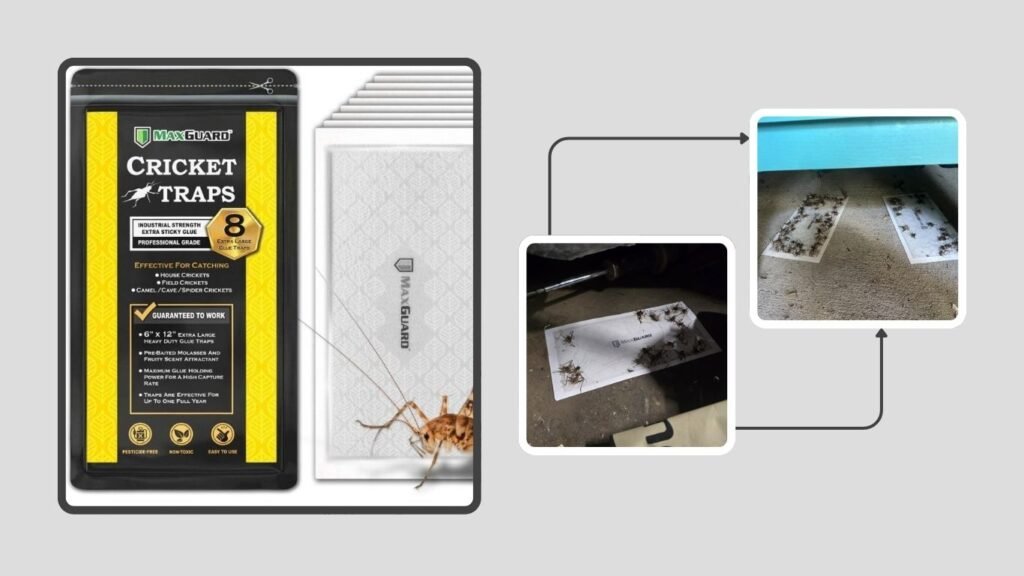
The MaxGuard Extra-Large Pre-Baited Cricket Traps are designed primarily for crickets but can also provide a large adhesive interception surface for other crawling insects moving through the same areas. Each trap measures approximately 6 by 12 inches and uses industrial-strength adhesive along with molasses and fruit-based attractants. The eight-trap pack is well suited to garages, basements, utility rooms, and other larger spaces.
Key Features
- Eight extra-large glue traps
- Approximately 6 x 12 inches each
- Industrial-strength adhesive
- Pre-baited with attractants
- Non-electric design
- No spray application required
- Designed primarily for crickets
- Useful for crawling-pest monitoring
Why It’s Best for Larger Problem Areas
The larger adhesive area is the biggest advantage of this MaxGuard trap. In garages, basements, sheds, and storage areas, crawling insects may use broad wall edges or floor junctions as travel paths. A larger board increases the interception area compared with compact glue traps.
For earwig control, these traps are best viewed as monitoring and capture tools rather than species-specific attractant traps, since the supplied lure is marketed mainly toward crickets.
Adhesive Performance & Long-Term Use
MaxGuard uses a strong glue surface intended to retain insects once they step onto the board. The manufacturer information describes the traps as long-lasting, which can reduce the need for frequent replacement when they remain clean and relatively empty.
Placement near damp foundations, garage entrances, utility areas, or suspected earwig routes can help determine where crawling pests are most active.
Overall Verdict
The MaxGuard Extra-Large Traps are useful when wide adhesive coverage is more important than compact placement. They make particular sense in garages and basements where earwigs, crickets, spiders, and other crawling insects may follow the same sheltered travel routes.
4. MaxGuard Spider + Insect Glue Traps
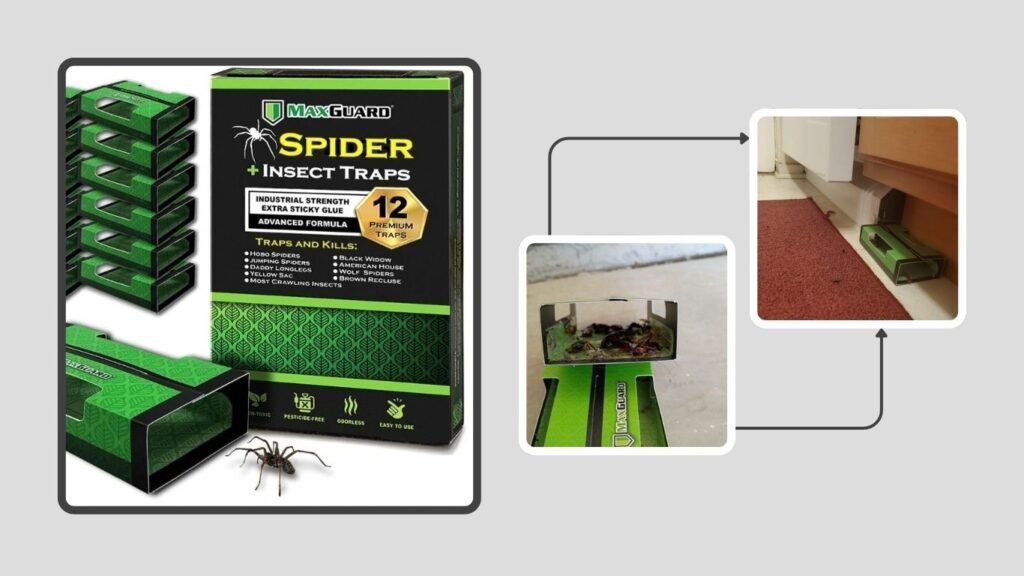
The MaxGuard Spider + Insect Traps combine strong adhesive with a foldable box-style design that allows discreet placement around indoor pest hotspots. The package contains 12 traps and uses an industrial-grade adhesive rather than an insecticide. Although marketed heavily for spiders, the traps are designed to catch other crawling insects that cross the sticky surface, making them useful around areas where earwigs are frequently seen.
Key Features
- Pack of 12 glue traps
- Industrial-grade adhesive
- Non-toxic, insecticide-free design
- Foldable box-style construction
- Dark interior design
- Suitable for crawling insects
- Easy peel, fold, and place setup
- Manufacturer states effectiveness up to six months
Why It’s Best for Discreet Indoor Placement
The enclosed shape makes these traps particularly useful in visible indoor spaces. Folding the board hides much of the adhesive surface and trapped insects while still allowing crawling pests to enter.
They can be placed near walls, behind furniture, inside garages, or close to basement entry points where earwigs tend to seek dark and sheltered conditions.
Performance & Ease of Use
Setup is straightforward: remove the protective covering, fold the trap, and position it along a suspected travel path. The adhesive does the rest when an insect moves across the surface.
MaxGuard specifically markets the product for spiders and crawling insects, so it can also help reveal whether earwig activity is accompanied by other pests.
Overall Verdict
The MaxGuard Spider + Insect Traps work well for homeowners who want a tidy, chemical-free way to monitor crawling-pest activity. The 12-pack provides enough coverage for several rooms, while the enclosed design is particularly convenient where exposed sticky boards would be undesirable.
5. MaxGuard Mini Pre-Baited Glue Traps
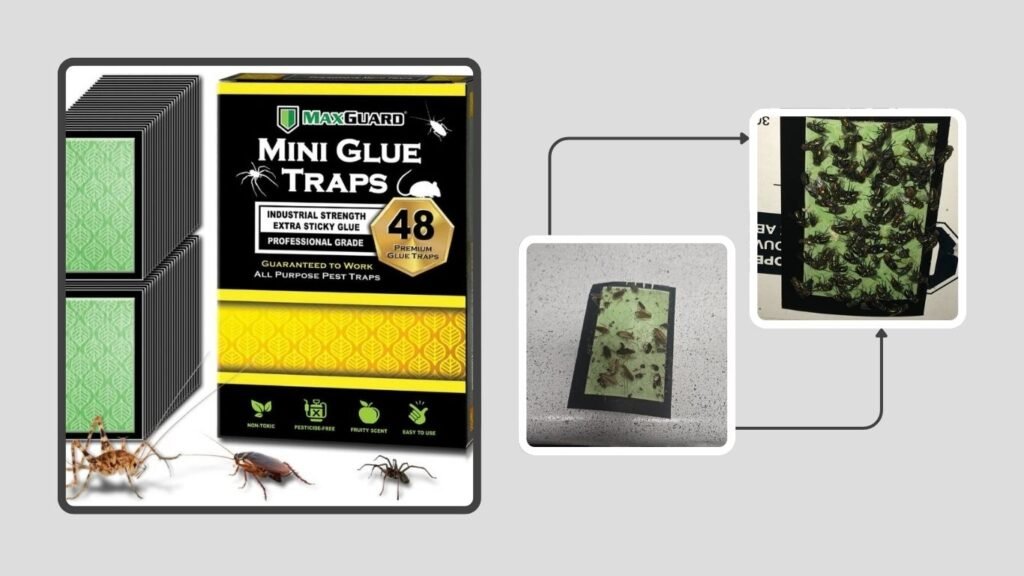
The MaxGuard Mini Glue Traps provide a more compact trapping approach for tight locations such as beneath cabinets, behind appliances, beside baseboards, and around storage areas. The 48-trap configuration uses a sticky glue board with a fruity-scent attractant and is marketed for insects, spiders, crickets, scorpions, cockroaches, centipedes, and even small rodents.
Key Features
- Large 48-trap quantity
- Compact mini glue-board format
- Extra-sticky adhesive surface
- Pre-baited with fruity scent
- No electrical power required
- Designed for various crawling pests
- Easy to distribute throughout multiple rooms
- Useful for pest monitoring
Why It’s Best for Tight Spaces
Earwigs commonly hide in cracks, dark corners, under cabinets, around plumbing, and behind appliances. A compact trap can be positioned closer to these concealed travel routes than a full-size glue board.
Having 48 individual traps also makes it possible to place multiple monitoring points throughout a home rather than relying on one or two larger stations.
Coverage & Practical Performance
The main strength of this system is coverage. Several traps can be placed in bathrooms, kitchens, garages, basements, and storage rooms at the same time. If one location consistently catches more insects, that can help identify moisture problems or entry points that need attention.
Because the attractant is not specifically formulated for earwigs, strategic placement remains essential when using these traps for earwig activity.
Overall Verdict
The MaxGuard Mini Glue Traps are particularly useful when widespread monitoring and tight-space placement are priorities. Their compact size and large quantity provide flexibility for households dealing with crawling insects in several different areas at once.
6. Granny Dee’s Earwig & Silverfish Killer Spray
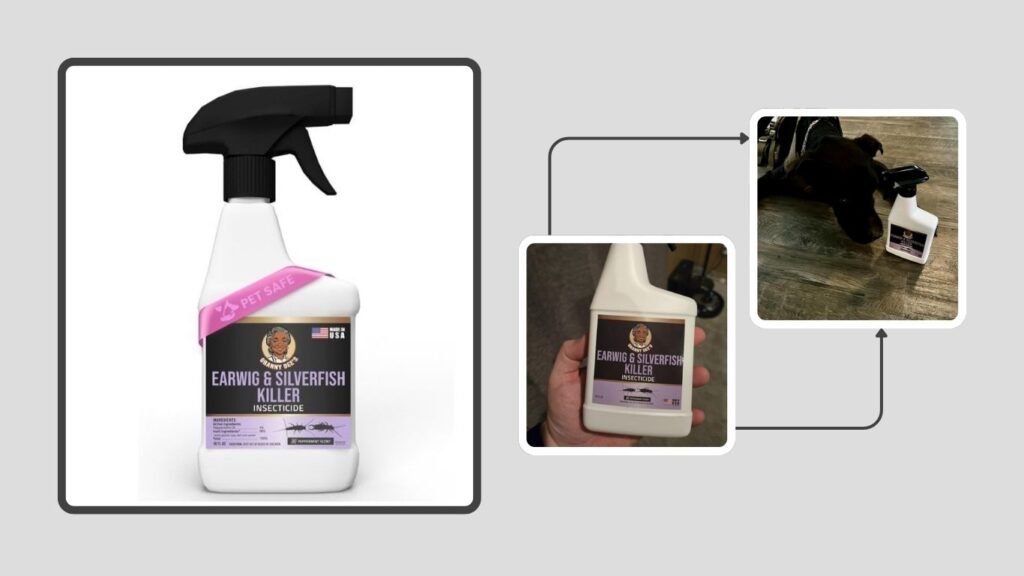
The Granny Dee’s Earwig & Silverfish Killer takes a different approach from adhesive traps by providing a ready-to-use liquid treatment specifically marketed for earwigs and silverfish. The 16-fluid-ounce formula uses peppermint oil and other plant-derived ingredients and is designed for both indoor and outdoor application. It can be applied around baseboards, closets, garages, patios, sheds, gardens, and other pest-prone locations according to the product directions.
Key Features
- 16-fluid-ounce spray bottle
- Specifically targets earwigs and silverfish
- Peppermint-oil-based formula
- Plant-derived ingredients
- Indoor and outdoor use
- Ready-to-use application
- Suitable for baseboards, garages, patios, and sheds
- Also marketed for several other crawling and flying pests
Why It’s Best for Direct Earwig Treatment
Unlike general-purpose sticky traps that depend on insects walking across an adhesive surface, this spray allows users to target areas where earwigs are repeatedly appearing.
That makes it useful around cracks, baseboards, storage spaces, garage edges, and outdoor sheltered areas. The peppermint scent may also appeal to users who prefer a plant-based product rather than a conventional synthetic-insecticide smell.
Application & Pest-Control Performance
The manufacturer markets the formula as acting on multiple pest life stages and recommends repeated applications for ongoing control. It is promoted for indoor and outdoor locations and is designed not to leave a sticky or oily residue.
As with any pest-control product, users should follow the label directions carefully, including instructions concerning surfaces, frequency, ventilation, children, pets, and plants.
Overall Verdict
The Granny Dee’s Earwig & Silverfish Killer Spray is one of the more targeted options in this lineup because earwigs are specifically named among its intended pests. Its ready-to-use format, plant-based formulation, and indoor/outdoor versatility make it especially practical for treating recurring earwig activity around multiple parts of a property.
7. NatureStop Indoor Earwig Repellent Spray
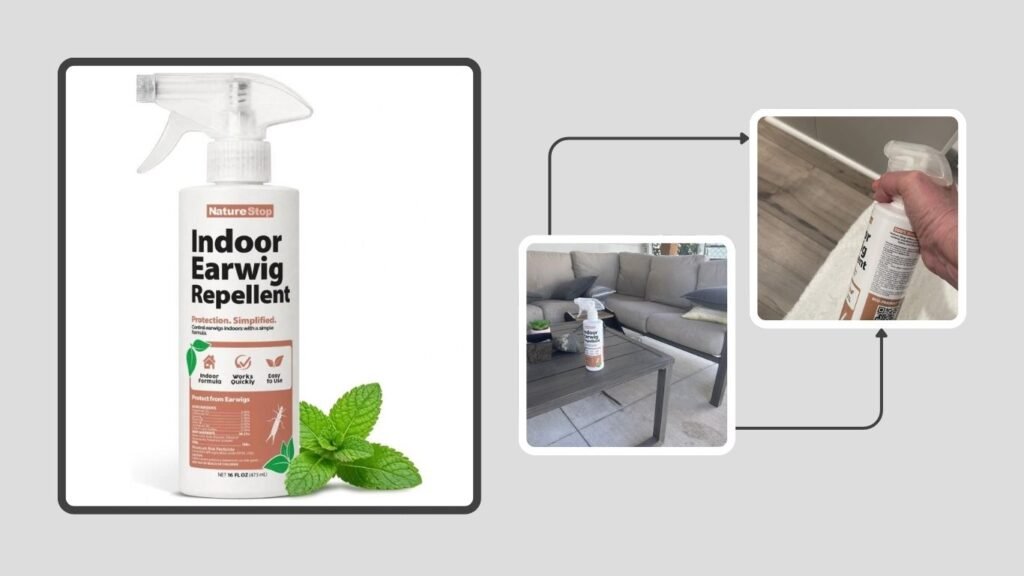
The NatureStop Indoor Earwig Repellent Spray is designed specifically for homeowners dealing with earwigs in damp indoor spaces such as bathrooms, basements, kitchens, garages, and storage rooms. Rather than functioning as a conventional contact insecticide, it works as a deterrent intended to make treated locations less attractive to earwigs. The 16-ounce ready-to-use format also makes targeted application around common entry and hiding areas straightforward.
Key Features
- 16 oz / 475 mL ready-to-use spray
- Formulated specifically for earwig deterrence
- Designed for indoor application
- Residue-free formula
- Suitable for baseboards and corners
- Useful around cracks and entry points
- Appropriate for bathrooms, kitchens, and basements
- Made for recurring indoor earwig activity
Why It’s Best for Targeted Indoor Deterrence
Earwigs often seek dark, humid locations during the day, which makes bathrooms, utility rooms, and basements common problem areas. NatureStop allows treatment to be concentrated around these locations instead of spraying an entire room.
It is particularly useful for homeowners who want to discourage earwig movement around baseboards, doorways, cracks, and corners rather than relying entirely on sticky traps.
Application & Everyday Performance
The spray is designed to create a scent-based barrier in treated areas. Regular application around known activity points can support a broader prevention strategy that also includes reducing moisture and sealing gaps.
Because it is a repellent rather than a traditional residual insecticide, expectations should focus on discouraging activity rather than providing the same direct-kill action as products specifically labeled as insecticides.
Overall Verdict
The NatureStop Earwig Repellent Spray is a practical choice for indoor areas where targeted deterrence and clean application are priorities. Its earwig-specific formulation and easy spray format make it particularly convenient for recurring activity around bathrooms, basements, and entry points.
8. Bonide Diatomaceous Earth Crawling Insect Killer
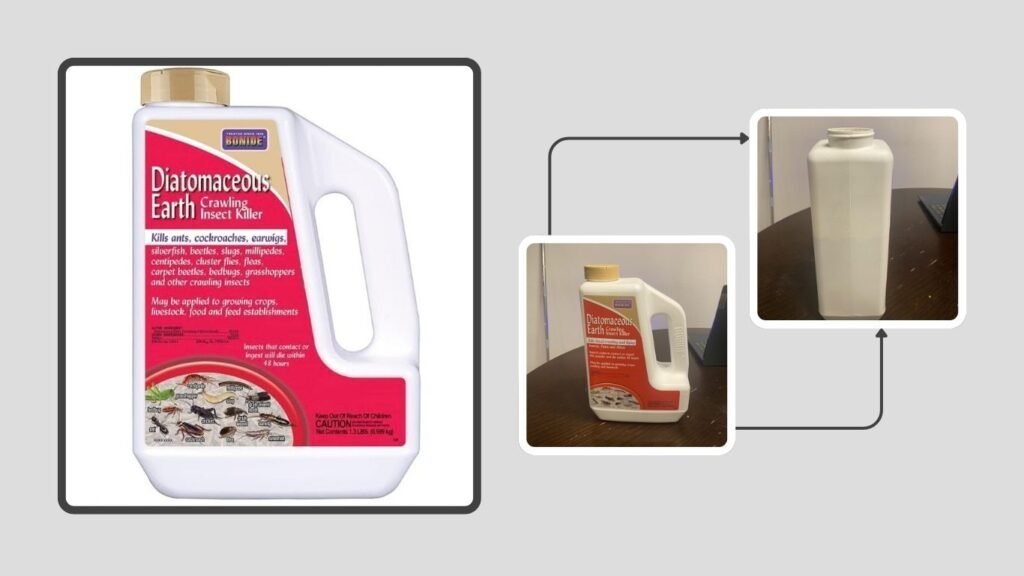
The Bonide Diatomaceous Earth Crawling Insect Killer offers a dust-based approach to controlling earwigs and numerous other crawling pests. Bonide lists earwigs among the insects controlled by this product and states that it can be used indoors and outdoors. Unlike conventional liquid sprays, diatomaceous earth works through physical contact and ingestion, making it useful around cracks, protected perimeter areas, gardens, and other locations where crawling insects travel.
Key Features
- 1.3-lb dust shaker option
- Diatomaceous earth insect-control formula
- Specifically labeled for earwigs
- Indoor and outdoor application
- Can be applied as dust or mixed as a slurry
- Also controls ants, cockroaches, silverfish, beetles, and more
- Works through contact and ingestion
- Bonide states affected insects succumb within 48 hours
Why It’s Best for Dry Crawling-Insect Control
Earwigs spend considerable time moving through cracks, sheltered edges, garden debris, and ground-level hiding places. A dust product can be useful in locations where a liquid spray may not be the preferred format.
Bonide’s formula can also address several other crawling pests at the same time, making it useful when earwigs occur alongside ants, silverfish, beetles, or centipedes.
Performance & Application Flexibility
One of its strongest technical advantages is application flexibility. Bonide states that the product can be used either as a dry dust or as a slurry, depending on the location and label directions.
Diatomaceous earth performs best when applied according to the label and protected from conditions that would interfere with the treatment.
Overall Verdict
The Bonide Diatomaceous Earth Crawling Insect Killer stands out for users who want a non-liquid option that specifically lists earwigs among its target pests. Its indoor/outdoor flexibility and broad crawling-insect coverage make it particularly useful as part of a wider earwig-control program.
9. Envu Suspend SC Insecticide
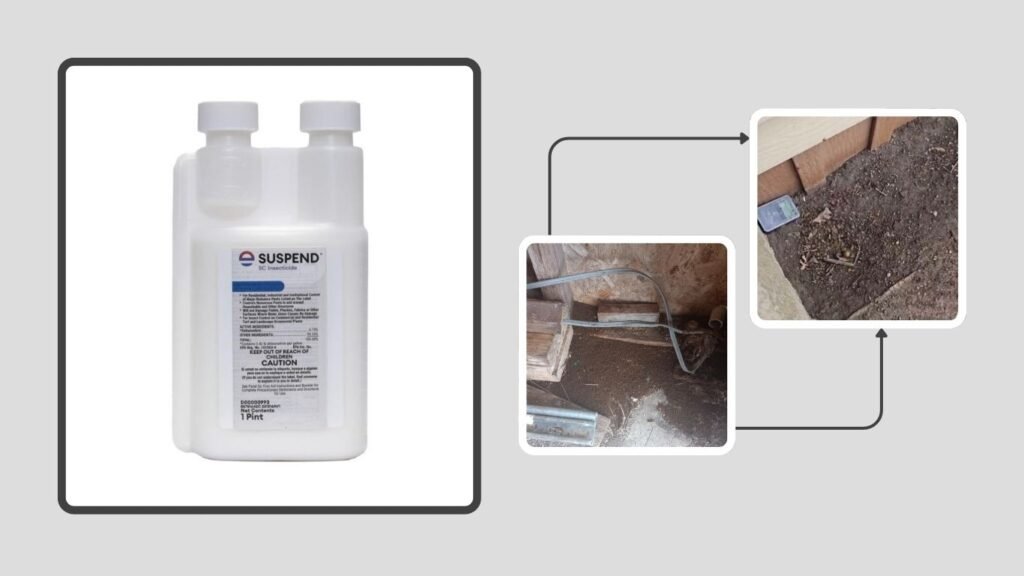
The Envu Suspend SC Insecticide is a professional-style suspension concentrate designed for broad-spectrum pest management. Its active ingredient is deltamethrin, a pyrethroid insecticide, and the current label information includes earwigs among a long list of controlled pests. The concentrated 16-ounce formula is intended to be diluted and applied according to label directions, making it better suited to users who need residual treatment rather than a simple ready-to-use household spray.
Key Features
- 16-ounce concentrated formulation
- Contains deltamethrin
- Earwigs included among labeled pests
- Indoor and outdoor applications
- Broad-spectrum pest control
- Long residual performance
- Low-odor formulation
- Designed for perimeter and structural pest treatment
Why It’s Best for Broader Pest-Control Programs
Suspend SC makes sense when earwigs are only one part of a larger crawling-insect problem. Its label covers numerous pests, including earwigs, ants, cockroaches, crickets, centipedes, ground beetles, spiders, and other nuisance insects.
That broad coverage can make one treatment program more versatile around garages, foundations, basements, and other pest-prone areas.
Residual Performance & Treatment Flexibility
Envu describes Suspend SC as providing effective knockdown along with a long residual. It can be used on a range of labeled structural and perimeter sites, and the suspension formulation is designed to leave no visible residue when applied appropriately.
Because this is a concentrated pesticide, accurate mixing and strict adherence to the current product label are essential.
Overall Verdict
The Envu Suspend SC Insecticide is the more technical option in this lineup. Its deltamethrin formulation, broad pest label, and residual characteristics make it especially suitable for users who need systematic treatment of recurring earwig and crawling-insect activity rather than occasional spot control.
10. Ortho Home Defense Max Insect Killer
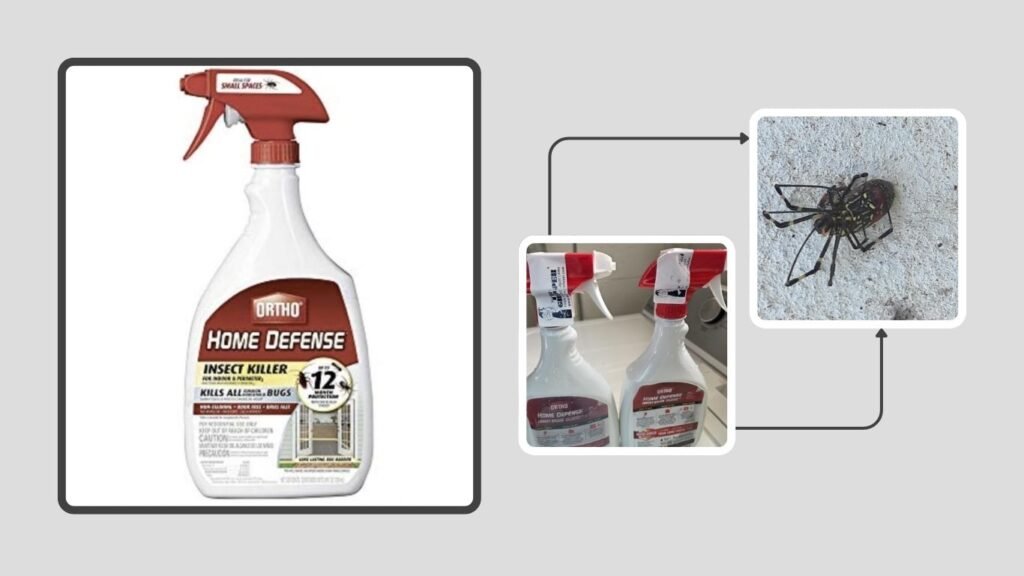
The Ortho Home Defense Max Insect Killer is a ready-to-use household treatment designed for common invading insects, including earwigs. It can be applied to labeled indoor and outdoor hard surfaces around locations such as doors, windows, bathrooms, basements, cracks, and other areas where pests enter or hide. Its ready-to-use format eliminates the measuring and mixing required with concentrated insecticides.
Key Features
- Ready-to-use liquid insecticide
- Earwigs specifically listed among controlled pests
- Suitable for labeled indoor and outdoor areas
- Useful around doors and windows
- Designed for cracks and crevices
- Fast-drying formulation
- No mixing required
- Creates residual protection on treated surfaces
Why It’s Best for Ready-to-Use Home Protection
Convenience is the main advantage of Ortho Home Defense Max. Instead of preparing a concentrate, users can treat common insect entry locations directly according to the label.
Earwigs frequently enter through gaps near foundations, door thresholds, windows, and basement areas, so a product designed for these structural zones fits naturally into an integrated control plan.
Performance & Residual Protection
Ortho specifically lists earwigs among the pests controlled by the product. The formula is intended to treat cracks, crevices, under-appliance areas, doors, windows, bathrooms, and basements.
The manufacturer notes that people and pets should remain off treated surfaces until they are completely dry. The widely advertised 12-month protection claim applies specifically to ants, roaches, and spiders indoors on nonporous surfaces—not necessarily to earwigs.
Overall Verdict
The Ortho Home Defense Max Insect Killer is a convenient option for homeowners who want a ready-to-use spray that specifically includes earwigs on its pest list. Its easy application and ability to treat common entry zones make it particularly practical for routine household perimeter protection.
FAQs
1. What is the best way to kill earwigs indoors?
A combination of targeted control and prevention usually works best. Sticky traps can capture individual earwigs, while properly labeled insecticides or diatomaceous earth can treat active areas. Reducing indoor moisture and sealing gaps around doors, windows, plumbing, and foundations helps prevent new earwigs from entering.
2. Do sticky traps work for earwigs?
Yes. Sticky traps can capture earwigs when positioned directly along their travel routes. Place them against baseboards, beneath sinks, in garages, around basements, and close to damp hiding places. They are also useful for monitoring where earwig activity is strongest.
3. Does diatomaceous earth kill earwigs?
Certain pesticide products containing diatomaceous earth are specifically labeled to control earwigs. For example, Bonide lists earwigs among the crawling insects controlled by its Diatomaceous Earth product and states that insects succumb after contact or ingestion. Always use the specific product according to its label.
4. Where should I spray for earwigs?
Focus only on locations permitted by the product label. Common treatment areas may include cracks, crevices, door and window edges, basement areas, foundation entry points, and other locations where earwigs repeatedly appear. Avoid unnecessary broad spraying when targeted treatment and exclusion can solve the problem.
5. How can I stop earwigs from coming back?
Reduce moisture, repair leaking plumbing, improve drainage, remove excessive leaf litter and debris near foundations, seal exterior cracks, repair door sweeps, and reduce hiding places beside the home. Combining these steps with traps or correctly labeled treatments generally provides more lasting control than repeatedly killing individual earwigs.