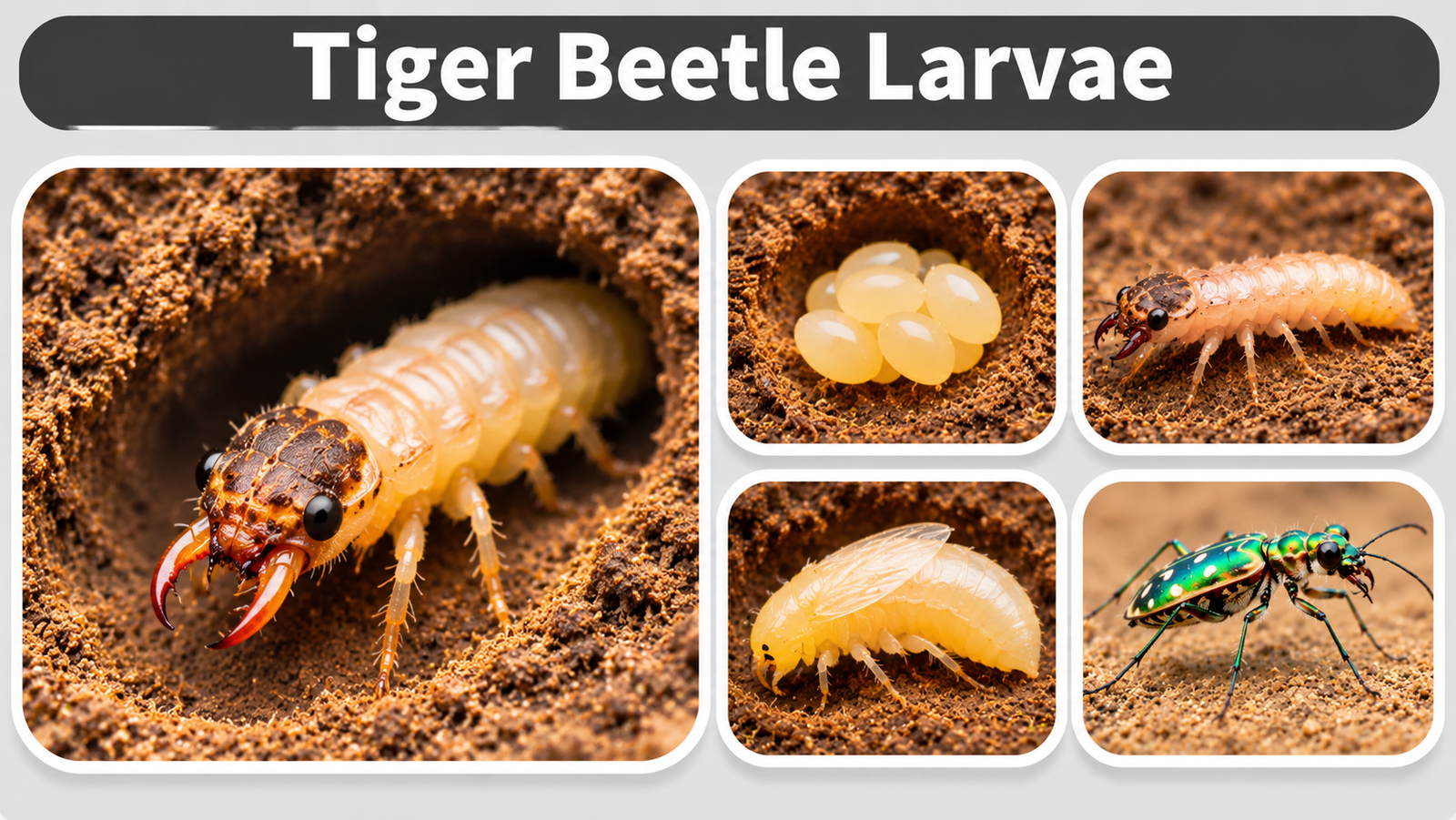
Tiger beetle larvae are underground hunters that spend much of their development in narrow soil burrows. Unlike adult tiger beetles, which chase prey across the ground, larvae wait near a burrow entrance and grab small animals that pass within reach. Their large heads, curved jaws, and unusual body shape help them capture prey and stay anchored inside the tunnel. The details of their development vary among species, but most tiger beetle larvae pass through three growth stages before pupating. Learning how they look, hunt, and develop can help you recognize these fascinating insects and protect their habitat.
What Are Tiger Beetle Larvae?
Tiger beetle larvae are the immature stage of beetles in the tiger beetle group, commonly treated as the subfamily Cicindelinae within the ground beetle family Carabidae. They hatch from eggs laid in soil and develop underground before becoming pupae and then adult beetles.
A larva does not look much like the brightly colored adult. It has a long, segmented body, a broad head, strong jaws, and three pairs of legs near the front. Many are pale or whitish, with darker heads and legs. Since most of the body stays inside a burrow, people often notice only the head or the small opening of the tunnel.
Tiger beetle larvae are predators from the time they hatch. They do not usually roam around searching for food. Instead, each larva occupies a burrow and waits for small prey to walk close enough to seize. This sit-and-wait strategy allows it to hunt while remaining sheltered below ground.
There are many tiger beetle species, and their larvae can differ in size, color, and habitat. A description that fits one species may not match every tiger beetle. For accurate identification, consider the location, the soil, the burrow, and the larva’s physical features together.
How to Identify a Tiger Beetle Larva
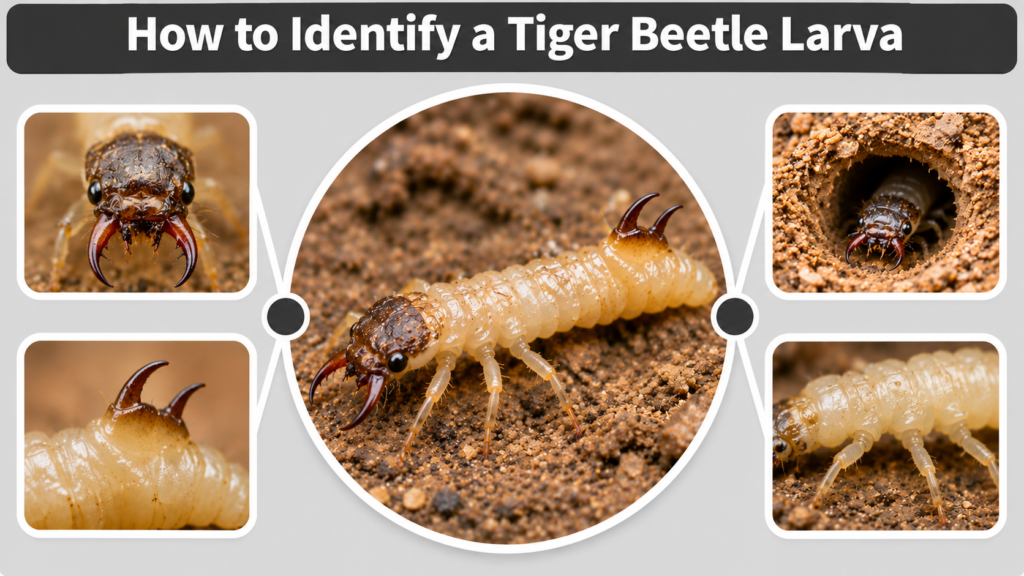
A typical tiger beetle larva has a large, flattened head that appears broad in relation to its body. Its strong, curved mandibles—the paired jaws—are used to grab prey. The head and front section may sit at the entrance of a burrow, making the larva look as if it is part of the soil surface.
The body is elongated and segmented, with three pairs of short legs near the head. A distinctive feature on the abdomen is a raised hump bearing backward-pointing hooks. These hooks help the larva brace itself against the tunnel walls when it lunges at prey. If the prey struggles, the hooks help keep the larva from being pulled out of its burrow.
Color alone is not a reliable way to identify one. Larvae may look pale, cream-colored, brownish, or dark in different areas, and their appearance changes as they grow. They also spend most of their time underground, so people may see only a partial view.
A small, round hole in bare soil may indicate an insect burrow, but it is not enough to confirm that a tiger beetle made it. Other insects can create similar openings. Tiger beetle burrows are often found in open ground suitable for the local species, and the larva may sometimes be seen positioned just below the entrance. Avoid poking into a hole to check: doing so can injure the insect or collapse its tunnel.
Tiger Beetle Larval Burrows
The burrow is both a shelter and a hunting station. After hatching, a larva typically digs into the soil and makes a narrow tunnel with an opening at the surface. It positions itself near the top, with its head ready to detect and seize passing prey.
Burrow depth and structure vary with species, soil conditions, and the larva’s age. As the larva grows, it may extend or reshape its tunnel. A burrow in loose sand may differ from one in compact soil. Some tiger beetle larvae live in sandy areas, while others occupy suitable open ground near rivers, beaches, grasslands, or other habitats.
The entrance helps the larva keep watch for prey while remaining mostly hidden. Its head can fit close to the opening, and the body stays inside the tunnel. When an insect passes nearby, the larva can spring forward, grab it with its jaws, and pull it below the surface.
Burrows may be difficult to see, and their presence can be easy to overlook. They can also be damaged by heavy foot traffic, digging, or repeated disturbance of the soil. If you find possible burrows, leave them undisturbed and observe from a short distance.
What Do Tiger Beetle Larvae Eat?
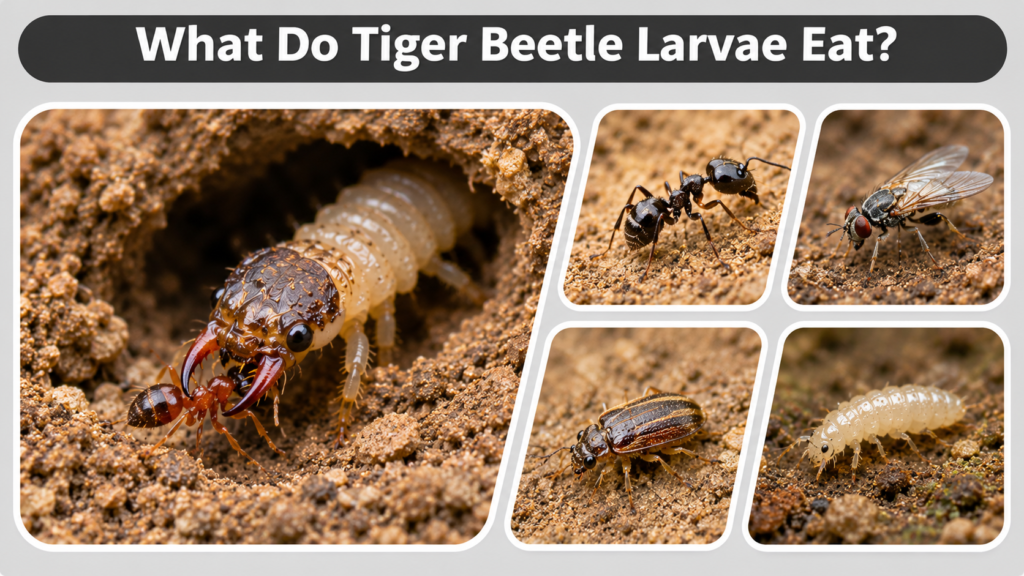
Tiger beetle larvae eat small invertebrates that move within reach of their burrows. Ants are common prey for some species, while other possible prey include small insects and other soil-surface animals. The precise diet depends on the tiger beetle species, prey available in its habitat, and the larva’s size.
To hunt, a larva waits with its jaws ready near the burrow entrance. When prey comes close, it lunges forward and grips the animal with its mandibles. It then draws the prey into the tunnel to feed. Its anchored position helps it hold on during the struggle.
This method differs from the hunting behavior of adult tiger beetles. Adults generally move across the surface in search of prey, while larvae rely on an ambush from a fixed burrow. Both stages are predatory, but they use different strategies and occupy different positions in the habitat.
Tiger beetle larvae are not plant-eating grubs and are not known for damaging garden plants, stored food, or household materials. They are part of the natural predator community in the places where they live.
Tiger Beetle Larval Stages and Growth
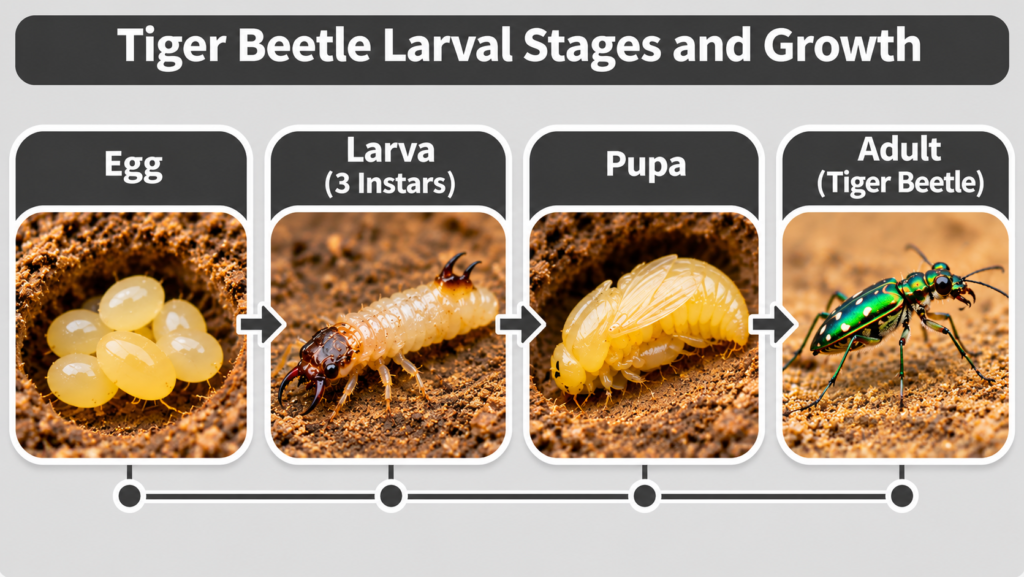
Tiger beetles undergo complete metamorphosis: egg, larva, pupa, and adult. In many species, the larva passes through three growth stages called instars. Between instars, it sheds its outer covering so it can grow. The larva’s body and burrow generally become larger as development continues.
The length of the larval period varies widely. Some species complete development in roughly a year, while others take multiple years. Climate, food availability, and species biology all affect how quickly a larva grows. In regions with cold winters, a larva may spend part of the year inactive below ground.
Once a larva reaches its final growth stage, it prepares to pupate. It may close or block the burrow entrance and create a chamber in the soil. Inside that chamber, it changes into a pupa. During pupation, it gradually transforms into the adult form, including the legs, wings, eyes, and body structure associated with the beetle.
When development is complete, the adult emerges from the soil. The newly emerged beetle may need time for its body and wing cases to harden. It then begins the surface-dwelling stage of its life, hunting and eventually reproducing.
Where Do Tiger Beetle Larvae Live?
Tiger beetle larvae live in soil within the habitats occupied by their species. Many are associated with open, sunny locations where adults can hunt and females can lay eggs. These places can include sandy beaches, riverbanks, dunes, grasslands, heathlands, woodland openings, and patches of bare soil.
Different species have different habitat needs. A beach-dwelling species may depend on a particular stretch of sand, while another may be found on dry, open ground inland. Soil texture, moisture, exposure to sunlight, vegetation, and prey availability can all influence whether a site is suitable.
The larva’s habitat needs may also change as the environment changes. Flooding, erosion, vegetation growth, land development, or intensive recreation can affect burrows and feeding areas. Because many larvae remain underground for a long time, disturbance can impact them even when no adult beetles are visible.
Natural Threats and Survival
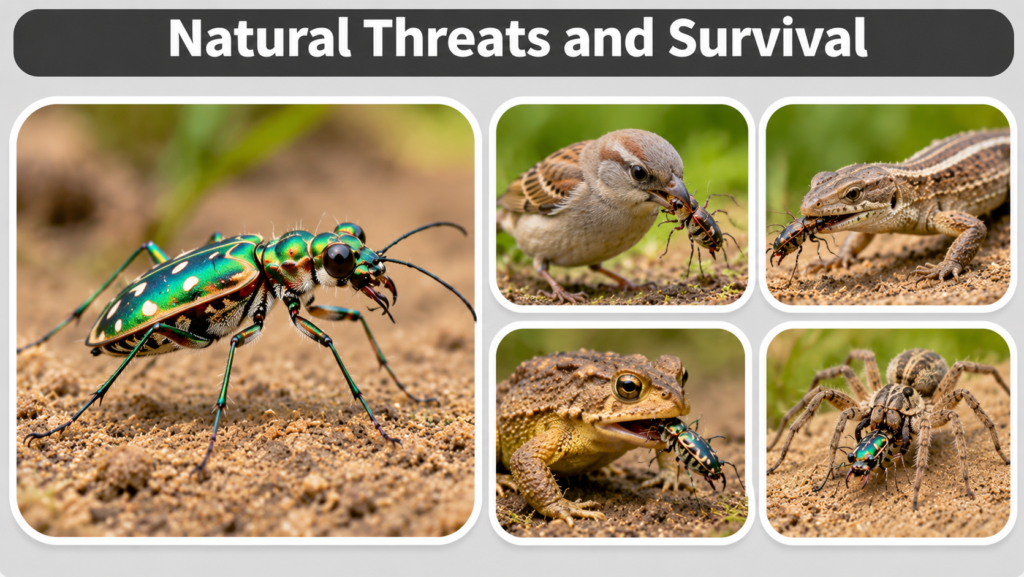
Tiger beetle larvae are predators, but they can also become prey. Birds and other animals may feed on them, and some wasps and flies parasitize beetle larvae. A parasitoid deposits an egg on or near a host; its young then develop by feeding on the host. The exact enemies vary by region and species.
Living inside a burrow offers some protection from predators and harsh surface conditions. The larva can retreat deeper into the tunnel when disturbed, while its concealed position helps it ambush prey. The burrow’s anchoring hooks also help during a struggle with prey.
However, a burrow does not protect the larva from every threat. Soil compaction, excavation, habitat destruction, and repeated disturbance may damage the tunnel or prevent larvae from completing development. Species with narrow habitat requirements may be particularly sensitive to changes in the places where they breed.
Are Tiger Beetle Larvae Harmful to People?
Tiger beetle larvae are not considered a danger to people. They do not seek out humans or feed on human food, and their burrows are generally small and unobtrusive. Their jaws are adapted for catching small invertebrates, not for attacking people.
It is still best not to handle a larva. It may try to defend itself if picked up, and handling can injure its delicate body. Digging into a burrow to find the larva can also destroy its shelter. For a closer look, use a camera from above and leave the soil intact.
How to Observe Tiger Beetle Larvae Responsibly
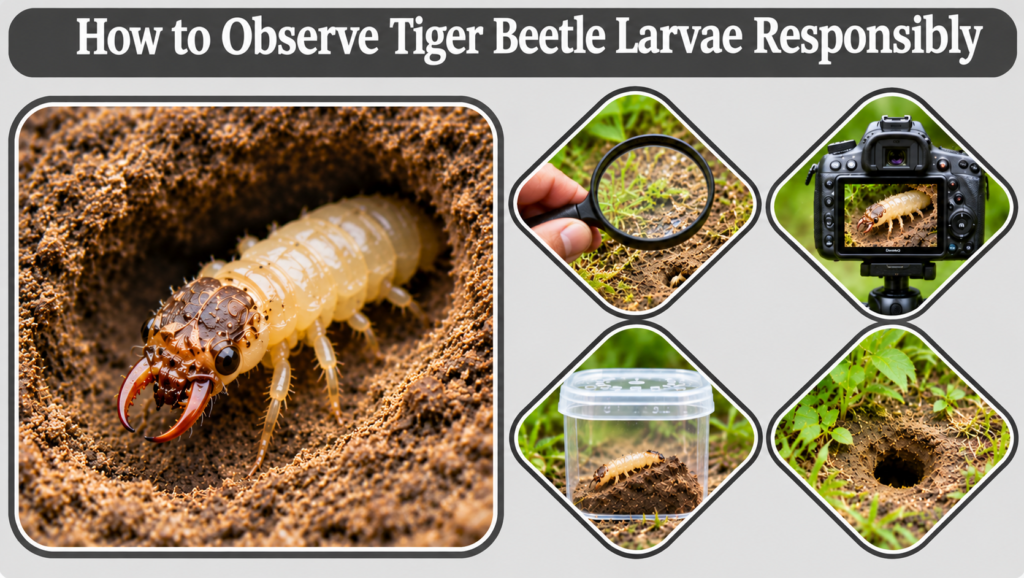
Look for possible burrows in open areas where tiger beetles are known to occur, but remember that small holes can be difficult to identify from appearance alone. Watch quietly and avoid blocking the entrance. If the larva is near the surface, you may see it withdraw when it senses movement.
Do not insert a stick, blade of grass, or other object into the tunnel. This can injure the larva, damage the burrow, or disturb the soil around it. Avoid stepping on visible openings, especially where many burrows are clustered together.
Photographs, location notes, and observations of nearby adult beetles can help with identification. If the species is rare or protected in your area, follow local wildlife guidance and avoid sharing precise locations publicly when doing so could attract harmful disturbance.
Why Tiger Beetle Larvae Matter
Tiger beetle larvae are part of the natural food web. As predators, they feed on other small invertebrates, and they in turn may be eaten or parasitized by other animals. Their presence can reflect the availability of suitable soil and habitat conditions for a particular species.
Because the larvae spend much of their lives below ground, they are easy to miss in wildlife surveys. Protecting the places where they live means paying attention not only to adult beetles but also to their breeding areas and burrows.
Understanding the larval stage gives a fuller picture of the tiger beetle’s life cycle. The adult may be the most visible stage, but the larva’s underground hunting strategy is a key part of how these beetles survive and develop.
FAQs About Tiger Beetle Larvae
1. What does a tiger beetle larva look like?
A tiger beetle larva has a pale, segmented body, a large flattened head, strong jaws, and three pairs of legs near the front. It also has a raised, hooked section on its back that helps it anchor itself inside its burrow.
2. Where do tiger beetle larvae live?
They live in narrow burrows in soil. Depending on the species, these burrows may be found in sandy beaches, riverbanks, dunes, grasslands, heathlands, or other open habitats.
3. What do tiger beetle larvae eat?
They are predators that ambush small invertebrates passing near the burrow entrance. Ants are common prey for some species, along with other small insects and ground-dwelling animals.
4. How long do tiger beetle larvae stay underground?
The larval stage varies by species and conditions. Some tiger beetles develop in about a year, while others remain larvae for multiple years before pupating.
5. Are tiger beetle larvae harmful to people or gardens?
No. They do not damage plants or household materials and are not considered dangerous to people. Avoid handling them or disturbing their burrows.