The dogbane leaf beetle (Chrysochus auratus) is one of North America’s most colorful beetles, known for its brilliant metallic green, blue, copper, and golden appearance. These small insects are commonly found on dogbane and milkweed plants, where they feed on leaves and spend much of their lives. Despite their striking appearance, dogbane leaf beetles are generally harmless to humans and rarely cause serious plant damage. Understanding their identification, habitat, diet, life cycle, and behavior can help you recognize these beautiful beetles and appreciate their role in nature.
What Is a Dogbane Leaf Beetle?
The dogbane leaf beetle (Chrysochus auratus) is a species of leaf beetle belonging to the family Chrysomelidae. It is native to North America and is especially recognized for its colorful, iridescent body.
Unlike many garden beetles that feed on vegetables and ornamental plants, this species primarily depends on plants in the dogbane family, particularly dogbane and certain milkweeds.
Dogbane leaf beetles are most commonly observed during late spring and summer when adult beetles become active on their host plants.
Dogbane Leaf Beetle Scientific Classification
| Classification | Details |
|---|---|
| Common Name | Dogbane Leaf Beetle |
| Scientific Name | Chrysochus auratus |
| Family | Chrysomelidae |
| Order | Coleoptera |
| Native Range | North America |
| Primary Food | Dogbane and milkweed plants |
| Body Length | Approximately 8–11 mm |
| Color | Metallic green, blue, copper, and gold |
How to Identify a Dogbane Leaf Beetle
Dogbane leaf beetles are relatively easy to recognize because of their distinctive metallic coloration. Their bodies reflect sunlight, creating different colors depending on the viewing angle.
Adult beetles have an oval, slightly elongated body with hardened wing covers and a smooth, shiny surface.
Physical Characteristics
Several features can help identify dogbane leaf beetles:
- Metallic coloration: Brilliant green, blue, copper, or golden reflections.
- Body size: Usually around 8–11 mm long.
- Body shape: Oval, elongated, and slightly convex.
- Antennae: Slender, segmented, and relatively short.
- Legs: Dark-colored with a metallic appearance.
- Wing covers: Smooth, shiny elytra that protect the wings underneath.
Their colors are produced largely by microscopic structures that reflect light rather than ordinary pigments alone.
Male vs. Female Dogbane Leaf Beetle
Male and female dogbane leaf beetles look very similar, making identification by appearance alone difficult.
Females may have slightly larger or broader abdomens, particularly when carrying eggs. However, body size and coloration are not reliable methods for determining sex.
During the breeding season, males and females are frequently observed mating on dogbane leaves and stems.
Where Do Dogbane Leaf Beetles Live?
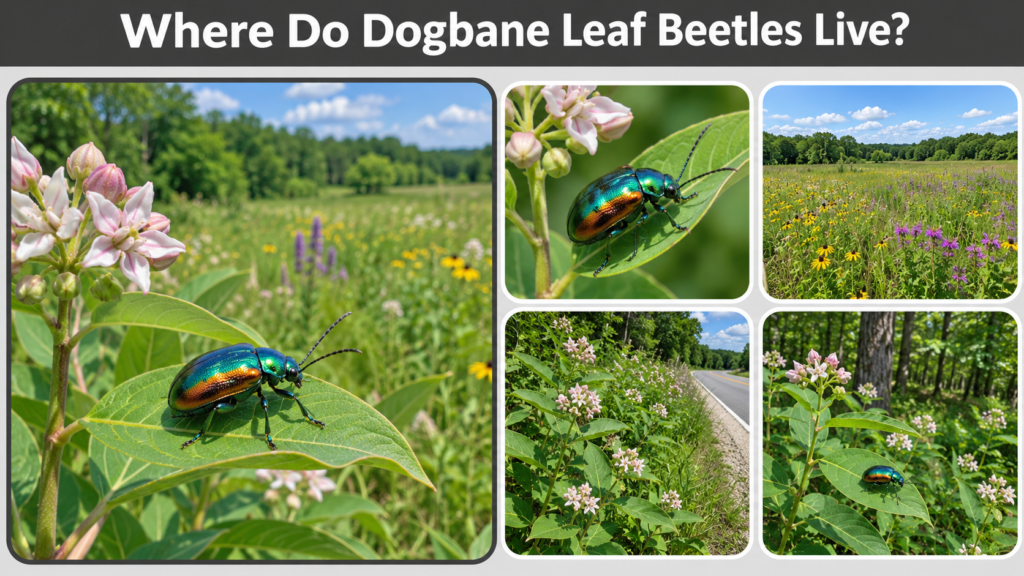
Dogbane leaf beetles are native to North America and occur across much of the eastern United States and parts of southern Canada.
Their distribution is closely associated with the availability of suitable host plants.
They prefer open, sunny habitats where dogbane grows naturally.
Common Dogbane Leaf Beetle Habitats
These beetles are frequently found in:
- Meadows: Open grassy areas containing wild dogbane plants.
- Fields: Abandoned agricultural land and natural grasslands.
- Roadsides: Sunny roadside vegetation with established host plants.
- Forest edges: Open woodland borders receiving adequate sunlight.
- Gardens: Native plant gardens where dogbane or milkweed grows.
Adult beetles are particularly noticeable on warm, sunny days when they feed and mate on exposed foliage.
What Do Dogbane Leaf Beetles Eat?
Dogbane leaf beetles primarily feed on plants in the dogbane family, Apocynaceae. Adults consume leaves, while developing larvae feed on underground portions of their host plants.
The most familiar host is spreading dogbane (Apocynum androsaemifolium), although other dogbane species may also support these insects.
Common Host Plants
Dogbane leaf beetles may feed on:
- Spreading dogbane (Apocynum androsaemifolium).
- Hemp dogbane (Apocynum cannabinum).
- Certain milkweed species (Asclepias spp.).
- Other suitable plants in the dogbane family.
Adult beetles usually chew small sections of leaves, leaving irregular feeding marks.
Why Do Dogbane Leaf Beetles Eat Toxic Plants?
Dogbane plants contain defensive chemicals, including cardiac glycosides, that can be harmful to many animals.
Dogbane leaf beetles have evolved adaptations that allow them to feed on these chemically defended plants.
They can accumulate certain plant toxins and use them as protection against predators.
Their striking metallic appearance may also help predators recognize them, although coloration alone does not establish a warning function.
Dogbane Leaf Beetle Life Cycle
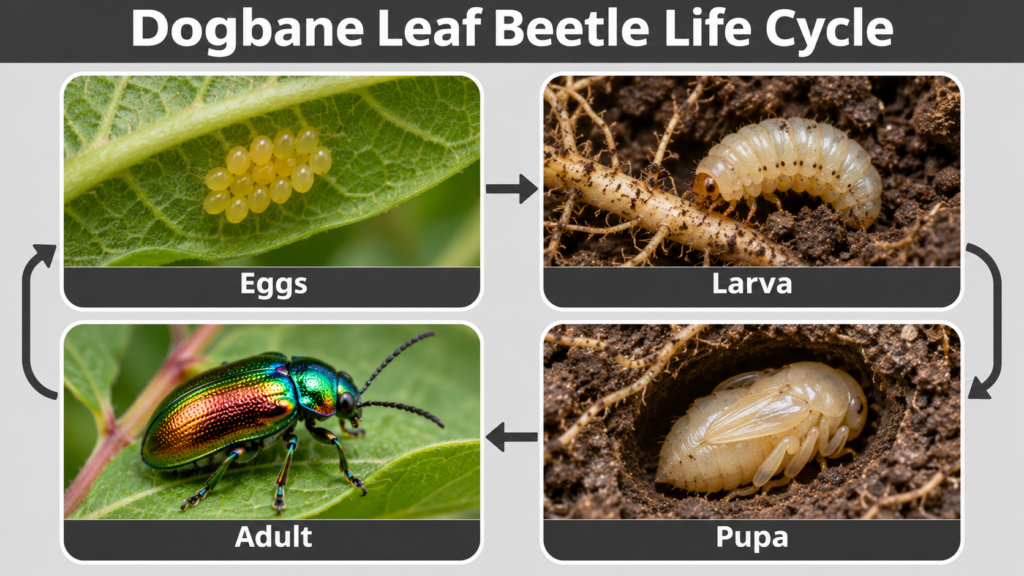
Dogbane leaf beetles undergo complete metamorphosis, developing through four stages: egg, larva, pupa, and adult.
Their development is closely associated with dogbane plants, which provide food for both adults and immature beetles.
1. Egg Stage
Female dogbane leaf beetles lay eggs on or near suitable host plants.
The eggs are typically deposited in groups, often on the undersides of leaves. Females may cover the eggs with protective material.
After an incubation period, the eggs hatch into young larvae.
2. Larval Stage
Dogbane leaf beetle larvae live primarily underground, where they feed on the roots of host plants.
Unlike adults, which are easily seen on leaves, larvae remain hidden in the soil.
They continue feeding and growing through several developmental stages before pupation.
3. Pupal Stage
After completing larval development, the beetles enter the pupal stage in the soil.
During this period, their bodies transform into the recognizable adult beetle form.
The duration of pupation depends on environmental conditions.
4. Adult Stage
Adult dogbane leaf beetles emerge and begin feeding on host plant foliage.
They spend much of their active lives eating, mating, and reproducing.
This species generally completes one generation per year, with immature stages overwintering underground.
Are Dogbane Leaf Beetles Poisonous?
Dogbane leaf beetles can accumulate toxic compounds from their host plants, helping protect them from certain predators.
However, they are not considered dangerous to humans during ordinary contact.
They do not possess stingers, and their primary defensive strategy involves chemical protection rather than physical aggression.
Avoid eating or deliberately handling these beetles unnecessarily, and wash your hands after contact with unfamiliar insects.
Do Dogbane Leaf Beetles Bite?
Dogbane leaf beetles are not known for biting humans.
Although they possess chewing mouthparts, these are adapted for feeding on plant material.
When disturbed, they generally cling to vegetation, move away, or drop from the plant rather than attack.
Are Dogbane Leaf Beetles Harmful to Plants?
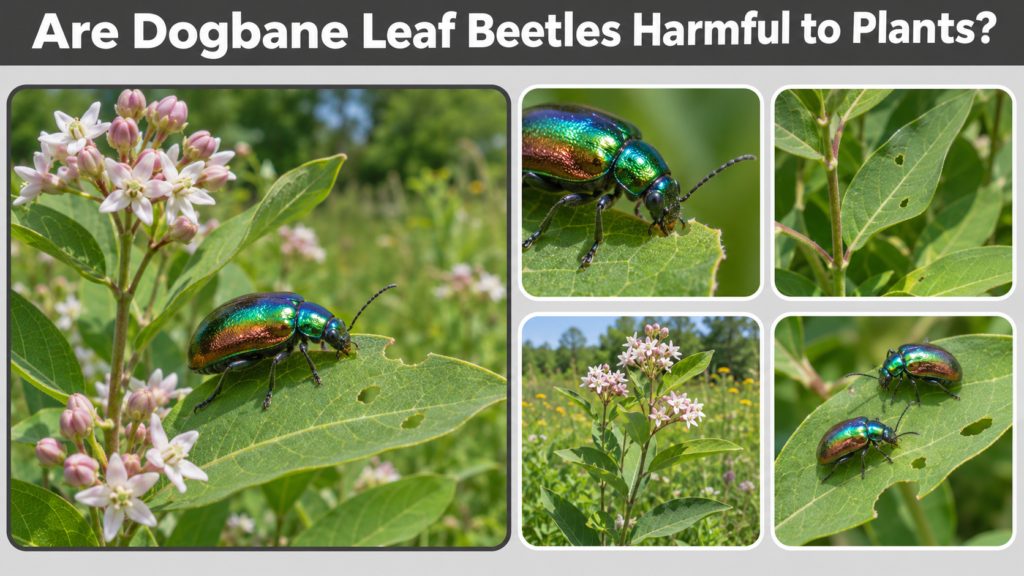
Dogbane leaf beetles consume foliage and can leave small holes or irregular chewing marks on host plants.
However, they rarely cause significant damage to healthy, established dogbane populations.
Because dogbane is often considered a wild plant or agricultural weed, these beetles are generally not viewed as serious garden pests.
Signs of Dogbane Leaf Beetle Damage
Common signs include:
- Small irregular holes in dogbane leaves.
- Chewed leaf margins.
- Adult metallic beetles resting on foliage.
- Multiple beetles gathering on individual plants.
- Occasional thinning of leaves during heavy feeding.
Most affected plants continue growing normally despite moderate feeding.
How to Get Rid of Dogbane Leaf Beetles Naturally

Dogbane leaf beetles rarely require control because they usually cause limited plant damage.
However, if large numbers are affecting valued plants, several nonchemical management methods may help.
1. Remove Beetles Manually
Inspect host plants and gently remove adult beetles by hand.
Relocating them to an area containing suitable wild host plants may be an option where local regulations allow it.
2. Monitor Plant Damage
Check affected plants regularly to determine whether feeding is actually harming their growth.
A few holes in leaves generally do not justify treatment.
3. Maintain Healthy Plants
Provide appropriate growing conditions for valued plants.
Healthy, established plants usually tolerate minor leaf feeding without lasting damage.
4. Avoid Unnecessary Pesticides
Broad-spectrum insecticides can harm beneficial insects and other wildlife.
Because dogbane leaf beetles are native insects that rarely become serious pests, chemical treatment is generally unnecessary.
Dogbane Leaf Beetle vs. Japanese Beetle
Dogbane leaf beetles and Japanese beetles can both display metallic colors, but they differ in appearance, food preferences, and potential damage.
| Feature | Dogbane Leaf Beetle | Japanese Beetle |
|---|---|---|
| Scientific Name | Chrysochus auratus | Popillia japonica |
| Body Color | Metallic green, blue, and copper | Metallic green with copper-brown wing covers |
| Body Length | 8–11 mm | Approximately 10–12 mm |
| Main Food | Dogbane and certain milkweeds | Hundreds of plant species |
| Plant Damage | Usually minor | Can cause severe defoliation |
| Pest Status | Generally not a serious pest | Significant invasive pest in North America |
Japanese beetles also have distinctive white hair tufts along the sides of their abdomens, which dogbane leaf beetles lack.
FAQs
1. Are Dogbane Leaf Beetles Rare?
Dogbane leaf beetles are not generally considered rare across their established North American range. They can be locally abundant wherever suitable dogbane plants grow. However, their specialized feeding habits mean they may be absent from areas without appropriate host plants.
2. Can Dogbane Leaf Beetles Fly?
Yes, dogbane leaf beetles have functional wings beneath their hardened wing covers and can fly. However, adults are frequently observed walking, feeding, or mating on dogbane foliage. Flying allows them to move between host plants and locate suitable areas for feeding and reproduction.
3. What Makes Dogbane Leaf Beetles So Colorful?
Their brilliant metallic appearance results primarily from microscopic structures in their outer body surfaces that reflect and manipulate light. This structural coloration produces shimmering green, blue, copper, and golden tones. The colors can appear different depending on lighting conditions and viewing angles.
4. How Long Do Dogbane Leaf Beetles Live?
Dogbane leaf beetles generally complete one generation annually, although individual adult lifespans are much shorter than the full life cycle. Adults are primarily active during the warmer months. Much of the insect’s development occurs underground, where larvae feed and survive unfavorable seasonal conditions.
5. Are Dogbane Leaf Beetles Good for the Garden?
Dogbane leaf beetles are native insects that contribute to local biodiversity and natural food webs. They usually cause minimal damage to healthy host plants. In native plant gardens, they can be appreciated as part of the ecosystem rather than treated as unwanted pests.