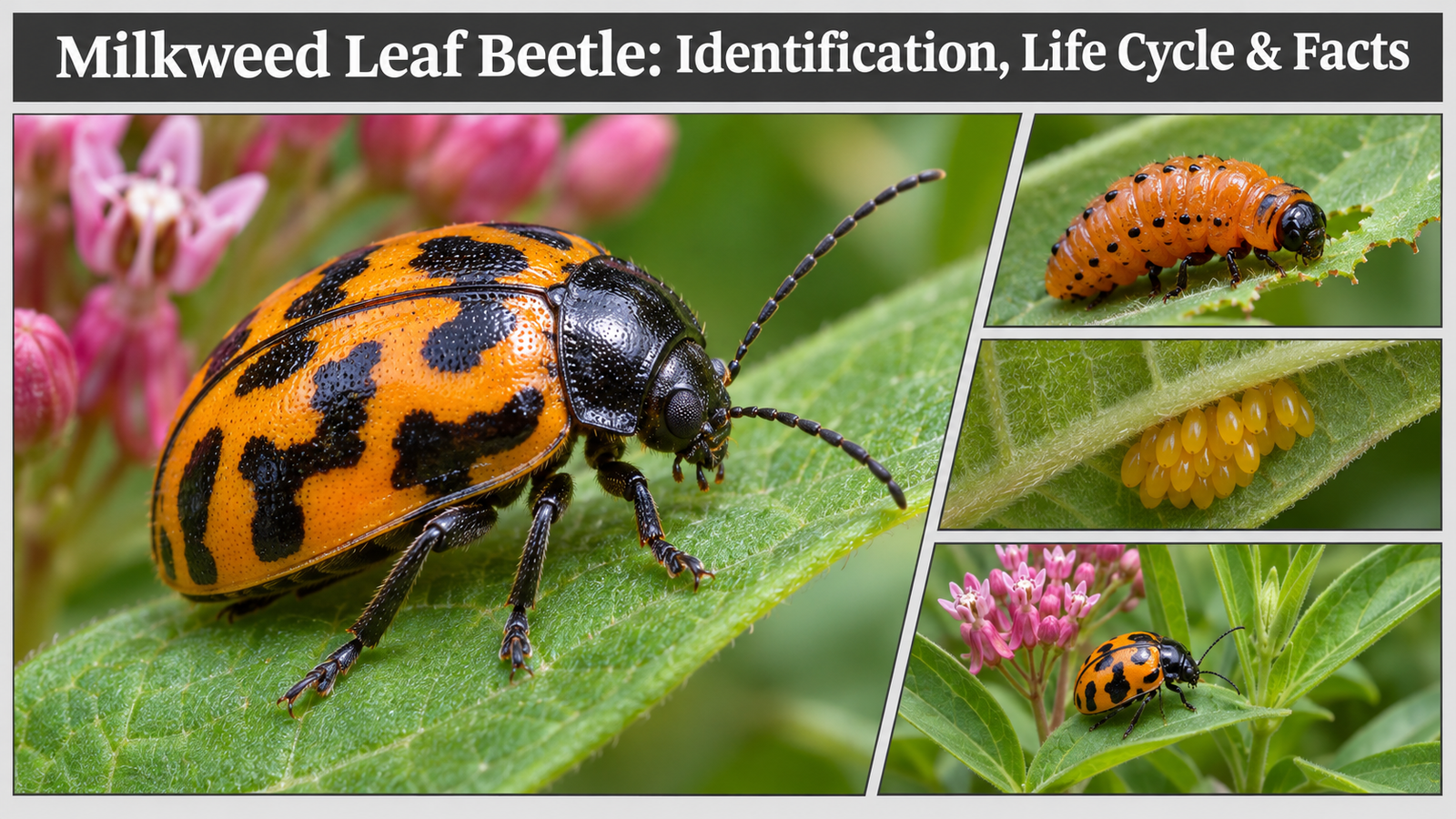
The milkweed leaf beetle (Labidomera clivicollis) is a colorful insect commonly found on milkweed plants throughout North America. Also known as the swamp milkweed leaf beetle, this species is recognized by its orange or yellow wing covers decorated with dark markings. Both adults and larvae feed on milkweed leaves, sometimes causing noticeable damage. However, these native beetles are also part of the natural milkweed ecosystem that supports monarch butterflies and other wildlife. This guide explores milkweed leaf beetle identification, habitat, diet, life cycle, behavior, and control.
What Is a Milkweed Leaf Beetle?
The milkweed leaf beetle is a North American beetle belonging to the family Chrysomelidae. Its scientific name is Labidomera clivicollis. It is closely associated with milkweed plants, particularly swamp milkweed, where adults feed, mate, and lay eggs. Unlike predatory lady beetles, milkweed leaf beetles primarily consume plant foliage and have specialized adaptations that help them tolerate milkweed’s natural chemical defenses.
Milkweed Leaf Beetle Scientific Classification
The milkweed leaf beetle belongs to the following taxonomic groups:
- Common Name: Milkweed Leaf Beetle
- Other Name: Swamp Milkweed Leaf Beetle
- Scientific Name: Labidomera clivicollis
- Family: Chrysomelidae
- Order: Coleoptera
- Genus: Labidomera
- Distribution: Primarily North America
- Primary Host Plant: Swamp milkweed (Asclepias incarnata)
It is a native species that has evolved alongside milkweed plants and other insects inhabiting the same environments.
How to Identify a Milkweed Leaf Beetle
Milkweed leaf beetles are relatively easy to recognize because of their rounded bodies and distinctive orange-and-black coloration. However, their appearance can vary considerably between individuals. Some have large dark patches, while others display smaller markings. Their resemblance to lady beetles can also cause confusion, especially when adults are resting on leaves.
Milkweed Leaf Beetle Identification Features
Look for these characteristics:
- Orange Wing Covers: Adults usually have orange or yellow wing covers with variable black or dark-blue markings.
- Black Head: The head is predominantly black.
- Rounded Body: Adults have broad, oval-shaped bodies that resemble certain lady beetles.
- Body Size: Most adults measure approximately 8–13 millimeters long.
- Dark Pronotum: The section directly behind the head is primarily black.
- Visible Antennae: Adults possess relatively short, segmented antennae.
- Plant Association: They are frequently found resting or feeding on milkweed leaves.
Milkweed Leaf Beetle vs. Ladybug
Milkweed leaf beetles are sometimes mistaken for ladybugs because both insects have rounded bodies and colorful wing covers.
However, ladybugs belong to the family Coccinellidae, while milkweed leaf beetles belong to Chrysomelidae.
Most familiar garden ladybugs feed on aphids and other small insects. In contrast, milkweed leaf beetles primarily eat milkweed foliage.
Where Do Milkweed Leaf Beetles Live?
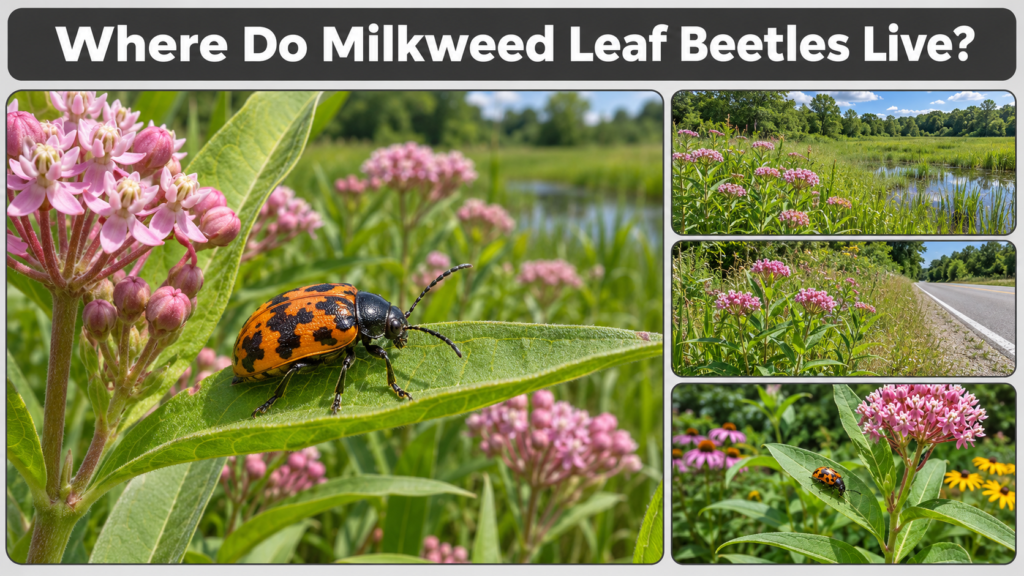
Milkweed leaf beetles are native to North America and occur mainly across areas east of the Rocky Mountains, extending into parts of Canada and northern Mexico. Their distribution is closely associated with the availability of suitable host plants. They are especially common in open environments where milkweed grows naturally, although they can also appear in home gardens and managed landscapes.
Milkweed Leaf Beetle Habitat
Common habitats include:
- Wet meadows containing swamp milkweed.
- Grasslands with naturally growing milkweed.
- Roadside vegetation and drainage areas.
- Wetlands, marsh margins, and open fields.
- Prairie habitats supporting native wildflowers.
- Pollinator gardens containing milkweed plants.
These environments provide food, mating sites, and suitable conditions for reproduction.
Swamp Milkweed Leaf Beetle Range
Swamp milkweed leaf beetles occur across much of eastern and central North America.
Their presence has been documented in numerous U.S. states, including Illinois, Missouri, Oklahoma, and Texas.
They may also occur in other regions where suitable milkweed hosts are available. Their abundance varies according to local conditions, seasonal changes, and host plant availability.
What Do Milkweed Leaf Beetles Eat?
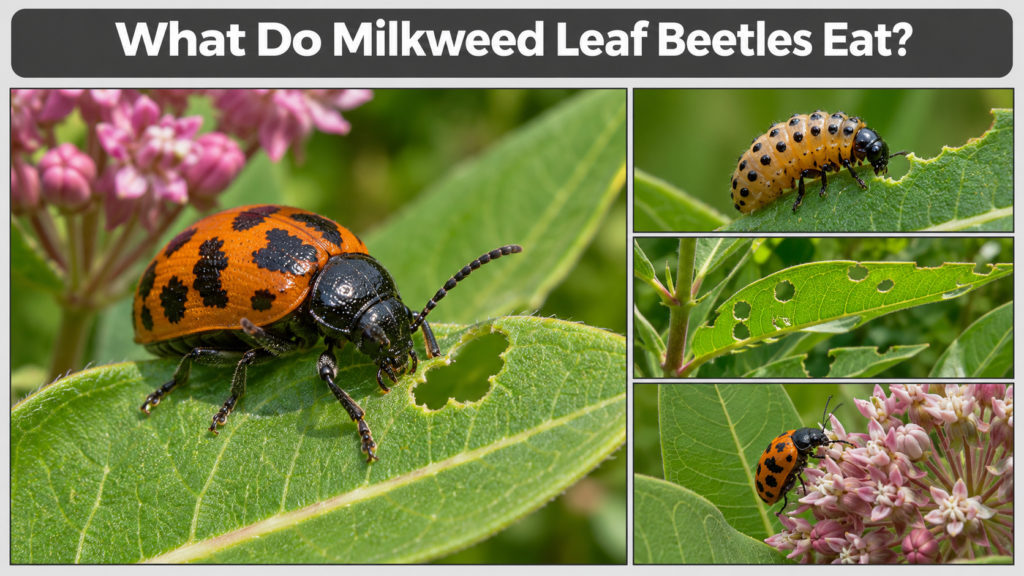
Milkweed leaf beetles primarily feed on milkweed leaves. Their preferred host is swamp milkweed (Asclepias incarnata), although they also consume common milkweed (Asclepias syriaca) and certain related plants. Both adults and larvae feed on foliage, creating irregular holes and occasionally removing substantial portions of leaves.
Milkweed Leaf Beetle Diet
Their food plants include:
- Swamp Milkweed: A primary host and preferred food source.
- Common Milkweed: Another frequently used host plant.
- Other Milkweed Species: Certain locally available Asclepias species.
- Related Plants: Some species in the dogbane family may also support feeding.
Unlike ladybugs, these beetles do not primarily hunt aphids or other common garden pests.
How Do They Eat Toxic Milkweed?
Milkweed plants produce sticky latex containing defensive compounds called cardenolides. These chemicals help discourage many insects from consuming the leaves.
However, milkweed leaf beetles have evolved special adaptations that allow them to feed successfully.
Before eating, adults and larvae may cut small leaf veins, allowing latex to drain away from the feeding area. This reduces exposure to sticky sap and makes the leaves easier to consume.
Milkweed Leaf Beetle Life Cycle

The milkweed leaf beetle undergoes complete metamorphosis, developing through four stages: egg, larva, pupa, and adult. Reproduction usually occurs on or near milkweed plants, while pupation takes place in the ground. In northern areas, the species generally completes one generation annually, although warmer southern regions may support additional generations during a growing season.
1. Egg Stage
Female milkweed leaf beetles lay eggs on the undersides of milkweed leaves.
The eggs are generally yellowish to orange and attached to the leaf surface in groups.
After hatching, young larvae begin feeding on nearby foliage. Some newly hatched larvae may also consume unhatched eggs.
2. Larval Stage
Milkweed leaf beetle larvae have rounded, soft bodies that may appear orange, grayish, or dark.
Their bodies display black markings, including spots along the sides.
The larvae pass through four developmental stages called instars. During this period, they feed on milkweed leaves and increase significantly in size.
3. Pupal Stage
When fully developed, the larvae leave their host plants and descend to the ground.
They enter the soil, where they transform into pupae.
Inside the pupal stage, the insect undergoes major structural changes, eventually developing the wings and body features of an adult beetle.
4. Adult Stage
Adult beetles emerge from the soil and return to milkweed plants to feed and reproduce.
As temperatures decline, surviving adults seek protected overwintering locations.
They remain relatively inactive during winter before becoming active again in spring, when suitable host plants are available.
Are Milkweed Leaf Beetles Good or Bad?
Milkweed leaf beetles are neither entirely beneficial nor universally harmful. They are native herbivores that naturally feed on milkweed plants and serve as part of the surrounding food web. Although heavy feeding can damage plants, small populations are generally not a serious concern. In gardens designed to support monarch butterflies, allowing some natural insect feeding can help maintain a diverse ecosystem.
Are Milkweed Leaf Beetles Harmful to Plants?
Milkweed leaf beetles can damage plants by chewing holes and removing leaf tissue.
Large populations may cause noticeable defoliation, particularly on young or stressed plants.
However, established milkweed plants often tolerate moderate feeding. Gardeners usually do not need to remove every beetle they encounter.
Do Milkweed Leaf Beetles Harm Monarch Butterflies?
Milkweed leaf beetles are not known as regular predators of monarch butterflies or their caterpillars.
However, both insects depend on milkweed foliage, meaning they may compete for available leaves when plants are heavily defoliated.
Using insecticides against leaf beetles can create a greater threat to monarch caterpillars than limited beetle feeding.
How to Get Rid of Milkweed Leaf Beetles Naturally

Most milkweed leaf beetle populations do not require treatment. Because milkweed is an essential host plant for monarch butterflies, chemical control should generally be avoided unless severe feeding threatens plant survival.
When intervention becomes necessary, use selective methods that minimize disturbance to other wildlife.
Natural Milkweed Leaf Beetle Control Methods
- Handpick Adult Beetles: Remove excess beetles from heavily infested plants.
- Inspect Leaf Undersides: Look for eggs and larvae before populations increase.
- Protect Monarch Caterpillars: Carefully inspect plants before removing insects or foliage.
- Maintain Healthy Milkweed: Provide suitable sunlight, moisture, and growing conditions.
- Encourage Natural Predators: Preserve spiders, predatory bugs, and other beneficial insects.
- Avoid Broad-Spectrum Insecticides: These products can harm monarchs and pollinators.
For severe infestations, consult local extension guidance before considering any labeled insecticidal soap or horticultural oil treatment.
Milkweed Leaf Beetle Predators and Lifespan
Milkweed leaf beetles participate in a complex ecosystem involving host plants, predators, and parasites. Although their bright coloring offers some protection, several animals and insects still attack them. Their survival also depends on seasonal conditions, food availability, and successful overwintering.
What Eats Milkweed Leaf Beetles?
Natural predators include:
- Predatory stink bugs.
- Damsel bugs.
- Certain hoverfly larvae.
- Spiders.
- Some insect-eating birds.
- Other opportunistic predators.
Milkweed leaf beetles can obtain defensive chemicals from their food plants, which may discourage certain predators.
Interestingly, cannibalism also occurs among their larvae, particularly when newly hatched individuals consume unhatched eggs or smaller larvae.
How Long Do Milkweed Leaf Beetles Live?
The exact lifespan of milkweed leaf beetles varies, and comprehensive lifespan estimates are limited.
Adults active during summer may survive for several weeks or months, depending on environmental conditions.
Individuals that successfully overwinter can survive considerably longer because they remain inactive during colder periods before returning to milkweed plants in spring.
FAQs
1. Are Milkweed Leaf Beetles Beneficial?
Milkweed leaf beetles are native insects that contribute to the natural food web. They are not primarily beneficial predators because they feed on milkweed leaves. However, they provide food for other animals and are part of the biodiversity associated with native milkweed habitats.
2. Do Milkweed Leaf Beetles Bite Humans?
Milkweed leaf beetles are not considered dangerous to humans, and there are no well-established reports of harmful bites. They primarily feed on plants rather than people. If handled, they may attempt to escape, but they do not present a significant household or garden safety concern.
3. Are Swamp Milkweed Leaf Beetles the Same as Milkweed Leaf Beetles?
Yes. Swamp milkweed leaf beetle and milkweed leaf beetle are common names for Labidomera clivicollis. The species particularly favors swamp milkweed but also feeds on other milkweed plants. It should not be confused with the red milkweed longhorn beetle or other milkweed-associated insects.
4. What Is a Blue Milkweed Leaf Beetle?
The blue milkweed beetle, Chrysochus cobaltinus, is a different species from the swamp milkweed leaf beetle. It has a metallic blue appearance rather than orange-and-black coloring. Both belong to the leaf beetle family and are associated with milkweed or related host plants.
5. Are Milkweed Leaf Beetle Larvae Harmful to Monarch Caterpillars?
Milkweed leaf beetle larvae are primarily plant feeders rather than monarch predators. Their feeding may reduce available foliage during heavy infestations, but moderate activity is usually tolerable. Removing beetles manually, when truly necessary, is preferable to spraying milkweed used by monarch caterpillars.