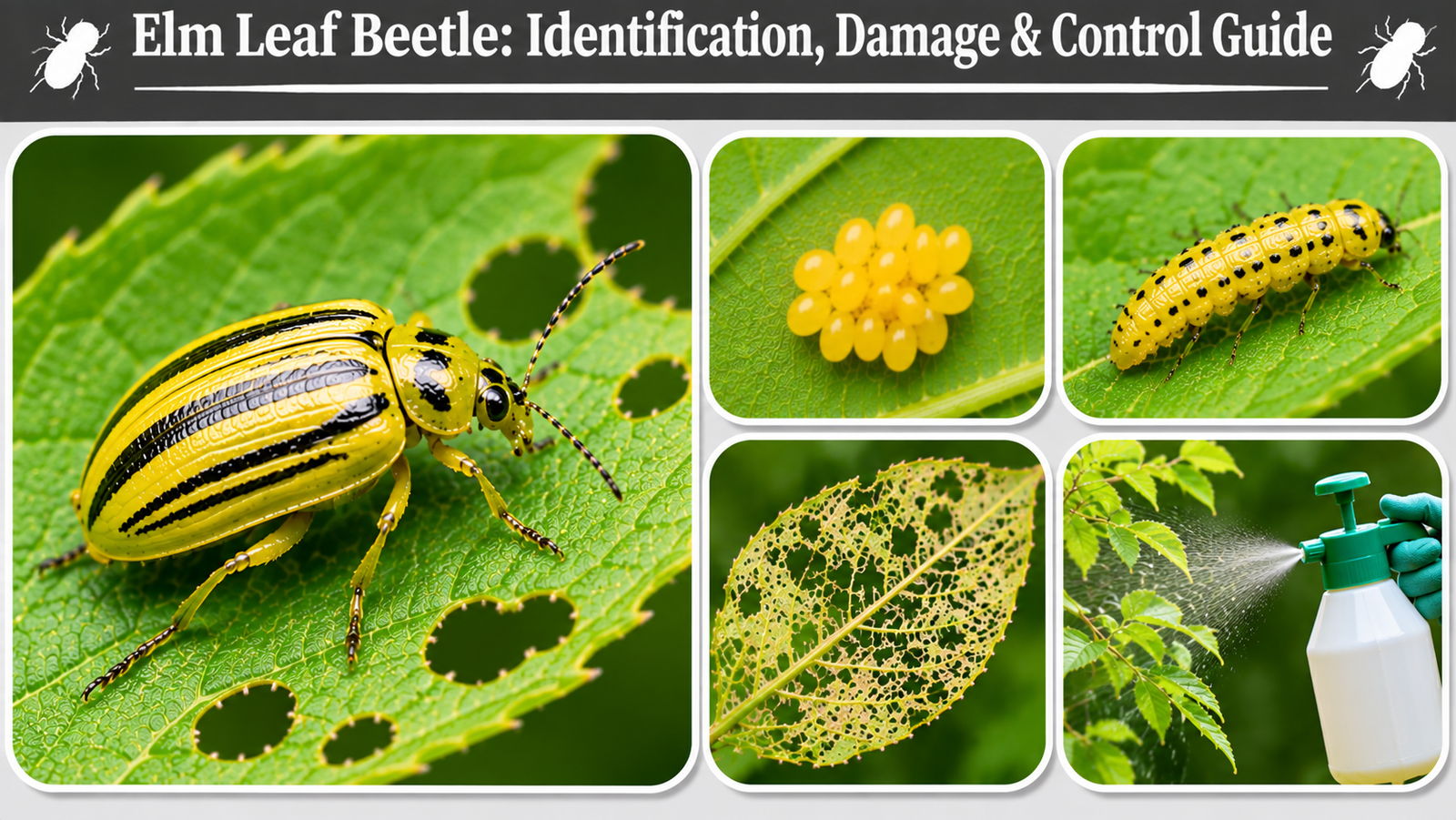
Elm leaf beetles are small, yellowish-green insects known for damaging elm trees by feeding on their leaves. Scientifically called Xanthogaleruca luteola, these beetles can cause serious defoliation when large populations develop. Both adults and larvae damage foliage, leaving holes, brown patches, and skeletonized leaves behind. Elm leaf beetles may also enter homes during colder months while searching for shelter. Although they are generally harmless to humans, repeated infestations can weaken trees. Understanding their identification, life cycle, feeding habits, and treatment options can help homeowners protect their elm trees effectively.
What Is an Elm Leaf Beetle?
The elm leaf beetle is a leaf-feeding insect belonging to the Chrysomelidae family. Originally native to Europe and surrounding regions, it has become established in North America, Australia, and other parts of the world. This species primarily attacks elm trees and is especially problematic where susceptible elm varieties grow close together.
Elm Leaf Beetle Identification
Adult elm leaf beetles are small, oval-shaped insects measuring approximately 6–7 mm long.
Their appearance changes slightly with age and season, but several characteristics make them recognizable.
- Color: Yellowish-green to olive-green body.
- Size: Approximately ¼ inch long.
- Wing markings: Dark longitudinal stripes along the wing covers.
- Head: Yellowish with small black markings.
- Antennae: Slender, segmented, and relatively short.
- Body shape: Elongated oval with hardened wing covers.
Adults often appear on elm leaves during spring and summer.
Larger Elm Leaf Beetle vs. Elm Leaf Beetle
The larger elm leaf beetle (Monocesta coryli) is a different species from the common elm leaf beetle.
It measures approximately 10–16 mm long and has an orange or yellowish body decorated with dark or metallic-blue spots. Some individuals have broad dark bands instead of distinct spots.
The larger species also feeds on elm trees but has a different life cycle and geographic distribution.
Elm Leaf Beetle Eggs and Larvae Identification
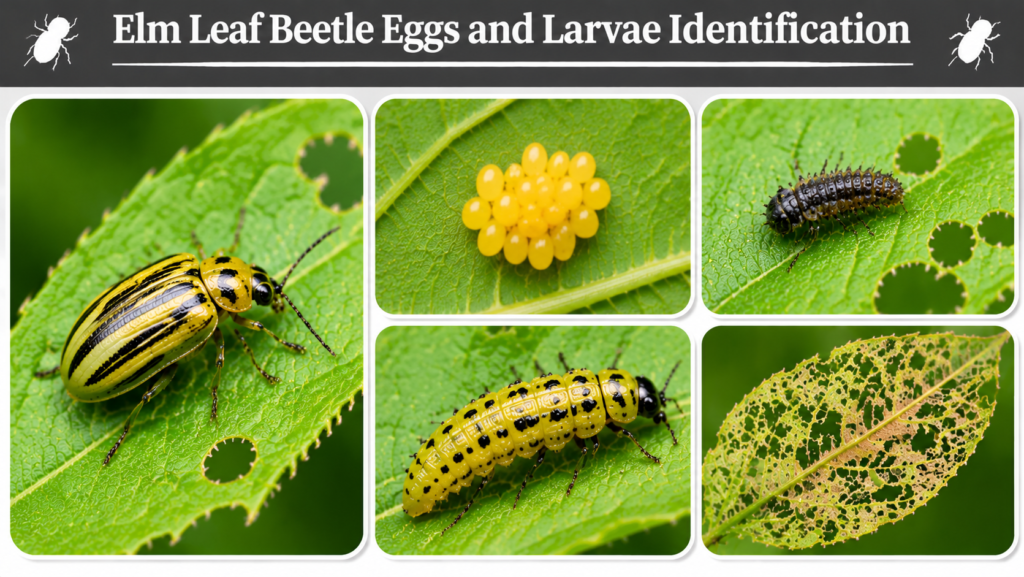
Elm leaf beetles undergo several developmental stages before becoming adults. Their eggs, larvae, and pupae look very different from mature beetles. Identifying these immature stages is particularly useful because larvae cause much of the damage to elm foliage. Early recognition also helps homeowners choose the most effective treatment timing.
What Do Elm Leaf Beetle Eggs Look Like?
Female elm leaf beetles lay small yellow eggs in clusters on the undersides of leaves.
Each cluster usually contains approximately 5–25 eggs arranged in rows.
The eggs are elongated and become darker as they approach hatching. Depending on environmental conditions, they generally hatch within about one week.
Elm Leaf Beetle Larvae Identification
Newly hatched elm leaf beetle larvae are small and dark, often appearing almost black.
As they grow, their bodies become yellowish-green with rows of dark bumps.
Mature larvae have elongated bodies with two prominent dark stripes along their sides.
They feed primarily on the undersides of elm leaves, scraping away soft tissue while leaving the larger veins intact.
Elm Leaf Beetle Pupa
When fully grown, elm leaf beetle larvae move down the tree trunk to find suitable pupation sites.
They often pupate in bark crevices, loose debris, or soil near the tree’s base.
The pupae are usually bright yellow to orange and remain relatively motionless.
Adult beetles generally emerge after approximately one to two weeks, depending on temperature.
Elm Leaf Beetle Life Cycle
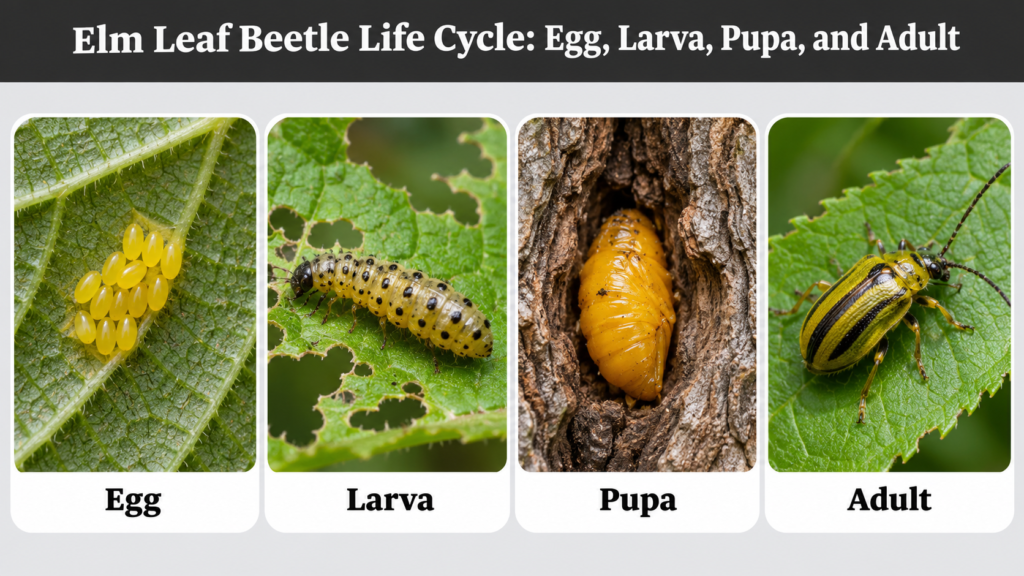
The elm leaf beetle undergoes complete metamorphosis through four stages: egg, larva, pupa, and adult. Its seasonal development depends on temperature and geographic location. In cooler regions, the insect may complete only one generation annually, while warmer areas can support multiple generations during the growing season.
Spring: Adult Emergence and Egg-Laying
Adult elm leaf beetles survive winter in sheltered locations, including bark crevices, woodpiles, and buildings.
When temperatures rise and elm leaves develop, the adults return to trees and begin feeding.
Females subsequently lay eggs on the undersides of leaves.
Summer: Larval Feeding and Pupation
After hatching, larvae begin feeding on elm foliage.
They pass through three larval stages before becoming mature.
Fully grown larvae crawl toward the lower trunk or ground to pupate. Emerging adults then return to the canopy.
Additional generations may develop during warm summers.
Autumn and Winter: Overwintering
As temperatures decline, adult beetles search for protected places to survive winter.
They may gather beneath bark, inside woodpiles, or within building cracks.
During this period, they do not normally feed or reproduce. Activity resumes when favorable spring conditions return.
What Damage Do Elm Leaf Beetles Cause?
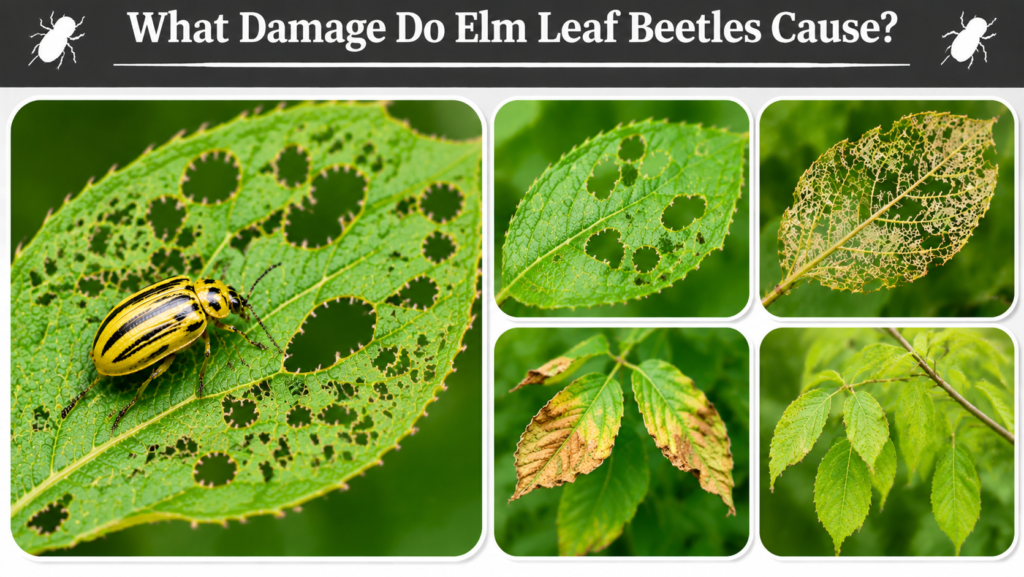
Elm leaf beetles damage trees by removing leaf tissue during feeding. Adults and larvae produce different patterns of injury, helping distinguish their activity. Small infestations usually cause cosmetic problems, but repeated heavy feeding reduces the tree’s ability to produce energy and may weaken its overall health.
Signs of Elm Leaf Beetle Damage
Common symptoms include:
- Small holes: Adult beetles chew irregular holes through leaves.
- Skeletonized foliage: Larvae remove tissue between the leaf veins.
- Brown leaves: Heavily damaged foliage becomes dry and discolored.
- Premature leaf drop: Severely affected leaves may fall early.
- Thinning canopy: Repeated feeding reduces the amount of healthy foliage.
- Reduced vigor: Trees may develop more slowly after multiple infestations.
Can Elm Leaf Beetles Kill Trees?
A single elm leaf beetle infestation rarely kills a healthy, established elm tree.
However, repeated severe defoliation can weaken trees over several growing seasons. Trees experiencing drought, disease, or other environmental stress may suffer greater damage.
Severely weakened elms can become more susceptible to secondary pests and diseases.
How to Get Rid of Elm Leaf Beetles
Effective elm leaf beetle control begins with monitoring trees and determining whether the infestation is severe enough to require treatment. Because larvae cause extensive feeding damage, management is often most successful when they are young. A combination of cultural care, natural enemies, and appropriately timed treatments offers the best long-term results.
Natural Elm Leaf Beetle Control Methods
Several nonchemical methods can help manage infestations:
- Inspect leaves regularly: Look for yellow egg clusters and young larvae.
- Remove accessible eggs: Destroy egg masses on reachable leaves when practical.
- Remove pupae: Collect visible pupae around the base of smaller trees.
- Maintain tree health: Water appropriately during drought and avoid unnecessary root damage.
- Encourage beneficial insects: Preserve predatory insects and parasitic wasps.
- Monitor nearby elms: Check surrounding trees that may support additional beetle populations.
Elm Leaf Beetle Insecticide Treatment
When populations are high and substantial damage is expected, insecticide treatment may be appropriate.
Products containing neem-derived ingredients, horticultural oil, or certain other insecticides can be considered when specifically labeled for the pest and application site.
Treatment is generally most effective against young larvae before extensive leaf damage develops.
Thorough coverage of the leaf undersides is important when applying suitable foliar products.
Always follow local pesticide regulations and label directions.
Elm Leaf Beetle Trunk Injection and Banding
For large trees, professional arborists may use systemic insecticides applied through trunk injection or other approved methods.
Trunk injection allows the tree to absorb an insecticide that moves into foliage and affects feeding beetles.
Another method, bark banding, involves applying an appropriately labeled insecticide around a section of the trunk to target mature larvae moving downward.
These treatments require correct timing and may need professional application.
How to Get Rid of Elm Leaf Beetles in the House
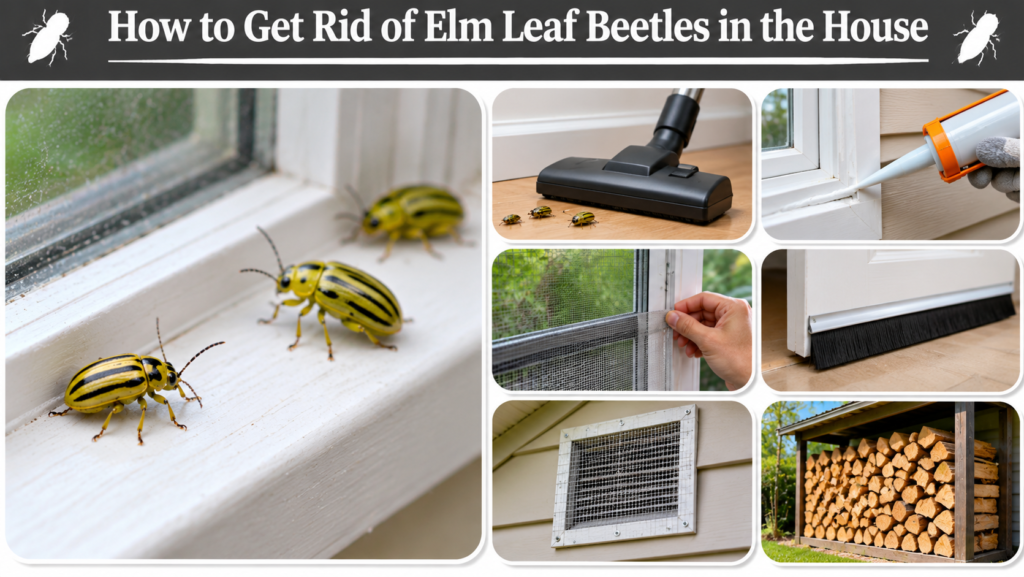
Adult elm leaf beetles sometimes enter homes during late summer and autumn while searching for winter shelter. They may appear around windows, ceilings, attics, and wall openings. Although their presence can be frustrating, they do not reproduce indoors or feed on household materials. Prevention focuses on exclusion rather than repeated indoor pesticide applications.
Removing Elm Leaf Beetles Indoors
The following methods are useful:
- Vacuum visible beetles: Remove adults from walls, windows, and floors.
- Seal cracks: Close gaps around doors, windows, and siding.
- Repair screens: Replace damaged window and ventilation screens.
- Install door sweeps: Reduce entry through gaps beneath doors.
- Inspect attic openings: Cover suitable openings with fine screening.
- Avoid unnecessary indoor spraying: Vacuuming and exclusion are usually sufficient.
Preventing Future Household Infestations
Inspect the exterior of your home before beetles begin seeking winter shelter.
Seal entry points around window frames, rooflines, utility openings, and exterior siding.
Keep firewood and other stored materials organized and avoid bringing beetle-infested wood indoors.
Controlling severe infestations on nearby elm trees may also reduce the number of beetles entering buildings.
FAQs
1. Do elm leaf beetles bite humans?
Elm leaf beetles are not known for biting humans and are generally harmless to people and pets. Their mouthparts are adapted for feeding on elm leaves. Although adults sometimes enter homes in large numbers, they do not feed on humans, damage furniture, or reproduce indoors.
2. Are elm leaf beetles invasive?
Elm leaf beetles are introduced pests in several regions, including North America and Australia. Their original range includes Europe and neighboring areas. They can become invasive because they reproduce successfully on susceptible elm trees and may cause widespread foliage damage during severe outbreaks.
3. What eats elm leaf beetles?
Elm leaf beetles have several natural enemies, including predatory bugs, lacewing larvae, earwigs, and ground beetles. Certain parasitic flies and tiny wasps also attack their eggs, larvae, or pupae. Protecting these beneficial insects can help reduce beetle populations naturally over time.
4. Do elm leaf beetles eat other plants?
The common elm leaf beetle primarily feeds on elm trees belonging to the genus Ulmus. Different elm species vary in susceptibility. It does not normally cause significant damage to unrelated garden plants. However, the larger elm leaf beetle is a separate species that can feed on additional hardwood trees.
5. What is the best time to treat elm leaf beetles?
The best treatment time depends on the method and local conditions. Foliar insecticides are generally most effective when young larvae appear in spring or early summer. Trunk banding targets larvae moving downward before pupation. Tree injections and other systemic treatments require appropriate timing and professional guidance.