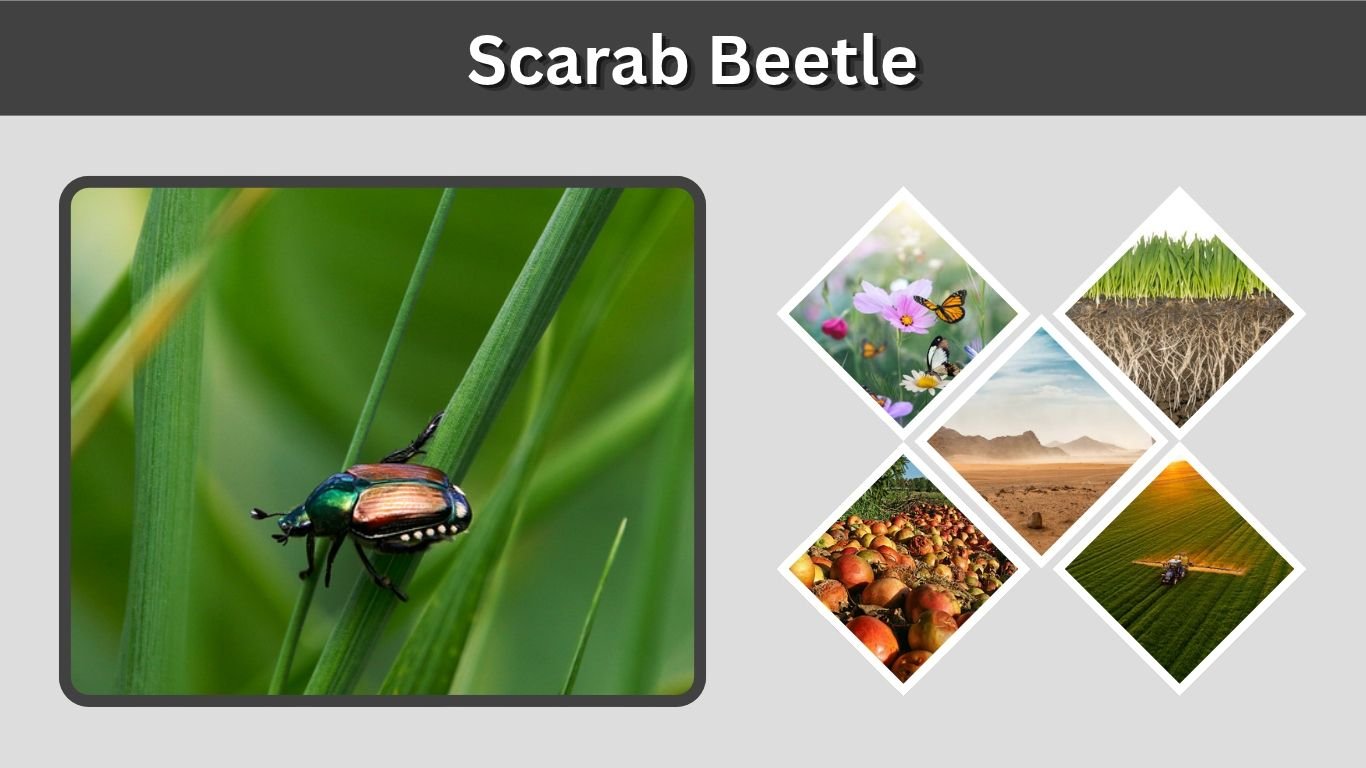
The scarab beetle is one of the most fascinating insects in the world, recognized for its sturdy body, distinctive antennae, and remarkable diversity of colors. These beetles belong to the family Scarabaeidae and include dung beetles, June beetles, rhinoceros beetles, and beautiful metallic jewel scarabs. Beyond their ecological importance, scarab beetles hold deep historical significance, especially in ancient Egypt, where they symbolized rebirth, protection, and the rising sun. Understanding scarab beetle identification, different species, feeding habits, life cycle, and Egyptian symbolism reveals why these remarkable insects have fascinated people for thousands of years.
What Is a Scarab Beetle?
Scarab beetles are insects belonging to the family Scarabaeidae within the order Coleoptera. This diverse family contains thousands of species distributed across nearly every continent except Antarctica. Although scarabs are often associated with dung beetles, the family also includes many species that feed on plants, flowers, fruits, and decomposing organic materials.
Their ecological roles vary from recycling nutrients to pollinating flowers and occasionally damaging agricultural crops.
Scarab Beetle Identification
Scarab beetles have distinctive physical characteristics that separate them from other beetle families. Most possess robust, oval-shaped bodies, powerful legs, and specialized antennae with flattened segments. Depending on the species, their coloration ranges from dull brown and black to brilliant metallic green, gold, blue, or red.
Key Physical Characteristics
- Body length: Ranges from a few millimeters to over 4 inches in some large species.
- Body shape: Oval, rounded, or elongated with a sturdy exoskeleton.
- Antennae: Club-shaped tips with flattened, leaf-like segments.
- Wings: Hardened front wings protect the folded flying wings underneath.
- Legs: Strong, frequently spiny, and adapted for digging.
- Colors: Black, brown, green, gold, blue, or iridescent combinations.
- Horns: Present in some species, particularly male rhinoceros beetles.
Male vs. Female Scarab Beetles
Male and female scarab beetles may differ in size, body shape, and ornamentation.
In certain rhinoceros and rainbow scarab species, males possess prominent horns used in competition for mates.
Females generally lack these large horns or have smaller structures. However, distinguishing males from females depends on the particular species.
Common Types of Scarab Beetles
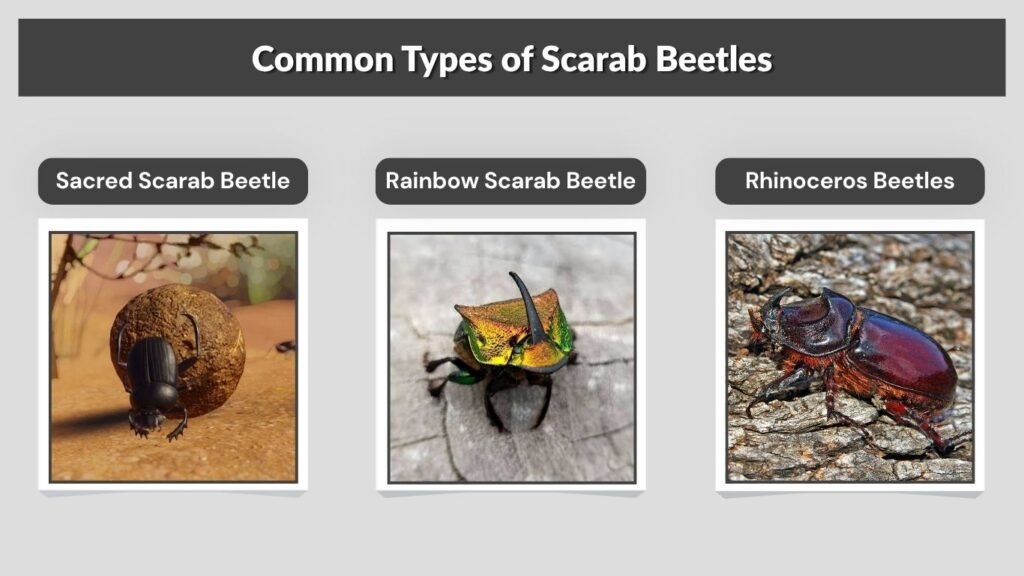
The scarab beetle family contains numerous species with different feeding habits and appearances. Some are recognized for their dung-rolling behavior, while others are admired for metallic colors or impressive horns. Several groups are particularly familiar in North America and other regions.
1. Sacred Scarab Beetle
The sacred scarab (Scarabaeus sacer) is a dung beetle historically associated with ancient Egyptian religion.
It has a rounded, predominantly black body and strong legs adapted for digging and manipulating dung.
This beetle became an important symbol of renewal because ancient Egyptians connected its dung-rolling behavior with the movement of the sun.
2. Rainbow Scarab Beetle
The rainbow scarab (Phanaeus vindex) is a colorful North American dung beetle displaying metallic green, copper, red, and golden reflections.
Males typically possess a prominent horn, while females lack this structure.
Unlike dung beetles that roll balls across the ground, rainbow scarabs usually bury dung in underground chambers near its original location.
3. Jewel and Glorious Scarab Beetles
Jewel scarabs, particularly species belonging to the genus Chrysina, are famous for their brilliant metallic appearance.
The glorious scarab (Chrysina gloriosa) displays green wing covers decorated with striking silver or dark stripes.
Other jewel scarabs exhibit golden, silver, or emerald coloration. Their reflective exoskeletons make them some of the most visually impressive beetles.
4. June and Rhinoceros Beetles
June beetles and rhinoceros beetles are also members of the scarab family.
June beetles usually have brown or green bodies and commonly appear during warmer months.
Rhinoceros beetles are generally larger, with males of many species possessing prominent horns. Their larvae commonly develop in soil or decomposing organic material.
Scarab Beetle Life Cycle
Scarab beetles undergo complete metamorphosis, meaning they develop through four distinct stages: egg, larva, pupa, and adult. Their development varies among species, with some completing a generation within one year while others require several years. Many scarabs spend most of their lives developing underground or inside decomposing material.
Four Stages of Development
- Egg: Females deposit eggs in soil, dung, compost, or other suitable environments.
- Larva: Eggs hatch into soft-bodied grubs that feed on roots, dung, or decomposing organic material.
- Pupa: Mature larvae enter a protected chamber and undergo metamorphosis.
- Adult: Fully developed beetles emerge, feed, reproduce, and begin another generation.
What Do Scarab Beetle Larvae Look Like?
Scarab beetle larvae are commonly called white grubs.
They typically possess creamy-white, C-shaped bodies, brown heads, and three pairs of short legs.
Some species feed on living plant roots and can damage lawns. Others consume decomposing material or dung, contributing to nutrient recycling.
What Do Scarab Beetles Eat?
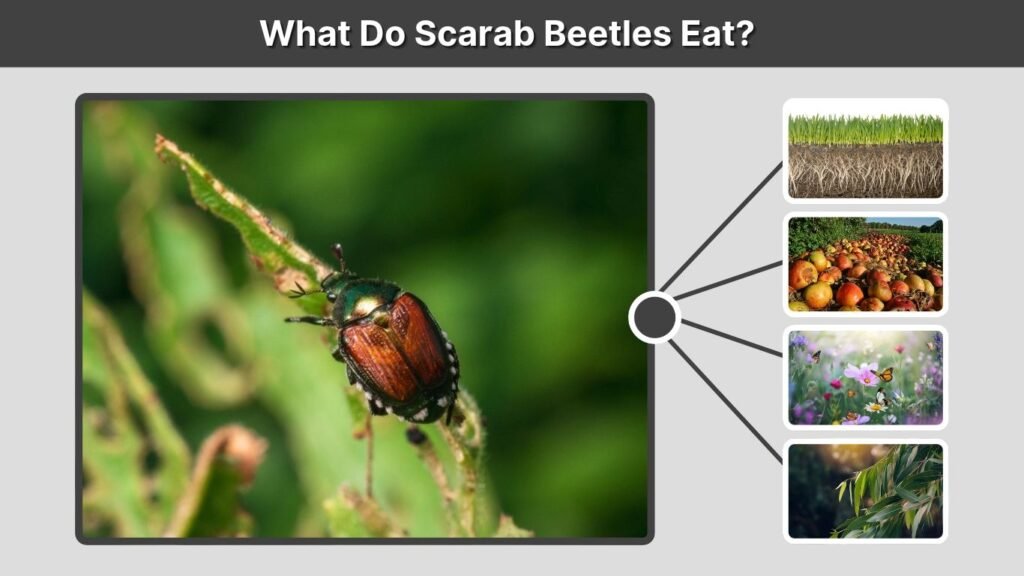
Scarab beetles have remarkably diverse diets depending on their species and developmental stage. Although dung beetles are particularly famous, many other scarabs feed on vegetation or decaying organic matter.
Common food sources include:
- Animal dung and manure.
- Grass roots and underground plant materials.
- Leaves, flowers, and pollen.
- Ripe or decaying fruits.
- Fungi and decomposing vegetation.
- Compost and rotting wood.
Dung-feeding species help break down animal waste, while flower-visiting scarabs may contribute to pollination.
However, root-feeding grubs and some adult plant-feeding scarabs can become agricultural or garden pests.
Scarab Beetle Meaning in Ancient Egypt
The scarab beetle held extraordinary religious and cultural importance in ancient Egypt. Egyptians closely observed dung beetles rolling spherical balls across the ground and associated this behavior with the sun’s daily movement. The beetle consequently became a powerful representation of renewal, transformation, and life after death.
Scarab Beetle Symbolism and Khepri
The Egyptian god Khepri was associated with the rising sun and was frequently depicted as a scarab beetle or a human figure with a scarab head.
Ancient Egyptians believed the beetle’s movement of a dung ball resembled the sun traveling across the sky.
The scarab therefore represented:
- Rebirth and regeneration.
- The rising sun and creation.
- Transformation and personal renewal.
- Divine protection.
- Eternal life and resurrection.
Why Was the Egyptian Scarab Sacred?
Ancient Egyptians observed beetles emerging from buried dung and associated this apparent appearance of new life with creation.
They incorporated scarab images into religious ceremonies, jewelry, seals, and burial practices.
The beetle became one of the most recognizable symbols of Egyptian civilization and remained culturally important for many centuries.
Ancient Egyptian Scarab Beetle Amulets and Jewelry
Scarab-shaped amulets were widely used in ancient Egypt for protection, good fortune, and religious purposes. Craftspeople carved these objects from materials such as stone, faience, and precious metals.
Many scarabs featured inscriptions or royal names on their flat undersides.
Special heart scarabs were placed within mummy wrappings or on the deceased’s chest. Their inscriptions were intended to protect the deceased during judgment in the afterlife.
Today, scarab beetle necklaces, rings, bracelets, and tattoos continue to represent renewal, protection, and personal transformation.
Are Scarab Beetles Dangerous to Humans?
Most scarab beetles are harmless to humans. They do not possess venomous stingers and generally do not attack people.
Although some larger beetles have strong mouthparts and gripping claws, they rarely cause more than minor discomfort when handled.
Do Scarab Beetles Bite or Sting?
Scarab beetles cannot sting because they lack stingers.
Some species may pinch with their mouthparts or scratch skin with their legs when roughly handled.
However, most are not aggressive and prefer escaping when disturbed.
The frightening flesh-eating scarab beetles depicted in certain fictional movies do not accurately represent real scarab beetle behavior.
Where Do Scarab Beetles Live?
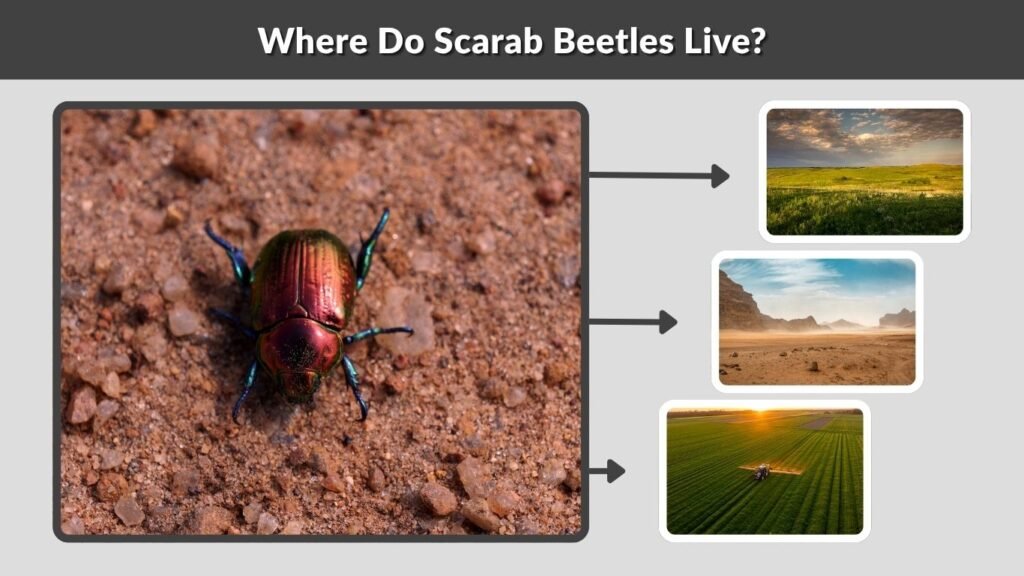
Scarab beetles inhabit forests, grasslands, deserts, agricultural fields, gardens, and tropical environments worldwide.
Their distribution depends on climate, vegetation, food availability, and soil conditions.
In North America, scarabs occur throughout the United States, including Florida, Texas, California, and many other states.
Some species prefer humid tropical forests, while others thrive in dry grasslands or sandy environments.
Many adults are active at night, although several colorful species are commonly seen during daylight.
Are Scarab Beetles Beneficial or Harmful?
Scarab beetles perform important ecological functions, although some species can damage plants. Their impact depends largely on feeding habits and population density. Dung beetles and decomposers generally benefit soil ecosystems, while certain root-feeding larvae may cause problems in lawns and gardens.
Benefits of Scarab Beetles
Many scarabs provide valuable environmental services:
- Recycle animal waste into the soil.
- Improve soil aeration through burrowing.
- Help return nutrients to the environment.
- Reduce accumulations of animal dung.
- Support pollination while visiting flowers.
- Provide food for birds, mammals, and other wildlife.
When Is Scarab Beetle Control Necessary?
Control may be appropriate when root-feeding grubs cause significant turf damage or adult beetles repeatedly damage crops.
Common warning signs include brown lawn patches, damaged roots, and heavy feeding on foliage.
However, finding a few scarab beetles does not indicate an infestation.
Identifying the species and confirming actual damage are essential before considering treatment.
FAQs
1. Are Scarab Beetles Real?
Yes, scarab beetles are real insects belonging to the family Scarabaeidae. They include thousands of species, such as dung beetles, June beetles, and rhinoceros beetles. Unlike fictional movie versions, real scarabs are generally harmless to humans.
2. Are All Scarab Beetles Dung Beetles?
No, not all scarab beetles are dung beetles. Although many scarab species consume animal waste, others feed on plant roots, leaves, flowers, fruits, and decaying organic materials. Their diets vary considerably across the family.
3. What Does a Blue Scarab Beetle Symbolize?
In modern symbolic interpretations, blue scarab beetles may represent protection, transformation, renewal, or spiritual growth. These meanings are inspired partly by ancient Egyptian scarab symbolism, although specific blue-color interpretations are not universal historical beliefs.
4. Can Scarab Beetles Kill Humans?
No, ordinary scarab beetles are not capable of killing humans through biting or stinging. They lack venomous stingers and generally avoid confrontation. The dangerous swarms portrayed in fictional films are not accurate representations of real scarab beetles.
5. Why Were Scarab Beetles Important in Ancient Egypt?
Ancient Egyptians associated scarab beetles with the rising sun, creation, and rebirth. Their dung-rolling behavior inspired connections with the god Khepri. Scarab-shaped amulets were widely used for protection, religious symbolism, and funerary practices.