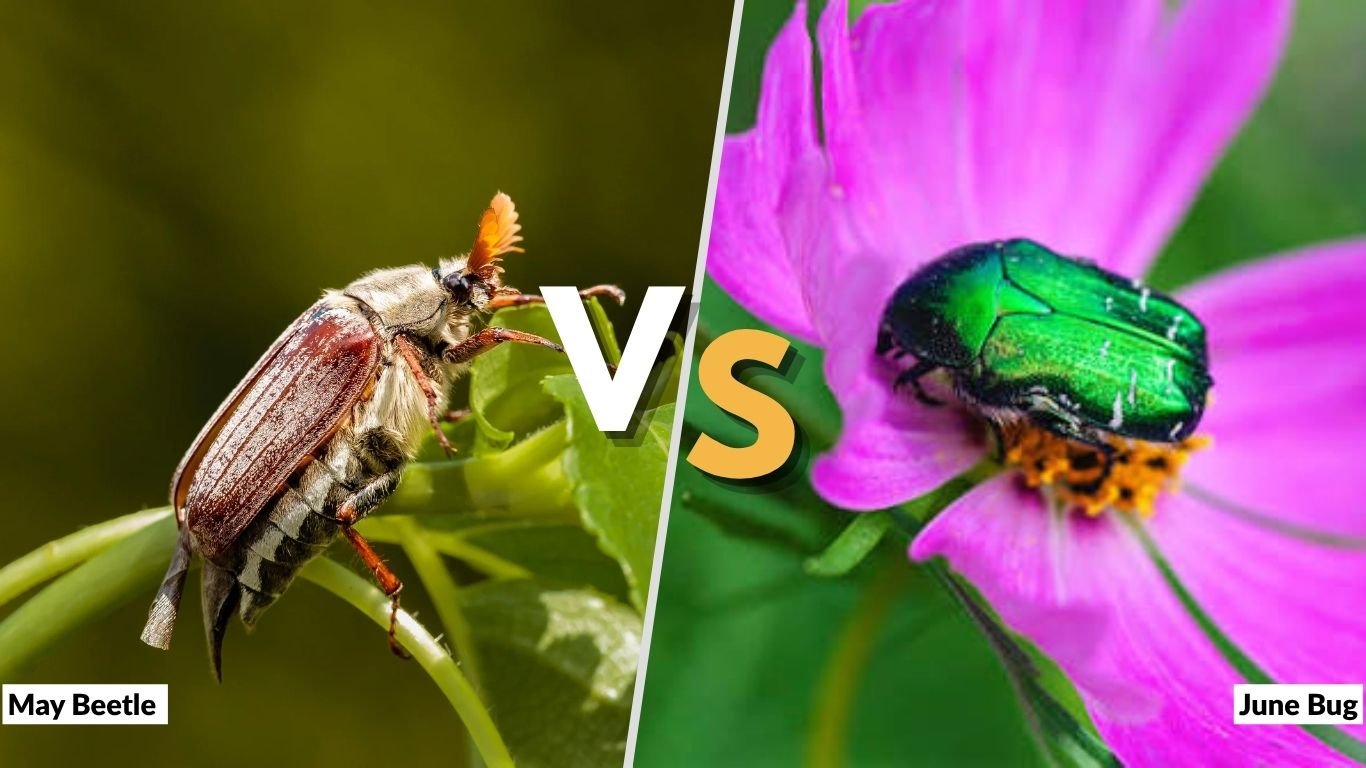
May beetle vs. June bug is a common comparison among gardeners and homeowners who notice large brown beetles flying around outdoor lights during spring and summer. Surprisingly, these names often describe the same group of insects rather than two different beetles. May and June beetles belong primarily to the genus Phyllophaga, and their larvae can damage lawns by feeding on grass roots. Understanding their appearance, habitat, life cycle, feeding habits, and control methods helps you identify these insects and prevent serious damage to your garden or lawn.
Are May Beetles and June Bugs the Same?
Yes, in North America, May beetles and June bugs are generally different common names for the same group of scarab beetles. They belong primarily to the genus Phyllophaga within the family Scarabaeidae.
These insects are called May beetles or June bugs because adults commonly emerge during late spring and early summer. Their appearance varies depending on local climate, location, and species.
However, regional naming differences sometimes create confusion, especially when comparing North American beetles with European species.
| Common Name | Scientific Classification | Common Usage |
| May beetle | Phyllophaga species | North America |
| June bug | Phyllophaga species and sometimes other scarabs | North America |
| May/June beetle | Phyllophaga species | North America |
| May bug or cockchafer | Melolontha melolontha | United Kingdom and Europe |
The European May bug, commonly called the cockchafer, is a different beetle from North American Phyllophaga species, although both belong to the scarab family.
May Beetle vs. June Bug: Key Differences
The main difference between a May beetle and a June bug is usually the name rather than the insect itself. Both names are commonly applied to similar brown scarab beetles with nocturnal habits and underground larval stages.
Some regional differences in adult emergence and appearance may exist because the names cover multiple species.
Appearance and Body Size
Most May/June beetles measure approximately ½ to 1 inch long. Their bodies are oval, sturdy, and typically reddish-brown, dark brown, or nearly black.
Their hard wing covers protect delicate flying wings, while their clubbed antennae help detect environmental signals.
Activity and Emergence Time
May beetles often become noticeable during May, while June bugs may appear later in warmer regions or when seasonal conditions delay emergence.
However, both names can describe beetles active throughout May, June, and sometimes July.
These beetles are primarily nocturnal and commonly gather around porch lights, windows, and streetlights.
How to Identify May and June Beetles
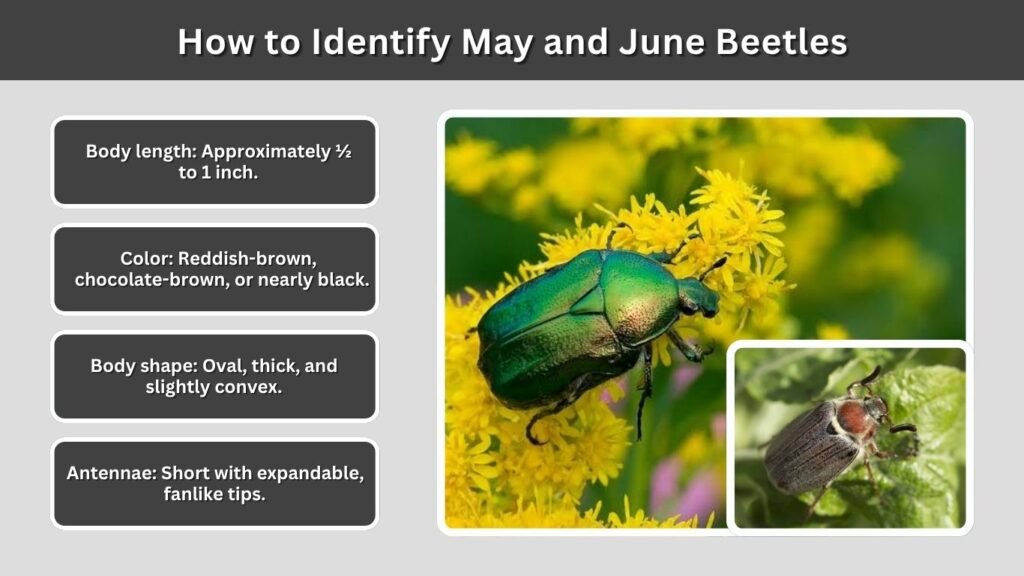
Identifying May/June beetles requires examining their physical characteristics and behavior. Adults usually have dark, rounded bodies, while larvae are creamy-white grubs that remain hidden in soil.
Although many beetles look similar, several features help distinguish these insects from other common garden pests.
Adult May/June Beetle Identification
Common identification features include:
- Body length: Approximately ½ to 1 inch.
- Color: Reddish-brown, chocolate-brown, or nearly black.
- Body shape: Oval, thick, and slightly convex.
- Antennae: Short with expandable, fanlike tips.
- Wings: Hard outer wing covers with flying wings underneath.
- Activity: Mostly active after sunset.
- Behavior: Frequently attracted to artificial lights.
May/June Beetle Grub Identification
The larvae are commonly called white grubs. They have soft, cream-colored bodies that naturally curl into a C shape.
Their heads are yellowish-brown, and three pairs of small legs appear near the front of the body.
Because numerous scarab species produce similar larvae, examining the arrangement of hairs on the underside of the final abdominal segment may be necessary for accurate identification.
Where Do May and June Beetles Live?
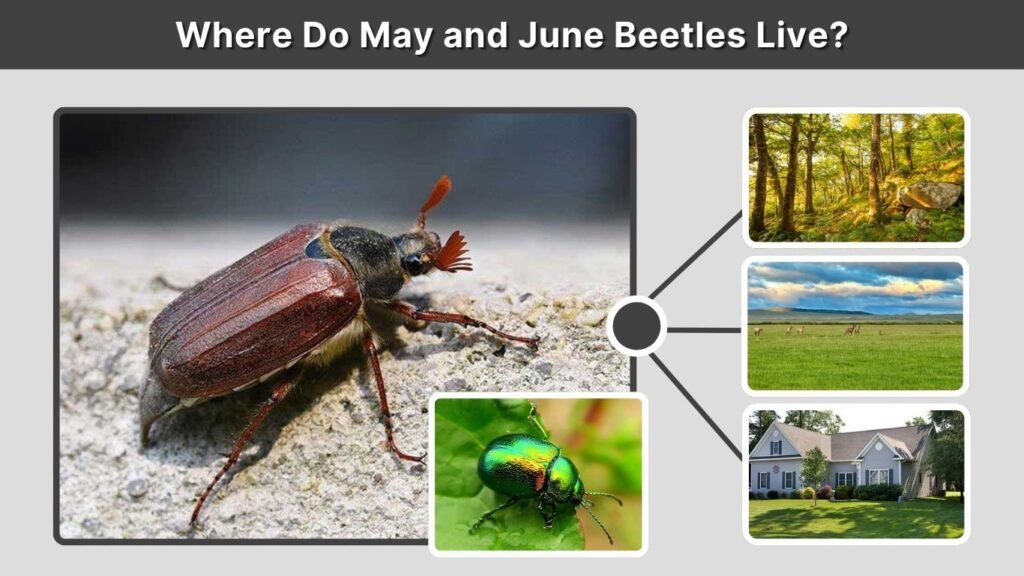
May/June beetles occur across much of North America, including the United States and Canada. They inhabit woodlands, grasslands, agricultural fields, lawns, parks, and residential gardens.
Adults frequently remain near trees and shrubs, while larvae develop underground in soil containing living plant roots.
Preferred Habitat
These beetles favor locations where soil provides suitable moisture and enough vegetation for larval feeding.
Adult beetles may gather around deciduous trees during warm evenings, especially when the leaves provide feeding opportunities.
Larvae generally remain within the root zone but move deeper underground during colder weather or unfavorable conditions.
What Do May and June Beetles Eat?
Adult May/June beetles commonly eat leaves from trees and shrubs, including oak, maple, and other broadleaf plants.
Their larvae consume underground plant roots, particularly grass roots.
Heavy grub feeding can weaken turfgrass, reduce water absorption, and cause irregular brown patches across lawns.
May/June Beetle Life Cycle
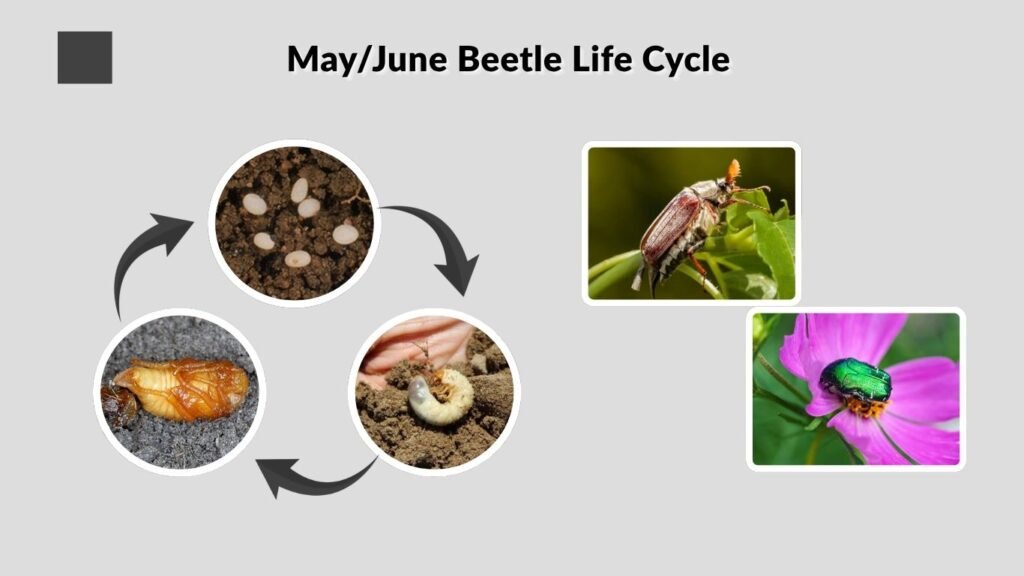
May and June beetles undergo complete metamorphosis, developing through egg, larva, pupa, and adult stages. Unlike some scarab beetles that complete development within one year, many Phyllophaga species need approximately two to three years.
The exact development period depends on species, temperature, and environmental conditions.
Four Stages of the Life Cycle
- Egg stage: Females deposit small white eggs in soil after mating. Eggs typically hatch within several weeks, depending on temperature and moisture.
- Larval stage: Newly hatched grubs begin feeding underground. They grow through three larval stages while consuming organic material and plant roots.
- Pupal stage: Mature larvae form chambers in the soil and transform into pupae. During this period, their bodies develop adult beetle structures.
- Adult stage: Adults eventually emerge, feed on foliage, search for mates, and reproduce. Their appearance generally occurs during late spring or summer.
How Long Do May/June Beetles Live?
The complete life cycle usually lasts two to three years for many species, although some develop faster or slower.
Most of this period is spent underground as larvae. Adult beetles live for a much shorter time, generally several weeks.
May/June Beetle vs. Japanese Beetle vs. Green June Beetle
May/June beetles are sometimes confused with Japanese beetles and green June beetles. Although all belong to the scarab family, their appearance, feeding behavior, and development differ considerably.
| Feature | May/June Beetle | Japanese Beetle | Green June Beetle |
| Scientific name | Phyllophaga spp. | Popillia japonica | Cotinis nitida |
| Appearance | Brown or black | Metallic green and copper | Green with bronze margins |
| Typical size | ½–1 inch | About ½ inch | ¾–1 inch |
| Adult activity | Mostly nighttime | Daytime | Daytime |
| Adult diet | Tree and shrub leaves | Leaves, flowers, fruits | Soft, ripe fruits |
| Larval development | Often 2–3 years | Usually 1 year | Usually 1 year |
| Main grub damage | Root feeding | Root feeding | Tunneling and occasional root feeding |
One important distinction is that adult Japanese beetles have distinctive white hair tufts along their sides, while common May/June beetles do not.
May/June Beetle Grub Damage to Lawns
May/June beetle larvae can become serious turfgrass pests when large populations develop underground. Their root-feeding activity disrupts water and nutrient absorption, eventually weakening or killing sections of grass.
Damage may resemble drought stress, fungal disease, or poor soil conditions, so examining the roots is important.
Signs of May/June Beetle Grub Damage
Typical warning signs include:
- Irregular yellow or brown lawn patches.
- Grass that wilts despite adequate watering.
- Loose turf that lifts easily from the ground.
- Reduced root development in affected areas.
- Birds, skunks, or raccoons digging for grubs.
- Large C-shaped larvae beneath damaged grass.
Grub Damage Threshold Per Square Foot
The number of grubs required to cause noticeable lawn damage depends on grass species, soil moisture, root health, and grub size.
The following figures provide general guidance for evaluating white grub populations, not an exact species-specific treatment rule.
| Grubs per Square Foot | General Interpretation |
| 1–4 | Often tolerated by healthy turf |
| 5–10 | Investigate grass condition and root damage |
| More than 10 | Greater potential for significant lawn damage |
Mature May/June beetle grubs can cause substantial damage at lower densities than some smaller grub species. Treatment decisions should therefore consider the grub species, its developmental stage, and actual damage rather than numbers alone.
How to Get Rid of May and June Beetles
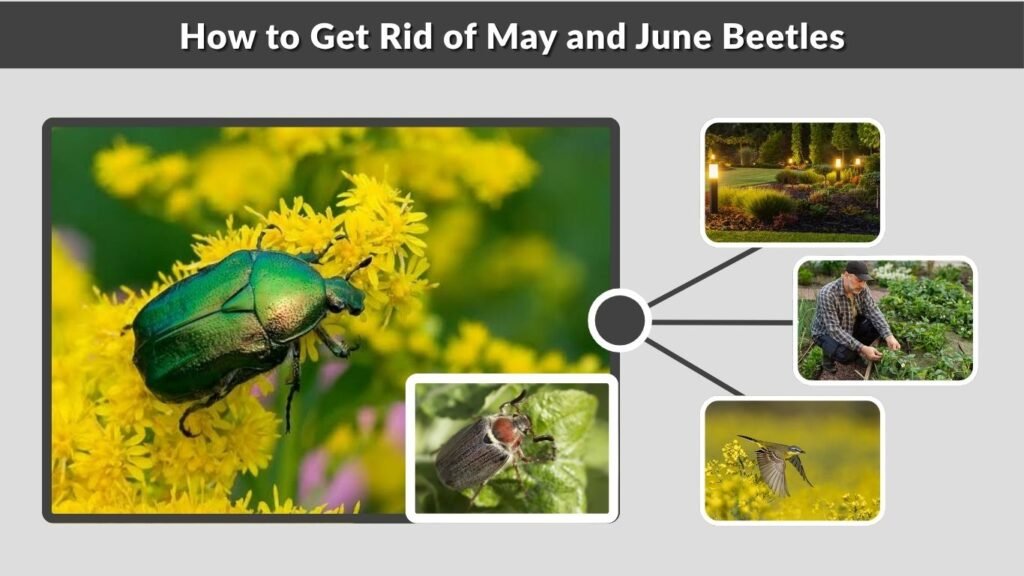
Controlling May/June beetles requires an integrated approach that targets damaging larvae while avoiding unnecessary insecticide applications.
Adults may temporarily become a nuisance around lights, but finding them does not automatically mean the lawn contains a damaging grub population.
Natural May/June Beetle Control Methods
- Reduce outdoor lighting: Turn off unnecessary exterior lights during peak beetle activity.
- Maintain healthy turfgrass: Proper mowing and watering help grass tolerate moderate root damage.
- Inspect lawn soil: Examine several affected sections before deciding whether treatment is necessary.
- Encourage natural predators: Birds and beneficial soil organisms can help regulate beetle populations.
- Use beneficial nematodes: Appropriate species may suppress grubs when applied under suitable soil conditions.
- Avoid excessive irrigation: Manage soil moisture according to grass needs rather than keeping lawns constantly wet.
Chemical Control for May/June Beetle Grubs
When serious grub damage is confirmed, a registered insecticide may be appropriate.
Treatment success depends on identifying the grub species and choosing a product labeled for that pest. Younger grubs may be easier to control than mature larvae deep in the soil.
Always follow product instructions, local regulations, and recommended application timing. Routine treatment of an otherwise healthy lawn is usually unnecessary.
Are May and June Beetles Dangerous?
May and June beetles are not considered dangerous to humans. They do not sting, carry venom, or intentionally attack people.
Their spiny legs may feel uncomfortable when handled, but these insects rarely bite.
They are also not considered poisonous to pets. Nevertheless, dogs and cats should be discouraged from eating large quantities of beetles because swallowed insects may cause digestive discomfort.
FAQs
1. Why Are May Beetles Called June Bugs?
May beetles are called June bugs because adults often emerge and become noticeable during May and June. Their seasonal appearance varies with temperature, rainfall, and geographic location. Both names commonly refer to beetles belonging to the genus Phyllophaga.
2. Do May and June Beetles Bite?
May and June beetles rarely bite humans and are not aggressive. They have chewing mouthparts designed for feeding on leaves. Although their legs may grip skin when handled, they do not sting or inject venom into people.
3. Are May/June Beetles Common in California?
Yes, several scarab beetles commonly called May or June beetles occur in California. However, the name June bug may also refer to other species, including the green figeater beetle. Correct identification depends on appearance, location, and behavior.
4. What Attracts May and June Beetles to Houses?
May and June beetles are strongly attracted to artificial lighting during nighttime activity. Porch lights, illuminated windows, and streetlights frequently attract adults. Nearby trees, lawns, and gardens can also provide feeding and breeding habitats that support local populations.
5. Are May/June Beetles Harmful to Gardens?
May and June beetles can damage gardens when populations become excessive. Adults feed on tree and shrub foliage, while underground grubs consume plant roots. However, occasional beetles or small grub populations generally do not justify chemical treatment.