
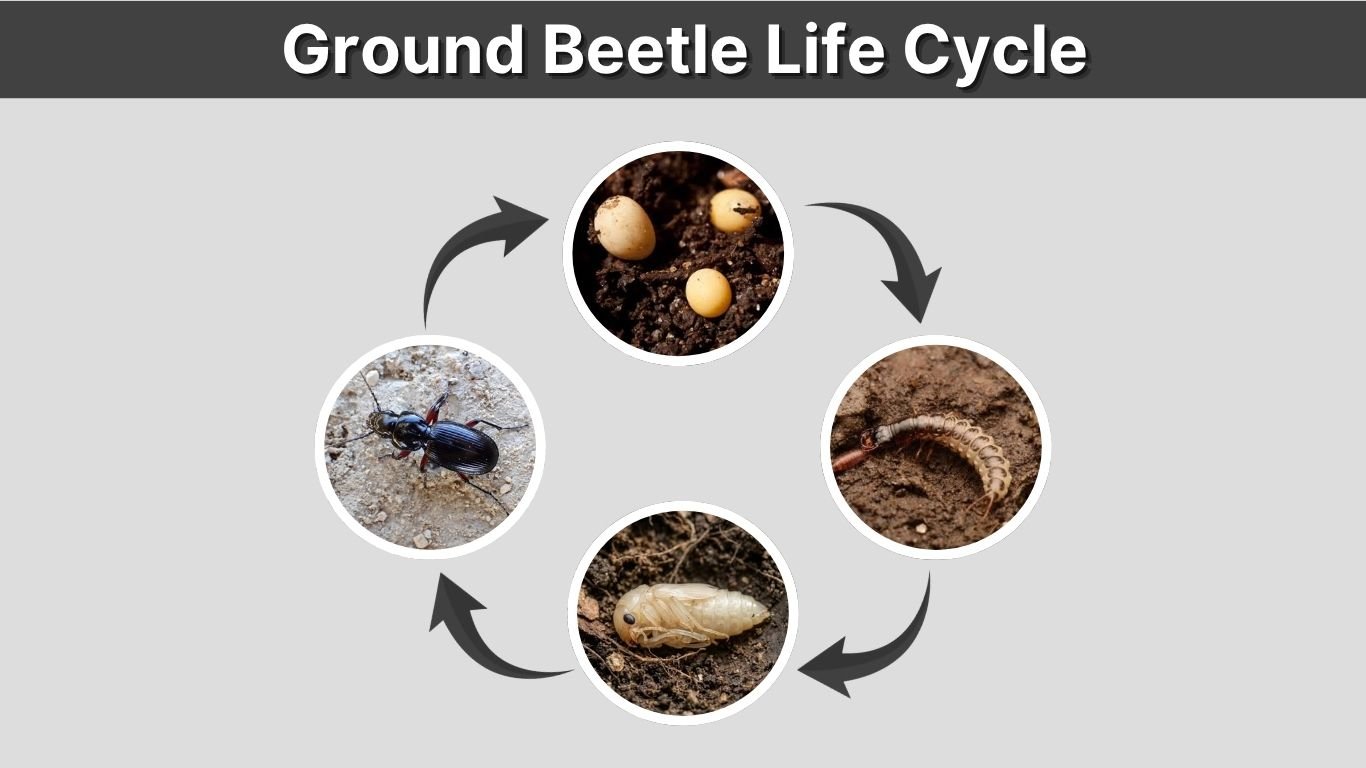
The ground beetle life cycle is a fascinating process that involves four developmental stages: egg, larva, pupa, and adult. Ground beetles belong to the family Carabidae and are commonly found in gardens, forests, agricultural fields, and grasslands. These beneficial insects play an important role in controlling pests by feeding on smaller insects and other invertebrates. Their reproduction, growth, and lifespan vary depending on the species and environmental conditions. Understanding how ground beetles develop can help gardeners appreciate their ecological importance and recognize their different life stages.
What Is the Ground Beetle Life Cycle?
Ground beetles undergo complete metamorphosis, meaning their appearance changes significantly as they develop. Unlike insects that gradually resemble miniature adults, ground beetles pass through distinct immature stages before reaching maturity. Most species spend their early development in soil or sheltered habitats. Their life cycles are influenced by temperature, moisture, seasonal conditions, and available food.
Four Stages of the Ground Beetle Life Cycle
The developmental process includes four main stages:
- Egg stage: A female deposits eggs in protected soil or organic material.
- Larval stage: Young beetles hatch and begin feeding while growing through several molts.
- Pupal stage: Mature larvae transform into pupae, where adult structures develop.
- Adult stage: Fully formed beetles emerge, feed, mature, and eventually reproduce.
Many ground beetle species produce one generation annually, although some have longer or more complex developmental cycles.
How Long Does the Ground Beetle Life Cycle Take?
The time required to complete the life cycle varies considerably among species.
Many temperate ground beetles develop a new generation within approximately one year. However, some species require two years or longer, particularly in cooler environments.
Development may slow during winter or periods of unfavorable weather. Therefore, no single timeline accurately describes every species of ground beetle.
Stage 1: Ground Beetle Eggs
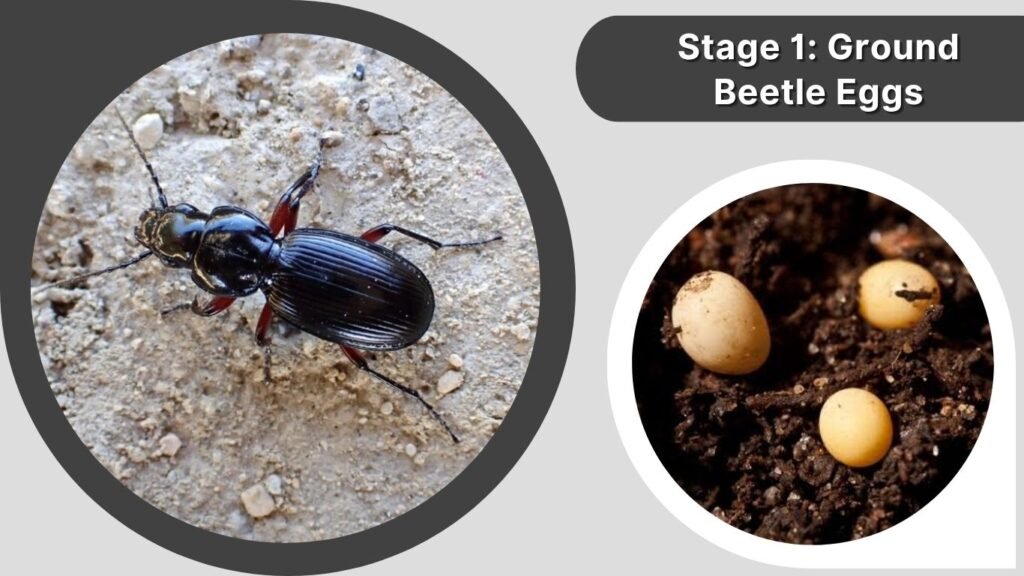
The ground beetle life cycle begins when an adult female lays fertilized eggs in a suitable environment. Egg placement is important because newly hatched larvae require protection from predators and access to food. Most females select sheltered locations containing appropriate moisture levels. The number of eggs and the timing of their development depend on the species.
Where Do Ground Beetles Lay Eggs?
Female ground beetles commonly deposit eggs within soil, beneath surface debris, or among decaying plant material.
The eggs are usually oval or elongated and pale in color. Some species lay eggs individually in protected locations, while certain others display specialized egg-guarding behavior.
Soil moisture and temperature affect embryonic development and egg survival.
How Many Eggs Do Ground Beetles Lay?
Egg production differs greatly across the Carabidae family. Some species produce relatively few eggs, while others may lay hundreds during their reproductive period.
Research summaries report lifetime or seasonal egg production ranging from dozens to several hundred in different species.
However, these numbers should not be interpreted as the reproductive output of every ground beetle.
Stage 2: Ground Beetle Larvae
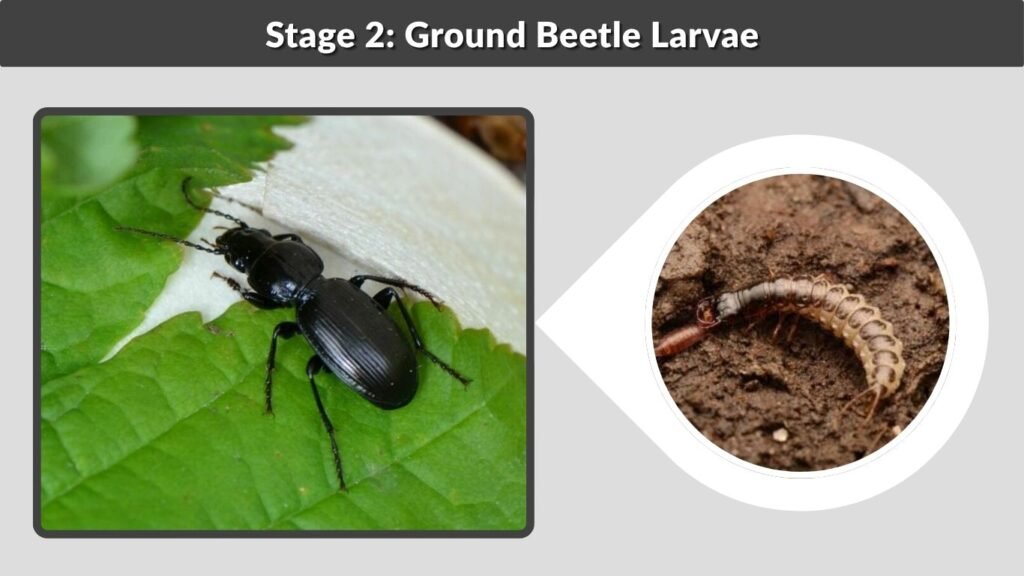
After hatching, ground beetles enter the larval stage, an important period for feeding and growth. Larvae look very different from adult beetles and typically live beneath soil, among fallen leaves, or within sheltered organic material. Many are active predators that consume smaller organisms. Their development involves repeated molting before they become mature enough to pupate.
What Do Ground Beetle Larvae Look Like?
Ground beetle larvae commonly have the following characteristics:
- Body shape: Long, slender, and segmented.
- Color: Whitish, yellowish, brown, or dark, depending on the species.
- Head: Distinct, hardened head with visible jaws.
- Legs: Three pairs of jointed legs near the front of the body.
- Mouthparts: Strong mandibles adapted for feeding.
- Habitat: Soil, leaf litter, and protected ground-level environments.
Their appearance differs from the thick, curved grubs associated with many scarab beetles.
What Do Ground Beetle Larvae Eat?
Most predatory ground beetle larvae feed on small insects, insect eggs, worms, and other invertebrates.
Some species also consume seeds or plant material. Feeding behavior depends on the beetle’s biological group and habitat.
As the larvae grow, they shed their external skeletons through a process called molting. Many species pass through three larval instars before pupation.
How Long Does the Larval Stage Last?
The larval stage can last several weeks, several months, or considerably longer, depending on the species.
Some larvae complete development during warmer months, while others remain underground through winter.
Cold temperatures may slow development until conditions improve, allowing the larvae to resume feeding and growth.
Stage 3: Ground Beetle Pupa
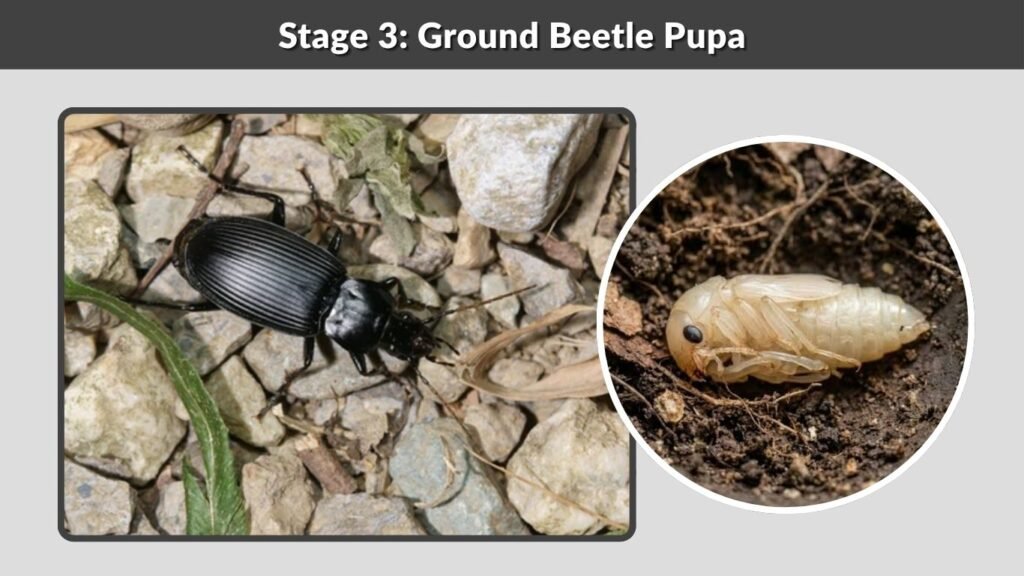
Once a larva completes its growth, it enters the pupal stage. During this period, the insect undergoes substantial internal changes that produce the recognizable adult beetle. Pupation usually occurs in a protected underground chamber, reducing exposure to predators and environmental disturbances. Unlike larvae and adults, pupae do not actively hunt or feed.
What Does a Ground Beetle Pupa Look Like?
Ground beetle pupae are generally pale yellow, cream, or whitish when newly formed.
Their developing legs, antennae, and other adult structures may be visible against the body. As development progresses, the tissues mature and adult features become more apparent.
Many species pupate within soil chambers formed by mature larvae.
How Long Does the Pupal Stage Last?
Pupal development varies according to species, soil conditions, and temperature.
Under favorable conditions, transformation may take days or weeks. Cooler conditions can slow development.
After metamorphosis, the newly emerged adult often has a relatively soft, pale exoskeleton that gradually hardens and darkens.
Stage 4: Adult Ground Beetle
The adult stage completes the ground beetle’s transformation. Adult beetles possess hardened wing covers, developed antennae, strong legs, and functional reproductive organs. Many species are nocturnal and spend daylight hours under stones, fallen leaves, or logs. Once reproductively mature, adults mate and begin another generation, continuing the life cycle.
Adult Ground Beetle Identification
Adult ground beetles typically have:
- Elongated or oval-shaped bodies
- Hardened wing covers called elytra
- Six well-developed legs
- Long, threadlike antennae
- Strong chewing mouthparts
- Dark brown, black, or metallic coloration
Some species possess functional wings and can fly, while others rely mainly on running.
What Do Adult Ground Beetles Eat?
Many adult ground beetles are predators that feed on caterpillars, insect larvae, small slugs, and other invertebrates.
Certain species also consume seeds, including weed seeds, helping reduce unwanted plant growth.
Their feeding behavior contributes to the natural regulation of insect populations in gardens and agricultural landscapes.
Ground Beetle Reproduction and Breeding Seasons
Ground beetle reproduction involves mating between adult males and females, followed by egg production. The breeding season differs by species and geographic location. In temperate regions, many species are classified as spring breeders or autumn breeders. However, this classification is a useful generalization rather than a rule that applies to every member of the family.
Spring-Breeding Ground Beetles
Spring-breeding species typically survive winter as adults and become reproductively active when temperatures rise.
After mating, females deposit eggs during spring or early summer. The larvae develop through warmer months, and new adults may emerge before winter.
Autumn-Breeding Ground Beetles
Autumn breeders usually reproduce during late summer or autumn.
Their eggs hatch into larvae that may remain active or dormant underground during colder months.
These larvae continue developing when conditions become favorable, eventually pupating and emerging as adults.
Life Cycles of Different Ground Beetle Species
Although all ground beetles undergo complete metamorphosis, their developmental patterns are not identical. Black ground beetles, big-headed ground beetles, and members of other genera may differ in breeding season, larval duration, and overwintering behavior. Understanding these differences is important because a general Carabidae life cycle cannot provide exact developmental dates for every species.
Common Black Ground Beetle Life Cycle
The black ground beetle Pterostichus melanarius is a well-studied example of an autumn-breeding species.
Adults mate during summer and early autumn, and females lay eggs in suitable moist environments.
The larvae commonly develop through autumn and winter before pupating. New adults generally emerge during late spring or early summer, although timing varies with climate.
Big-Headed Ground Beetle Life Cycle
Big-headed ground beetles, including Scarites species, belong to the ground beetle subfamily Scaritinae.
They develop through the same egg, larval, pupal, and adult stages as other ground beetles.
Their larvae occupy protected ground habitats, while adults are recognizable by their enlarged heads and powerful mandibles.
Precise developmental durations should be determined from species-specific studies.
Abacetus Ground Beetle Reproduction
Abacetus is a diverse genus of ground beetles occurring in multiple regions, including tropical environments.
Like other carabids, these beetles reproduce sexually and undergo complete metamorphosis.
However, detailed breeding schedules and developmental durations are not equally well documented for every Abacetus species.
It is therefore inappropriate to assign a universal egg count or life-cycle duration to the entire genus.
Ground Beetle Lifespan and Winter Survival
Ground beetle lifespan varies with species, habitat, climate, and food availability. Some beetles develop rapidly and reproduce within a relatively short period, while others survive across multiple seasons. Seasonal dormancy helps many species tolerate unfavorable conditions, particularly in temperate climates with cold winters and limited insect activity.
How Long Do Ground Beetles Live?
Adult ground beetles can survive for one or several years, depending on the species.
Some research summaries report adult lifespans of approximately one to four years in certain groups.
However, the total life cycle and adult lifespan are different measurements. A beetle may spend months developing as a larva before becoming an adult.
How Do Ground Beetles Survive Winter?
Many species seek protected environments beneath rocks, fallen logs, leaf litter, or within soil.
Some overwinter as adults, while others survive as larvae. Certain species may also overwinter in the pupal stage.
Reduced activity and seasonal dormancy help conserve energy until favorable conditions return.
Factors Affecting Ground Beetle Development
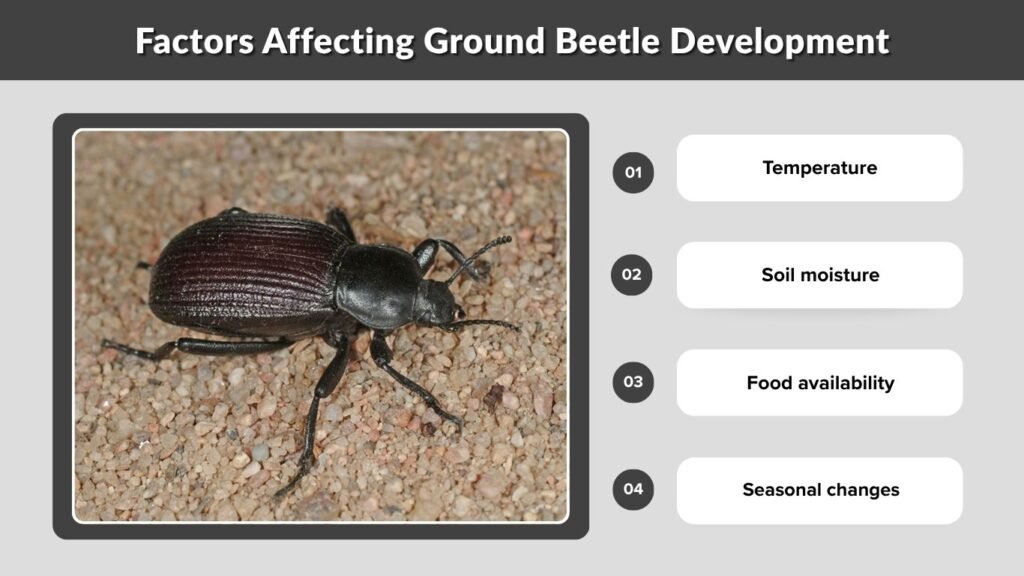
Ground beetle development depends on environmental conditions that influence survival, feeding, and reproduction. Even individuals of the same species may develop at different rates when temperatures or food supplies change. Suitable ground-level habitats provide shelter throughout the immature stages and can improve the likelihood of successful adult emergence.
Environmental Factors Influencing Growth
Important factors include:
- Temperature: Influences metabolism and developmental speed.
- Soil moisture: Helps maintain suitable egg and larval habitats.
- Food availability: Supports larval growth and adult reproduction.
- Seasonal changes: Influence dormancy and breeding schedules.
- Habitat disturbance: May damage eggs, larvae, and pupae.
- Predators: Birds, mammals, and larger invertebrates can reduce survival.
Why Ground Beetles Matter in Gardens
Both adult and larval ground beetles contribute to natural pest management.
Predatory species consume caterpillars, insect larvae, and other organisms that may damage crops or ornamental plants. Seed-eating species can also help reduce weed populations.
Maintaining leaf litter, permanent vegetation, and undisturbed refuges in suitable garden areas can support beneficial ground beetle populations.
FAQs
1. What are the four stages of the ground beetle life cycle?
Ground beetles pass through four developmental stages: egg, larva, pupa, and adult. This process is known as complete metamorphosis.
2. How long does a ground beetle take to become an adult?
Many species produce one generation each year. However, development may take longer depending on the species, temperature, and seasonal conditions.
3. Do ground beetles reproduce inside houses?
Ground beetles generally reproduce in outdoor soil or protected organic material. Most indoor encounters involve beetles that entered accidentally rather than an established breeding population.
4. Do ground beetle larvae live underground?
Many ground beetle larvae develop beneath the soil surface or within leaf litter, where they find food and protection. Their preferred habitat varies among species.
5. Can ground beetles survive winter?
Yes. Many species survive winter as adults or larvae in protected habitats. Some remain relatively inactive until warmer conditions allow feeding and development to resume.
