
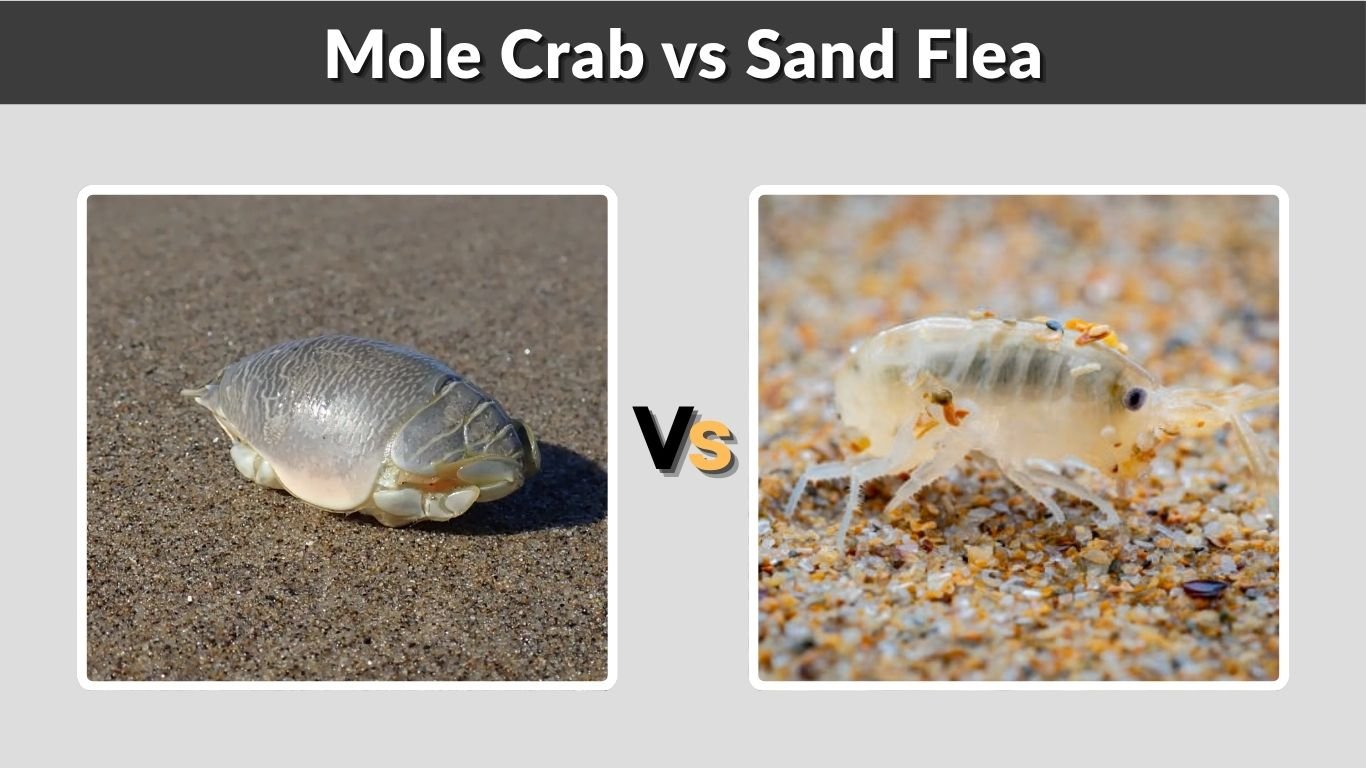
The mole crab vs sand flea comparison is confusing because, in surf-fishing terminology, these names often describe the same animal. Mole crabs are small crustaceans that burrow into wet beach sand and are commonly called sand fleas or sand crabs. However, “sand flea” is also loosely used for several biting beach pests. Understanding this naming problem makes it much easier to distinguish harmless mole crabs from no-see-ums, regular fleas, bed bugs, chiggers, and other organisms associated with itchy bites.
Mole Crab vs Sand Flea: Are They the Same?
In a fishing or beach-crustacean context, mole crab, sand flea, and sand crab often refer to the same animal. Florida Fish and Wildlife specifically lists the mole crab under the common names “sand flea” and “sand crab.” These small crustaceans live in the swash zone and are frequently collected by anglers as natural surf-fishing bait.
Quick Comparison
| Feature | Mole Crab / Fishing Sand Flea | Biting “Sand Flea” |
| Animal type | Crustacean | Name may refer to several insects |
| Habitat | Wet surf sand | Beaches, marshes, animals, or vegetation |
| Bites humans? | No | Some insects do |
| Size | Up to about 2 inches | Often very small |
| Wings | No | Depends on insect |
| Fishing bait | Yes | No |
| Main behavior | Burrows and filter-feeds | Blood-feeding in biting species |
The important point is that a mole crab should not be blamed for itchy beach bites.
What Does a Mole Crab Look Like?
Mole crabs have an oval, light brownish-gray shell and a compact body adapted for digging. They have five pairs of appendages, feathery antennae, and a short triangular tail.
They burrow tail-first into wet sand as waves move over the beach. Florida FWC reports that they can grow to about two inches long and live in the swash portion of sandy intertidal beaches.
Sand Fleas vs Sand Crabs
The sand fleas vs sand crabs question usually has a surprisingly simple answer: anglers commonly use both names for mole crabs. Regional terminology varies, so one fisherman may say “sand flea” while another calls the same crustacean a “sand crab.”
Why Are Mole Crabs Called Sand Fleas?
The nickname likely comes from their small size, beach habitat, and quick movements beneath the sand rather than from any relationship to true fleas.
Mole crabs are crustaceans, placing them much closer biologically to crabs and shrimp than to insects.
FWC even uses “mole crab,” “sand flea,” and “sand crab” together when describing live bait for Florida surf fishing.
Do Mole Crabs Bite People?
No. Mole crabs are filter feeders and scavengers rather than blood-feeding parasites.
They use their antennae to collect plankton and organic material from moving seawater. Their first pair of appendages also lacks the large claws associated with many familiar crab species.
If you develop itchy bumps after visiting a beach, another organism is a more likely explanation.
Sand Fleas vs Sand Flies and No-See-Ums
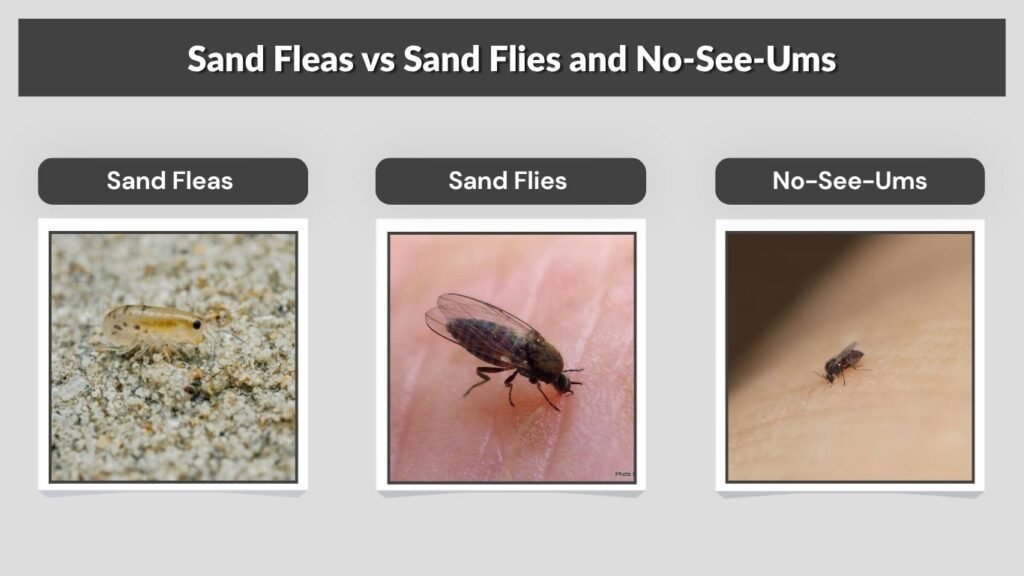
The name “sand flea” becomes much less precise when people are discussing bites. On coastal beaches, tiny biting midges called no-see-ums, sand flies, or sand gnats are often blamed for irritating bites. These are true flying insects and are completely different from the mole crabs fishermen collect from the surf.
No-See-Ums vs Sand Fleas
Key differences include:
- No-see-ums are tiny flying insects.
- Many biting midges are only about 1 mm long.
- Female biting midges feed on blood.
- Mole crabs do not feed on human blood.
- No-see-ums may occur around beaches, salt marshes, and other moist habitats.
- Mole crabs remain associated with moving surf sand.
- A biting midge has wings; a mole crab does not.
UF/IFAS notes that Culicoides biting midges are also called no-see-ums, sand flies, and sand gnats and are especially troublesome in coastal environments.
Sand Fly vs Sand Flea
“Sand fly” can itself refer to different groups depending on geographic region. For that reason, common names alone are unreliable.
If you actually see a tiny flying insect biting exposed skin, it is not the fishing sand flea or mole crab. Identifying the insect, habitat, and bite circumstances is much more useful than relying on the word “sand.”
Sand Flea Bites vs Bed Bug Bites
Sand flea bites vs bed bug bites cannot always be distinguished from the skin reaction alone. Many arthropod bites produce itchy, red bumps. Bed bugs typically feed indoors around sleeping areas, whereas beach-associated biting insects are more likely to attack people outdoors. Finding the actual pest or other environmental evidence provides a much more reliable identification.
Main Differences to Look For
Consider these clues:
- Location: Bed bug bites commonly appear after sleeping indoors.
- Beach exposure: Outdoor bites after time near sand or marshes suggest biting flies or other outdoor pests.
- Bed evidence: Bed bugs may leave shed skins, live bugs, or rusty spotting near mattresses.
- Timing: Bed bug bite reactions can appear hours or days later.
- Distribution: Both bed bugs and fleas can produce clusters of red bumps.
- Insect evidence: Identifying the actual insect is more reliable than comparing bite photographs.
CDC states that bed bug bite reactions vary greatly and may resemble mosquito or flea bites, so bite appearance by itself is not diagnostic.
Bed Bugs Are Different Animals
Bed bugs are flat, reddish-brown, wingless insects that usually stay near locations where people sleep.
Adults and nymphs feed on blood, while mole crabs live in beach surf and filter food from seawater. The two animals have completely different habitats, appearances, and feeding behaviors.
Sand Fleas vs Regular Fleas
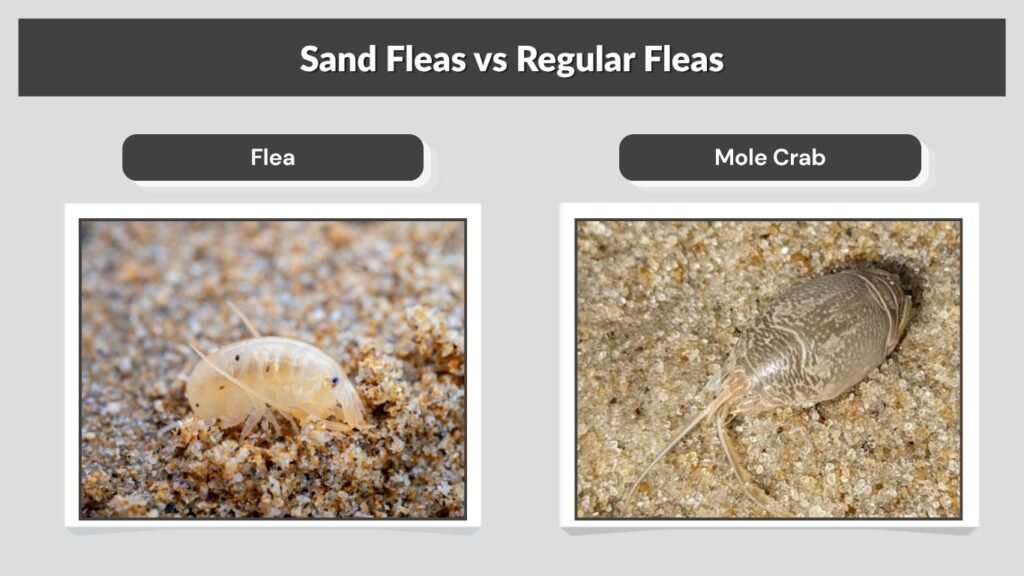
True fleas are small, wingless insects that feed on blood. Cat fleas, dog fleas, and several other flea species may bite humans. Their biology is completely different from that of mole crabs, despite the shared word “flea.”
Flea vs Mole Crab
Regular fleas are usually only a few millimeters long and are laterally compressed, helping them move through animal fur.
They can jump and commonly occur around pets, wildlife, bedding, carpets, and other areas associated with animal hosts. CDC notes that flea bites often cause itching and irritation and may occur especially around the lower legs and feet.
A mole crab, by comparison, is much larger, lives in seawater-washed sand, cannot jump like a flea, and does not parasitize dogs, cats, or people.
Chiggers vs Sand Fleas
Chiggers are the larval stage of certain mites. They are extremely small and occur primarily in grassy, brushy, or vegetated habitats rather than living like mole crabs in the active ocean surf.
How They Differ
A chigger attaches to the skin and produces an intensely itchy reaction. It is an arachnid relative rather than an insect or crustacean.
A fishing sand flea is a visible marine crustacean that burrows in the beach. If someone develops itching after walking through vegetation, chiggers may be more plausible than mole crabs; if exposure occurred directly at a coastal beach, biting midges or other beach pests may deserve consideration.
Sand Fleas vs Mosquito Bites
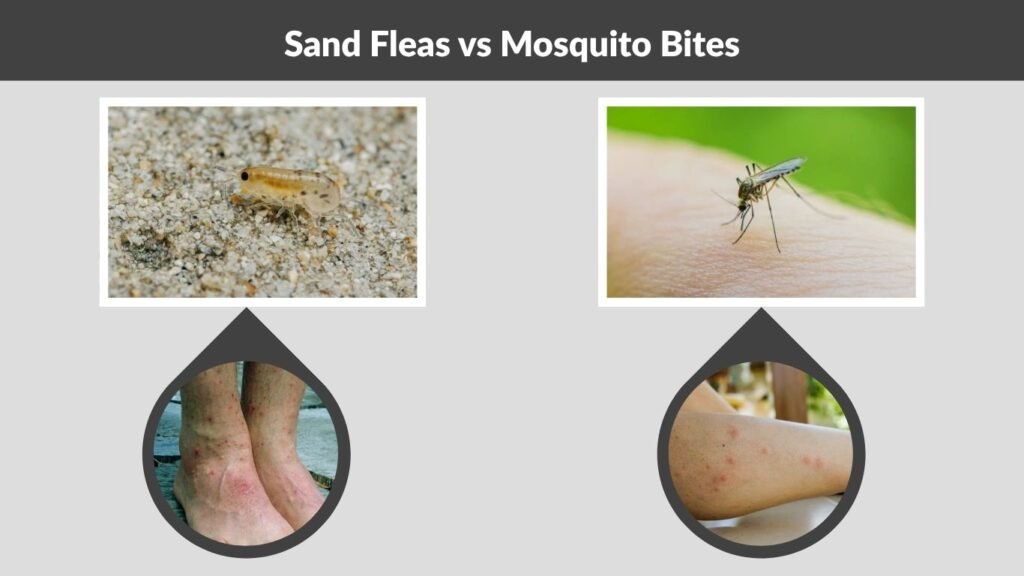
Mosquito bites and bites attributed to “sand fleas” can both produce itchy red bumps, making skin appearance alone unreliable. Exposure circumstances are more useful. Mosquitoes are flying insects that often become obvious around standing water or during periods of high activity, while coastal biting midges can be so small that the person may never see them.
Why Bite Identification Is Difficult
CDC notes that many biting insects—including bed bugs, fleas, midges, mosquitoes, and sand flies—can produce similar itchy red papules.
That means a photograph of a skin reaction generally cannot prove which pest caused it. Consider when and where the bites appeared, whether other people were affected, and whether insects or infestation signs can be found.
How to Avoid Confusing Sand Fleas With Other Pests
The easiest way to identify the problem is to start with habitat. A small crustacean dug from wet surf sand is probably a mole crab. A tiny insect flying around a coastal marsh may be a biting midge, while jumping insects around pets suggest true fleas. Bugs found in mattress seams require an entirely different inspection.
Identification Checklist
Ask:
- Was the animal in wet ocean sand?
- Did it have a crab-like shell?
- Could it fly?
- Did it jump?
- Were bites noticed outdoors or after sleeping?
- Are pets scratching?
- Are insects hiding around a mattress?
- Were you walking through tall grass or vegetation?
These simple questions can quickly narrow the possibilities and prevent unnecessary pest treatments.
FAQs
The term “sand flea” has several meanings, which explains why searches often mix fishing bait with skin bites and household pests. The most important distinction is whether the discussion concerns a mole crab from the surf or a blood-feeding insect or mite.
1. Is a Mole Crab the Same as a Sand Flea?
Yes, in fishing terminology. Mole crabs are commonly called sand fleas and sand crabs, particularly among surf anglers.
2. Do Mole Crabs Bite Humans?
No. Mole crabs are filter-feeding crustaceans and are not responsible for typical itchy beach bites.
3. Are Sand Fleas and Regular Fleas the Same?
No. True fleas are blood-feeding insects. The “sand fleas” used as fishing bait are mole crabs and are crustaceans.
4. How Can I Tell Sand Flea Bites From Bed Bug Bites?
You generally cannot identify them reliably from bites alone. Bed bug evidence around a sleeping area or direct evidence of an outdoor biting pest is much more useful.
5. Are No-See-Ums the Same as Sand Fleas?
Not biologically. No-see-ums are tiny biting flies, although people sometimes loosely call coastal biting insects sand fleas. Mole crabs, the fishing “sand fleas,” are harmless crustaceans.
