
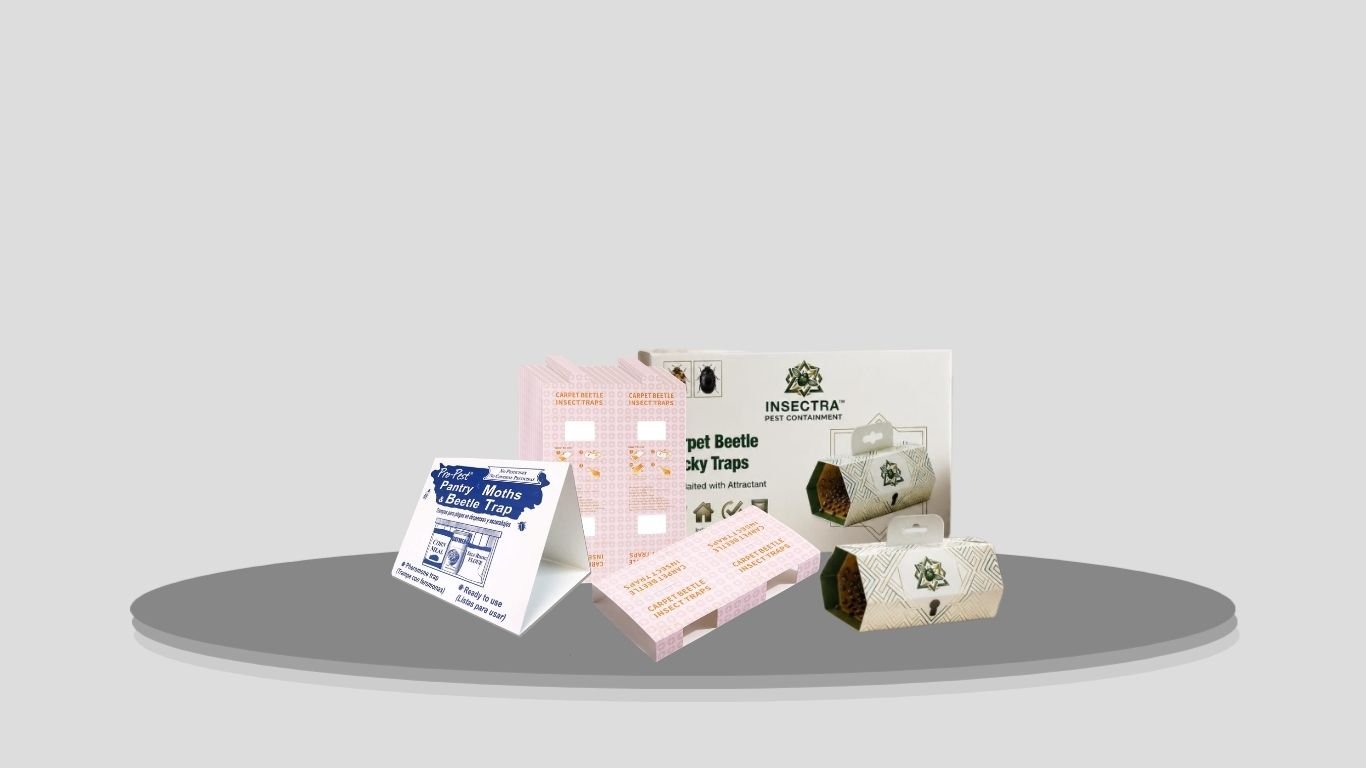
Carpet beetles can damage rugs, clothing, upholstery, stored fabrics, and other natural-fiber materials if an infestation goes unnoticed. The best carpet beetle traps help monitor activity and capture adult beetles or crawling insects using sticky surfaces, pheromone lures, or pre-baited designs. They are especially useful around closets, carpets, baseboards, storage areas, and other places where beetles may appear. In this guide, we review seven carpet beetle traps that vary in lure type, coverage, and ease of use so you can compare the most practical options for your home.
1. 10-Pack Sticky Traps for Carpet Beetles & Crawling Insects
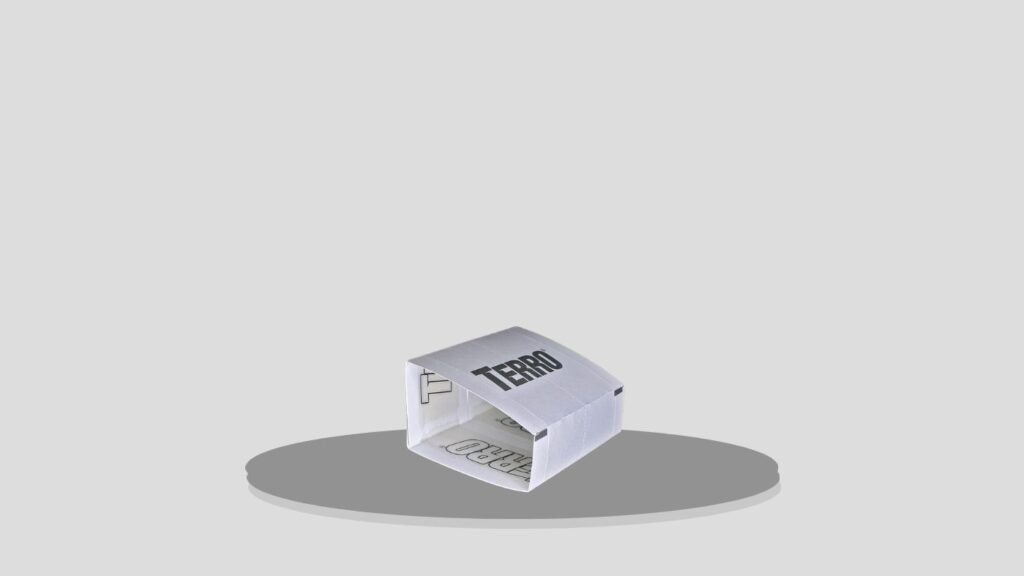
This 10-pack sticky trap set provides a simple way to monitor crawling insects around carpets, closets, baseboards, furniture, and other hidden areas of the home. Although the product is designed for multiple crawling pests rather than carpet beetles alone, its adhesive surface can help reveal where beetles or larvae are moving. It requires no electricity, complicated equipment, or ongoing maintenance beyond periodic inspection.
Key Features
- 10 sticky traps included
- Strong adhesive trapping surface
- Suitable for multiple crawling insects
- No electricity or batteries required
- Easy placement along walls and baseboards
- Compact design for hidden locations
- Useful for indoor pest monitoring
- Disposable after use
Why It’s Best for Multi-Area Monitoring
Having ten traps makes this set particularly useful when you are unsure where carpet beetle activity originates. Rather than placing a single monitor in one closet, traps can be distributed around several rooms, furniture edges, storage spaces, and carpeted areas.
This approach can help identify hotspots. If one trap consistently catches more insects than the others, that area deserves a closer inspection for lint, pet hair, dead insects, natural-fiber materials, or other potential larval food sources.
The traps also work without a specialized pheromone, making them useful as general crawling-insect monitors.
Placement and Everyday Performance
Plain sticky traps can be useful for monitoring carpet beetles, especially around windows, shelves, closets, baseboards, and locations where susceptible materials are stored. University guidance notes that sticky monitors can help reveal infestations and indicate where activity is concentrated.
Because this product is not specifically pheromone-targeted to carpet beetles, strategic placement matters more than simply putting traps randomly throughout a room.
Keep them close to walls and undisturbed areas where crawling insects naturally travel.
Overall Verdict
This 10-pack is most appealing for users who want broad indoor monitoring at several locations. Its simple adhesive design, generous quantity, and ability to capture different crawling pests give it good everyday versatility.
For homeowners still trying to determine where carpet beetles are concentrated, distributing several inexpensive sticky monitors around likely problem areas can provide useful information before taking more targeted control measures.
2. INSECTRA Carpet Beetle Pheromone Traps
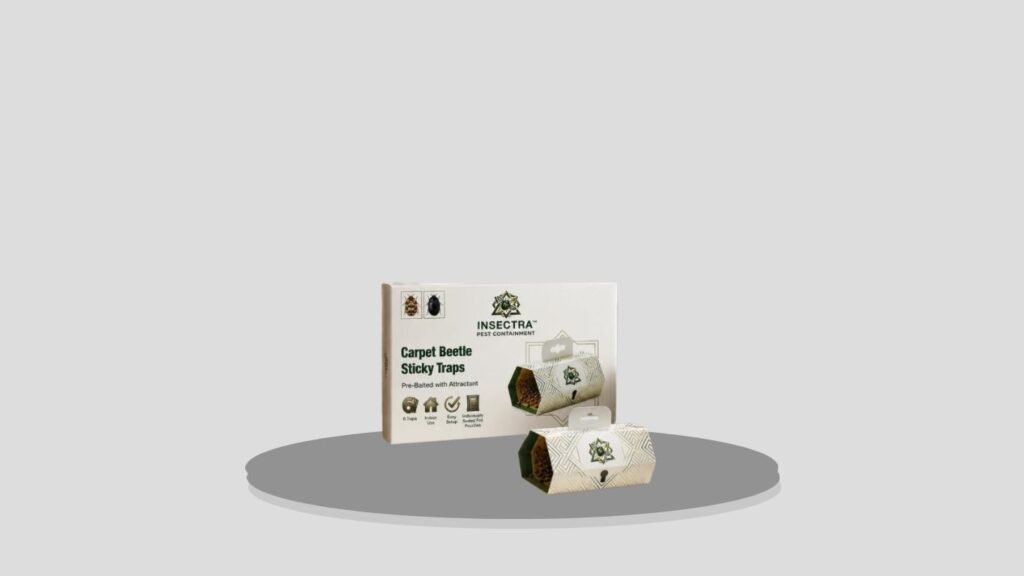
INSECTRA Carpet Beetle Pheromone Traps are designed more specifically for carpet beetle monitoring than ordinary glue boards. The combination of a chemical attractant and adhesive capture surface is intended to draw adult carpet beetles toward the trap, making the system useful around closets, stored textiles, carpets, wardrobes, and rooms where adults have already been observed. Its targeted approach gives it an advantage when identification is already reasonably certain.
Key Features
- Carpet beetle-specific positioning
- Pheromone attractant
- Adhesive capture surface
- No electricity required
- Compact indoor design
- Useful around closets and textiles
- Designed for monitoring adult beetles
- Simple peel-and-place setup
Why It’s Best for Targeted Carpet Beetle Monitoring
The main reason to consider INSECTRA over a general sticky board is its pheromone-based approach. A generic glue trap depends on an insect accidentally crossing the adhesive, while an appropriate pheromone lure actively attracts certain adult beetles.
That can make monitoring more informative when you already know carpet beetles are present and want to identify areas with higher adult activity.
Pheromone traps can be particularly useful in rooms containing wool, feathers, stored clothing, upholstered furniture, or other materials vulnerable to carpet beetle larvae.
Pheromone Performance and Placement
Pheromone traps are primarily monitoring tools rather than complete infestation treatments. UC IPM recommends appropriately baited sticky traps for detecting carpet beetles and determining where they may be coming from. It also notes that carpet beetle pheromones can be species-specific, so identifying the pest correctly is important.
Traps should be checked regularly rather than forgotten after placement. Comparing captures across locations can help narrow the search for the underlying breeding source.
Remember that adult beetles are not responsible for fabric damage—the larvae are the damaging stage.
Overall Verdict
INSECTRA is a stronger choice for users specifically trying to monitor known carpet beetle activity rather than a broad mix of household insects.
Its pheromone-plus-adhesive format offers a more targeted approach and can help guide inspections toward closets, storage spaces, or rooms showing increased captures. Used alongside cleaning, vacuuming, and source removal, it can become a useful part of a broader carpet beetle management plan.
3. Non-Toxic Carpet Beetle & Crawling Insect Monitoring Traps
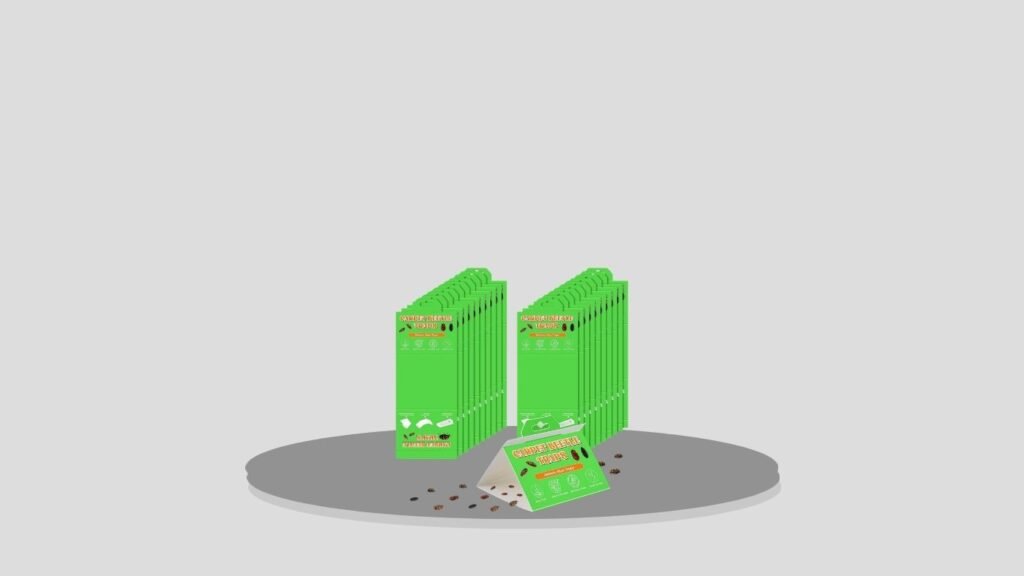
These Carpet Beetle & Crawling Insect Monitoring Traps provide a straightforward adhesive-based solution for detecting pest movement indoors. They are designed to work without sprays or powered components, making them easy to position beneath furniture, alongside baseboards, in closets, and around storage spaces. Their general crawling-pest design is particularly helpful when carpet beetles may be present alongside other small household insects.
Key Features
- Adhesive monitoring surface
- No electrical power required
- No spray application
- Suitable for crawling insects
- Compact indoor construction
- Easy placement under furniture
- Useful around closets and baseboards
- Disposable monitoring format
Why It’s Best for Hidden Household Areas
Carpet beetle larvae often remain out of sight rather than crawling across open floors in daylight. They may develop behind furniture, near baseboards, in closets, or where lint and animal-based materials accumulate.
A thin adhesive monitor can fit into many of these spaces without interfering with everyday activity. Placing several units around a room allows you to compare where insect movement is occurring.
This is particularly valuable when visible fabric damage has appeared but the precise source of the infestation remains unclear.
Monitoring Performance and Practical Placement
University of Maryland Extension notes that carpet beetle larvae are frequently found in concealed areas including beneath furniture, along baseboards, and in little-used storage locations.
Consequently, traps positioned in these quieter locations make more sense than monitors placed in the middle of a heavily trafficked floor.
Sticky monitoring should also be combined with inspection. Look for hairy larvae, shed skins, damaged natural-fiber materials, lint accumulations, and dead insects near areas with the highest catches.
A trap can indicate activity, but it does not remove the hidden food source supporting larvae.
Overall Verdict
These non-powered monitoring traps offer a convenient choice for homeowners who want a simple tool for identifying problem areas.
Their greatest value comes from strategic placement rather than complicated technology. For closets, carpet edges, furniture gaps, and storage rooms, they can help reveal where a closer inspection and more thorough cleaning are needed.
For a developing carpet beetle problem, that information can be more useful than relying on guesswork.
4. Carpet Beetle Traps for Crawling Insects
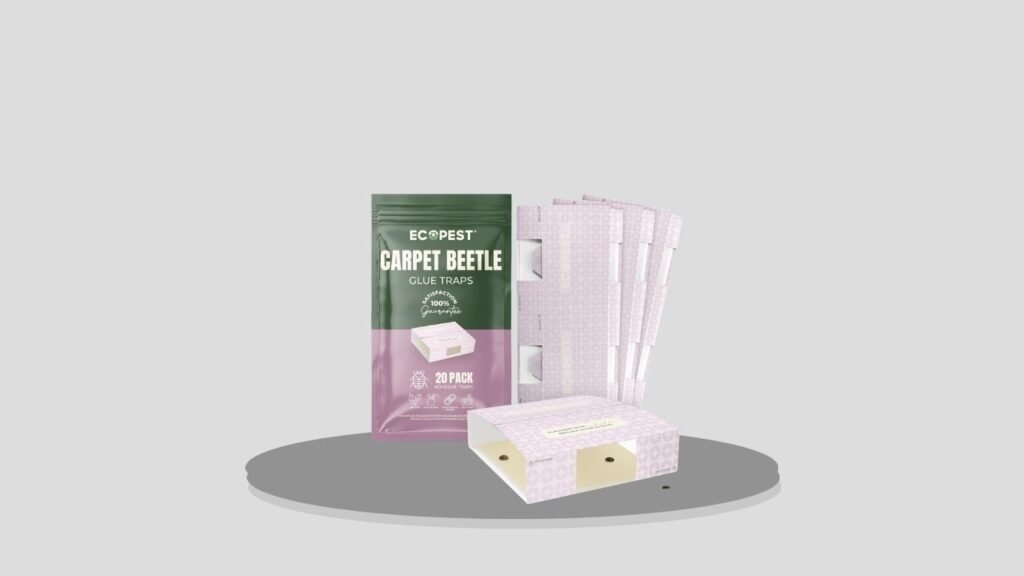
These Carpet Beetle Traps use an adhesive monitoring design intended for carpet beetles and other crawling insects. Their low-maintenance format makes them practical for placing around closets, rugs, baseboards, bedrooms, storage areas, and underneath furniture. Since no charging, wiring, or liquid treatment is required, several traps can remain in place while users watch for signs of ongoing beetle activity.
Key Features
- Sticky capture surface
- Designed for carpet beetles and crawling pests
- No batteries required
- No electrical connection
- Compact indoor format
- Suitable for closets and carpet edges
- Simple setup and disposal
- Useful for infestation monitoring
Why It’s Best for Simple Indoor Detection
The strongest feature of this trap is simplicity. Users can position it in likely travel areas and then periodically inspect the adhesive board for insects.
This approach can be particularly useful when you have noticed one or two adult carpet beetles but are uncertain whether there is a developing infestation elsewhere in the house.
Using multiple monitors can also provide a clearer picture of activity. A trap with repeated catches near one room or closet may indicate that the source is relatively close.
Placement and Carpet Beetle Control
Carpet beetle adults are commonly seen around windows because many species are attracted to light. Plain sticky traps can therefore be positioned on or near windowsills to capture adults and monitor their presence.
For possible larval activity, inspect less-visible locations such as carpet edges, behind furniture, wardrobes, heating vents, and stored fabrics.
Trapping alone is rarely enough to solve the underlying problem. Effective management depends heavily on vacuuming, removing lint and hair, cleaning susceptible fabrics, and locating infested materials.
Overall Verdict
These Carpet Beetle Traps are best suited to users who want uncomplicated indoor monitoring without specialized equipment.
The adhesive construction is easy to deploy throughout several likely hotspots, and routine inspection can help identify patterns in beetle activity.
For homeowners looking for a supporting tool alongside vacuuming, fabric inspection, and sanitation, this style of trap offers useful visibility into what is happening in otherwise hidden locations.
5. Mysora Carpet Beetle Pheromone Traps

Mysora Carpet Beetle Pheromone Traps are aimed at users who want more targeted monitoring than an ordinary crawling-insect glue board can provide. The pheromone lure is designed to draw carpet beetles toward the adhesive capture area, making the traps particularly appropriate for closets, wardrobes, textile storage rooms, carpeted bedrooms, and other spaces where adult beetles have already been identified.
Key Features
- Pheromone-based attractant
- Sticky capture surface
- Designed for carpet beetle monitoring
- No electrical power needed
- Compact indoor format
- Easy placement near stored textiles
- Useful for locating active areas
- Low-maintenance monitoring system
Why It’s Best for Focused Infestation Monitoring
A pheromone trap is most valuable when the goal is identifying whether adult carpet beetles are active in a specific part of the home.
Unlike basic glue boards, which rely largely on insects wandering onto them, pheromone-baited traps actively attract responsive adults toward an adhesive surface.
This can be especially helpful in large closets, storage spaces, textile collections, or rooms where valuable wool, fur, feathers, or upholstered items need closer monitoring.
Lure Performance and Strategic Use
Appropriate pheromone traps are recognized as useful tools for monitoring carpet beetle infestations, but their effectiveness depends on the species targeted by the lure. UC IPM specifically cautions that carpet beetle pheromones may be species-specific.
Consequently, users should not interpret an empty pheromone trap as absolute proof that no carpet beetles exist.
Traps are most useful when combined with visual inspection and sanitation. Check them once or twice weekly and investigate locations where captures become concentrated.
Remember that catching adult beetles does not directly eliminate hidden larvae feeding within fabrics or accumulated organic debris.
Overall Verdict
Mysora Pheromone Traps are a logical option for users who want targeted adult carpet beetle monitoring rather than broad-spectrum crawling-pest detection.
Their greatest value is helping pinpoint active areas and monitor whether a management program is reducing beetle activity.
For homes with recurring carpet beetle problems, placing pheromone monitors near susceptible textiles can provide an additional layer of information that general sticky traps may not offer.
6. Catchmaster Crawling Pest & Insect Glue Traps

Catchmaster Crawling Pest & Insect Glue Traps are broad-spectrum adhesive monitors rather than carpet beetle-specific pheromone traps. This 12-count package contains three packs of four glue boards made from paper-based material. They are designed for crawling pests such as spiders, crickets, roaches, and ants, but their adhesive construction can also serve as a general monitoring tool where carpet beetles or larvae are moving across surfaces.
Key Features
- 12 glue traps included
- Three packs of four
- Strong adhesive surface
- Paper-based construction
- No electricity required
- Compact 7.13 x 3.62-inch format
- Suitable for multiple crawling pests
- Easy placement along walls and furniture
- Disposable after capture
Why It’s Best for Whole-Home Pest Monitoring
The 12-count quantity is Catchmaster’s biggest advantage in this roundup. Instead of reserving monitoring for one or two locations, users can distribute glue boards across closets, basement areas, furniture edges, storage rooms, and baseboards.
That makes them particularly helpful in homes where carpet beetles are only one of several crawling pest concerns.
Because these traps do not rely on a carpet beetle pheromone, they can capture insects that happen to cross the adhesive surface without being limited to one targeted species.
Adhesive Performance and Placement
For carpet beetle monitoring specifically, strategic placement is essential. University guidance suggests using unbaited sticky traps near windows where adult carpet beetles commonly congregate, while monitors in closets and near susceptible materials can help reveal other areas of activity.
Position glue boards tight against walls, beneath furniture, or near suspected travel routes rather than in open areas.
Because Catchmaster is a general monitoring product, it should not be expected to actively lure carpet beetles from across a room in the way a species-appropriate pheromone trap might.
Overall Verdict
Catchmaster is the most versatile choice here for users who want numerous adhesive monitors for several household pests.
The 12-count package provides enough traps to test many areas simultaneously, and the simple, electricity-free design requires almost no maintenance.
For dedicated carpet beetle detection, a pheromone product may offer more targeted attraction, but Catchmaster is an excellent supporting option when broad household monitoring and flexible placement are priorities.
7. JF Oakes Pro-Pest Pantry Moth & Beetle Traps
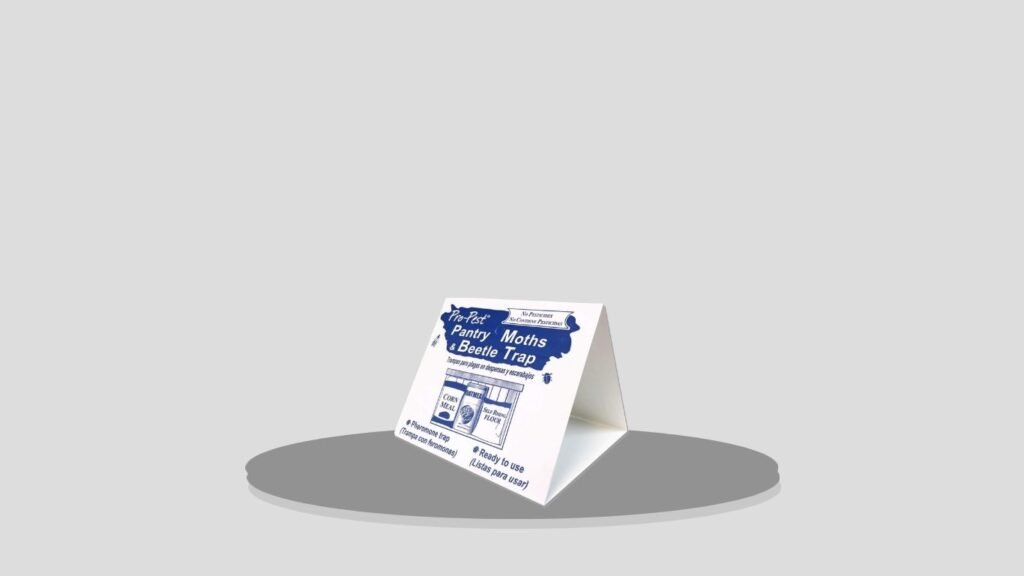
JF Oakes Pro-Pest Pantry Moth & Beetle Traps are included here with an important distinction: they are primarily designed for pantry pests, not carpet beetles. The two pre-baited pheromone traps target insects including Indian meal moths, flour moths, and cigarette beetles. They can be placed on a shelf or hung in a pantry and remain usable for up to about two months after deployment.
Key Features
- Two pre-baited traps
- Pheromone embedded in the glue
- Ready to use after unfolding
- Foldable triangular construction
- Can hang or sit on a shelf
- Targets pantry moths and cigarette beetles
- No electricity required
- Up to approximately two months of use
- Compact pantry-friendly design
Why It’s Best for Pantry Beetles Rather Than Carpet Beetles
This trap earns a place in the comparison mainly to clarify its intended purpose. A household may have several different beetle species, and small pantry beetles can easily be mistaken for carpet beetles without close identification.
JF Oakes specifically targets pantry pests such as cigarette beetles and several moth species. Its pheromone lure is therefore not a substitute for a carpet beetle-specific pheromone trap.
If insects are appearing around flour, grains, spices, cereal, or other dry foods, this product becomes much more relevant.
Setup and Monitoring Performance
The trap arrives pre-baited, so users simply remove it from its packaging, fold it into shape, and place or hang it near the suspected pantry infestation.
Pheromones in the adhesive attract targeted pantry pests, and the sticky interior captures them after entry. The manufacturer information recommends changing traps as needed or about every two months.
For suspected carpet beetles around carpets, wool, clothing, upholstery, or animal-fiber materials, one of the carpet-beetle-focused products above is a more appropriate monitoring choice.
Overall Verdict
JF Oakes Pro-Pest is a useful trap, but it should be chosen for the right problem. It is particularly practical for monitoring cigarette beetles and pantry moths around stored foods, not as a primary carpet beetle trap.
For households uncertain about which small beetle they are seeing, correct identification should come first. Once pantry pests are confirmed, the pre-baited design, simple setup, and two-trap package make JF Oakes an easy monitoring solution.
FAQs
1. Do Carpet Beetle Traps Really Work?
Carpet beetle traps can be useful for monitoring adult beetles and identifying where activity is concentrated. Pheromone traps may attract certain adult species, while plain sticky traps capture insects moving through an area. However, traps alone usually do not eliminate an infestation because carpet beetle larvae are the stage that damages fabrics and often remain hidden.
2. Where Should I Place Carpet Beetle Traps?
Place traps near closets, carpet edges, baseboards, windows, upholstered furniture, storage areas, and places containing wool, fur, feathers, or other natural-fiber materials. Adult carpet beetles are often found near windows, while larvae tend to remain in darker, undisturbed locations. Using several traps in different areas can help reveal where activity is strongest.
3. How Often Should I Check Carpet Beetle Traps?
Check traps about once or twice a week during an active infestation. Replace sticky traps when they become dusty, full of insects, or lose their adhesive strength. Pheromone traps should also be replaced according to the manufacturer’s recommended lure life. Regular inspection makes it easier to compare activity between rooms and determine whether control efforts are working.
4. Will Carpet Beetle Traps Kill the Larvae?
Most carpet beetle traps mainly capture adult beetles or larvae that happen to crawl onto the adhesive surface. They do not reach larvae hidden inside carpets, closets, furniture, wall voids, or stored fabrics. Vacuuming, laundering or dry-cleaning infested materials, removing lint and pet hair, and locating the food source are important for controlling larvae.
5. Are Pheromone Traps Better Than Regular Sticky Traps?
Pheromone traps can be more targeted because they attract certain adult carpet beetles instead of relying only on insects accidentally crossing a glue board. However, pheromone lures may be species-specific, so they work best when the pest has been correctly identified. Regular sticky traps are more versatile for general monitoring and can capture several types of crawling household insects.
