
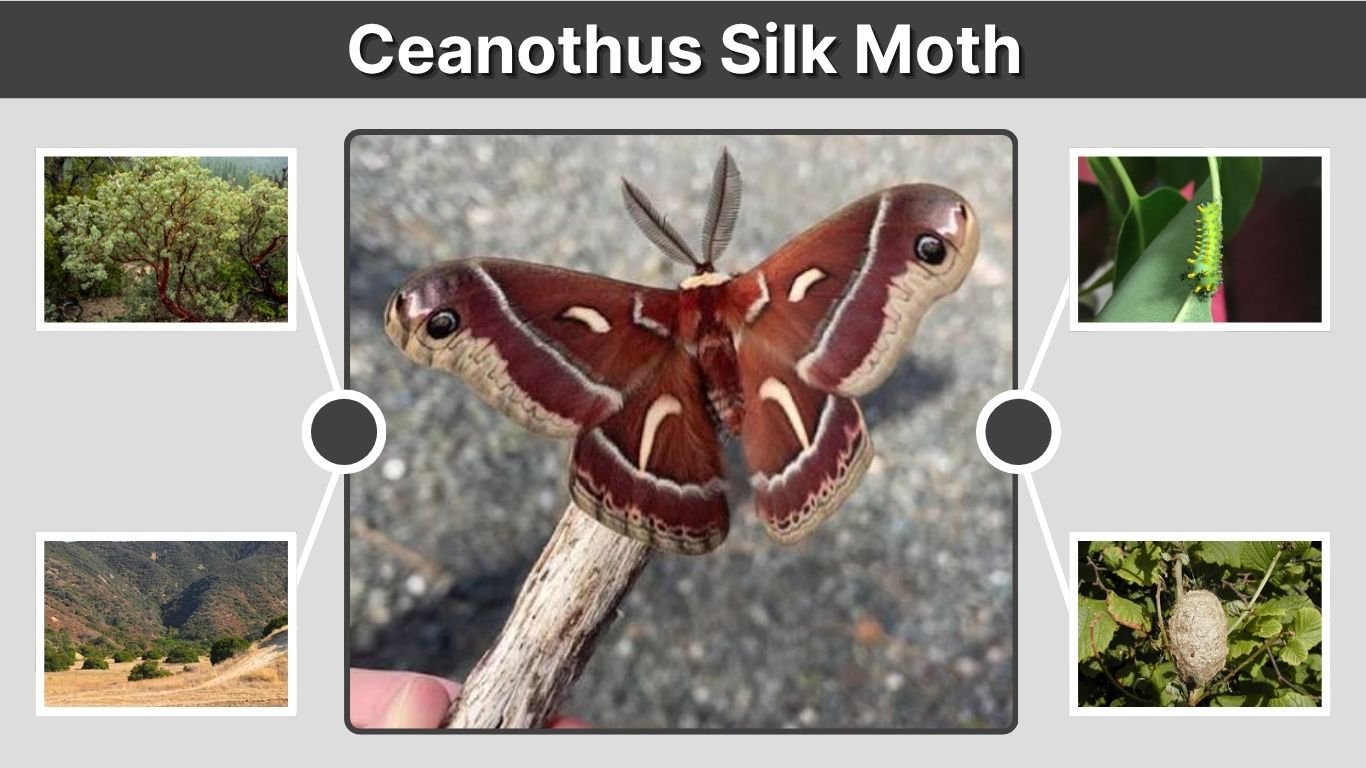
The Ceanothus silk moth (Hyalophora euryalus) is one of the largest and most impressive native silk moths of western North America. Its broad reddish-brown wings, creamy white markings, furry body, and bold eyespots make an adult difficult to overlook. The species occurs from British Columbia south through Washington, Oregon, California, and into Baja California. Although the adult moth lives only briefly and does not eat, its caterpillar spends weeks feeding on shrubs and trees such as ceanothus, manzanita, willow, madrone, and gooseberry before producing a durable silk cocoon.
What Is a Ceanothus Silk Moth?
The Ceanothus silk moth belongs to the giant silk moth family Saturniidae. Its scientific name is Hyalophora euryalus.
It is closely related to other spectacular North American silk moths, including the Cecropia and Columbia silk moths. Ceanothus silk moths are primarily western, however, and are strongly associated with the Pacific Coast and western mountain habitats.
Adults generally appear from winter through summer depending on elevation, latitude, and seasonal weather. Most populations produce one generation per year.
What Does a Ceanothus Silk Moth Look Like?
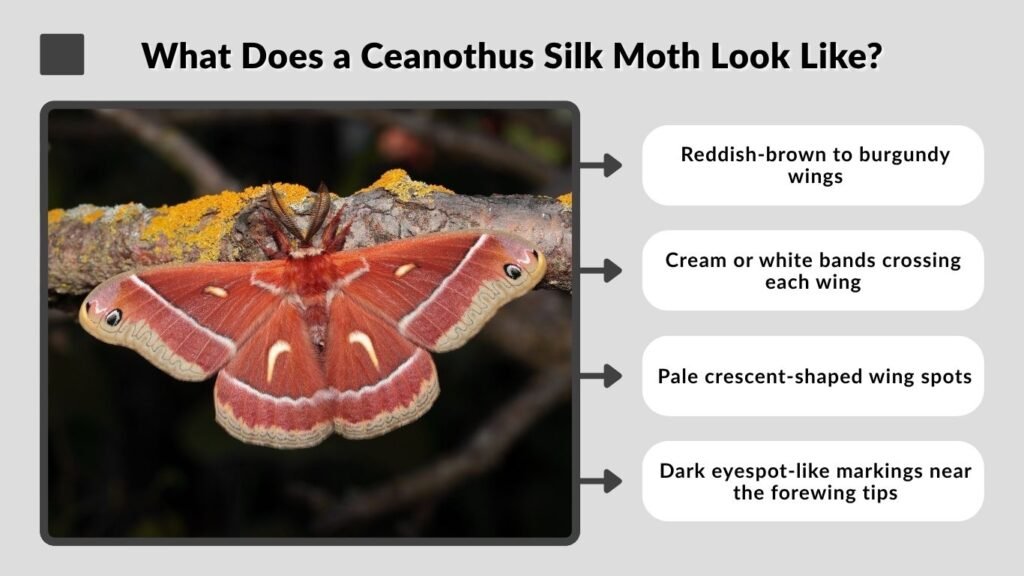
Adult Ceanothus silk moths are large, heavily patterned moths with broad wings.
Their basic coloration ranges from reddish brown and burgundy to darker chocolate shades. Narrow white bands cross the wings, while pale crescent-shaped markings appear near the center.
Identification
- Reddish-brown to burgundy wings
- Cream or white bands crossing each wing
- Pale crescent-shaped wing spots
- Dark eyespot-like markings near the forewing tips
- Thick, furry reddish body
- White bands across the abdomen
- Broad wings
- Feathery antennae
- Wingspan of approximately 3.5–5 inches (8.9–12.7 cm)
Color can vary geographically. Some northern individuals may appear much darker or grayer than the reddish forms commonly photographed in California.
Ceanothus Silk Moth Male vs Female
Males and females have similar wing patterns, so their antennae provide one of the easiest ways to distinguish them.
Male Ceanothus Silk Moth
Males have especially broad, strongly feathered antennae. These structures contain sensory receptors that help detect pheromones released by receptive females.
Males also tend to have a narrower abdomen.
Female Ceanothus Silk Moth
Females have narrower, less feathery antennae and typically a larger, fuller abdomen, particularly when carrying eggs.
The larger antennae of males are such a useful characteristic that they can often be used to identify the sex from a clear photograph.
Ceanothus Silk Moth Caterpillar
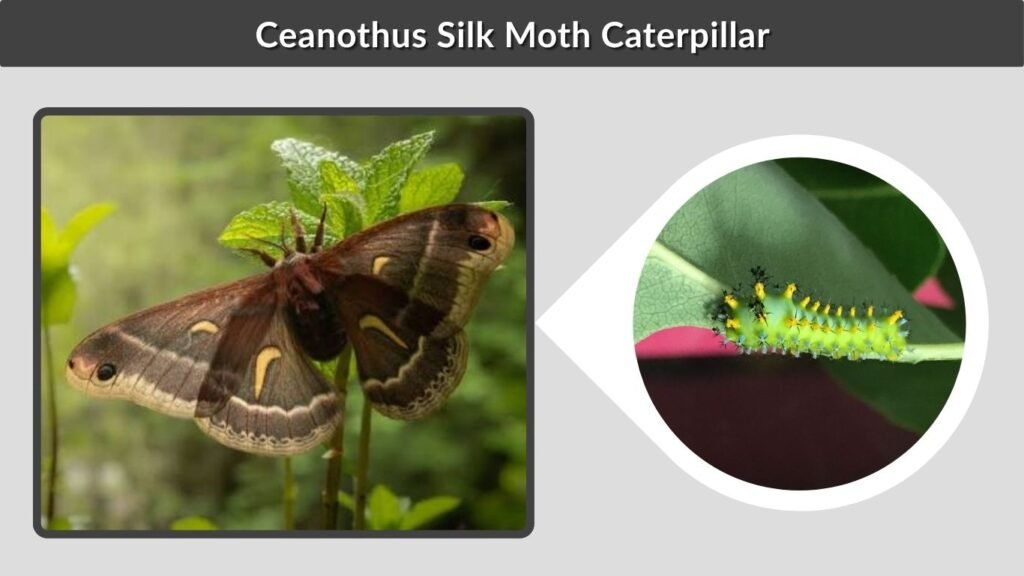
The caterpillar looks dramatically different at various stages of growth.
Young larvae change appearance after each molt. During the colorful middle stages, they can have green bodies covered with rows of bright projections.
Caterpillar Identification
- Green to whitish-green body
- Nine pairs of yellow dorsal spines in middle stages
- Some front spines have dark rings
- Blue side projections tipped with white
- Later-stage caterpillars become paler
- Mature larvae may have predominantly white projections
- Large, thick-bodied appearance when fully grown
The dramatic spines may make the caterpillar look dangerous, but they are primarily part of its unusual appearance rather than evidence that it has a medically significant sting.
Is the Ceanothus Silk Moth Caterpillar Poisonous?
Ceanothus silk moth caterpillars are not considered dangerous venomous caterpillars like some species with medically important stinging spines.
Their colorful projections can look intimidating, but they are not known for delivering the painful venomous sting associated with caterpillars such as puss caterpillars or some Automeris species.
It is still sensible to avoid unnecessary handling. Caterpillars are delicate animals, and people with sensitive skin may experience irritation after contact with various hairy or spiny insects.
Ceanothus Silk Moth Host Plants
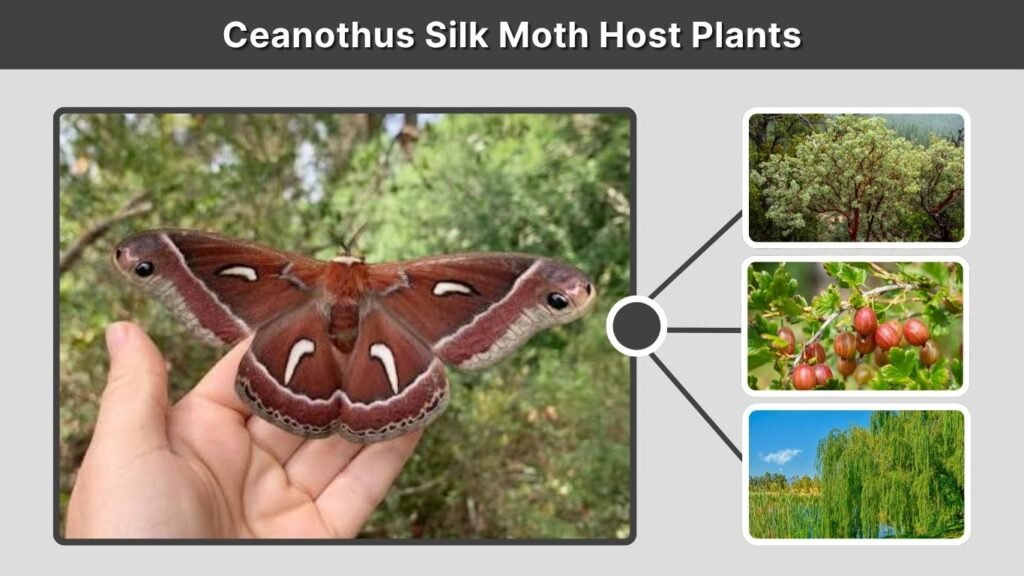
The name “Ceanothus silk moth” reflects one of its important host plants, but the caterpillar is not restricted to ceanothus.
Larvae can feed on a surprisingly broad range of shrubs and trees.
Common Host Plants
- Ceanothus or buckbrush
- Manzanita
- Madrone
- Gooseberry
- Willow
- Alder
- Mountain mahogany
- Wild rose
- Cherry
- Bitterbrush
- Serviceberry
- Maple
This flexible diet helps the species survive across habitats ranging from coastal areas to dry chaparral and mountain forests.
What Do Adult Ceanothus Silk Moths Eat?
Adult Ceanothus silk moths do not eat.
Like many giant silk moths, adults have greatly reduced or nonfunctional feeding structures. They survive on energy stored during the caterpillar stage.
This explains why caterpillar nutrition is so important. The larva must accumulate enough energy not only to transform into an adult but also to power adult flight, mating, and reproduction.
The adult’s short life is therefore almost entirely devoted to finding a mate and producing the next generation.
Ceanothus Silk Moth Range and Habitat
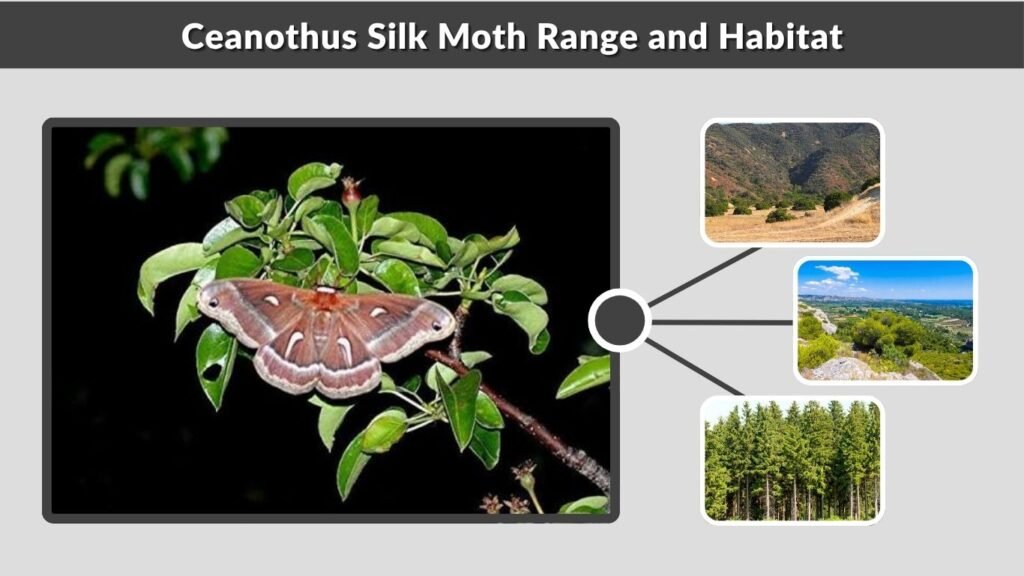
The species has a primarily western North American distribution.
Its range extends from British Columbia through Washington and western Oregon, across much of California, and south into Baja California.
In California it is particularly widespread west of the Sierra Nevada.
Habitat
Ceanothus silk moths can live in:
- Coastal environments
- Chaparral
- Shrublands
- Mountain valleys
- Conifer forests
- Woodland edges
- Areas containing abundant host shrubs
Adults may also appear around porch lights and other artificial lights at night.
Ceanothus Silk Moth in California
California provides extensive suitable habitat for this moth, especially where ceanothus, manzanita, madrone, and related host plants grow.
Adults can be found from coastal areas into mountain environments. Their emergence period varies because warmer low-elevation populations may become active earlier than populations living at higher elevations.
Records from California include both adults and caterpillars, including larvae feeding on manzanita.
Ceanothus Silk Moth in Oregon
The Ceanothus silk moth also occurs through western Oregon.
Forested landscapes, woodland openings, shrub habitats, and areas containing suitable larval food plants provide potential habitat.
Oregon falls well within the species’ broader Pacific Coast range, which extends north into British Columbia and south through California.
Ceanothus Silk Moth Eggs
After mating, females place eggs on suitable host vegetation.
The eggs may be deposited individually or in small groups directly on leaves.
Under suitable conditions, they generally hatch in approximately 9–14 days.
The tiny caterpillars then begin eating the host plant and grow rapidly, periodically shedding their outer skin as their bodies increase in size.
Ceanothus Silk Moth Cocoon
Once fully grown, the caterpillar stops feeding and begins producing silk.
It constructs a strong, elongated or teardrop-shaped cocoon on the outer portion of the host plant, often securing it to a twig.
Inside, the larva changes into a pupa.
The cocoon is especially important because the moth commonly overwinters as a pupa, protected inside the silk structure until conditions are suitable for adult emergence.
Ceanothus Silk Moth Life Cycle
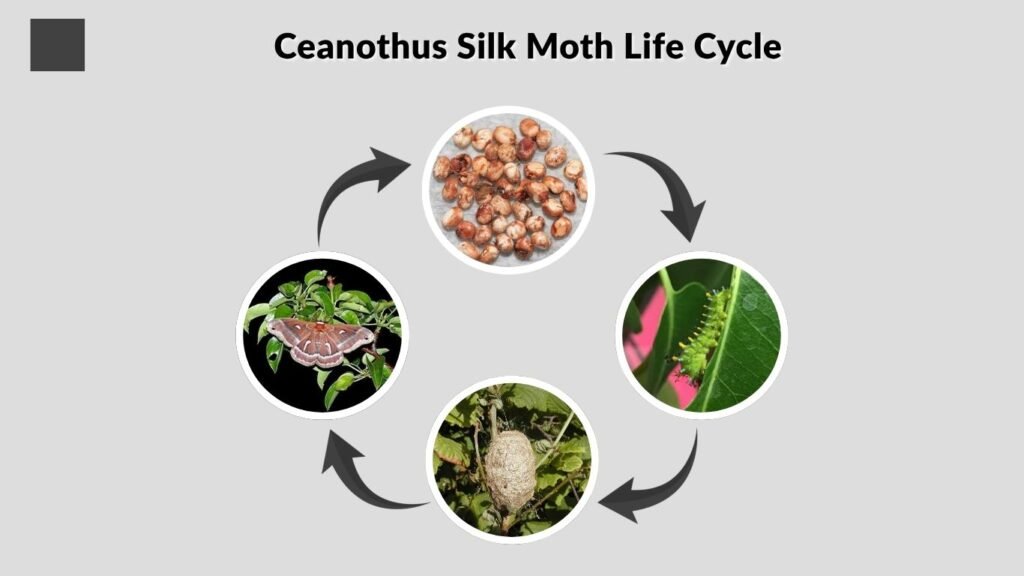
The Ceanothus silk moth undergoes complete metamorphosis with four basic stages:
Egg → Caterpillar → Pupa → Adult
Egg Stage
Females attach their eggs to host-plant leaves. Hatching generally occurs after 9–14 days.
Caterpillar Stage
The larvae eat leaves and grow through multiple instars. Their color and spine patterns change significantly as they mature.
Pupal Stage
A mature caterpillar spins a strong cocoon and becomes a pupa. The species commonly spends the winter in this stage.
Adult Stage
The adult emerges when seasonal conditions are appropriate. It does not feed, so its remaining stored energy is directed toward flight and reproduction.
Most populations have one brood annually.
How Long Does a Ceanothus Silk Moth Live?
The complete life cycle lasts far longer than the adult stage.
The caterpillar feeds and grows for weeks, while the pupa may remain inside its cocoon for many months, often through winter.
The adult itself is extremely short-lived. Accounts from California describe adult lives lasting only a few days, during which males search intensely for females and females mate and lay eggs.
Because adults cannot replenish their energy by eating, their lives naturally end soon after reproduction.
Ceanothus Silk Moth Adaptations
Several features help the species survive.
Its large eyespot-like wing patterns and contrasting markings may help confuse predators or make the moth appear less like ordinary prey.
The moth’s reddish-brown colors also blend well with bark, dead leaves, and branches when the wings are folded.
Male antennae provide another important adaptation. Their large surface area allows males to detect female pheromones efficiently while flying through the landscape.
Finally, the tough silk cocoon protects the developing pupa during months of unfavorable weather.
Ceanothus Silk Moth Spiritual Meaning and Symbolism
There is no single scientifically recognized or universal traditional meaning specifically assigned to the Ceanothus silk moth.
However, moths are commonly used symbolically in modern art and personal interpretations to represent transformation, change, renewal, attraction to light, and the temporary nature of life.
The Ceanothus silk moth’s dramatic transformation from caterpillar to cocoon to winged adult can naturally inspire those interpretations. Such symbolism should be understood as cultural or personal meaning rather than biological fact.
Interesting Ceanothus Silk Moth Facts
The Ceanothus silk moth is one of the largest moths of western North America, with some adults reaching approximately five inches across the wings.
Despite their size, adults never need to search for food. Everything required for their brief adult existence was accumulated while they were caterpillars.
Another remarkable feature is their variability. Individuals from different parts of the range can differ noticeably in color, from rich burgundy-red to much darker brown or gray forms.
Their short adult period contrasts dramatically with the much longer caterpillar and overwintering pupal stages.
FAQs
Are Ceanothus silk moths rare?
They are not considered globally rare, although abundance varies considerably by region and from year to year. Their short adult flight period can make them seem uncommon.
Do Ceanothus silk moths bite?
No. Adults are harmless to people and do not feed. They lack the functional feeding structures needed to bite people.
What does a Ceanothus silk moth caterpillar eat?
Caterpillars feed on ceanothus, manzanita, madrone, willow, alder, gooseberry, mountain mahogany, and several other woody plants.
How can you tell a male from a female?
Males have much broader and more strongly feathered antennae, while females generally have narrower antennae and fuller abdomens.
Where can Ceanothus silk moths be found?
They occur mainly in western North America, from British Columbia through Washington, Oregon, and California into Baja California.
