
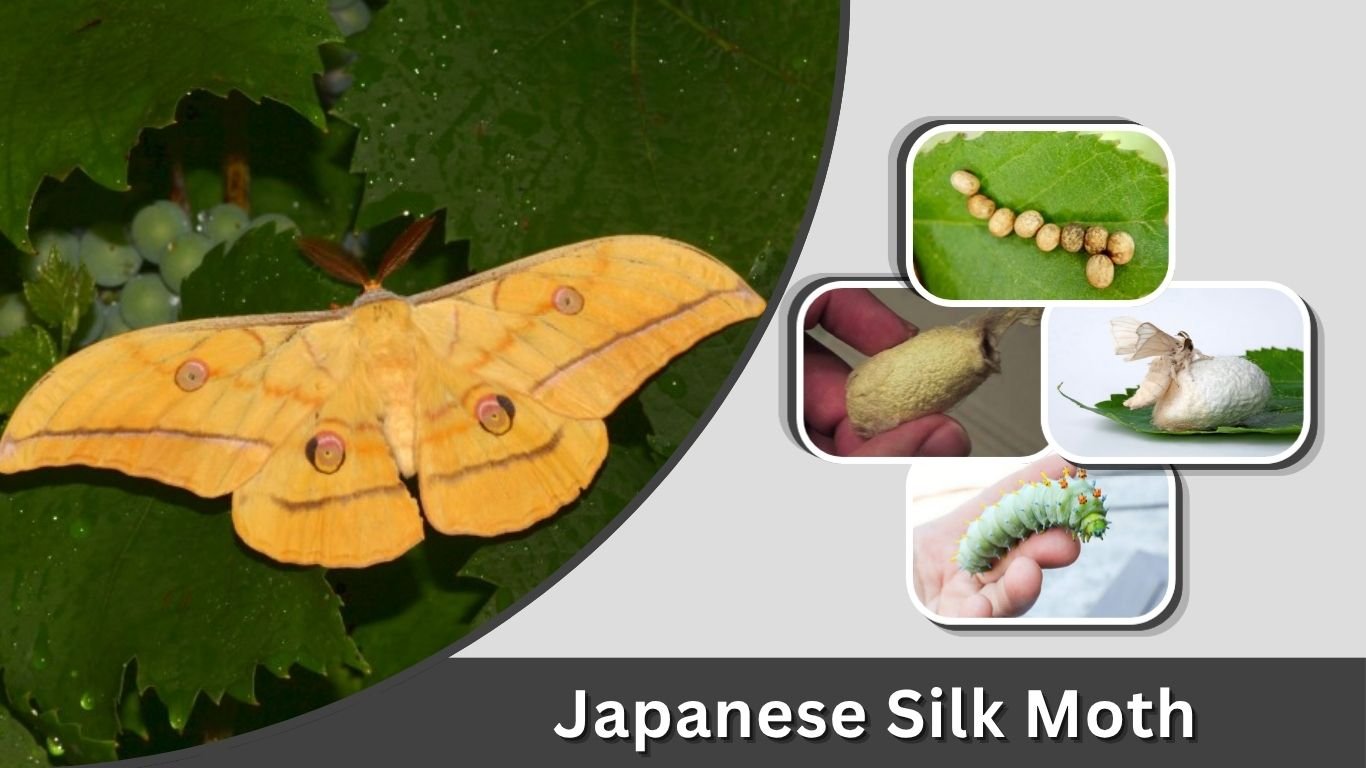
The Japanese silk moth (Antheraea yamamai), also called the Japanese oak silkmoth, is a spectacular giant silk moth native to East Asia. Adults have broad yellow, orange, or brown wings decorated with four distinctive eyespots, while the caterpillars are large, green leaf-eaters that favor oak trees. This species is especially famous for producing a naturally beautiful silk known as tensan silk. Unlike the domesticated silk moth, it remains a wild species capable of flight and completing its life cycle without human care.
What Does a Japanese Silk Moth Look Like?
The Japanese oak silkmoth belongs to Saturniidae, the family containing many of the world’s largest moths. Its broad wings, heavy furry body, feathery antennae, and circular transparent-centered eyespots give it an unmistakable appearance. Color varies considerably between individuals, ranging from yellowish gold to reddish brown, helping adults blend into leaves and tree bark.
Japanese Silk Moth Identification
Important features include:
- Scientific name: Antheraea yamamai
- Family: Saturniidae
- Wingspan commonly around 11–14 cm
- Yellow, golden, orange, or brown wings
- One prominent eyespot on each wing
- Dark wavy bands crossing the wings
- Thick, furry body
- Large feathery antennae
- Broad, slightly scalloped wing edges
- Strong nocturnal flight
Published records describe A. yamamai as a very large and distinctive moth with a wingspan of approximately 110–140 mm.
Male vs Female Japanese Oak Silkmoth
Males and females have broadly similar wing patterns, but their bodies and antennae provide useful clues.
Males generally have noticeably broader, more strongly feathered antennae. These structures detect chemical pheromones released by females, allowing males to locate potential mates at night.
Females tend to have heavier, broader abdomens because they carry eggs. Their antennae are still feathered but usually less impressive than those of males.
Japanese Silk Moth Caterpillar
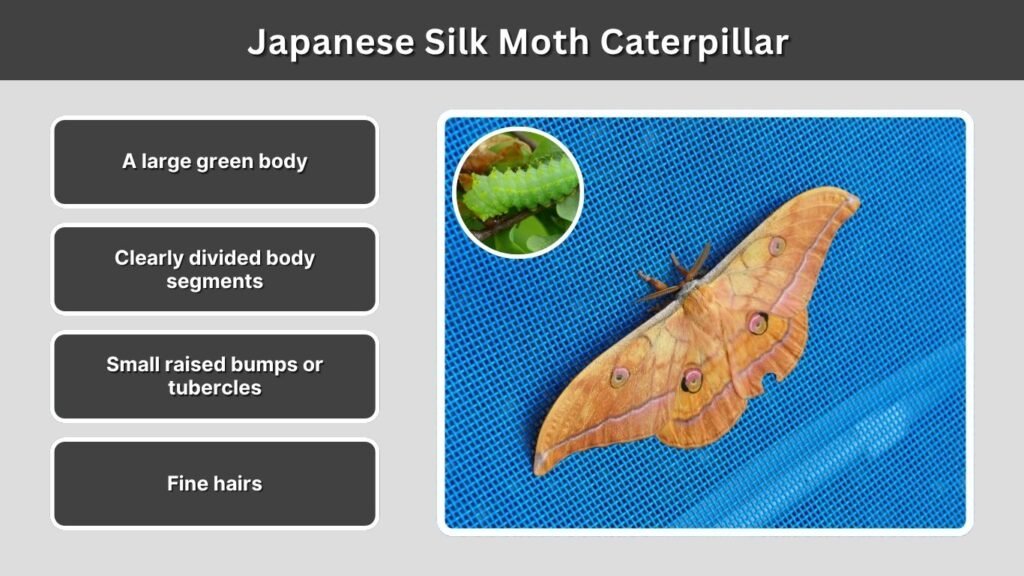
The caterpillar stage is responsible for nearly all feeding and growth. Japanese silk moth larvae become large, bright green caterpillars that spend weeks eating tree leaves before producing their silk cocoons. Like other giant silkmoths, they must accumulate enough energy as larvae to support pupation, adult flight, mating, and egg production later in life.
What Does the Caterpillar Look Like?
A Japanese silk moth caterpillar typically develops:
- A large green body
- Clearly divided body segments
- Small raised bumps or tubercles
- Fine hairs
- Pale or yellowish markings
- Six true legs near the head
- Fleshy abdominal prolegs
- Strong chewing mouthparts
- Increasingly robust size with each molt
Young caterpillars look considerably smaller and may differ somewhat in coloration. As they mature, they develop the characteristic large green appearance associated with many Antheraea silkworms.
What Do Japanese Silk Moth Caterpillars Eat?
Oak leaves are the primary food. Research on Antheraea yamamai has tested several Quercus species successfully, and oak is generally regarded as its principal host.
Recorded host plants include:
- Oak (Quercus species)
- Beech
- Chestnut
- Hornbeam
- Elm
- Apple
- Hawthorn
- Rose-family trees and shrubs
Oak remains the most characteristic host. Research has identified species such as Quercus acutissima as particularly suitable for larval development.
Japanese Silk Moth Cocoon and Life Cycle
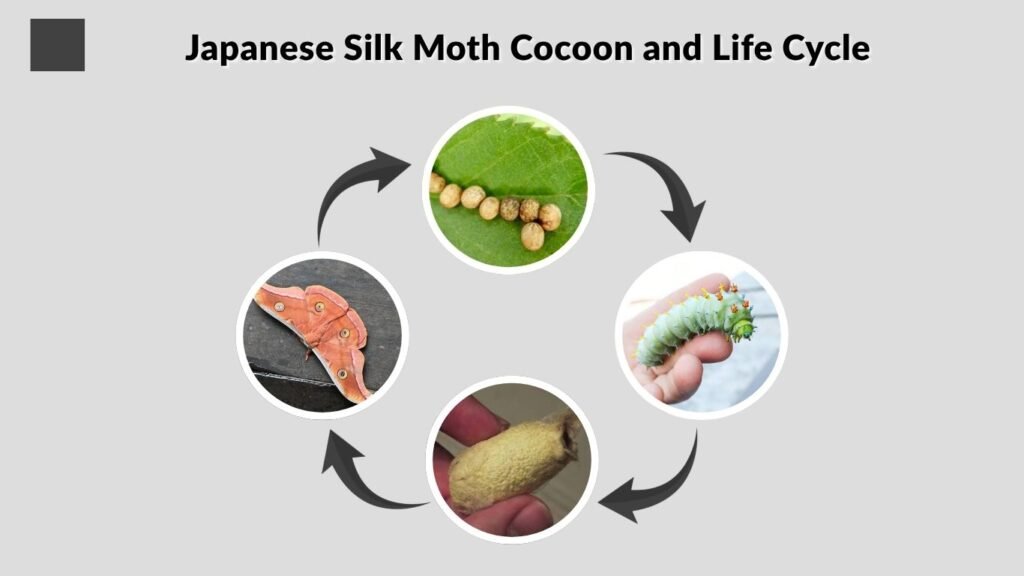
The Japanese oak silkmoth undergoes complete metamorphosis through egg, larva, pupa, and adult stages. It normally produces one generation annually in temperate regions. Much of the year may be spent in a dormant developmental stage, allowing the insect’s emergence and feeding period to remain synchronized with suitable seasonal conditions and fresh host-plant foliage.
Japanese Silk Moth Life Cycle
The cycle proceeds through four major stages:
- Egg: Females lay eggs on or near host-tree branches. In many populations, the eggs overwinter.
- Caterpillar: Eggs hatch in spring, and larvae spend roughly two months feeding and growing.
- Cocoon and pupa: Mature caterpillars spin silk among leaves and transform into pupae.
- Adult moth: Adults emerge later in the season, mate, and females produce the next generation of eggs.
Research on the species describes it as univoltine, meaning it generally has one generation each year. Eggs can overwinter before hatching when spring conditions return.
What Does the Cocoon Look Like?
The Japanese silk moth produces a strong silk cocoon, often associated with leaves on its host plant.
The cocoon is particularly important because it produces the material historically known as tensan silk. Japanese sericulture research describes A. yamamai as a wild silkworm that forms a beautiful green cocoon.
Inside the cocoon, the caterpillar becomes a pupa. Adult tissues develop during this period until the mature moth is ready to emerge.
Can Japanese Silk Moths Eat and Fly?
Adult Japanese silk moths live very differently from their caterpillars. The larvae are active feeding machines, while adulthood is primarily devoted to reproduction. Like other giant silkworm moths, adults possess greatly reduced mouthparts and do not normally feed. They therefore rely on fat and nutritional reserves accumulated while they were caterpillars.
Do Adult Japanese Silk Moths Eat?
No. Adult Japanese oak silkmoths do not normally eat.
This means adults do not need oak leaves, fruit, nectar, or sugar water. Their digestive and feeding structures are reduced, and the moth survives on stored energy.
This strategy explains why adult life is comparatively brief. Once the moth emerges, its priorities are locating a mate and reproducing rather than feeding and continuing to grow.
Can Japanese Silk Moths Fly?
Yes.
Unlike the heavily domesticated Bombyx mori, Japanese oak silkmoths are wild, fully winged moths capable of flight. Males in particular may travel at night while following female pheromones.
Adults are primarily nocturnal and can be attracted to artificial lights. Their large wings allow strong flight despite their relatively heavy bodies. Field reports commonly collect males at lights during the adult flight season.
Japanese Silk Moth Lifespan
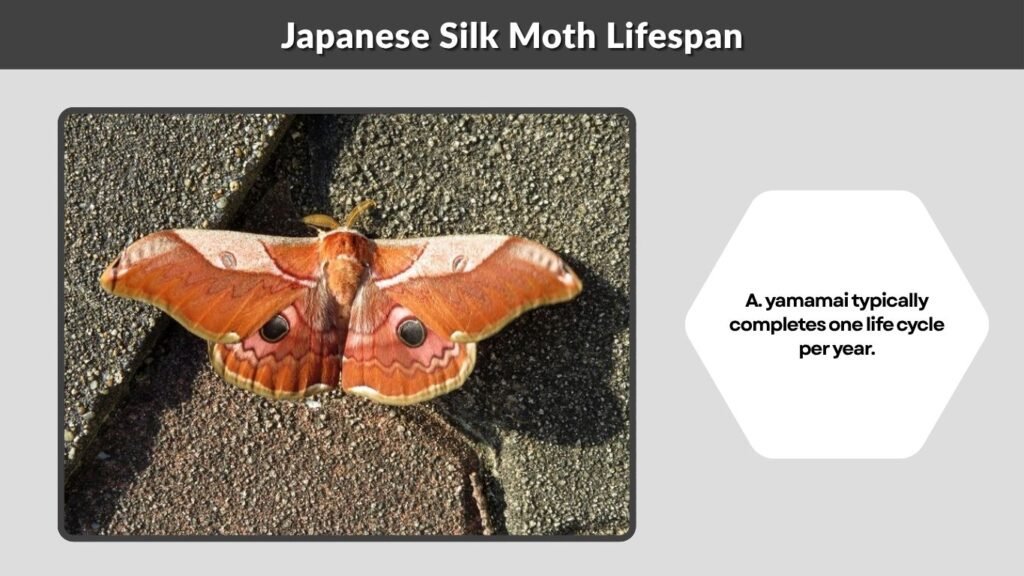
The total lifespan should not be confused with the short adult stage. Most of the yearly cycle is spent developing as an egg, caterpillar, or pupa. Adult Saturniid moths generally live only long enough to reproduce because they cannot replenish energy through feeding. The exact timing varies according to climate, population, weather, and local seasonal conditions.
How Long Does a Japanese Silk Moth Live?
A. yamamai typically completes one life cycle per year. Eggs laid in autumn may remain dormant through winter, hatch in spring, and produce caterpillars that feed for around two months. Adults commonly appear from late summer into early autumn in European populations.
The actual adult stage is much shorter than the entire yearly cycle. A precise universal adult lifespan is difficult to give because conditions vary, but giant silkmoth adults generally survive only a relatively short period devoted to reproduction.
Why Is Adult Life So Short?
The absence of functional feeding means every flight consumes stored energy that cannot be replaced.
A male must locate a female, while the female must mate and deposit her eggs before those reserves are exhausted. Natural predators, weather, and nighttime activity can shorten adult survival even further.
The seemingly brief adult stage is therefore only the final reproductive chapter of a much longer developmental cycle.
Japanese Silk Moth vs Domestic Silk Moth
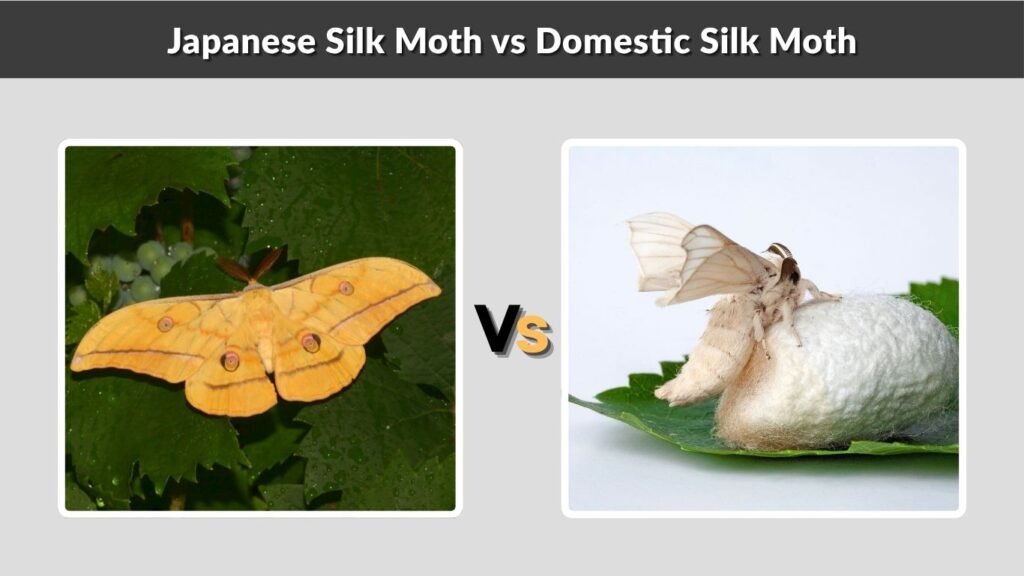
Although both insects produce silk, the Japanese oak silkmoth and the domestic silk moth are very different animals. Antheraea yamamai is a wild Saturniid associated mainly with oak forests, whereas Bombyx mori has undergone thousands of years of domestication and depends heavily on people for survival.
Major Differences
Japanese silk moth (Antheraea yamamai):
- Wild giant silk moth
- Family Saturniidae
- Usually feeds on oak as a caterpillar
- Adult can fly
- Large wings with four eyespots
- Produces tensan wild silk
- Naturally survives outdoors
Domestic silk moth (Bombyx mori):
- Fully domesticated species
- Family Bombycidae
- Caterpillar mainly eats mulberry
- Adult is functionally flightless
- Pale cream-colored adult
- Main source of commercial mulberry silk
- Highly dependent on humans
Japanese oak silkmoth silk has been studied separately from Bombyx mori silk because the two have different cocoon and fiber properties.
Japanese Silk Moth Meaning and Human Uses
Humans have valued Antheraea yamamai primarily because of its unusual silk and dramatic appearance. The species has also been introduced outside its original Asian range during attempts to establish silk production. Today, its large eyespots and warm coloration make it popular in moth photography, artwork, collections, and nature-inspired tattoo designs.
Japanese Tensan Silk
The Japanese oak silkworm is traditionally associated with tensan, a wild silk valued for its distinctive appearance.
Its cocoon can have a beautiful greenish coloration, and the resulting silk differs from ordinary white mulberry silk produced by Bombyx mori. Research in Japan continues to examine its silk fibers, cocoon structure, genetics, and rearing biology.
Japanese Silk Moth Tattoo Meaning
There is no fixed traditional meaning that every Japanese silk moth tattoo must represent.
Modern moth tattoos are often associated with transformation, attraction to light, change, resilience, or appreciation of nature. A Japanese silk moth design may additionally emphasize beauty, silk, Japanese nature, or the striking eyespots.
The meaning ultimately depends on the person choosing the design.
FAQs
The Japanese oak silkmoth stands out because it combines enormous wings, dramatic eyespots, valuable silk, and an annual life cycle closely connected with oak trees. Its wild lifestyle also separates it from the familiar domesticated silkworm. The following questions address several of the most common points about its identity, lifespan, feeding habits, and silk.
1. What is the scientific name of the Japanese silk moth?
Its scientific name is Antheraea yamamai, and it belongs to the giant silkmoth family Saturniidae.
2. Is the Japanese silk moth a giant silk moth?
Yes. It is a large Saturniid and can reach approximately 11–14 cm in wingspan, making it one of the impressive giant silk moths.
3. What do Japanese silk moth caterpillars eat?
They feed mainly on oak leaves, although several other deciduous trees and shrubs can serve as host plants.
4. Do adult Japanese silk moths eat?
No. Like other giant silkworm moths, adults have greatly reduced mouthparts and do not feed. They depend on energy accumulated during larval development.
5. What is Japanese silk moth silk called?
Silk produced from Antheraea yamamai is commonly known as tensan silk or Japanese oak silkworm silk. The species produces a distinctive greenish cocoon that has long been valued in Japanese silk production.
