
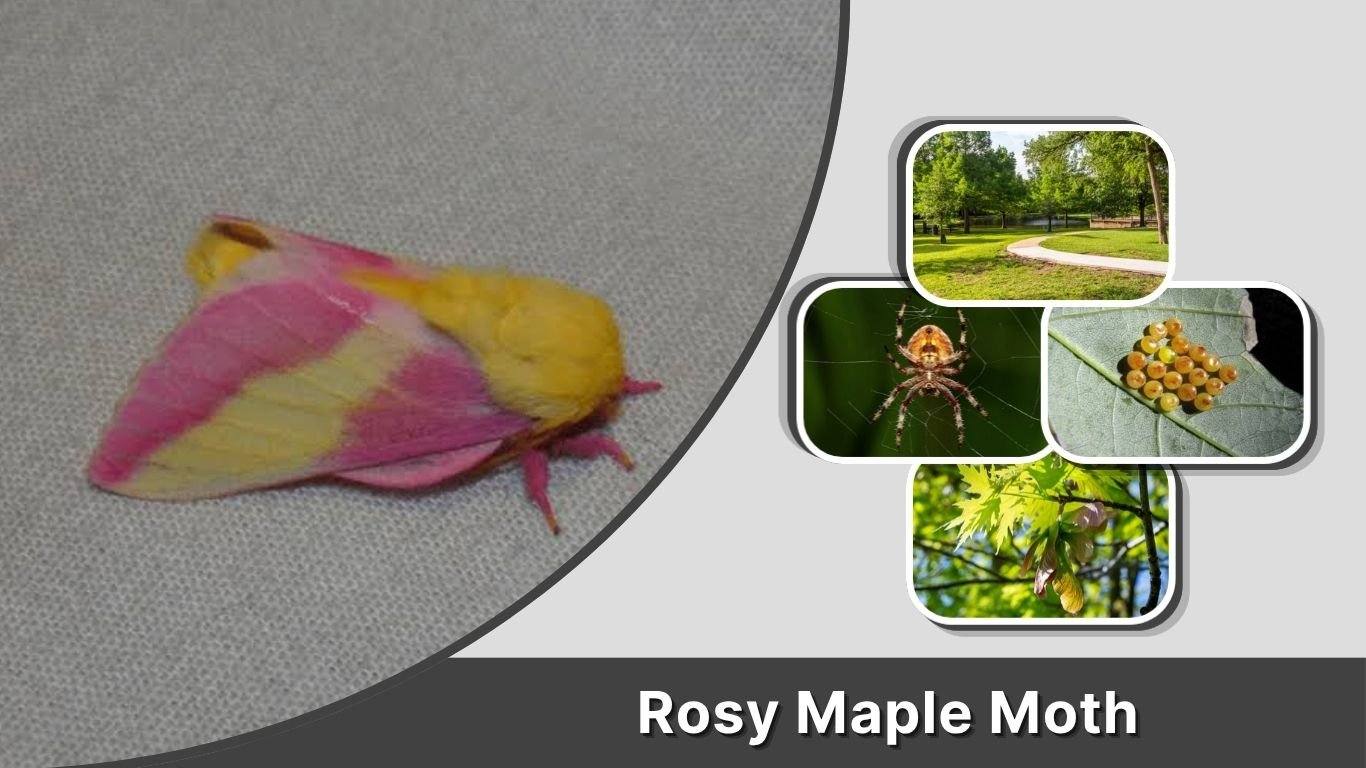
The rosy maple moth (Dryocampa rubicunda) is one of North America’s most colorful moths, famous for its soft yellow body and striking pink-and-yellow wings. Despite looking almost like a plush toy, it is a real wild silk moth in the family Saturniidae. Its caterpillar, called the greenstriped mapleworm, looks completely different and feeds mainly on maple leaves. Rosy maple moths occur across much of eastern North America, where they inhabit deciduous forests, parks, gardens, and neighborhoods containing maple trees.
What Is a Rosy Maple Moth?
The rosy maple moth is a small silk moth belonging to the family Saturniidae and subfamily Ceratocampinae. Its scientific name is Dryocampa rubicunda.
It is considered one of the smallest North American silk moths. Adults are nocturnal and are sometimes attracted to outdoor lights during warm spring and summer nights.
Rosy Maple Moth Quick Facts
- Scientific name: Dryocampa rubicunda
- Family: Saturniidae
- Caterpillar: Greenstriped mapleworm
- Wingspan: About 3.4–5.2 cm
- Adult colors: Pink, yellow, cream, or white
- Primary host plants: Maple trees
- Adult diet: Adults do not feed
- Activity: Mainly nocturnal
- Range: Eastern North America
- Overwintering stage: Pupa
- Life cycle: Egg, larva, pupa, adult
Color varies considerably between individuals. Some moths are intensely pink, while others have considerably more cream or yellow. Rare pale forms can have very little pink.
What Does a Rosy Maple Moth Look Like?
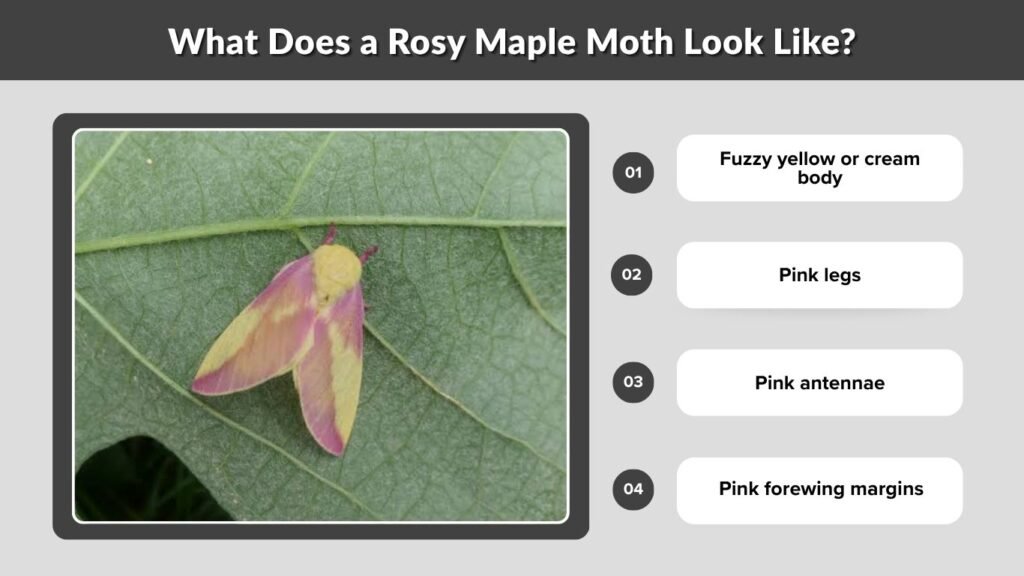
Rosy maple moths are easy to recognize because very few North American moths combine such vivid pink and yellow coloration.
Their bodies are thick and fuzzy, while their wings are relatively rounded.
Identification Features
Look for:
- Fuzzy yellow or cream body
- Pink legs
- Pink antennae
- Pink forewing margins
- Broad yellow or cream wing areas
- Yellow hindwings
- Small, fluffy appearance
- Wingspan usually under 2.1 inches
The amount of pink varies greatly, so an unusually pale rosy maple moth may still belong to the same species.
Male vs. Female Rosy Maple Moth
Males and females share the same basic coloration, but several physical differences can help distinguish them.
Male Rosy Maple Moth
Males generally have:
- Smaller overall body size
- Smaller wingspan
- Very bushy, comb-like antennae
- Often stronger pink coloration
Their enlarged antennae help them detect pheromones released by receptive females.
Female Rosy Maple Moth
Females generally have:
- Larger bodies
- Slightly larger wings
- Less feathery antennae
- Fuller abdomen, particularly when carrying eggs
Females typically have a wingspan toward the larger end of the species’ approximately 3.4–5.2 cm range.
Rosy Maple Moth Caterpillar
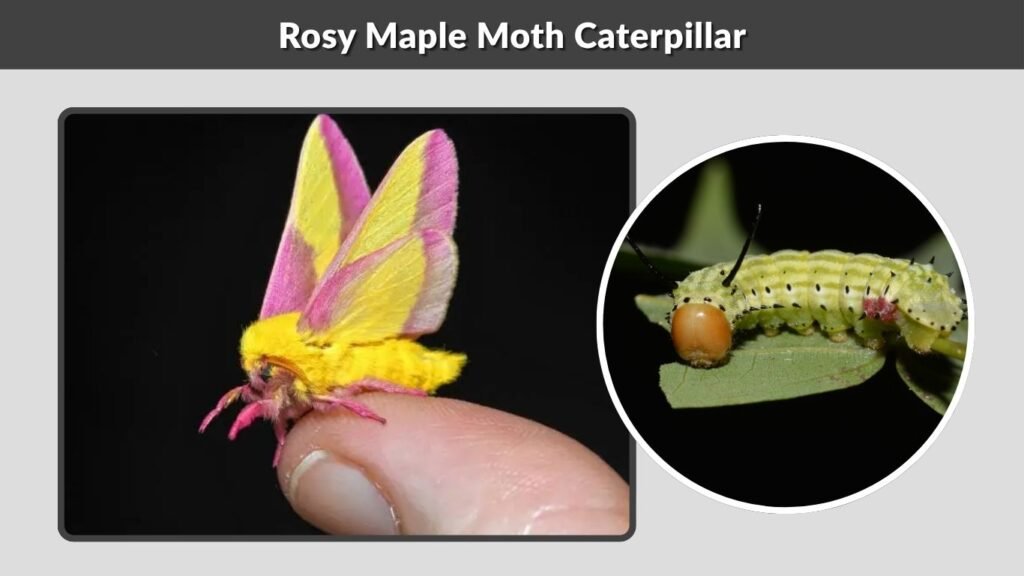
The rosy maple moth caterpillar looks nothing like the pastel-colored adult.
It is commonly called the greenstriped mapleworm.
Mature caterpillars are largely green with longitudinal pale-green stripes. They also possess small spines along the body and a pair of more noticeable dark projections near the front.
Caterpillar Identification
A mature larva may have:
- Green body
- Pale green longitudinal stripes
- Orange-brown or reddish head
- Small black body spines
- Two prominent dark horns near the head
- Body length approaching 5 cm
Young caterpillars look different and change their coloration and markings as they pass through their developmental stages.
Are Rosy Maple Moth Caterpillars Poisonous?
Greenstriped mapleworms are not considered dangerously venomous or poisonous caterpillars.
Their small spines can look intimidating, but they are not comparable to medically important stinging caterpillars such as the Io moth caterpillar or puss caterpillar.
Unnecessary handling is still best avoided because caterpillars are delicate and some people may experience minor irritation from contact with spiny insects.
What Do Rosy Maple Moth Caterpillars Eat?
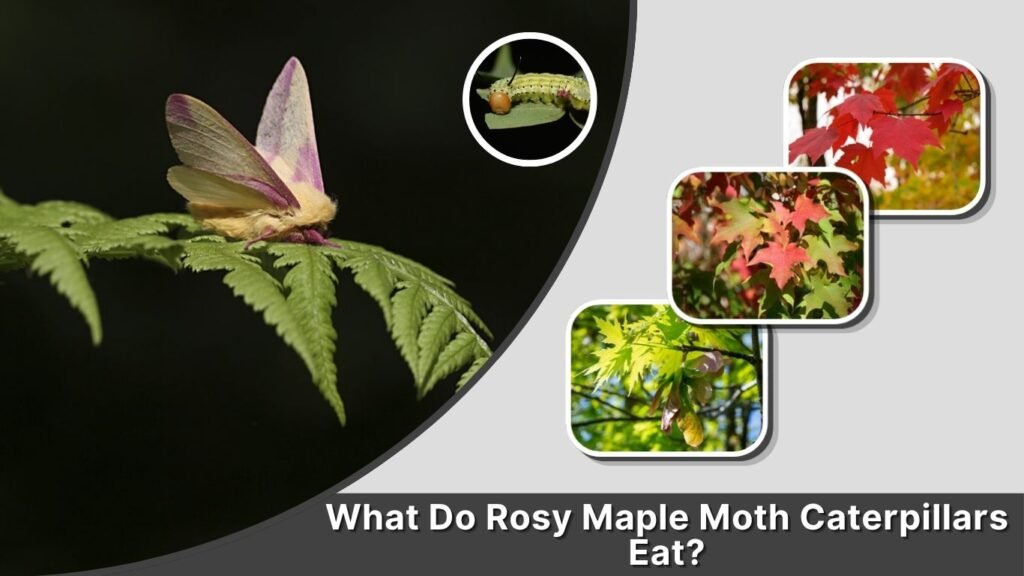
The caterpillars feed on tree leaves, particularly maples.
Important Host Plants
Common hosts include:
- Red maple
- Sugar maple
- Silver maple
- Box elder
- Turkey oak
- Other maple and occasional deciduous tree species
Maples are the most important hosts and are responsible for the moth’s common name.
Young larvae initially feed together. As they grow through later instars, they become increasingly solitary.
Large groups can occasionally remove substantial foliage from maple trees, although established trees generally recover from this defoliation.
What Do Adult Rosy Maple Moths Eat?
Adult rosy maple moths do not eat.
They emerge with enough stored energy from the caterpillar stage to complete their short adult reproductive period.
They therefore do not need flower nectar, fruit, or maple leaves.
The adult stage is primarily devoted to:
- Finding a mate
- Mating
- Laying eggs
- Beginning the next generation
Not feeding as an adult is common among several large silk moths.
Rosy Maple Moth Habitat and Range
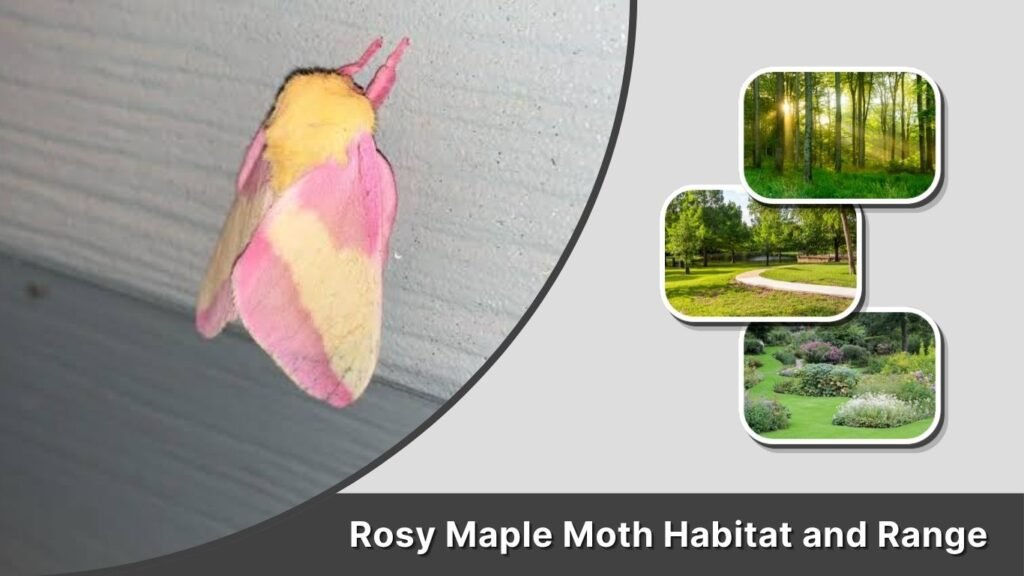
Rosy maple moths are native to eastern North America and are strongly associated with deciduous woodland containing maple trees.
Their range extends from parts of southern Canada through much of the eastern United States and south into Florida and the Gulf Coast, reaching west toward eastern Texas and Minnesota.
Common Habitats
They may occur in:
- Deciduous forests
- Maple woodlands
- Suburban neighborhoods
- Parks
- Large gardens
- Forest edges
- Areas containing mature maple trees
The species is documented in Ontario and other southern Canadian provinces as well as numerous eastern U.S. states.
Rosy Maple Moth Life Cycle
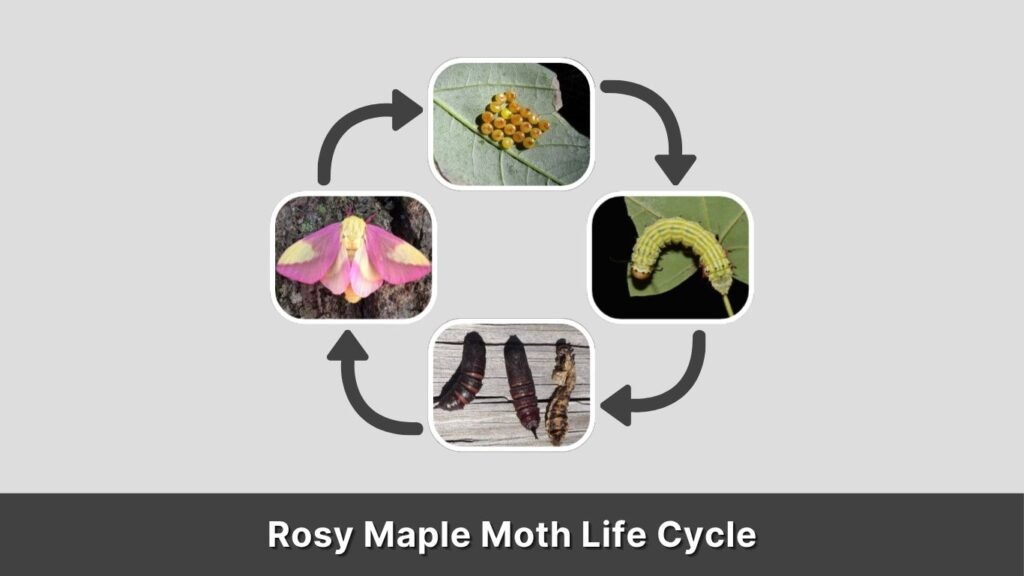
The rosy maple moth undergoes complete metamorphosis:
Egg → Caterpillar → Pupa → Adult
The timing varies considerably depending on climate.
Eggs
After mating, females lay groups of approximately 10–30 eggs on leaves of suitable host trees.
The eggs are generally yellowish and hatch after roughly two weeks depending on temperature.
Caterpillar Stages
Rosy maple moth larvae pass through five instars.
Young caterpillars feed together, but older larvae become solitary. They spend several weeks consuming leaves and storing energy that will later support both pupal development and the non-feeding adult stage.
Pupa and “Cocoon”
People frequently search for a rosy maple moth “cocoon,” but the species normally pupates in a shallow underground chamber rather than forming a conspicuous silk cocoon hanging from a branch.
The mature caterpillar descends from its host tree and searches for suitable soft soil.
The pupa is dark brown and remains protected underground.
In colder climates, the moth may spend the entire winter in this stage.
Adult Emergence
Adults emerge during warm weather, often in late afternoon.
Their wings initially appear small and soft. After emerging, they pump fluid through the wing veins, expanding them to full size before flight.
Adults begin searching for mates soon afterward.
How Long Do Rosy Maple Moths Live?
The answer depends on whether you mean the adult moth or its entire life cycle.
A complete life cycle can last roughly two to nine months, with much of the longer lifespan spent underground as an overwintering pupa.
Adult life is much shorter.
Because adults cannot eat, females generally survive long enough to mate and lay eggs, while males often die shortly after mating. Adults typically persist for only a relatively brief period compared with the total life cycle.
How Many Generations Occur Each Year?
Climate strongly influences the number of generations.
Northern populations generally produce one brood per year, often flying between May and August.
Southern populations may produce two generations, while portions of the Deep South and Florida can potentially support three during a long warm season.
Are Rosy Maple Moths Rare?
Rosy maple moths are not globally considered rare or endangered, although their abundance varies greatly by location.
A person may never see one simply because adults are nocturnal and relatively short-lived.
Some populations can be locally common where extensive maple habitat remains. Butterflies and Moths of North America currently describes the species as globally secure, although declines have been noted in portions of its range.
What Eats Rosy Maple Moths?
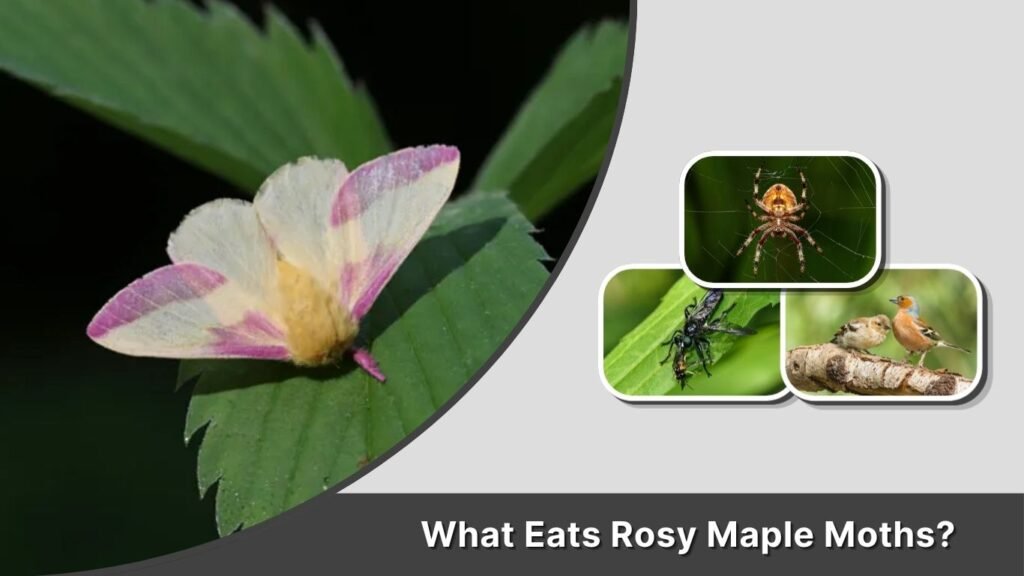
Rosy maple moths face predators throughout their development.
Potential predators include:
- Birds
- Small mammals
- Spiders
- Predatory insects
- Parasitoid flies and wasps
Caterpillars rely partly on coloration, body spines, and their position on host foliage for protection.
Adults are nocturnal, which can help reduce exposure to some daytime predators, although bats and other nocturnal hunters remain threats.
Can You Keep a Rosy Maple Moth as a Pet?
A rosy maple moth is better considered a temporary observation animal than a conventional pet.
Adults do not eat and have a brief reproductive life. Keeping one also requires knowledge of its natural life cycle and appropriate host plants if eggs or caterpillars are involved.
Wild adults should not be collected simply because of their attractive appearance.
If someone raises rosy maple moths for educational purposes, caterpillars need fresh, pesticide-free host foliage and later require suitable conditions for underground pupation.
Local wildlife regulations should also be checked before collecting or transporting native insects.
Rosy Maple Moth vs. Luna Moth
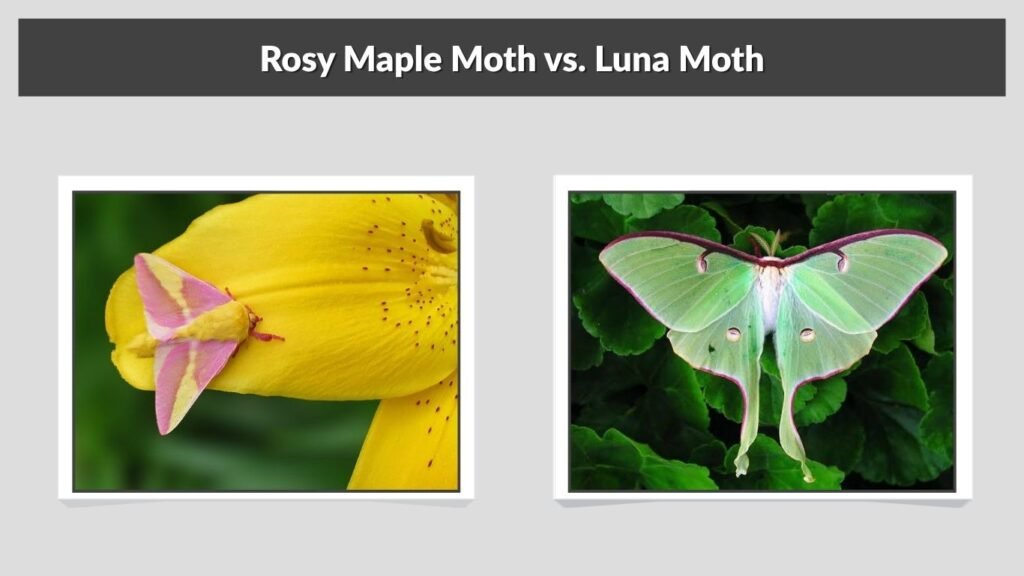
Both belong to the Saturniidae family, but they are easy to distinguish.
Rosy Maple Moth
The rosy maple moth is small, fuzzy, pink and yellow, and lacks long hindwing tails. Caterpillars feed heavily on maples, and adults do not eat.
Luna Moth
The Luna moth is dramatically larger, pale green, and has long tails extending from its hindwings. Its caterpillars use several deciduous host trees.
Although both are silk moths, their adult appearance is completely different.
FAQs
What is the scientific name of the rosy maple moth?
Its scientific name is Dryocampa rubicunda, and it belongs to the silk moth family Saturniidae.
What does a rosy maple moth caterpillar eat?
The greenstriped mapleworm mainly feeds on maple trees, particularly red, sugar, and silver maples.
Are rosy maple moths poisonous?
Rosy maple moth adults are not considered poisonous or venomous to humans. Their caterpillars are also not regarded as dangerous stinging caterpillars.
How big is a rosy maple moth?
Adults typically have a wingspan of approximately 3.4–5.2 cm, or roughly 1.3–2 inches. Females are usually larger than males.
Do rosy maple moths eat?
Adult rosy maple moths do not feed. All of the energy they use during adulthood comes from nutrients stored while they were caterpillars.
