

Ticks on cats are blood-feeding parasites that attach to the skin and can remain hidden beneath the fur for several days. Outdoor cats are at greater risk, but even indoor cats can encounter ticks brought inside by people or other pets. A tick may initially look like a tiny dark speck and become rounder or swollen after feeding. Although one tick may cause only minor irritation, ticks can transmit disease and heavy infestations may lead to anemia or other serious problems. Prompt removal and cat-safe prevention are the best protection.
What Do Ticks Look Like on Cats?
Ticks are arachnids related to spiders and mites. Adult ticks have eight legs and attach their mouthparts firmly to the cat’s skin.
A recently attached tick usually looks flatter, while one that has been feeding for several days becomes noticeably rounded as its body fills with blood.
Signs You May Be Looking at a Tick
Check for:
- A small brown, black, reddish, or gray bump
- Eight visible legs around the body
- A parasite firmly attached to the skin
- A swollen, bean-like appearance after feeding
- Redness around the attachment point
- A small scab after the tick detaches
An engorged tick may become pale gray or cream-colored and can sometimes look almost white.
Where Are Ticks Commonly Found on Cats?
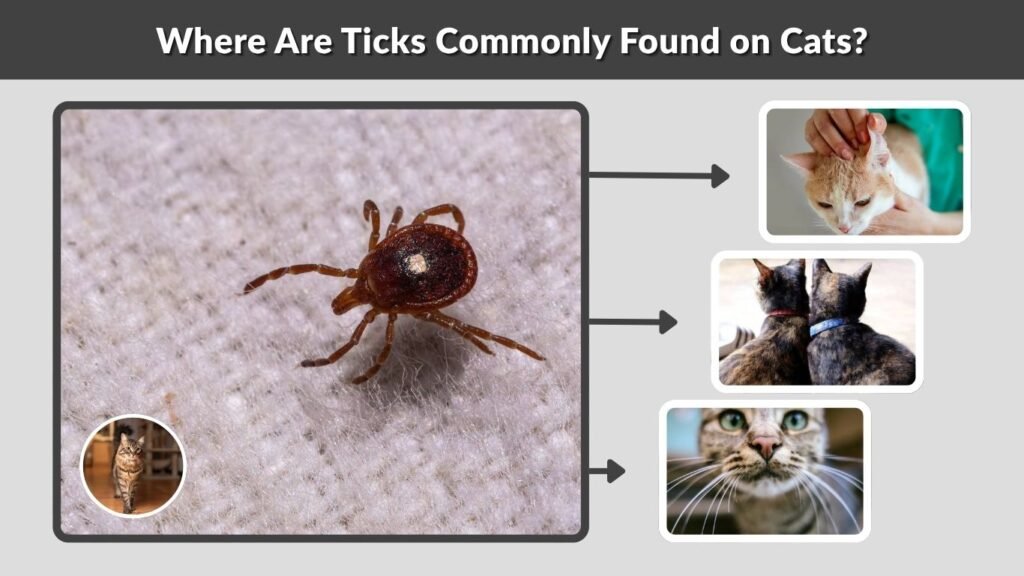
Ticks can attach almost anywhere, but areas where the fur is thinner or where cats have difficulty grooming deserve extra attention.
Check These Areas
- Around the ears
- Inside the outer ear area
- Head and face
- Neck
- Under the collar
- Around the eyelids
- Armpits
- Between the toes
- Groin
- Belly
- Base of the tail
After your cat spends time outdoors, slowly run your fingers through the coat and feel for unusual bumps.
Ticks on Cats’ Ears and Eyelids
The ears are particularly common places to discover attached ticks because the skin is relatively thin.
A tick near the edge of the ear may be relatively easy to remove. However, removal becomes more difficult when the tick is deep inside the ear, extremely close to the eye, or attached directly to an eyelid.
When to Let a Veterinarian Remove It
Professional removal is safer when:
- The tick is attached to an eyelid
- It is inside the ear canal
- Your cat will not remain still
- Several ticks are tightly attached
- The skin is significantly swollen
- You cannot confidently grasp the tick
Trying to remove a tick next to the eye from a struggling cat can cause accidental injury.
How to Remove Ticks From Cats

An attached tick should be removed promptly. The longer ticks remain attached, the greater the opportunity for exposure to tick saliva and some disease-causing organisms.
Safe Tick Removal
- Put on disposable gloves.
- Part the cat’s fur.
- Use clean, fine-tipped tweezers.
- Grasp the tick close to the skin.
- Pull upward slowly with steady, even pressure.
- Do not squeeze the swollen body.
- Clean the bite area afterward.
- Wash your hands thoroughly.
Do not twist, jerk, burn, crush, or coat an attached tick in petroleum jelly.
What Kills Ticks on Cats Instantly?
There is no household remedy that should be considered a safe, reliable “instant tick killer” for cats.
For a single attached tick, physical removal with fine-tipped tweezers is usually the fastest way to eliminate the immediate problem.
For ongoing infestations, veterinarians may recommend cat-specific topical, oral, or other tick-control medications.
Important Safety Warning
Never apply a flea or tick product labeled only for dogs to a cat.
Some pesticides that dogs tolerate can be dangerous or potentially life-threatening to cats. Always match the product to the animal species, age, and weight listed on the label.
Certain prescription cat tick treatments belong to the isoxazoline class. These are considered effective for appropriate cats, but rare neurological adverse reactions such as tremors, poor coordination, or seizures have been reported, so product selection should be discussed with a veterinarian.
How to Get Rid of Ticks on Cats
Finding one tick does not necessarily mean your cat has a major infestation. However, multiple ticks indicate continued exposure and make prevention particularly important.
Effective Control Includes
- Remove every visible attached tick.
- Check the entire coat carefully.
- Wash bedding regularly.
- Keep grass and vegetation trimmed.
- Reduce access to heavily tick-infested areas.
- Use a cat-labeled preventive recommended by your veterinarian.
- Check other pets for ticks.
- Continue regular tick inspections.
Keeping cats indoors can substantially reduce exposure to tick habitat. Veterinary parasite-control guidance also recommends consistent tick prevention based on local risk.
Ticks on Cats: Symptoms to Watch For

Some cats show little reaction to a single tick. Others develop local irritation or symptoms associated with heavy infestation or tick-borne disease.
Possible Symptoms
Watch for:
- Redness around the bite
- Swelling
- Scratching
- Small scabs
- Skin infection
- Loss of appetite
- Lethargy
- Fever
- Pale gums
- Weakness
- Abnormal walking
- Breathing difficulties
Heavy infestations can cause significant skin injury and anemia, while ticks can transmit several infectious diseases.
A cat that suddenly becomes extremely weak, has difficulty breathing, cannot walk normally, or appears seriously ill needs urgent veterinary attention.
Tick Bite on a Cat After Removal
A small red bump or scab may remain after removing a tick.
Monitor the area over the following days.
Contact Your Veterinarian If You Notice
- Increasing redness
- Increasing swelling
- Pus or discharge
- Significant pain
- Persistent bleeding
- A growing lump
- Your cat continually scratching the area
Merck Veterinary Manual recommends veterinary evaluation when a tick-removal site becomes red or swollen.
Fleas vs Ticks on Cats
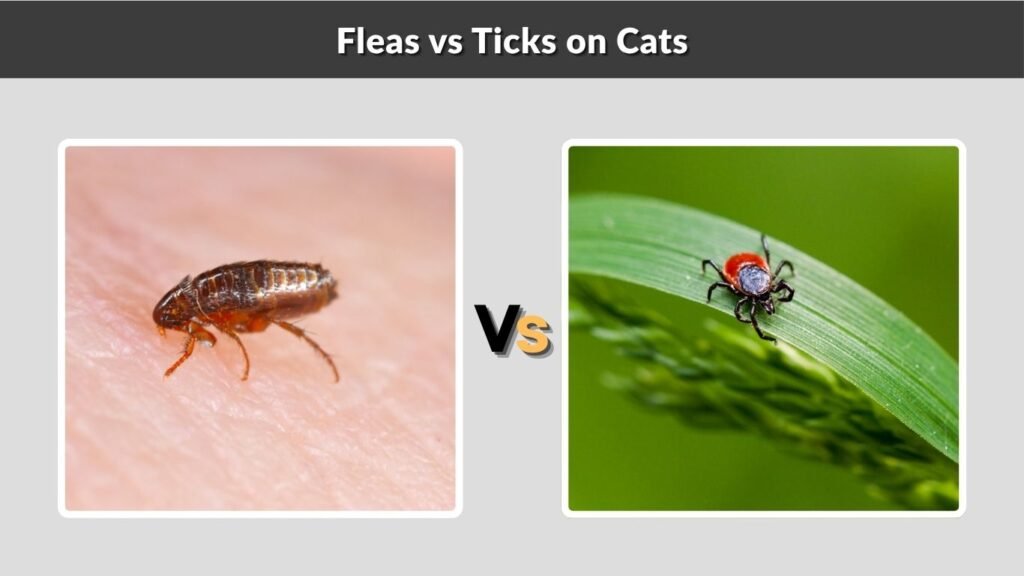
Fleas and ticks are both external parasites, but they look and behave differently.
Ticks
Ticks:
- Attach firmly to one location
- Grow larger while feeding
- Have eight legs as adults
- May stay attached for several days
- Can resemble small lumps
Fleas
Fleas:
- Are much smaller
- Move rapidly through fur
- Have flattened bodies
- Jump
- Frequently cause intense itching
- May leave black “flea dirt” in the coat
A stationary swollen parasite attached to the skin is much more likely to be a tick than a flea.
How Long Do Ticks Stay on Cats?
Depending on species and life stage, a tick can remain attached while feeding for several days.
As it feeds, the body typically becomes increasingly swollen.
Eventually, many ticks detach after completing their blood meal. However, you should not wait for a tick to fall off naturally.
Removing it promptly reduces the amount of time it remains attached.
Can Ticks on Cats Transfer to Humans?
Yes, but not usually in the sense of jumping directly from your cat onto you.
A tick can be carried indoors on a cat, remain unattached or later detach, and then crawl onto a person or another pet.
Ticks that feed on cats may also feed on humans, which is why bringing ticks indoors can increase household exposure.
Cats themselves are not normally the direct source of diseases such as Lyme disease; the infected tick must bite the person.
Are Home Remedies for Ticks on Cats Safe?
Be cautious with online remedies.
Apple cider vinegar, dishwashing liquid, essential oils, and similar homemade mixtures should not replace proven tick removal or veterinary-approved prevention.
Avoid Essential Oils
Tea tree oil and certain other concentrated essential oils can cause poisoning in cats.
Likewise, never assume that a “natural” insecticide is automatically cat-safe.
Avoid putting any concentrated essential oil directly on your cat unless a veterinarian specifically approves the formulation and dose.
How to Prevent Ticks on Cats

Prevention is easier than repeatedly removing attached ticks.
Helpful Prevention Steps
- Use a veterinarian-recommended cat tick preventive.
- Keep your cat indoors when practical.
- Check outdoor cats daily.
- Inspect the ears, neck, toes, and belly.
- Keep lawn vegetation trimmed.
- Reduce contact with tall grass and brush.
- Check other household pets.
- Follow prevention-product schedules consistently.
Never substitute a dog product simply because the animals are similar in weight. Cat-specific labeling matters because cats metabolize some chemicals differently.
FAQs
Can cats get ticks?
Yes. Cats can pick up ticks from grass, brush, wooded areas, wildlife habitats, and occasionally ticks carried indoors by another animal or person.
What kills ticks on cats?
Removing attached ticks with fine-tipped tweezers deals with individual ticks. For ongoing control, use a veterinarian-recommended product specifically labeled for cats.
Do ticks eventually fall off cats?
Many ticks eventually detach after completing their blood meal, but you should remove an attached tick as soon as you find it rather than waiting.
Are ticks on cats dangerous?
They can be. Ticks may cause skin irritation, infection, anemia in heavy infestations, and transmission of certain tick-borne diseases.
Can I use dog tick medicine on my cat?
No. Never use a dog-only flea or tick medication on a cat unless a veterinarian specifically directs you to do so. Some dog products can cause severe or potentially fatal poisoning in cats.
