
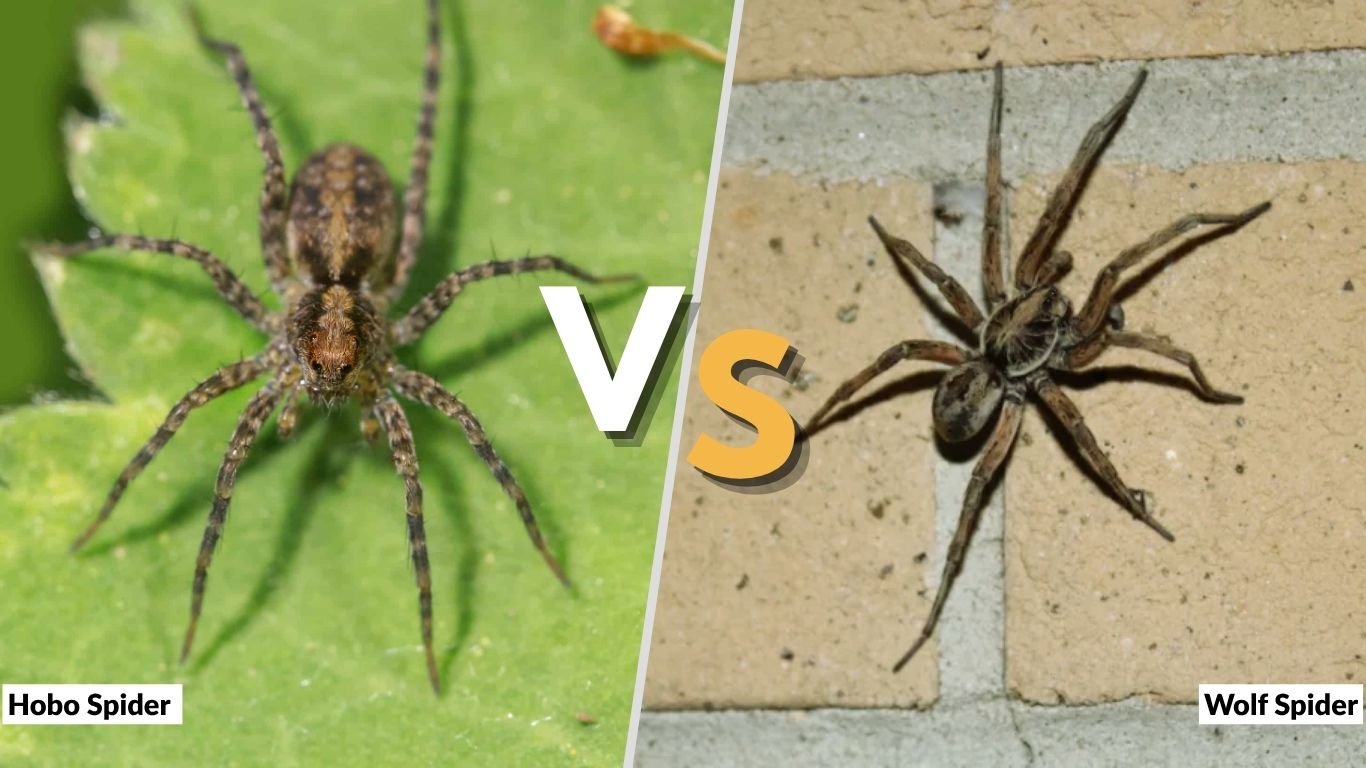
A hobo spider vs wolf spider comparison can be confusing because both are brown, fast-moving spiders commonly encountered near homes, gardens, and ground-level hiding places. However, they belong to different spider families and differ noticeably in their eyes, webs, body shape, hunting style, and reproductive behavior. Hobo spiders are funnel-web spiders that usually wait near silken retreats, while most wolf spiders actively hunt without prey-catching webs. Learning a few key features can make wolf spider vs hobo spider identification much easier.
Hobo Spider vs Wolf Spider: Quick Comparison
Hobo spiders (Eratigena agrestis) belong to the family Agelenidae, while wolf spiders belong to Lycosidae. Although their brown coloring can look similar, eye arrangement and behavior provide much stronger identification clues than color alone. Hobo spiders can also be difficult to distinguish from other funnel weavers without expert examination.
| Feature | Hobo Spider | Wolf Spider |
| Family | Agelenidae | Lycosidae |
| Typical color | Brown with lighter markings | Brown, gray, tan, or dark brown |
| Body shape | Long-legged, relatively streamlined | Stockier and often hairier |
| Eyes | 8 eyes in two rows | 8 eyes in three rows |
| Large eyes | No extremely large central pair | Two very large middle eyes |
| Hunting method | Waits near a web retreat | Actively hunts prey |
| Prey-catching web | Yes | Usually no |
| Female carries babies | No | Spiderlings ride on mother’s back |
| Common habitat | Foundations, rocks, grass, wood piles | Lawns, gardens, forests, fields |
| Human danger | Not considered medically important | Generally not medically significant |
How to Identify a Hobo Spider
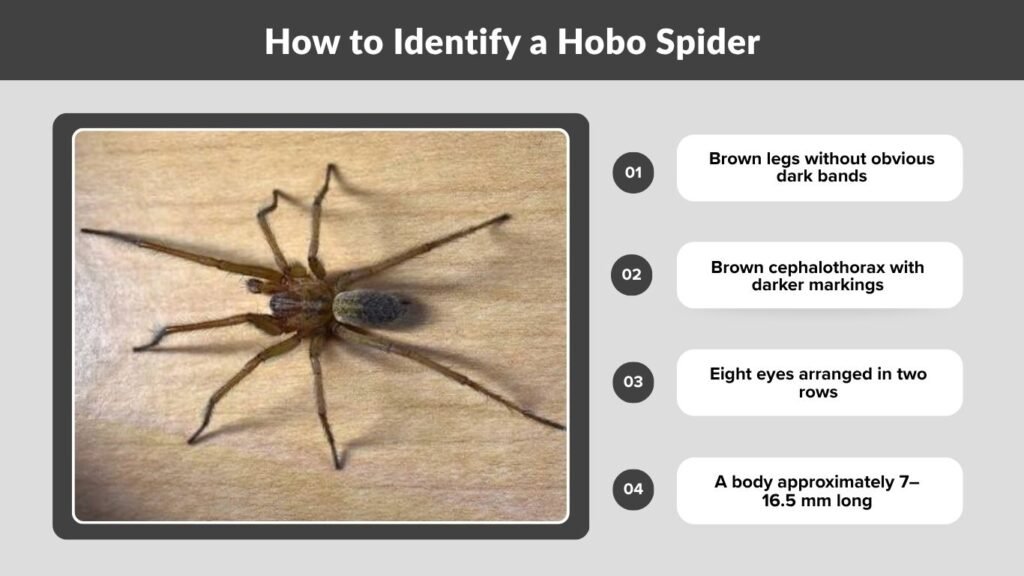
Hobo spiders are long-legged funnel weavers native to Europe that became established in portions of western North America. They are particularly associated with the Pacific Northwest and parts of the interior West. They are frequently confused with grass spiders, giant house spiders, and other members of the funnel-web spider family.
Hobo Spider Identification
A hobo spider may show:
- Brown legs without obvious dark bands
- Brown cephalothorax with darker markings
- Grayish abdomen with pale or yellowish chevrons
- Eight eyes arranged in two rows
- Long legs suited for rapid running
- A body approximately 7–16.5 mm long in mature individuals
- Enlarged, glove-like pedipalps in adult males
Color alone is unreliable. Utah State University notes that confidently identifying a hobo spider to species often requires examining microscopic anatomical features.
Hobo Spider Web
Hobo spiders and their close relatives use funnel-style retreats. The spider generally remains near the narrow section and rushes outward when an insect contacts the surrounding sheet of silk.
These webs may occur around retaining walls, foundation cracks, grass, wood piles, rocks, and other sheltered locations. Hobo spider webs themselves can be relatively concealed and may not always display the dramatic funnel shape associated with some other agelenids.
How to Identify a Wolf Spider
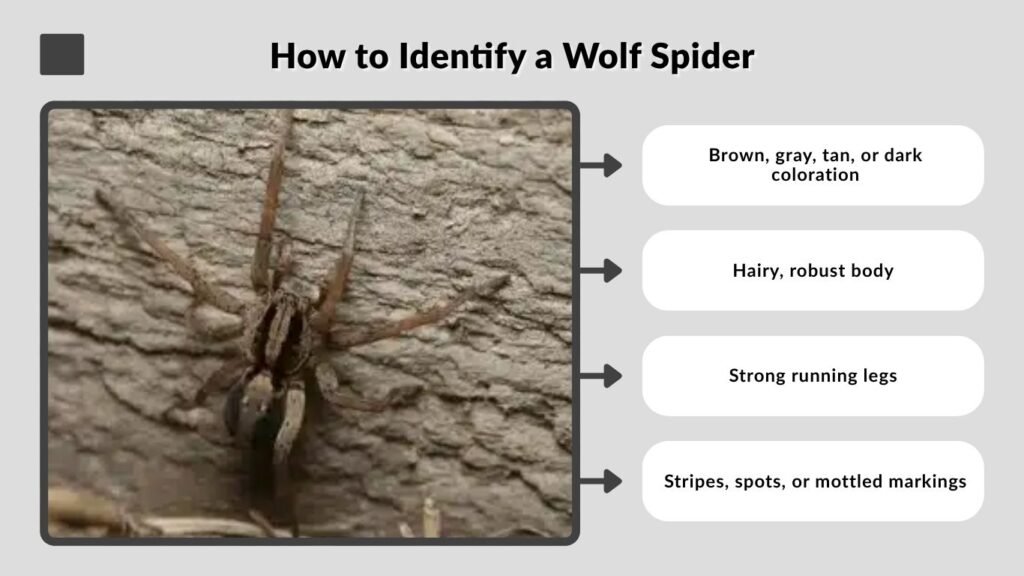
Wolf spiders are wandering hunters rather than conventional web trappers. Most spend their time running along the ground searching for insects and other small arthropods. Their robust bodies, hairy legs, and exceptionally distinctive eyes are useful identification characteristics.
Wolf Spider Identification
Typical features include:
- Brown, gray, tan, or dark coloration
- Hairy, robust body
- Strong running legs
- Stripes, spots, or mottled markings
- Eight eyes arranged in three rows
- Two exceptionally large middle eyes
- Ground-hunting behavior
- Females sometimes covered with spiderlings
The two large eyes are especially useful. Wolf spiders typically have four small eyes along the lower front of the face, two very large eyes above them, and another pair positioned farther back.
Wolf Spider Web
Most wolf spiders do not construct webs for catching prey. They hunt by searching, stalking, and rushing at insects.
They still produce silk and may use it for retreats, burrows, egg sacs, and other purposes. There are exceptions within the family, but the familiar wandering wolf spiders encountered in lawns and houses generally lack the flat prey-catching funnel web typical of hobo and grass spiders.
Hobo Spider vs Wolf Spider Eyes
The hobo spider vs wolf spider eye pattern is one of the best visible differences. Body color varies too much to provide dependable identification, whereas their basic eye arrangements are substantially different.
Hobo Spider Eyes
Hobo spiders have eight eyes arranged across two rows. The individual eyes are relatively similar in size, without the striking pair of oversized eyes characteristic of wolf spiders.
Wolf Spider Eyes
Wolf spiders have a much more distinctive facial appearance. Two enlarged middle eyes dominate the face, with four smaller eyes below and two additional eyes farther back.
If a close photograph clearly reveals two enormous forward-facing eyes, the spider is much more likely to be a wolf spider than a hobo spider.
Hobo Spider vs Wolf Spider Size
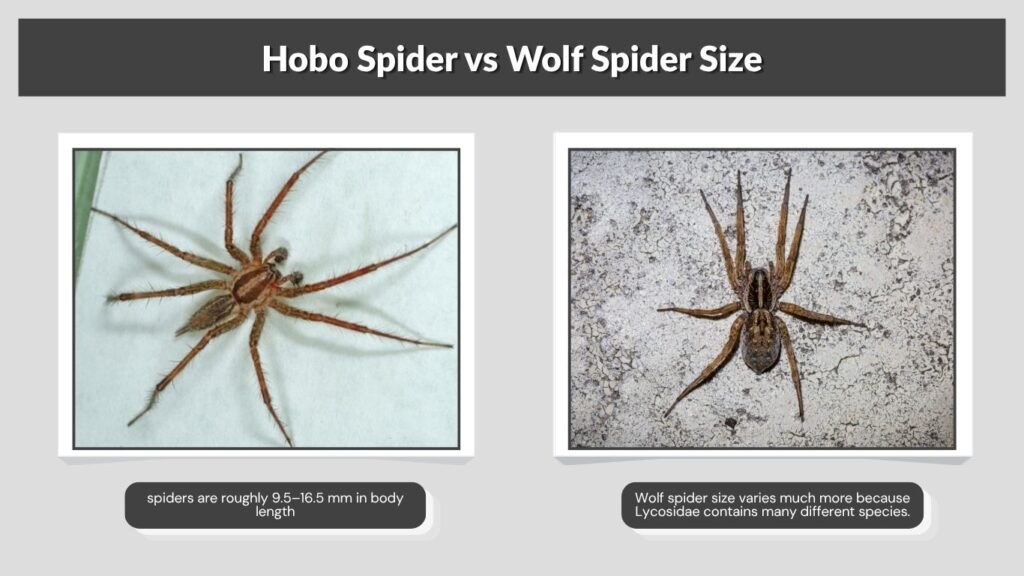
Size is not a dependable way to separate these spiders because both groups contain individuals that overlap substantially in dimensions. Maturity and sex also influence how large a spider appears.
Which Is Bigger?
Mature female hobo spiders are roughly 9.5–16.5 mm in body length, while males are about 7–13.5 mm.
Wolf spider size varies much more because Lycosidae contains many different species. Some are small, while large species can look substantially bigger than a hobo spider.
When comparing wolf spider vs hobo spider size, therefore, use size only as a secondary clue. Eyes, web type, and body proportions are more useful.
Hobo Spider vs Wolf Spider vs Brown Recluse
The hobo spider vs wolf spider vs brown recluse comparison is particularly important because all three may be described simply as “brown spiders.” Their eye patterns provide one of the clearest distinctions.
Identification Differences
Look for these features:
- Hobo spider: Eight eyes in two rows and a brown patterned body.
- Wolf spider: Eight eyes in three rows, including two very large middle eyes.
- Brown recluse: Six eyes arranged in three separate pairs.
- Hobo spider: Associated with funnel-style web retreats.
- Wolf spider: Usually an active ground hunter without a prey-catching web.
- Brown recluse: Usually has uniformly colored legs with fine hairs rather than heavy spines.
The familiar violin-shaped marking can help identify some brown recluses, but eye arrangement is a more dependable characteristic because violin-like markings can be misinterpreted on unrelated spiders.
Hobo Spider vs Wolf Spider vs Grass Spider
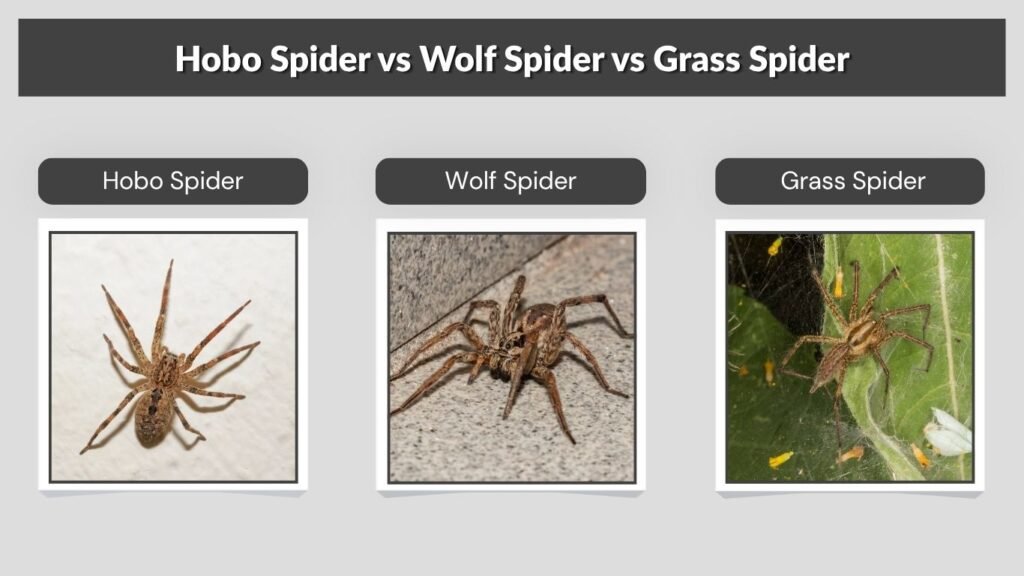
Grass spiders create additional confusion because they and hobo spiders are both members of Agelenidae. As a result, they share several features that wolf spiders lack.
Grass Spider and Hobo Spider
Both may have:
- Long legs
- Brown coloration
- Patterned abdomens
- Funnel or sheet-style webs
- Fast running behavior
- Eight eyes without the wolf spider’s huge central pair
Distinguishing a hobo spider from a closely related funnel-weaving species can be difficult for nonexperts and sometimes requires microscopic examination.
A wolf spider is usually easier to separate because of its large central eyes and wandering hunting behavior.
Hobo Spider vs Wolf Spider Bite
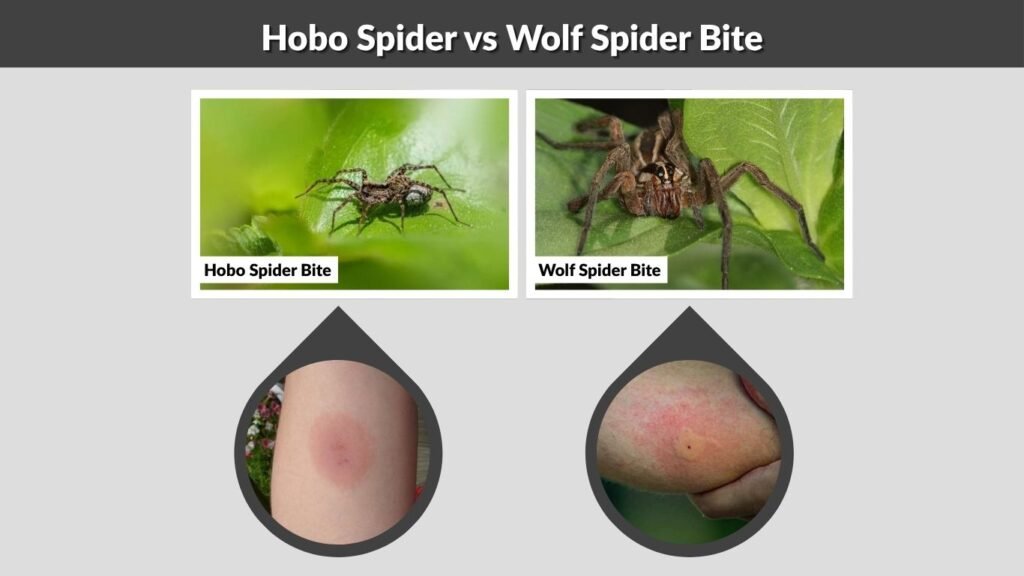
Both hobo spiders and wolf spiders possess venom for subduing prey, but neither normally seeks out people. A bite is more likely when a spider is trapped against the skin or physically disturbed.
Is a Hobo Spider Bite Dangerous?
Older reports gave the hobo spider a reputation for causing serious necrotic skin wounds. Current guidance from Utah State University and UC IPM states that significant scientific evidence does not support that reputation and that hobo spider bites are not considered medically important.
Is a Wolf Spider Bite Dangerous?
Wolf spiders can bite defensively, but they are generally considered nuisance or beneficial spiders rather than medically important ones. Their intimidating size often causes more concern than their actual risk to humans.
Any unidentified bite that produces severe pain, rapidly worsening swelling, breathing difficulty, significant tissue damage, or other serious symptoms should receive medical attention rather than being diagnosed from the spider’s presumed appearance alone.
Behavior: Hobo Spider vs Wolf Spider
Watching how the spider behaves can often provide useful identification clues.
Hunting Differences
A hobo spider typically stays around a silken retreat and responds when prey contacts its web. Wolf spiders instead travel across the ground searching for prey.
Female behavior provides another major clue. Female wolf spiders carry their egg sacs attached behind the abdomen, and newly hatched spiderlings climb onto the mother’s back. This baby-carrying behavior is characteristic of wolf spiders.
FAQs
1. What is the easiest way to tell a hobo spider from a wolf spider?
Look at the eyes and web. Wolf spiders have two unusually large central eyes and normally hunt without prey-catching webs. Hobo spiders have eight more similarly sized eyes in two rows and use funnel-style retreats.
2. Is a hobo spider bigger than a wolf spider?
Not necessarily. Their sizes overlap, and many wolf spider species can become larger than hobo spiders. Size alone is not a reliable identification feature.
3. Are hobo spiders more dangerous than wolf spiders?
Current evidence does not support the older reputation that hobo spider bites commonly cause necrotic wounds. Hobo spider bites are not currently considered medically important.
4. Is a hobo spider the same as a grass spider?
No. They are different spiders, although both belong to the family Agelenidae and can look very similar. Species-level identification can sometimes require expert examination.
5. How can I distinguish a wolf spider, hobo spider, and brown recluse?
Check the eyes first. Wolf spiders have eight eyes with two very large central eyes, hobo spiders have eight eyes arranged in two rows, and recluse spiders have six eyes arranged in three pairs.
