
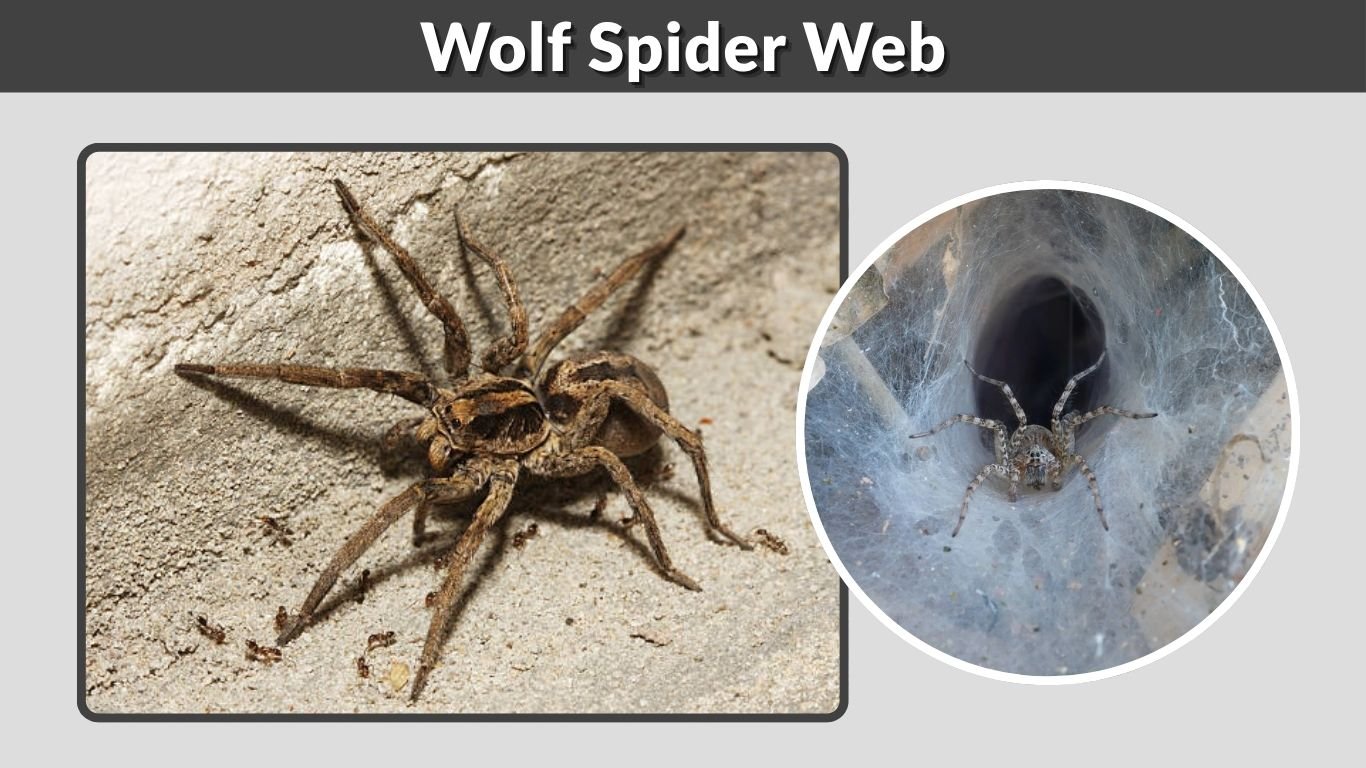
Wolf spiders are active hunters famous for chasing prey across the ground rather than waiting in large sticky webs. However, saying that wolf spiders never use silk is not completely accurate. They produce silk for egg sacs, burrow linings, retreats, and other purposes. Some species may surround their shelters with silk, which can be mistaken for a funnel web. Understanding what a wolf spider web looks like—and how it differs from grass, nursery web, and funnel-web spiders—makes identification much easier.
Do Wolf Spiders Make Webs?
Wolf spiders belong to the family Lycosidae and generally hunt without building prey-catching webs. Their strong legs, sharp vision, and quick movements allow them to pursue insects directly. They still possess spinnerets and produce silk throughout their lives. Instead of constructing an aerial web for capturing prey, they typically use silk for reproduction, shelter, protection, and sometimes lining their burrows.
Do Wolf Spiders Spin Webs to Catch Prey?
Most wolf spiders do not spin webs to catch insects. They are wandering hunters that rely on speed and ambush behavior.
A typical wolf spider will:
- Walk or run across the ground searching for prey
- Wait near a burrow entrance for insects
- Chase insects over short distances
- Grab prey using its legs and fangs
- Inject venom to subdue captured insects
This hunting method is one of the easiest ways to distinguish wolf spiders from many web-building spiders.
Why Do Wolf Spiders Produce Silk?
Although they rarely use silk as a hunting trap, wolf spiders still depend heavily on it. Females create strong silk egg sacs and carry them attached to their spinnerets. Newly hatched spiderlings later climb onto their mother’s abdomen.
Some burrowing species also use silk around or inside their shelters. Silk can stabilize soil, create a retreat, or provide protection while the spider rests.
What Does a Wolf Spider Web Look Like?
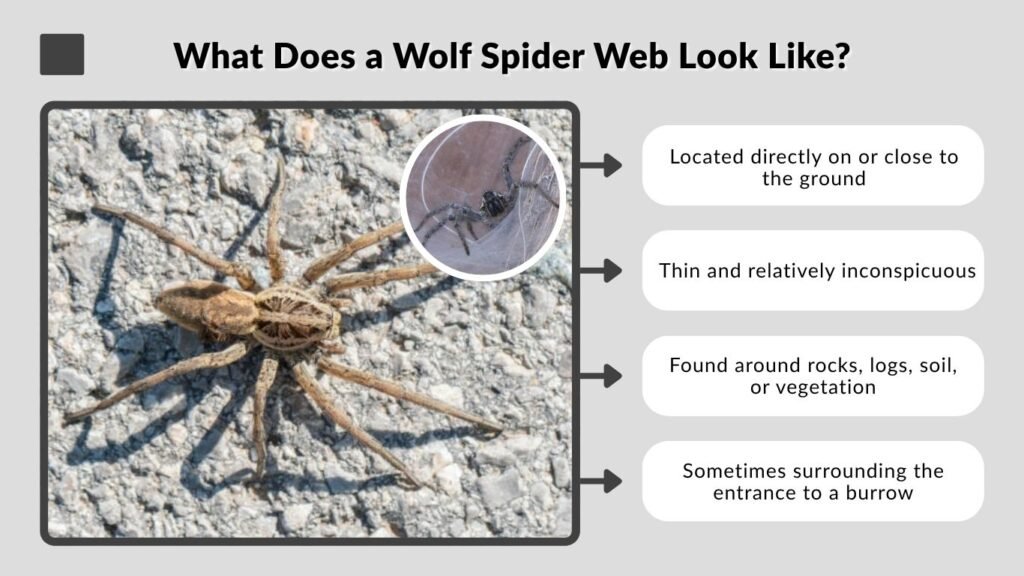
There is no typical large, symmetrical “wolf spider web” comparable to an orb-weaver’s circular web. Instead, silk associated with wolf spiders tends to appear close to the ground, around a retreat, or within a burrow. Because several unrelated spiders create similar-looking ground-level silk structures, seeing webbing alone is rarely enough for certain identification.
Wolf Spider Web Identification
Silk produced around a wolf spider’s retreat may have these characteristics:
- Located directly on or close to the ground
- Thin and relatively inconspicuous
- Found around rocks, logs, soil, or vegetation
- Sometimes surrounding the entrance to a burrow
- Usually lacking a large sticky capture surface
- Irregular rather than geometrically patterned
- Often much smaller than a typical funnel web
If you see a large sheet of silk leading into an obvious funnel, another spider may be responsible.
Wolf Spider Webs in Grass
Wolf spiders frequently live in lawns, fields, gardens, and other grassy habitats. However, conspicuous sheets of webbing covering grass are often created by grass spiders, not wolf spiders.
Grass spiders commonly build horizontal sheet webs with a funnel-shaped retreat at one side. From a distance, the spider itself can sometimes resemble a wolf spider, which explains why these webs are frequently misidentified.
Wolf Spider Funnel Web: Do They Build Funnels?
The phrase “wolf spider funnel web” can be confusing because several different spider groups construct silk-lined tubes or funnel-shaped retreats. Some wolf spiders occupy burrows that are reinforced with silk, but this does not make them true funnel-web spiders. Their behavior, taxonomy, hunting strategy, and web construction differ substantially from spiders commonly called funnel weavers or funnel-web spiders.
Wolf Spider Burrows and Silk
Some ground-dwelling wolf spiders dig burrows and remain close to their entrances. These shelters may include silk around the entrance or along the inside walls.
The silk can help:
- Reinforce loose soil
- Stabilize the burrow walls
- Create a protected resting place
- Provide an attachment surface near the entrance
- Help protect eggs or young spiders
This structure may loosely resemble a web tunnel, but it generally does not function like the extensive prey-catching funnel web of a grass spider.
Funnel Web Spider vs Wolf Spider
Funnel-web spiders and wolf spiders should not automatically be treated as the same animal. The term “funnel web” itself can refer to several kinds of spiders, depending on region.
Typical differences include:
- Wolf spider: usually hunts actively without a prey-catching web.
- Grass/funnel weaver: waits inside a funnel connected to a broad sheet web.
- Australian funnel-web spider: belongs to an entirely different spider group and should not be confused with wolf spiders.
- Wolf spider burrow: may contain silk but generally lacks the broad capture sheet found around many funnel-weaver retreats.
Spider appearance should therefore be considered together with web shape and behavior.
Spiders That Look Like Wolf Spiders but Make Webs
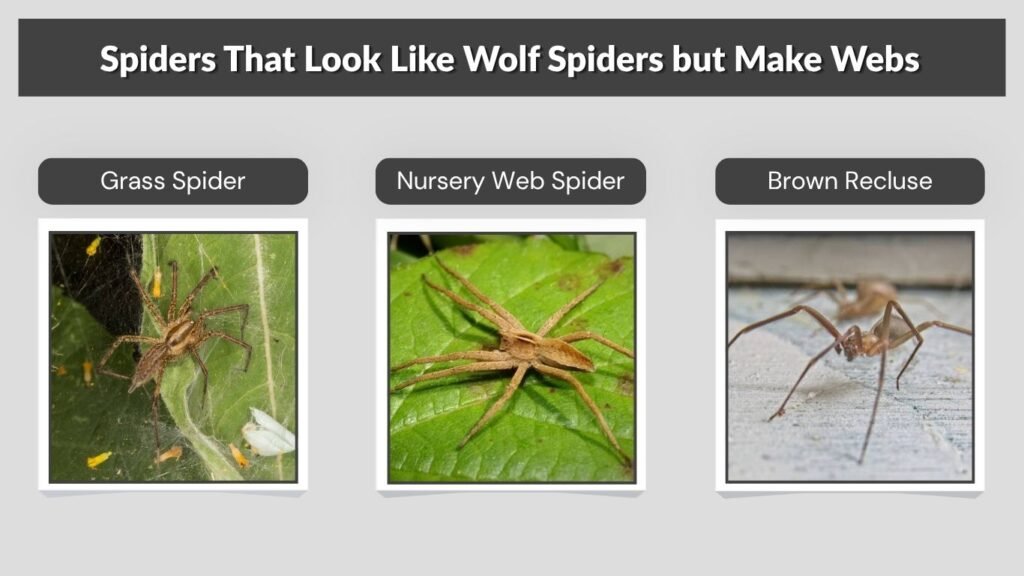
Finding a large brown spider in a web does not necessarily mean you have discovered a web-building wolf spider. Several common spiders have brown markings, long legs, and similar body proportions. The location and construction of the web can provide important clues when distinguishing these spiders.
Grass Spider vs Wolf Spider
Grass spiders are among the spiders most frequently mistaken for wolf spiders. Both may have brown bodies and dark longitudinal markings.
Grass spiders generally build:
- Flat sheet-like webs
- A distinct funnel or tunnel
- Webs among grass and low shrubs
- Retreats where they wait for prey
Wolf spiders usually roam freely and do not create this type of prey-catching structure. Grass spiders also tend to have noticeably long spinnerets at the rear of the abdomen.
Nursery Web Spider vs Wolf Spider
Nursery web spiders can also resemble wolf spiders because they are large, active hunters. However, they belong to the family Pisauridae rather than Lycosidae.
Female nursery web spiders create special silk structures for their young. Shortly before the eggs hatch, the female builds a nursery web among vegetation and guards the spiderlings.
Wolf spider mothers behave differently. They carry their egg sacs attached to their spinnerets, and after hatching, the spiderlings ride directly on the mother’s abdomen.
Brown Recluse vs Wolf Spider Web
Brown recluse spiders create irregular silk retreats rather than large prey-catching webs. Their webbing may occur in sheltered, undisturbed areas such as boxes, storage spaces, or beneath objects.
Wolf spiders usually have a more robust, hairy appearance and are frequently seen moving openly across floors or ground surfaces. Because identifying medically significant spiders from general appearance can be difficult, avoid handling an unknown spider directly.
Carolina and Rabid Wolf Spider Webs
Both the Carolina wolf spider and rabid wolf spider are true wolf spiders. Like other members of the family, they are primarily hunters rather than traditional web builders. Their presence around lawns, gardens, leaf litter, or soil sometimes leads people to associate nearby webbing with them when the silk may actually belong to another species.
Carolina Wolf Spider Web
The Carolina wolf spider (Hogna carolinensis) is a large wolf spider that commonly spends time on the ground. It may occupy a burrow and use silk around its shelter, but it does not normally create a large web designed to trap flying insects.
A Carolina wolf spider discovered beside a web is therefore not necessarily the spider that built it.
Rabid Wolf Spider Web
The rabid wolf spider (Rabidosa rabida) is another active hunter. Despite its intimidating common name, “rabid” refers to its quick movements rather than the disease rabies.
It does not depend on a large prey-catching web. When one is seen running through grass or vegetation containing webbing, that silk may have been produced by grass spiders, orb weavers, or other nearby species.
Wolf Spider Webs in the House
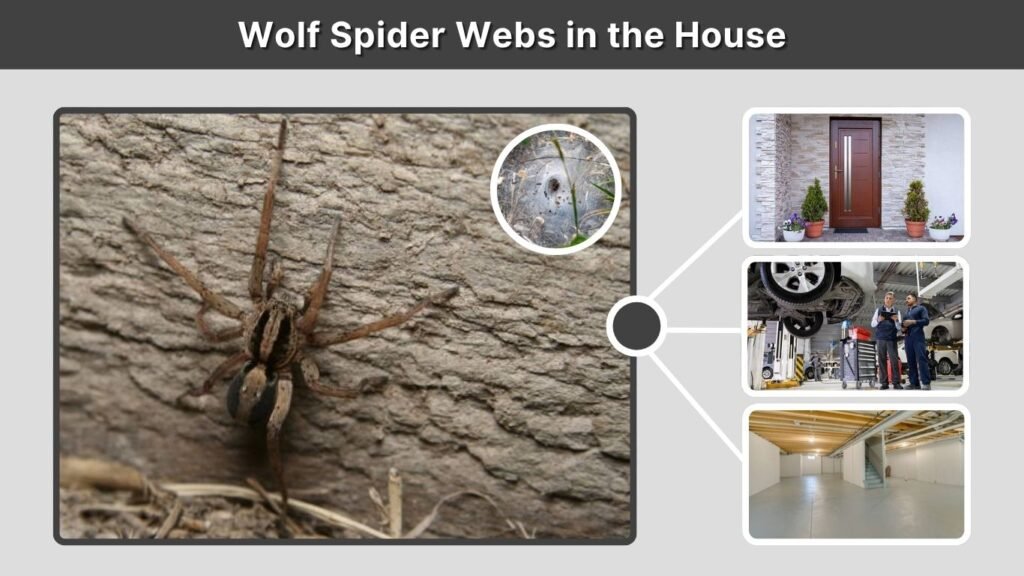
Wolf spiders sometimes enter homes accidentally while searching for prey, shelter, or favorable conditions. Seeing one indoors does not usually mean that it has constructed a permanent web or established a large colony. Individual spiders commonly wander across floors, garages, basements, and other ground-level areas.
Signs of Wolf Spiders Indoors
You may notice:
- A large brown spider running across the floor
- Spiders near doors, garages, or basements
- Wolf spiders hiding beneath stored objects
- Individuals near areas containing insects
- Occasional silk associated with a temporary retreat
Large webs on walls, ceilings, windows, or corners are more likely to belong to other spider species.
How to Reduce Wolf Spiders Around the Home
Seal cracks around foundations, doors, and windows to limit entry. Reduce clutter in garages and basements, keep vegetation away from exterior walls, and control insects that serve as food.
Removing leaf piles, wood, stones, and debris beside the foundation can also reduce suitable hiding places without needing to handle spiders directly.
FAQs
1. Do wolf spiders make webs?
Wolf spiders produce silk, but most do not construct prey-catching webs. Instead, they actively hunt insects on the ground. Their silk is primarily used for egg sacs, burrow linings, temporary retreats, and reproductive purposes.
2. What does a wolf spider web look like?
Wolf spider silk is generally irregular and close to a shelter or burrow rather than forming a large aerial web. A broad sheet web with a prominent funnel in grass is more likely to have been produced by a grass spider or another funnel weaver.
3. Do wolf spiders make funnel webs?
Some wolf spiders live in silk-lined burrows that may appear funnel-like, but they are not generally funnel-web builders. True funnel-weaving spiders construct larger silk sheets connected to a funnel-shaped retreat that helps them capture prey.
4. What spider looks like a wolf spider but spins webs?
Grass spiders are commonly mistaken for wolf spiders. They often have brown bodies with striped markings but build obvious sheet-and-funnel webs in grass, bushes, and around buildings. Their long spinnerets also help distinguish them from most wolf spiders.
5. Why is there a wolf spider sitting in a web?
A wolf spider may accidentally walk across another spider’s web, investigate trapped prey, or rest near silk produced by a different species. Alternatively, the spider may have been misidentified. Large web-building grass spiders and nursery web spiders can sometimes resemble wolf spiders.
