
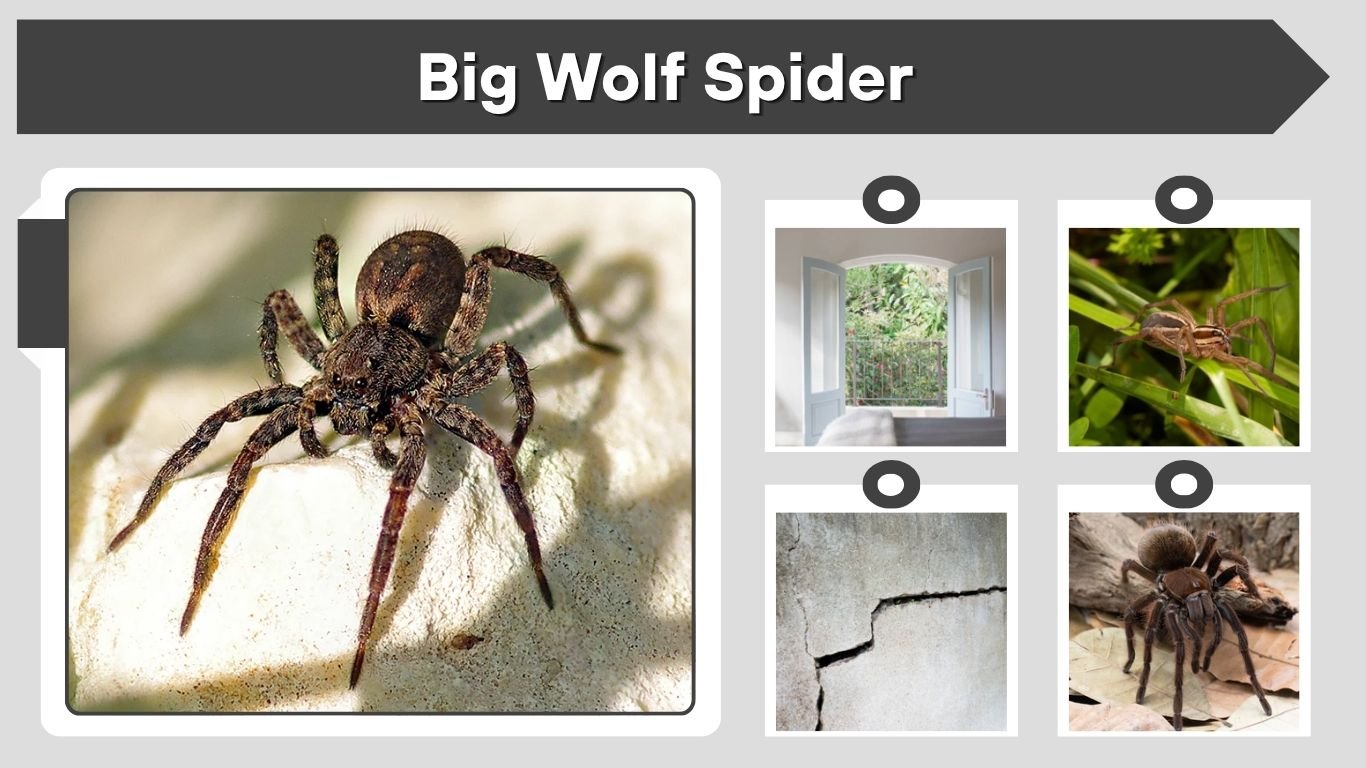
A big wolf spider can look surprisingly intimidating, especially when one runs across a floor or appears in a garage. Wolf spiders vary greatly in size depending on species, age, and sex, with the largest species reaching several inches across when the legs are included. Their hairy bodies and long legs often make them appear larger than their actual body size. This guide explains how big wolf spiders get, the largest species, common colors, regional differences, and how they compare with tarantulas.
How Big Can a Wolf Spider Get?
Wolf spiders belong to the family Lycosidae, which includes many species of very different sizes. Small species may measure less than half an inch in body length, while some of the largest have bodies around 1 to 1.5 inches long. When their legs are spread, large individuals may span roughly 3 inches or more.
Typical Wolf Spider Size
A wolf spider’s size can be described in several ways:
- Body length: commonly about 0.4 to 1.4 inches
- Leg span: often 1 to 3 inches in larger species
- Adult females: generally larger and heavier than males
- Adult males: often slimmer with proportionally longer legs
- Juveniles: much smaller and gradually increase in size through molts
- Largest species: may appear several inches wide with legs extended
Leg span often creates the impression that a wolf spider is much larger than its actual body.
How Big Is a Full-Grown Wolf Spider?
A fully grown wolf spider may have a body measuring around 0.5 to 1.5 inches, depending on the species. Larger females frequently appear especially robust because of their broad abdomen.
The legs can more than double the spider’s visible width. This is why a wolf spider that appears three inches across may still have a body only about an inch long.
What Is the Biggest Wolf Spider?
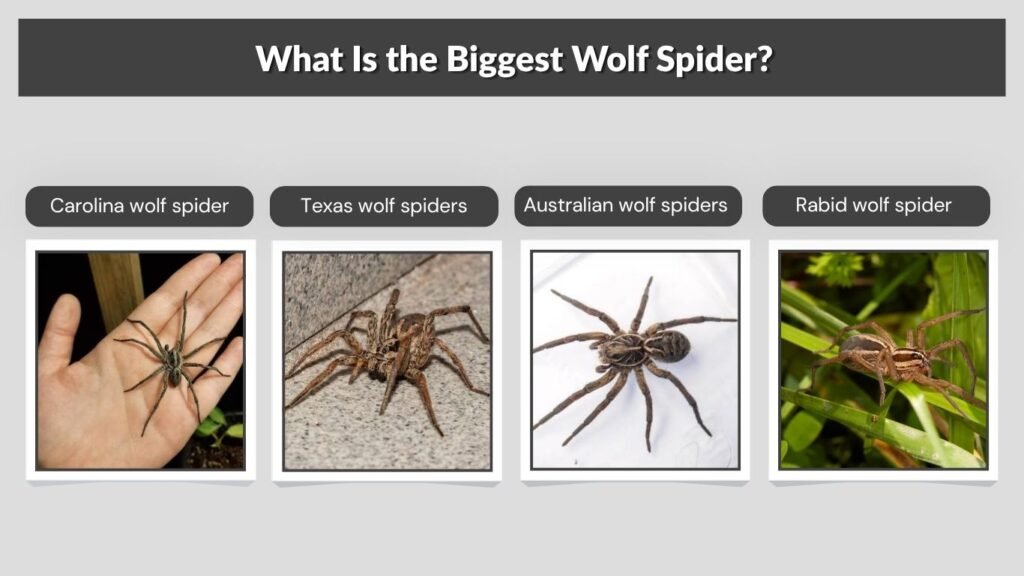
Some wolf spider species are considerably larger than others. The Carolina wolf spider is among the largest commonly encountered wolf spiders in North America. Other large members of the family occur in warm regions around the world. Exact size varies between individual spiders, even within the same species.
Large Wolf Spider Species
Some wolf spiders known for relatively large size include:
- Carolina wolf spider (Hogna carolinensis) – one of the largest North American wolf spiders
- Texas wolf spiders – several large Hogna species occur in the state
- Australian wolf spiders – include many medium-to-large ground hunters
- Rabid wolf spider (Rabidosa rabida) – large, long-legged species common in North America
- Giant wolf spiders – the term is sometimes used informally for unusually large species or individuals
The Carolina wolf spider is especially noticeable because of its thick body, powerful legs, and relatively large overall size.
How Big Is a Carolina Wolf Spider?
Adult Carolina wolf spiders can reach roughly an inch or more in body length, with females generally being larger than males. Including the legs, large individuals may span several inches.
Their brown or gray coloration, heavy build, and hairy appearance can make them look even bigger, particularly when seen moving quickly across an open floor.
Big Black, Brown, and Gray Wolf Spiders
Wolf spiders appear in many shades of brown, gray, tan, and nearly black. Color alone does not reliably identify a species because markings can vary between individuals. Large wolf spiders often have stripes or contrasting patterns that provide camouflage in soil, leaves, grass, and rocky environments.
Big Black Wolf Spider
A very dark wolf spider may look black under indoor lighting, even when its true color is dark brown or charcoal gray. Large Hogna species are sometimes described as black wolf spiders.
Common features include:
- Dark brown, gray, or nearly black coloration
- Thick, hairy legs
- Robust body
- Eight eyes arranged in characteristic rows
- Fast ground movement
- No large prey-catching web
A flashlight can make wolf spider eyes reflect brightly at night, helping reveal them in lawns or gardens.
Big Brown Wolf Spider
Brown is one of the most common wolf spider colors. Their bodies frequently contain tan, cream, gray, or dark brown stripes.
This coloration helps them blend into:
- Soil
- Dry leaves
- Tree bark
- Grass
- Rocks
- Garden debris
A big brown spider does not automatically mean it is a wolf spider, so eye arrangement and body structure provide better identification clues than color alone.
Big Gray Wolf Spider
Gray wolf spiders may appear silver-gray, charcoal, or mottled brown and gray. Their patterns are particularly useful for camouflage on stone, dry soil, and bark.
Some large gray spiders found near homes may actually be fishing spiders, huntsman spiders, or other ground-dwelling species, making careful identification important.
Big Wolf Spider in the House
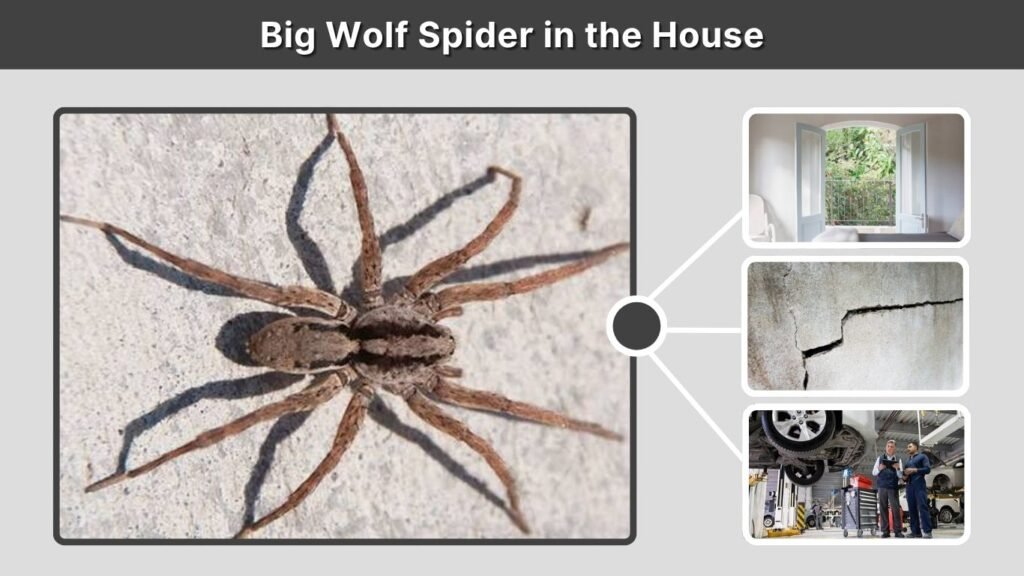
Finding a large wolf spider indoors can be alarming, but it usually does not indicate an infestation. Wolf spiders generally live outdoors and wander inside accidentally while searching for insects, shelter, or warmth. They do not normally build permanent webs in corners or establish large indoor colonies.
Why Big Wolf Spiders Enter Houses
Large wolf spiders may enter homes because of:
- Open doors or windows
- Gaps beneath exterior doors
- Cracks around foundations
- Abundant insect prey indoors
- Seasonal temperature changes
- Garages connected to living spaces
- Boxes, firewood, or outdoor items brought inside
Basements and garages are common places to encounter them because these areas provide dark hiding places and insect prey.
Are Big Wolf Spiders Dangerous?
Despite their intimidating appearance, wolf spiders generally avoid people. They prefer running away rather than confronting a human.
A bite is possible when a spider is trapped against the skin, handled, or accidentally pressed. Typical reactions may include temporary pain, redness, swelling, or itching. Large size does not necessarily mean that a wolf spider is more dangerous.
Big Pregnant Wolf Spiders and Babies
Female wolf spiders have one of the most distinctive parenting behaviors among spiders. A pregnant-looking female may have a noticeably enlarged abdomen, while a mother with newly hatched young can appear much larger because dozens of tiny spiderlings ride on her back.
Big Pregnant Wolf Spider
Before producing an egg sac, a mature female’s abdomen may become enlarged. After laying her eggs, she encloses them inside a round silk sac.
She then carries the egg sac attached to her spinnerets. This behavior is a strong identification clue because wolf spider females actively transport their egg sacs rather than leaving them in a stationary web.
Big Wolf Spider With Babies
After the eggs hatch, the spiderlings climb onto their mother’s abdomen and remain there for several days.
A female carrying babies may appear:
- Unusually large or bumpy
- Covered with tiny moving dots
- Darker than normal
- Much wider across the abdomen
- Surrounded by small spiderlings if disturbed
The babies eventually leave their mother and begin hunting independently.
Wolf Spider vs Tarantula Size
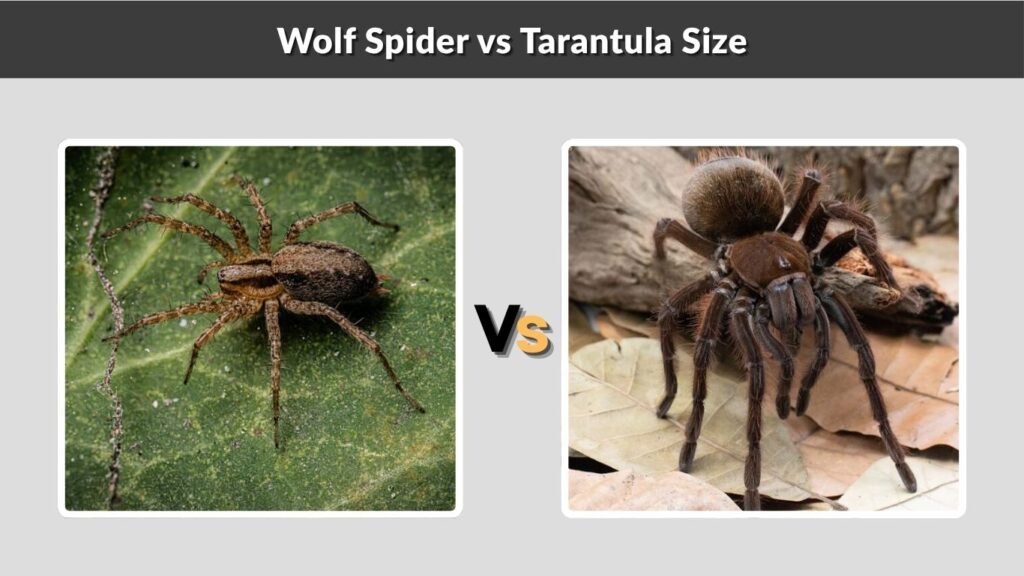
Large wolf spiders are sometimes mistaken for small tarantulas because both can have thick legs and hairy bodies. However, tarantulas are usually heavier-bodied and can grow much larger. Wolf spiders are typically faster runners and have a different eye arrangement.
Size Comparison
Key differences include:
- Wolf spider: usually much lighter and smaller-bodied
- Tarantula: generally thicker and heavier
- Wolf spider legs: relatively long for the body
- Tarantula legs: thick and heavily built
- Wolf spider movement: fast and agile
- Tarantula movement: generally slower and more deliberate
A very large wolf spider can look impressive, but most are still considerably smaller in mass than a full-grown tarantula.
How to Identify a Large Wolf Spider
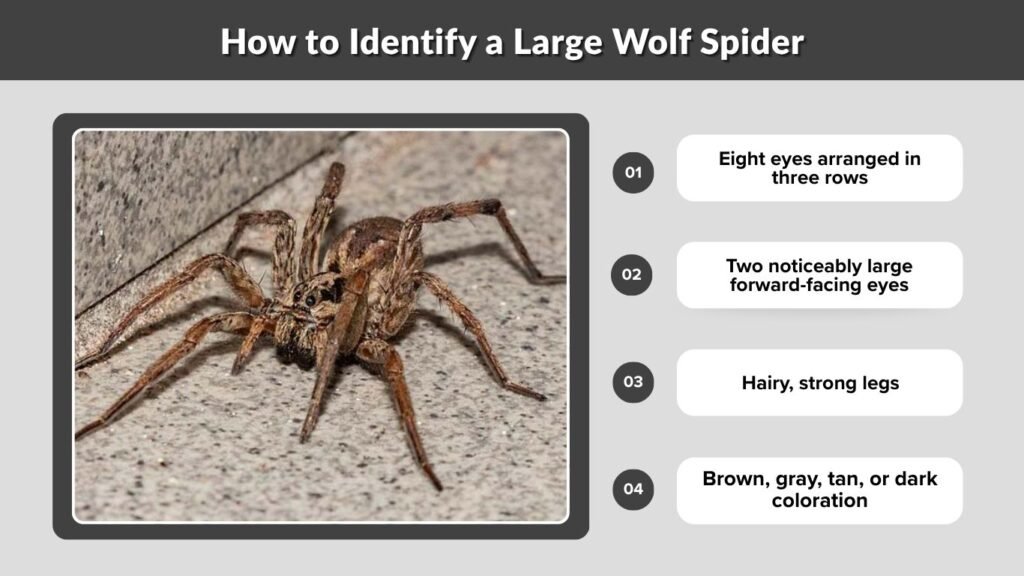
Size alone is not enough to confirm that a spider belongs to the wolf spider family. Several unrelated spiders can reach similar dimensions. Wolf spiders are best identified using a combination of their eyes, body shape, hunting behavior, and habitat.
Key Identification Features
Look for:
- Eight eyes arranged in three rows
- Two noticeably large forward-facing eyes
- Hairy, strong legs
- Brown, gray, tan, or dark coloration
- Robust but not extremely bulky body
- Fast movement across the ground
- Lack of a large prey-catching web
- Females carrying an egg sac or spiderlings
Their prominent middle pair of eyes is one of the most useful features for separating wolf spiders from many similar-looking species.
FAQs
1. How big can a wolf spider get?
Large wolf spiders may have bodies around 1 to 1.5 inches long, while the leg span can reach several inches in some species. Size varies considerably by species, sex, age, and individual development.
2. How big is the average wolf spider?
Many adult wolf spiders have body lengths between roughly 0.5 and 1 inch. Including the legs, they can appear much larger. Females are generally heavier and larger-bodied than males of the same species.
3. What is the biggest wolf spider in the United States?
The Carolina wolf spider is commonly regarded as one of the largest wolf spiders in the United States. Large females may exceed an inch in body length and appear several inches wide when their legs are fully extended.
4. Are big wolf spiders dangerous?
Large wolf spiders are not usually dangerous to people. They normally avoid confrontation and bite mainly when trapped or handled. A bite can cause localized pain, redness, itching, or swelling, but serious reactions are uncommon.
5. Why did I find a big wolf spider in my house?
Wolf spiders may wander indoors while searching for prey, shelter, or favorable temperatures. Doors, foundation cracks, garages, and stored outdoor items provide possible entry points. Seeing one large wolf spider generally does not mean that your home is infested.
