
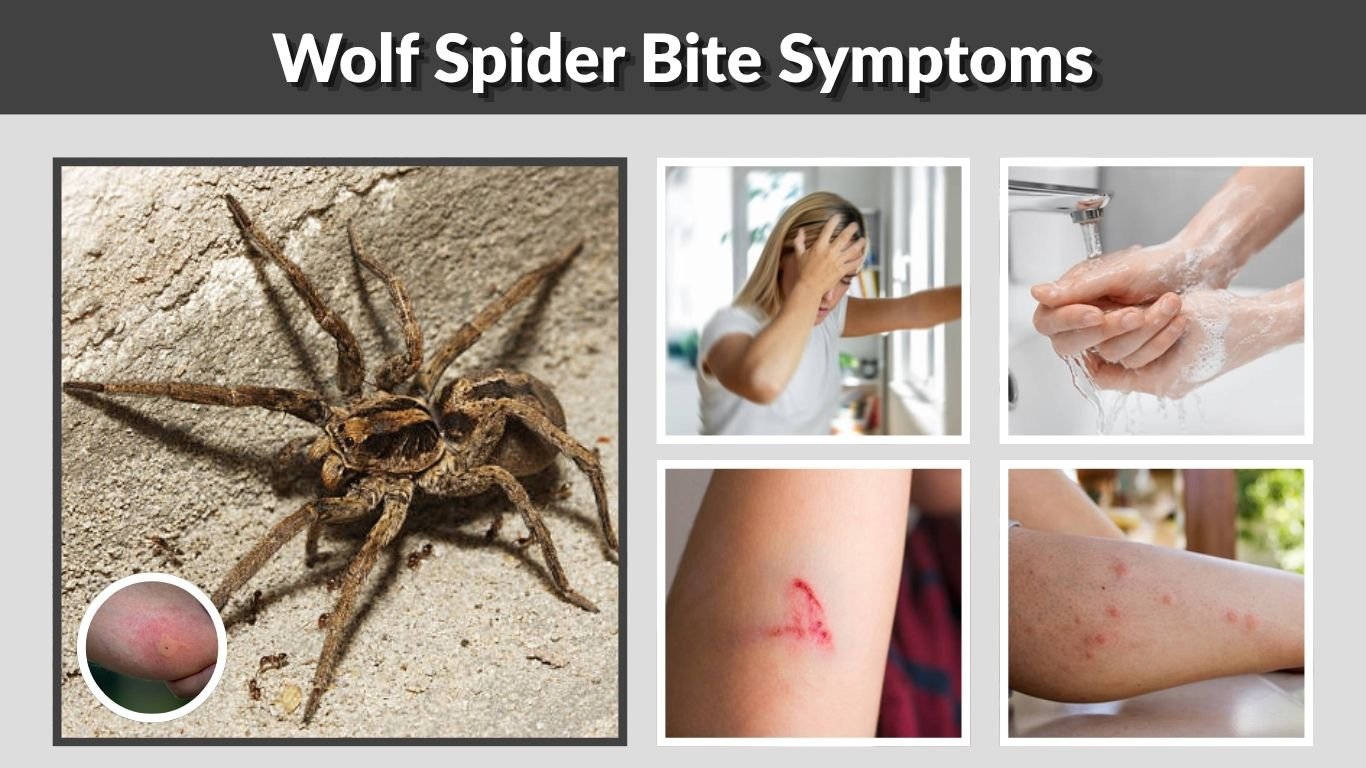
A wolf spider bite can be painful and alarming, especially because these spiders are often large and hairy. Fortunately, wolf spider bite symptoms are usually mild and limited to the skin around the bite. Typical reactions include pain, redness, swelling, itching, and a small red bump. Wolf spider bites generally do not cause serious illness in healthy people.
Research involving confirmed wolf spider bites also found that pain and redness were the most frequent effects, while swelling, itching, puncture marks, and minor whole-body symptoms occurred less often.
Here are 12 signs and symptoms you may notice after a wolf spider bite.
12 Wolf Spider Bite Symptoms
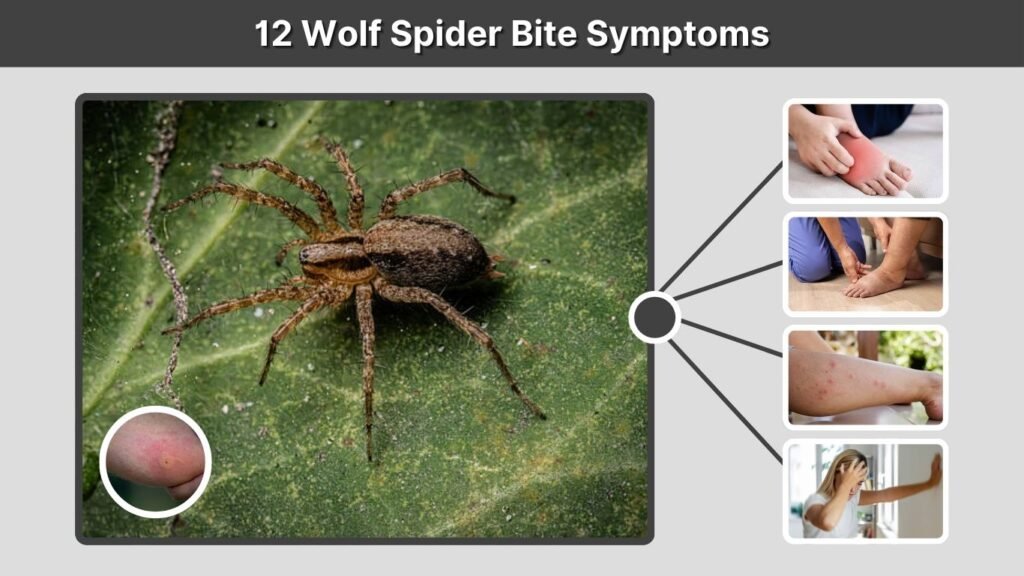
Not everyone develops all 12 symptoms. In fact, most bites cause only a few mild local reactions. Symptoms such as nausea, headache, or general illness are much less common and deserve closer monitoring.
1. Pain at the Bite Site
Pain is one of the most common wolf spider bite symptoms.
You may feel the bite immediately as a sharp pinch, sting, or prick. Wolf spiders have fangs capable of penetrating human skin, so some of the initial discomfort comes from the bite itself.
A study of confirmed Australian wolf spider bites found pain in all documented cases, although the intensity varied considerably. Larger spiders were more likely to cause severe pain and leave noticeable fang marks.
For many people, the strongest pain occurs shortly after the bite and then gradually decreases.
2. Redness
Redness around the bite is another typical reaction.
The affected skin may become pink or red as inflammation develops. The red area is usually concentrated immediately around the bite rather than spreading widely across the body.
Redness was reported in 67% of confirmed wolf spider bites in one clinical study.
A small amount of redness is generally expected. However, redness that continues spreading or becomes increasingly painful should be evaluated because another condition, including infection, may be responsible.
3. Swelling
A wolf spider bite can cause localized swelling around the puncture site.
The skin might become slightly raised, puffy, or firm. Cleveland Clinic lists swelling as one of the characteristic effects of wolf spider bites.
Mild swelling usually remains close to the bite.
Rapidly increasing swelling or swelling involving the lips, tongue, mouth, or throat should not be considered a normal wolf spider bite reaction because it may indicate a serious allergic response.
4. Itching
Some people experience itching around the bite.
Itching may appear along with redness and swelling or develop after the initial pain begins to fade.
Confirmed wolf spider bites have produced itching, although it appears to occur less frequently than pain and redness.
Try not to scratch the bite repeatedly. Scratching can damage the skin and potentially increase the risk of a secondary infection.
5. A Small Red Bump
A small raised red bump may develop where the spider bit.
This is one reason wolf spider bites can easily be confused with:
- Mosquito bites
- Ant bites
- Flea bites
- Bee or wasp stings
- Other spider bites
- Minor skin irritation
Cleveland Clinic describes a wolf spider bite as potentially appearing as a red bump with swelling around the affected area.
The bump should gradually become smaller as the inflammation resolves.
6. Fang or Puncture Marks
Two tiny puncture marks may occasionally be visible where the spider’s fangs entered the skin.
However, you should not expect two clearly visible holes in every case.
Clinical research found puncture marks or bleeding in roughly one-third of confirmed wolf spider bites. Larger spiders were more likely to leave visible fang marks.
Therefore, the absence of two marks does not prove that a wolf spider did not cause the bite.
7. Minor Bleeding
A wolf spider’s fangs can physically break the skin enough to produce a small amount of bleeding.
It may look like two tiny blood spots or a minor superficial wound.
Puncture marks or bleeding were recorded in 33% of cases in one study of confirmed wolf spider bites.
Minor bleeding usually stops quickly. The bite should then be washed gently with soap and water to reduce contamination.
8. Tenderness or Soreness
The area surrounding the bite may remain sore or tender for some time.
Touching the bite, pressing against it, or rubbing it with clothing may make the discomfort more noticeable.
This tenderness usually accompanies the local pain and inflammation associated with the bite. Wolf spider bites generally produce local rather than severe whole-body effects.
Increasing rather than improving tenderness deserves attention, particularly if the area also becomes increasingly red, swollen, or begins draining fluid.
9. Burning or Stinging Sensation
Some people describe spider bites as producing a stinging or burning sensation.
With a wolf spider bite, this feeling is typically concentrated at or close to the bite itself.
Most spider bites cause localized reactions resembling other bites or stings, with pain, redness, and swelling being particularly common.
Persistent severe burning pain is less typical and may be a reason to seek medical evaluation, particularly if you did not positively identify the spider.
10. Nausea
Nausea is possible but uncommon after a wolf spider bite.
In a clinical study of 45 confirmed wolf spider bites, only a small number of people experienced systemic symptoms, and nausea was reported in two cases.
Therefore, nausea should not be described as a normal reaction to every wolf spider bite.
If nausea becomes severe, is accompanied by repeated vomiting, or occurs with other significant symptoms, medical evaluation is appropriate because the spider may have been incorrectly identified or another medical issue may be present.
11. Headache
A headache is another uncommon systemic symptom that has been reported following a confirmed wolf spider bite.
In the same clinical study, headache occurred in only one patient.
A mild headache alone does not necessarily indicate a dangerous bite.
However, severe headache accompanied by vomiting, weakness, muscle problems, breathing difficulties, or rapidly worsening symptoms should receive medical attention.
12. Malaise or Feeling Unwell
A small number of people may experience malaise, meaning a general feeling of discomfort, tiredness, or being unwell.
This is not one of the usual local symptoms. Only minor systemic reactions were reported in about 7% of confirmed wolf spider bites in one study.
Significant weakness, fainting, severe fatigue, or rapidly worsening illness should not simply be assumed to be a normal reaction to a wolf spider.
Wolf Spider Bite Symptoms at a Glance
| Symptom | How Typical Is It? | Usual Concern |
|---|---|---|
| Pain | Very common | Usually mild to moderate |
| Redness | Common | Usually mild |
| Swelling | Common | Usually localized |
| Itching | Possible | Usually mild |
| Red bump | Common appearance | Usually mild |
| Fang marks | Sometimes visible | Usually minor |
| Minor bleeding | Sometimes | Usually brief |
| Tenderness | Possible | Usually localized |
| Burning/stinging | Possible | Usually temporary |
| Nausea | Uncommon | Monitor carefully |
| Headache | Uncommon | Monitor carefully |
| Malaise | Uncommon | Monitor carefully |
Early-Stage Wolf Spider Bite Symptoms
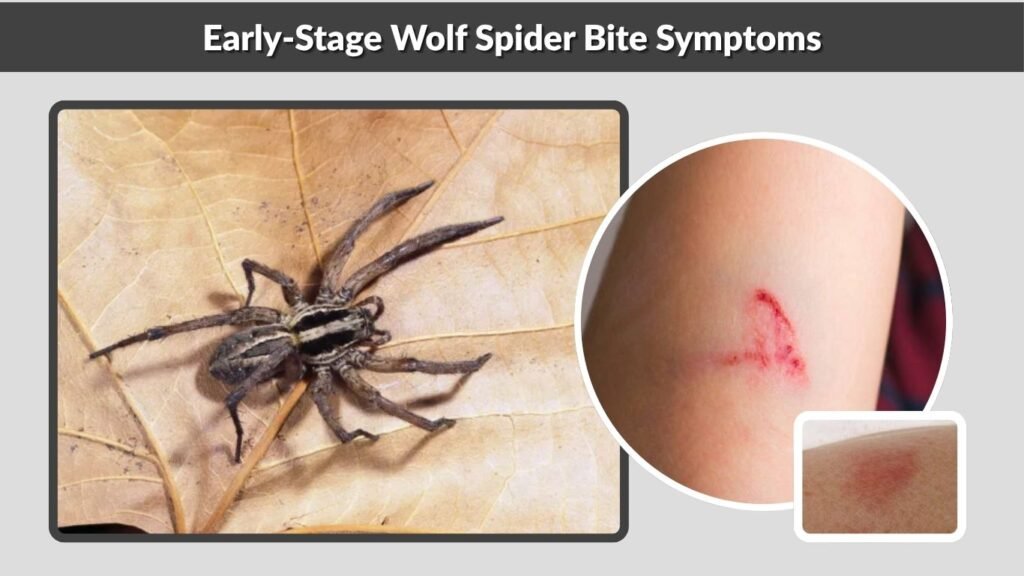
During the early stage of a wolf spider bite, the reaction is usually centered around the bite site.
The first signs may include:
- A sharp pinch or sting
- Immediate localized pain
- A small red spot
- Mild swelling
- Tenderness
- Small fang marks
- Minor bleeding
Redness, swelling, and itching can become more noticeable as the inflammatory response develops.
Most wolf spider bites remain mild and do not require medical treatment.
What Does a Wolf Spider Bite Look Like?
A wolf spider bite does not have one unique appearance that allows it to be identified simply from a photograph.
It commonly resembles an ordinary bug bite, with a red bump, redness, swelling, and sometimes fang marks.
This means wolf spider bite pictures are not always reliable for diagnosis.
A person may assume a skin lesion is a spider bite even when it actually comes from another insect, irritation, infection, or medical condition.
Seeing and accurately identifying the spider provides much stronger evidence than judging the wound alone.
Wolf Spider Bite Symptoms in Humans
In humans, the most typical wolf spider bite symptoms are:
- Local pain
- Redness
- Swelling
- Itching
- A red bump
- Possible puncture marks
Wolf spider venom is used to subdue small prey and is not generally considered medically dangerous to humans. Most bites do not require professional treatment.
A large wolf spider may still deliver a painful bite because its fangs can puncture the skin.
Allergic Reaction to a Wolf Spider Bite
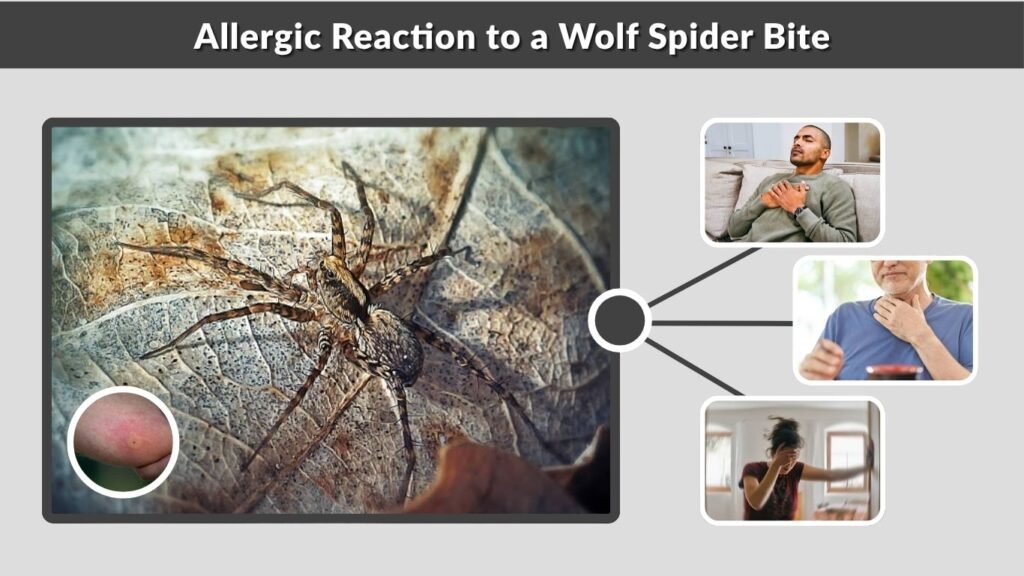
Although uncommon, allergic reactions can occur after spider bites.
Signs of a potentially serious allergic reaction include:
- Widespread hives
- Significant swelling away from the bite
- Swelling of the lips, face, tongue, or throat
- Difficulty breathing
- Difficulty swallowing
- Dizziness
- Fainting
Severe allergic reactions can become medical emergencies. Spider bites, like many bites and stings, can occasionally cause anaphylaxis.
Difficulty breathing, throat swelling, fainting, or rapidly worsening symptoms require emergency medical attention.
Can a Wolf Spider Bite Cause Flu-Like Symptoms?
Flu-like symptoms are not typical of an uncomplicated wolf spider bite.
Confirmed bites have occasionally produced mild systemic symptoms such as nausea, headache, or malaise, but these reactions were uncommon. citeturn341399search20
If you develop fever, significant body aches, repeated vomiting, chills, profound weakness, or other widespread symptoms after a suspected spider bite, do not automatically assume they are caused by a wolf spider.
Medical evaluation may be needed to rule out another spider species, infection, or unrelated illness.
Rabid Wolf Spider Bite Symptoms
Despite its alarming name, the rabid wolf spider (Rabidosa rabida) does not have rabies.
It belongs to the wolf spider family and can bite defensively when trapped or handled.
A suspected bite would generally be expected to produce the same types of localized reactions associated with other wolf spiders, such as:
- Pain
- Redness
- Swelling
- Itching
- Local tenderness
The word “rabid” in its common name should not be interpreted as meaning that the spider transmits rabies.
Carolina Wolf Spider Bite Symptoms
The Carolina wolf spider is a large wolf spider, so its size can make an encounter particularly intimidating.
If it bites, the physical puncture may be painful, and localized redness, tenderness, or swelling can develop.
Research on wolf spiders indicates that larger individuals may cause more intense bite pain and are more likely to leave visible fang marks.
Its large body size does not automatically mean that its venom is dangerously toxic to humans.
Australian Wolf Spider Bite Symptoms
Australia has numerous wolf spider species.
A clinical study examining 45 confirmed Australian wolf spider bites found:
- Pain in 100% of cases
- Redness in 67%
- Puncture marks or bleeding in 33%
- Swelling in 20%
- Itching in 13%
- Minor systemic effects in 7%
Importantly, the study reported no necrotic ulcers among the confirmed cases. citeturn341399search20
Australia also has other spiders capable of causing much more serious envenomation, so an unidentified spider bite should not automatically be assumed to be from a wolf spider.
Wolf Spider Bite Symptoms in Dogs
A dog may encounter a wolf spider while investigating grass, garages, sheds, or other hiding places.
Possible signs after a suspected bite could include localized reactions such as:
- Swelling
- Redness
- Tenderness
- Licking the area
- Pawing at the face
- Limping if a paw was affected
Because it is often impossible to know exactly what bit a pet, significant or rapidly worsening symptoms should be discussed with a veterinarian.
Breathing difficulty, collapse, severe swelling, repeated vomiting, or pronounced weakness requires prompt veterinary attention.
Wolf Spider Bite Symptoms in Cats
Cats frequently chase spiders and other small moving animals, increasing the possibility of a defensive bite.
Possible signs around the affected area can include:
- Local swelling
- Redness
- Pain
- Excessive licking
- Pawing at the mouth or face
- Sensitivity when touched
Serious illness should not automatically be attributed to a wolf spider without veterinary assessment, especially when the spider was not positively identified.
How Long Do Wolf Spider Bite Symptoms Last?
A mild wolf spider bite should generally improve rather than progressively worsen.
Pain can begin immediately, while redness, swelling, and itching may remain for some time afterward. In the study of confirmed Australian wolf spider bites, pain generally had a relatively short duration, although reactions varied between individuals.
If the bite continues worsening instead of healing, particularly after a day or two, medical evaluation may be appropriate.
Wolf Spider Bite Treatment
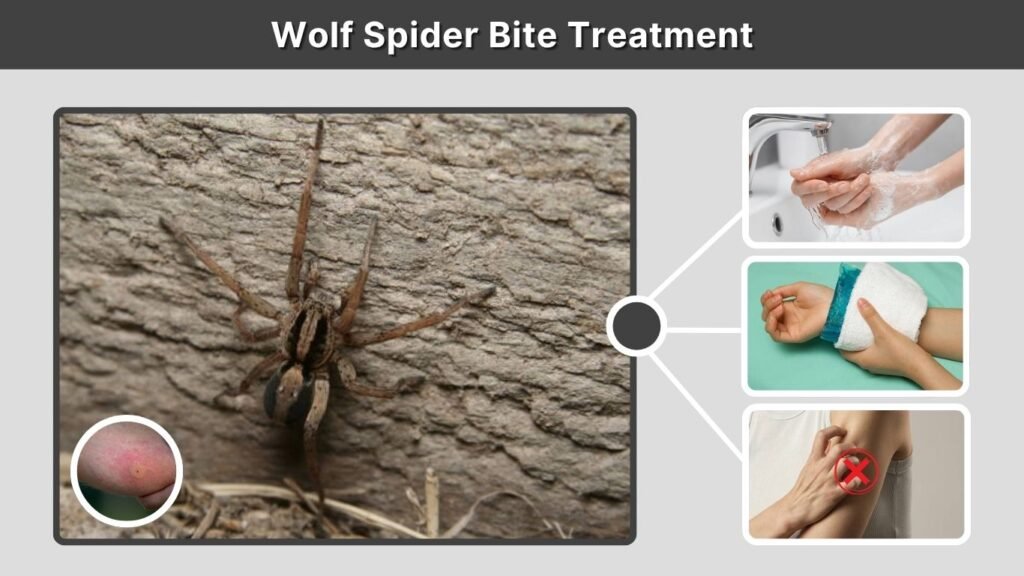
Most uncomplicated wolf spider bites can be managed with basic first aid.
Basic Treatment
You can:
- Wash the bite gently with soap and water.
- Apply a cool compress to help reduce pain and swelling.
- Keep the area clean and dry.
- Avoid scratching the bite.
- Monitor redness and swelling for changes.
General guidance for minor spider bites also includes cleaning the wound and using measures to reduce discomfort and swelling.
Do not cut the wound, attempt to suck out venom, or deliberately squeeze the bite.
When to Seek Medical Attention
A typical wolf spider bite is unlikely to become medically serious. However, seek professional care when symptoms are unusual or worsening.
Get medical help if you notice:
- Severe or increasing pain
- Rapidly expanding swelling
- Redness that continues spreading
- Pus or drainage
- Fever
- Repeated vomiting
- Severe weakness
- A worsening open wound
- Widespread hives
- Difficulty swallowing
- Difficulty breathing
- Swelling of the lips, tongue, or throat
Spider identification can be difficult, and medically significant bites may initially be mistaken for bites from less dangerous species.
FAQs
1. What are the most common wolf spider bite symptoms?
The most characteristic symptoms are localized pain, redness, swelling, itching, and a small red bump. Some bites may also leave fang marks or minor bleeding. Serious whole-body reactions are uncommon following confirmed wolf spider bites.
2. How soon do wolf spider bite symptoms appear?
Pain may occur immediately when the spider’s fangs penetrate the skin. Redness, swelling, tenderness, or itching can become more noticeable afterward as the body’s local inflammatory response develops.
3. Can a wolf spider bite cause a severe allergic reaction?
It is possible for spider bites to cause allergic reactions, although severe reactions are uncommon. Widespread hives, facial or throat swelling, difficulty breathing, fainting, or rapidly worsening symptoms require emergency medical attention.
4. Does a wolf spider bite cause skin necrosis?
Skin necrosis is not considered a characteristic effect of wolf spider bites. A clinical study of 45 confirmed Australian wolf spider bites reported no necrotic ulcers. A worsening or ulcerating wound should therefore receive medical evaluation rather than automatically being attributed to a wolf spider.
5. How dangerous is a wolf spider bite?
For most healthy people, a wolf spider bite is painful but not dangerous. Reactions usually remain localized around the bite, and most cases do not require medical treatment. Severe or unusual symptoms should still be evaluated because spider bites can be difficult to identify accurately.
