
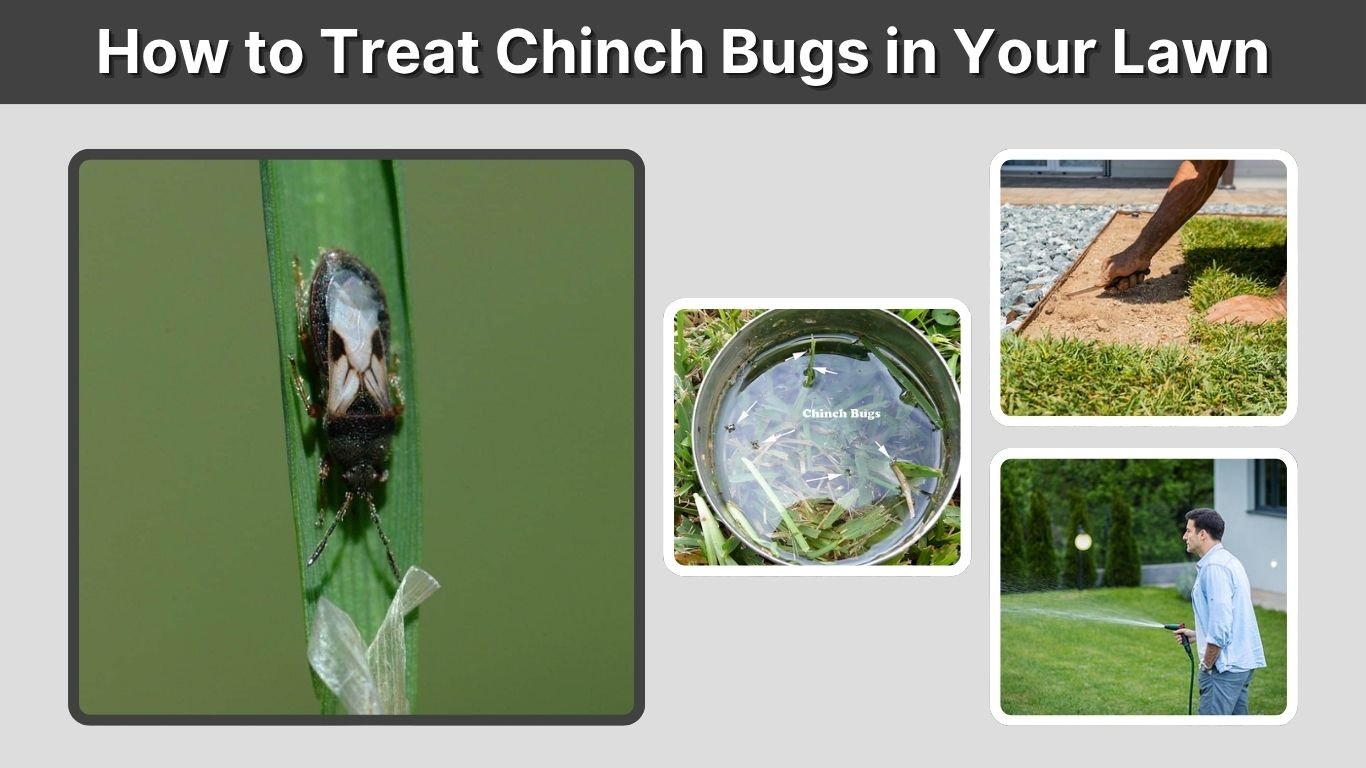
To treat chinch bugs successfully, first confirm that they—not drought, disease, or fertilizer damage—are causing the brown patches. Once identified, treat the active edge of the damaged area with a lawn insecticide labeled for chinch bugs and your grass species. At the same time, correct mowing, watering, fertilization, and thatch problems that weaken the lawn. Early treatment is important because chinch bugs can spread quickly during hot, dry weather, particularly in sunny areas.
How to Identify a Chinch Bug Problem
Chinch bug damage can closely resemble drought stress. Treatment should begin only after you find the insects because pesticides will not repair turf damaged by disease, poor irrigation, fertilizer burn, or another lawn pest.
Signs of Chinch Bug Damage
Chinch bugs use piercing mouthparts to feed on grass. Their damage usually begins as irregular yellow patches that gradually become brown and expand into surrounding healthy turf.
Common signs include:
- Yellow or straw-brown patches
- Damage that continues after watering
- Problems concentrated in hot, sunny areas
- Patches near sidewalks, driveways, or curbs
- Small insects moving through the thatch
- Bugs concentrated between green and dead grass
St. Augustinegrass is especially vulnerable, although bermudagrass, zoysiagrass, centipedegrass, and bahiagrass may also be affected. Chinch bug damage is often most noticeable during hot, dry conditions.
Identify Adults and Nymphs
Adult chinch bugs are approximately 1/5 inch long. They have dark bodies and pale wings marked with black triangular patches.
Young nymphs are smaller and usually reddish or orange with a light band across the abdomen. They gradually become darker as they mature. Both adults and nymphs may be found near the soil surface and inside the thatch.
Confirm Chinch Bugs With a Flotation Test
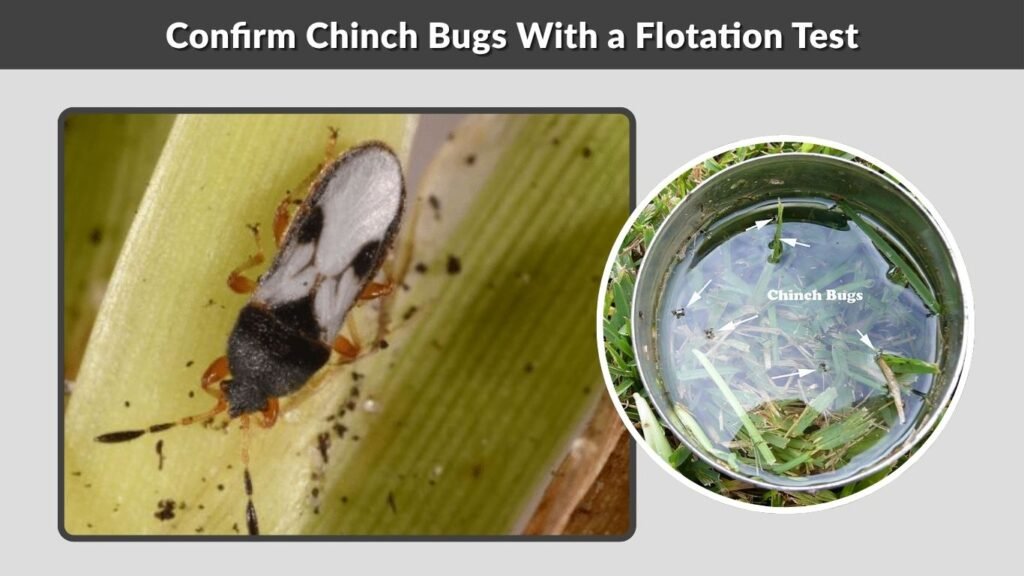
A flotation test is one of the easiest ways to determine whether chinch bugs are present. Perform it along the living edge of a damaged patch, where actively feeding bugs are most likely to gather.
How to Perform the Test
- Remove both ends from a metal coffee can.
- Push the can two or three inches into the soil.
- Fill it with water.
- Keep the water level full for five to seven minutes.
- Watch for chinch bugs floating to the surface.
Repeat the test in several places because the insects may be unevenly distributed. University of Georgia guidance uses sampling thresholds that vary with the size of the testing device, reinforcing the need to follow regional Extension recommendations rather than treating merely because one insect is seen.
How to Treat Chinch Bugs Step by Step
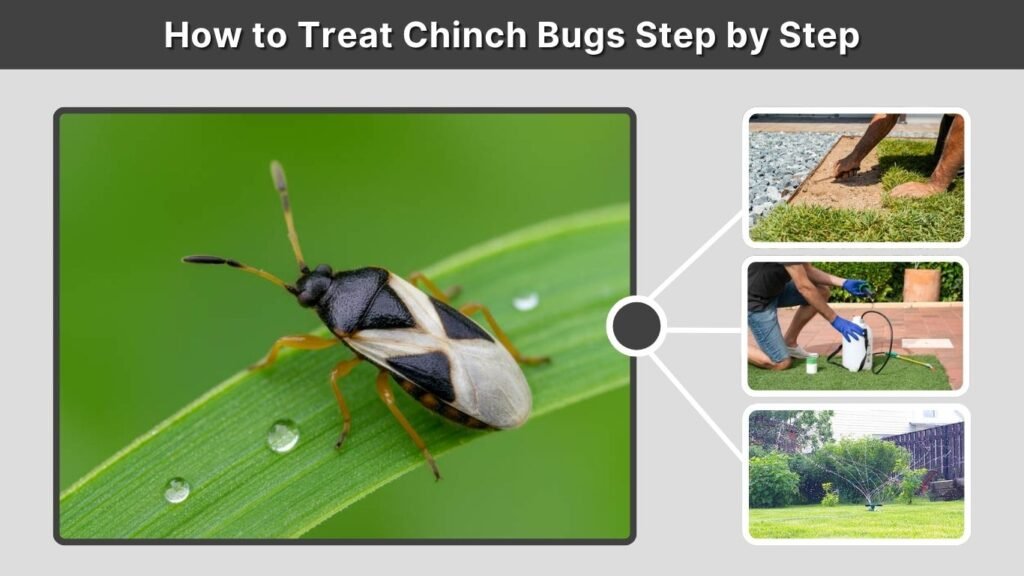
Treating the entire lawn without inspecting it first wastes product and exposes beneficial insects unnecessarily. Concentrate on confirmed infestations and the grass surrounding them.
1. Prepare the Lawn
If the soil is extremely dry, irrigate the lawn several hours to one day before applying a treatment, provided the product label permits it. Applying certain pesticides to severely dry turf can increase the risk of grass injury or reduce treatment performance.
Avoid mowing the lawn excessively short. Scalping adds stress and reduces the grass’s ability to recover.
Remove toys, pet dishes, furniture, and other objects from the treatment area. Mow flowering weeds before treatment when appropriate to reduce pollinator exposure.
2. Treat the Active Border
Do not focus only on the completely brown center. Most actively feeding chinch bugs are found in the thatch and along the border between damaged and healthy grass.
Treat:
- The yellowing edge of the patch
- Nearby green turf
- The surrounding thatch layer
- Additional areas where testing confirms bugs
Spot treatment is usually preferable when the infestation is limited. A wider application may be needed when sampling shows that chinch bugs are distributed throughout the lawn.
3. Apply a Labeled Lawn Insecticide
Choose a product whose label lists:
- Chinch bugs as a target pest
- Lawns or residential turf as an approved site
- Your turfgrass species, when specified
- Clear mixing and application instructions
Depending on the region and product, labeled treatments may contain pyrethroid, carbamate, systemic, microbial, or combination ingredients. Resistance has developed in some chinch bug populations, including resistance to several commonly used active ingredients. Repeatedly applying the same chemical group may therefore produce poor results.
Never assume that products with different brand names work differently. Check the active ingredient and mode-of-action group.
4. Follow Watering Directions
Whether the lawn should be watered after application depends on the formulation.
| Product type | Typical requirement |
| Contact liquid spray | Often requires thorough turf coverage |
| Granular insecticide | Frequently needs irrigation to activate it |
| Systemic treatment | May need watering into the root zone |
| Microbial product | May require sustained moisture |
These are general patterns, not universal instructions. Follow the product label because it determines the correct application rate, watering method, reapplication interval, and reentry period. EPA explains that pesticide labels specify where, how, how much, and how often a product may be used.
5. Reinspect the Lawn
Check the treated area after the period stated on the label. Repeat the flotation test at the edge of the patch.
Do not judge treatment only by the color of the grass. Dead grass cannot immediately turn green again, even when the insects have been controlled.
Look for:
- Living chinch bugs
- Continued patch expansion
- Fresh yellowing
- New infestations elsewhere
Do not automatically reapply the same product. Confirm that bugs remain and observe the minimum reapplication interval.
How to Treat Chinch Bugs in St. Augustine Grass
Southern chinch bugs are particularly damaging to St. Augustinegrass. They hide within its dense canopy and thatch, making complete treatment coverage important.
Protect the Remaining Healthy Grass
Treat the advancing edge before the entire patch dies. Grass that is only yellow or wilted may recover after the insects are controlled, but completely dead stolons may need replacement.
Avoid heavy nitrogen fertilization during hot, dry weather. Excessive fertilizer can promote lush but stressed growth and may contribute to thatch accumulation.
Manage Thatch
Chinch bug populations tend to increase where thatch is excessive. A thick layer gives the insects shelter and can prevent water and treatments from reaching the lower turf canopy.
Core aeration may help when soil compaction contributes to thatch and poor rooting. Aggressive dethatching should be timed carefully because it can further stress St. Augustinegrass.
When Is the Best Time to Treat Chinch Bugs?
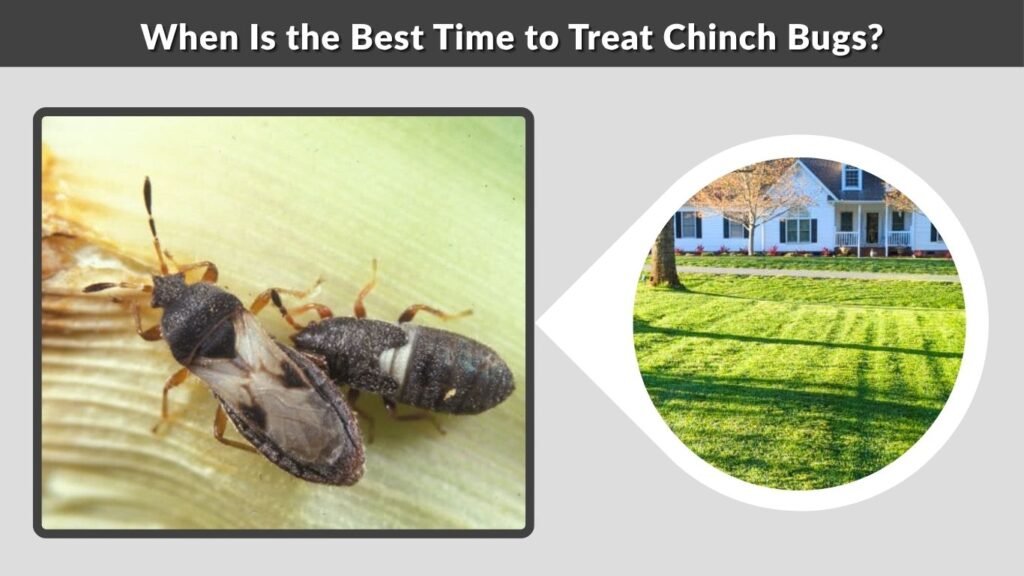
The best time is when an active infestation has been confirmed but before the damaged patch becomes extensive. Do not depend solely on a calendar.
Chinch bugs are especially active during warm weather, and populations can grow rapidly during hot, dry periods. In warmer regions, monitoring may be necessary throughout much of the growing season.
Inspect vulnerable areas regularly, particularly:
- Full-sun sections
- Grass beside pavement
- Previously infested areas
- Drought-stressed turf
- Locations with excessive thatch
Morning or evening treatment may reduce heat stress and evaporation, but the weather and timing requirements on the label take priority.
How to Treat Chinch Bugs Naturally
Nonchemical treatment is most practical when the population is small and detected early. Cultural methods also reduce lawn stress and make future infestations less damaging.
Vacuum Small Infestations
A powerful outdoor vacuum may remove chinch bugs from the border of a small patch. Run it through the grass and thatch, then empty the debris into a sealed bag.
Vacuuming may reduce the population but will not remove every egg or hidden nymph.
Improve Lawn Care
Maintain healthy grass by:
- Mowing at the recommended height
- Watering deeply when needed
- Avoiding frequent shallow irrigation
- Preventing excessive nitrogen use
- Reducing severe soil compaction
- Managing excessive thatch
- Preserving beneficial predators
Big-eyed bugs, pirate bugs, predatory earwigs, and other natural enemies may help suppress chinch bugs. Broad-spectrum insecticides can kill these beneficial insects, so unnecessary preventive spraying should be avoided.
Consider Microbial Products
Some products containing the beneficial fungus Beauveria bassiana are labeled for chinch bugs. They generally work more slowly than conventional contact insecticides and need suitable moisture conditions.
Use only products labeled for lawns, the target pest, and the intended treatment area.
Avoid Strong Homemade Soap Mixtures
A mild soap-and-water solution is sometimes used to flush insects to the surface for identification. However, household dish detergent is not a reliable lawn insecticide and may burn grass.
Commercial insecticidal soap should be used only when its label specifically permits application to turf and identifies the target pest.
How to Repair Chinch Bug Damage
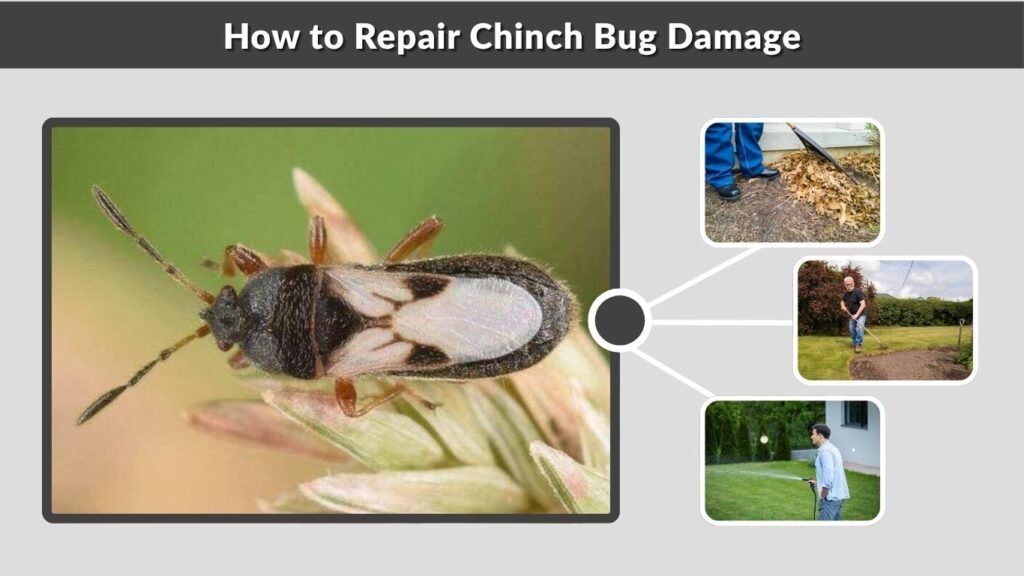
Control the living insects before repairing the lawn. Otherwise, chinch bugs may attack the replacement grass.
Evaluate the Turf
Wait briefly after treatment and inspect the crowns, roots, and runners. Yellow grass with living crowns may recover with proper irrigation and care.
Completely dead areas may require:
- Raking out dead material
- Adding suitable topsoil where needed
- Installing matching sod or plugs
- Watering replacement grass correctly
- Limiting traffic while roots establish
Avoid applying excessive fertilizer to force rapid recovery. Follow the seasonal recommendations for your grass species and location.
Pesticide Safety
Use the lowest amount permitted by the label and never assume that doubling the rate will improve control.
Wear all required protective clothing, keep people and pets away for the stated period, and avoid spraying before rain or during windy weather. Prevent runoff into drains, ponds, gardens, and neighboring properties. EPA recommends removing children, toys, and pets before treatment and keeping them away until the product has dried or the label permits reentry.
FAQs
What is the best way to treat chinch bugs?
Confirm the infestation with a flotation test, then treat the border between damaged and healthy grass using a lawn insecticide labeled for chinch bugs. Improve watering, mowing, and thatch management at the same time. Reinspect before deciding whether another application is necessary.
How often should you treat a lawn for chinch bugs?
Treat only when sampling confirms an active population. Reapplication frequency depends entirely on the product label. Do not establish a routine spray schedule or repeat treatment merely because the grass remains brown. Retest the area and observe the minimum interval and annual application limit.
Can damaged grass recover after chinch bug treatment?
Yellow or wilted turf may recover if its crowns and roots remain alive. Completely brown, brittle grass with dead stolons usually will not regrow. Control the chinch bugs first, provide appropriate irrigation, and replace dead sections with matching sod or plugs when necessary.
Can you treat chinch bugs without chemicals?
Small infestations may be reduced through vacuuming, proper irrigation, correct mowing, thatch management, and preservation of natural predators. Microbial insecticides may also be available. Severe populations often require a labeled lawn treatment, especially when patches continue expanding despite improved cultural care.
Do chinch bugs bite people?
Chinch bugs are grass-feeding insects and are not considered human-biting pests. They use piercing mouthparts to remove fluids from turfgrass. A skin irritation occurring in the lawn is more likely connected to another arthropod, plant material, or environmental cause.
