
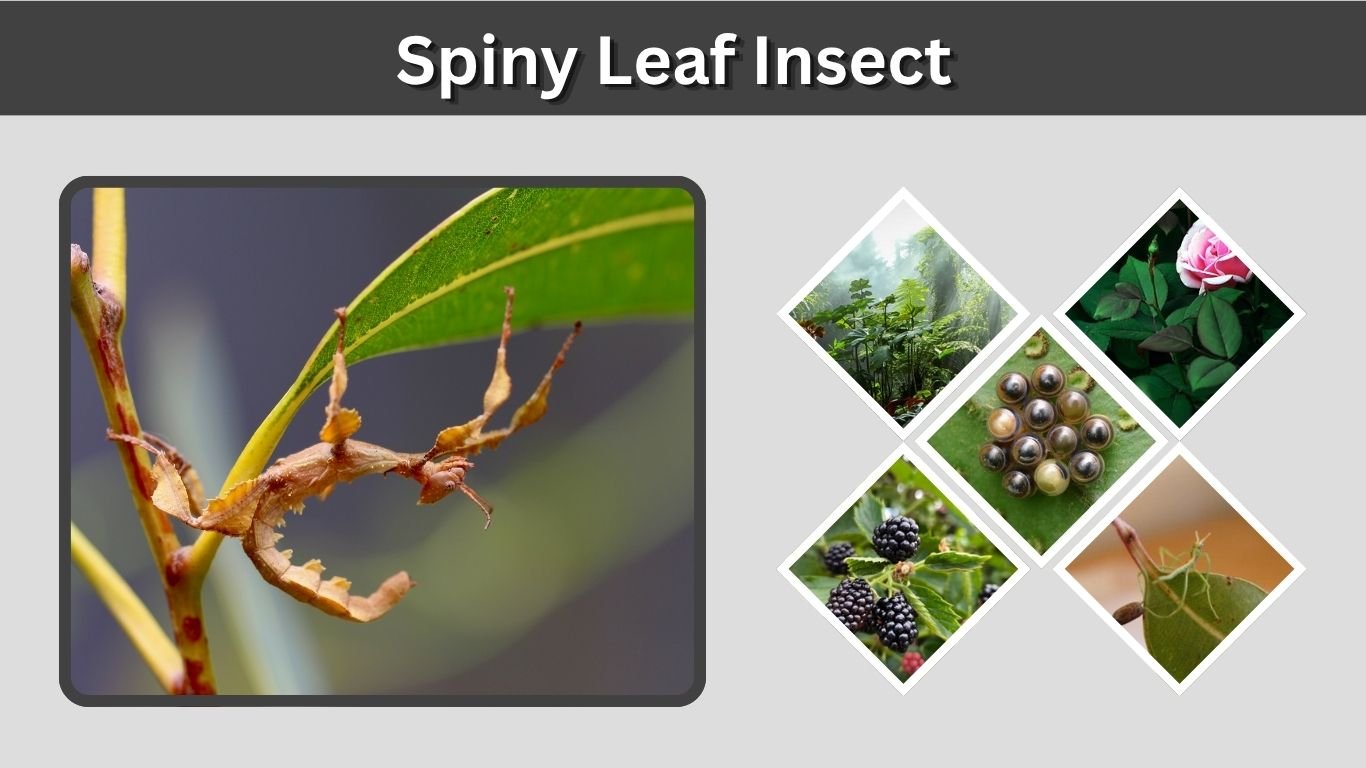
The spiny leaf insect (Extatosoma tiaratum) is a large Australian stick insect famous for resembling a curled, damaged leaf. Also called Macleay’s spectre or the giant prickly stick insect, it uses camouflage, spines, swaying movements, and a scorpion-like posture to discourage predators. This guide explains how to identify spiny leaf insects, where they live, what they eat, how males and females differ, and what they require when kept as pets.
What Is a Spiny Leaf Insect?
Despite its common name, the spiny leaf insect is technically a stick insect rather than a true leaf insect from the family Phylliidae. It belongs to the order Phasmatodea, whose members are commonly called phasmids.
Its curved abdomen, irregular outline, and thorn-like projections make it resemble a dry or damaged leaf. Other common names include the Australian spiny leaf insect, Australian walking stick, giant prickly stick insect, and Macleay’s spectre.
Identification and Appearance
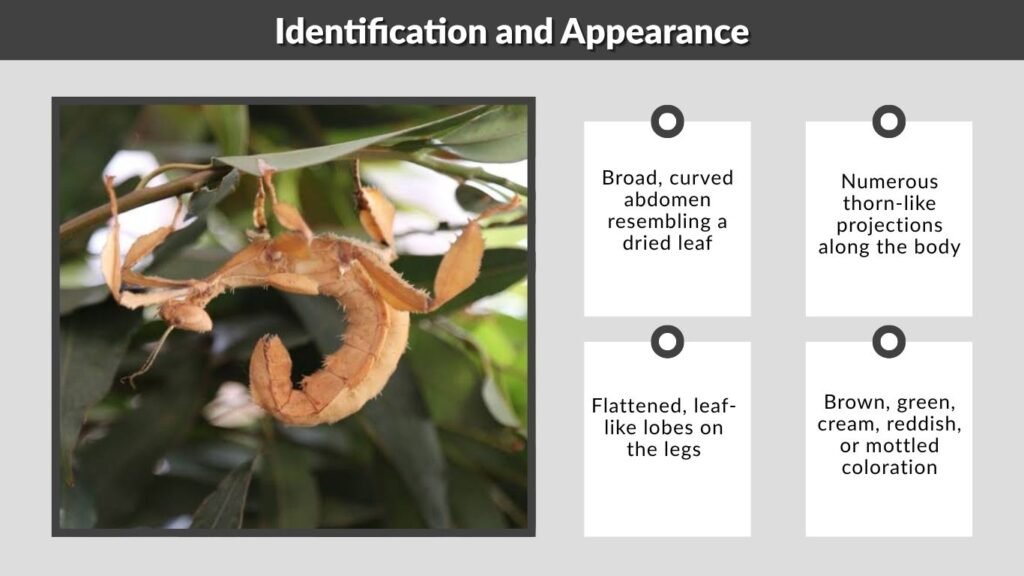
Spiny leaf insects vary greatly in appearance. Females are usually brown, reddish, tan, green, or cream. Some nymphs develop unusual white, green, and black patterns known as the lichen color form.
Key Identification Features
- Broad, curved abdomen resembling a dried leaf
- Numerous thorn-like projections along the body
- Flattened, leaf-like lobes on the legs
- Brown, green, cream, reddish, or mottled coloration
- Small head with chewing mouthparts
- Long legs with hooked feet for gripping branches
- Gentle swaying movements when disturbed
Newly hatched nymphs look surprisingly different from adults. They have dark bodies, reddish-orange heads, pale markings, and fast movements that help them resemble ants. After their first molt, they become slower and develop a more leaf-like appearance.
Male vs Female Spiny Leaf Insect
Adult males and females are so different that inexperienced observers may mistake them for separate species.
| Feature | Female | Male |
| Size | Usually 13–18 cm | Usually up to 11 cm |
| Body | Heavy, broad and strongly curled | Thin, straight and lightweight |
| Wings | Short and unable to support flight | Long, functional wings |
| Flight | Flightless | Can fly |
| Spines | Numerous and prominent | Smaller and less noticeable |
| Lifespan | Approximately 12–18 months | Commonly 6–8 months |
| Color | Brown, green, cream or mottled | Usually brown |
Females have large abdomens for producing eggs. Males are slender, possess long antennae, and can fly while searching for mates.
Spiny Leaf Insects Habitat and Distribution
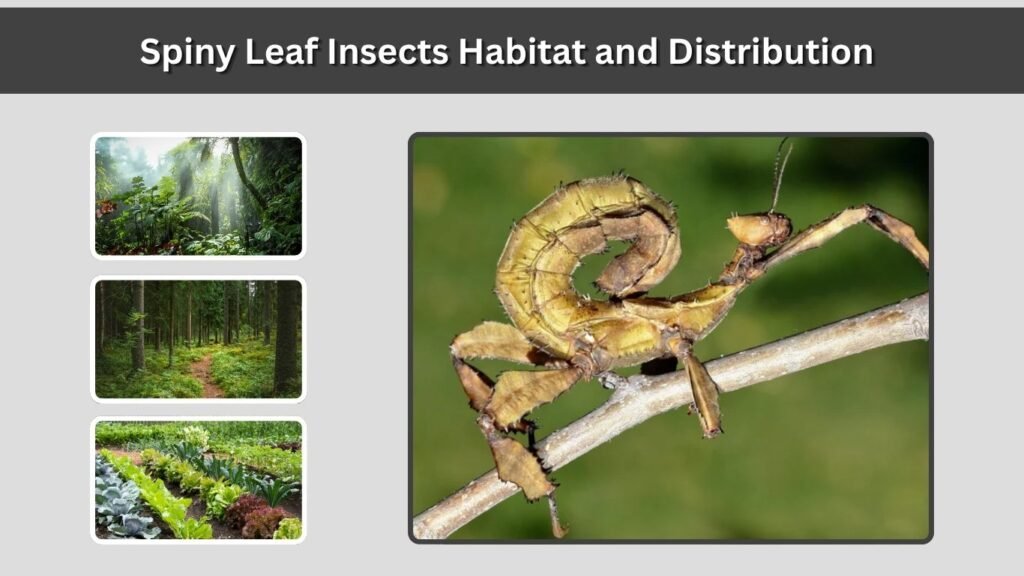
Spiny leaf insects are native to Australia, particularly Queensland and New South Wales. They inhabit rainforests, woodlands, eucalyptus forests, gardens, and vegetation-rich areas along the country’s eastern side.
They spend most of their lives hanging from branches or resting among foliage. During the day, they remain almost motionless. Most feeding and movement occur after dark.
Their natural predators include birds, reptiles, spiders, rodents, and predatory insects such as praying mantises. Camouflage provides their main protection. When threatened, a spiny leaf insect may curl its abdomen over its body, creating a scorpion-like appearance. However, it has no stinger or venom.
What Do Spiny Leaf Insects Eat?
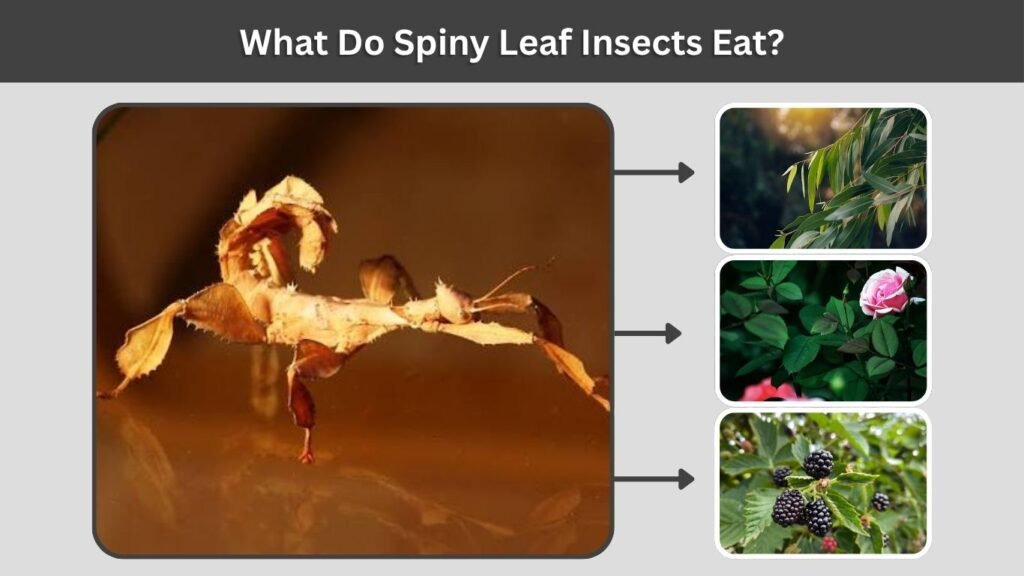
Spiny leaf insects are herbivores and do not eat other insects. In their native habitat, eucalyptus or gum leaves are their primary food.
Suitable captive foods can include:
- Eucalyptus or gum leaves
- Rose leaves
- Guava leaves
- Bramble
- Blackberry and raspberry leaves
- Some wattle leaves
- Cadagi
- Tree lucerne
Food must be fresh and free from pesticides, roadside pollutants, and chemical treatments. Place cut branches in a covered water container to keep them fresh. Block the opening around the stems so nymphs cannot fall into the water and drown.
Spiny leaf insects obtain much of their moisture from leaves but also drink droplets. Lightly misting the foliage once daily usually provides drinking water.
Spiny Leaf Insect Care Guide
Spiny leaf insects can make fascinating pets, but they need adequate height, ventilation, fresh foliage, and suitable humidity to molt safely.
| Care requirement | Recommended condition |
| Enclosure | Tall, well-ventilated mesh cage |
| Minimum size | Around 35 × 30 × 30 cm |
| Temperature | Ideally 22–26°C |
| Humidity | Approximately 60–80% |
| Water | Light daily misting |
| Food | Fresh, pesticide-free foliage |
| Cleaning | Remove waste and old leaves regularly |
Enclosure and Cage Setup
The cage should be taller than it is wide because spiny leaf insects climb upward and hang vertically while shedding their skin. A larger enclosure is preferable for adult females or groups.
Add sturdy branches and leafy stems at different heights. Provide sufficient open space beneath the branches for molting. Use mesh sides or a ventilated lid to prevent stagnant, excessively humid air.
Keep the cage away from heaters and direct sunlight. A glass enclosure can overheat quickly, even when the surrounding room feels comfortable.
Handling
Spiny leaf insects are generally calm but have delicate legs. Never pull one from a branch. Place your hand nearby and gently encourage it to walk onto you.
Their hooked feet may feel slightly prickly. Large females can press their spiny hind legs together defensively, so handling should remain gentle and limited. They do not normally bite, although their leg spines can scratch or pinch the skin.
Life Cycle and Reproduction
The spiny leaf insect undergoes incomplete metamorphosis, progressing from egg to nymph and then adult without a pupal stage.
Males usually molt five times, while females generally molt six times before maturity. During each molt, the insect hangs upside down and slowly pulls itself from its old exoskeleton. It must have enough space and humidity to complete this process.
Females can reproduce in two ways. After mating, they produce fertilized eggs containing both male and female offspring. An unmated female can reproduce through parthenogenesis, producing eggs that normally develop into females genetically similar to their mother.
Eggs and Hatching
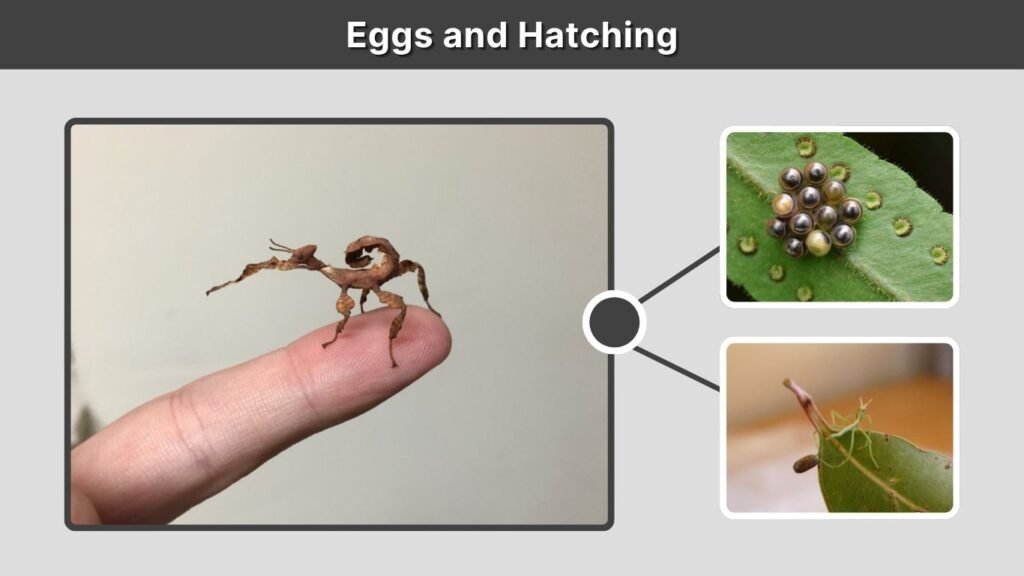
Spiny leaf insect eggs resemble small mottled seeds and have a knob called a capitulum. Females flick individual eggs onto the forest floor. Ants may carry them underground after being attracted to the capitulum, unintentionally protecting the eggs from predators and fire.
A female can produce hundreds of eggs during her life. Captive eggs are usually kept in a ventilated container with slightly humid—not wet—material. Many begin hatching within 3–9 months under warm conditions, but some may take considerably longer.
Newly hatched nymphs need soft, fresh leaves and a secure enclosure with extremely small ventilation openings.
Common Care Problems
Molting problems are commonly caused by insufficient cage height, low humidity, overcrowding, or disturbance. A failed molt can leave the insect trapped or result in deformed or missing legs.
Young insects may regrow a lost limb over several molts. Adults cannot regenerate limbs because they no longer molt.
If an insect stops eating, check that its food is fresh and suitable. Temporary fasting can occur before molting. However, remaining on the cage floor, repeated falling, extreme weakness, or a darkened body may indicate injury, dehydration, unsuitable temperatures, or old age.
Never release captive spiny leaf insects outdoors. Before purchasing insects or eggs, check local regulations. In the United States, permits may be required for possessing, importing, or transporting plant-feeding insects.
FAQs
Can spiny leaf insects fly?
Adult males have fully developed wings and can fly, especially when searching for females. Adult females are much heavier and have short wings that cannot support flight. Nymphs of both sexes are wingless.
How long do spiny leaf insects live?
Females commonly live for approximately 12–18 months, while adult males usually have shorter lives of around 6–8 months. Temperature, food quality, molting success, sex, and general care can influence their lifespan.
Do spiny leaf insects bite?
Spiny leaf insects rarely attempt to bite and are not venomous. However, a frightened adult female may press her spiny hind legs together, producing a mild pinch or scratch. Gentle handling reduces defensive behavior.
Do spiny leaf insects eat each other?
Spiny leaf insects are herbivores and do not normally eat each other. They may accidentally damage another insect when crowded or competing for space. Providing plentiful food, branches, and molting room helps prevent injuries.
How is a praying mantis different from a spiny leaf insect?
A praying mantis is a predator that catches and eats other animals using powerful front legs. A spiny leaf insect is a harmless plant eater. Both use camouflage, but they have completely different diets, body structures, and hunting behaviors.
