
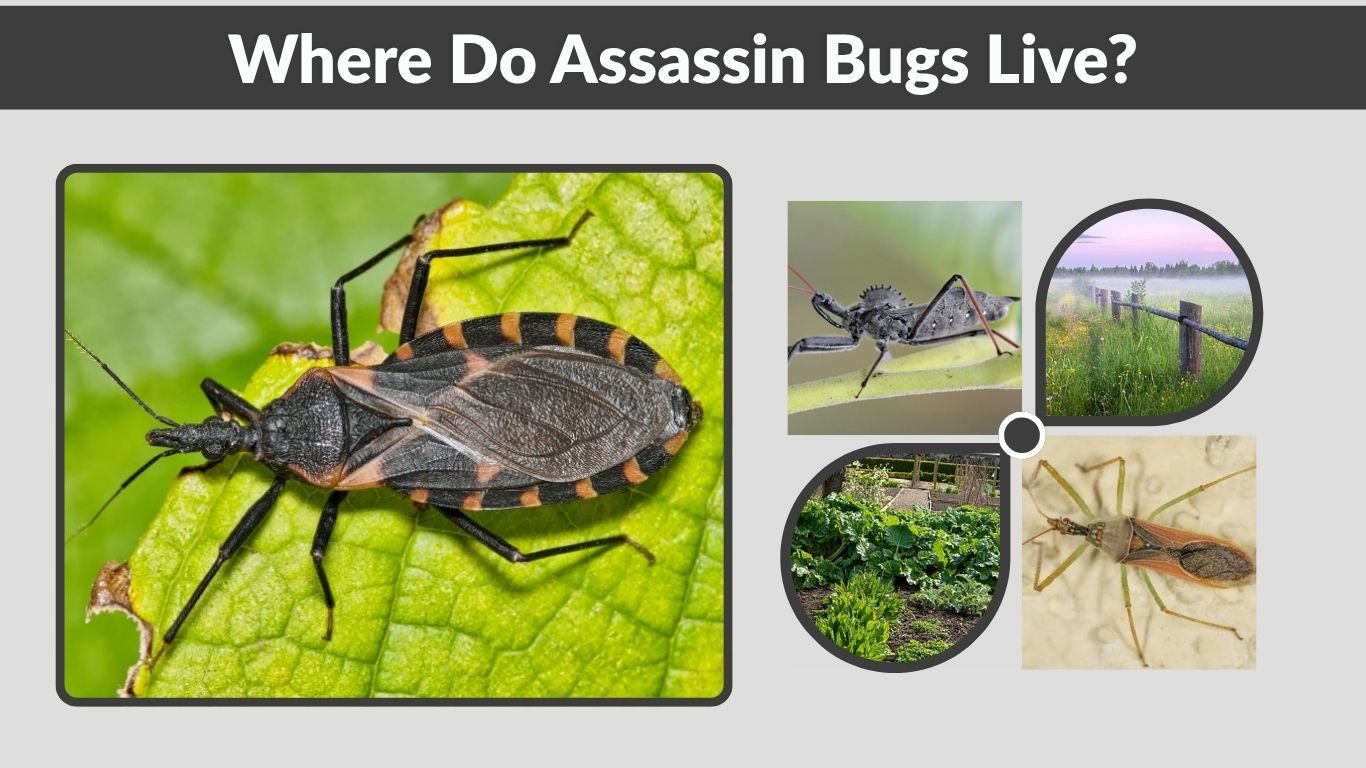
Assassin bugs live in a surprisingly wide variety of places, from gardens and crop fields to forests, grasslands, and occasionally houses. Most species remain on plants where they can hunt caterpillars, flies, beetles, and other insects. However, their exact habitat depends on the species. Some patrol leaves and flowers, while others hide beneath bark, enter buildings, occupy animal nests, or even hunt inside spider webs. Assassin bugs occur worldwide but are especially diverse in tropical regions.
Where Are Assassin Bugs Found Worldwide?
Assassin bugs belong to the family Reduviidae, which includes almost 7,000 described species. They occur around the world and are most diverse in the tropical regions of Africa, Asia, and the Americas. Different groups have adapted to highly varied environments and prey, allowing them to occupy warm forests, dry landscapes, agricultural land, suburban gardens, and buildings.
Most assassin bugs are land-dwelling predators. They generally live wherever suitable insect prey and hiding places are available. Some species tolerate cooler temperate climates, but warm conditions usually support a greater variety of species.
What Is the Natural Habitat of an Assassin Bug?
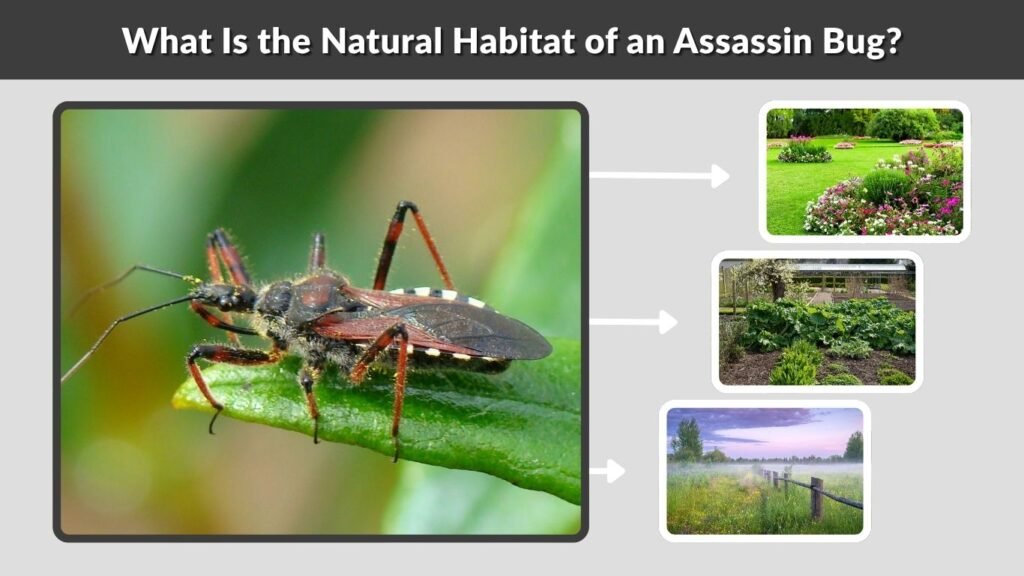
There is no single assassin bug habitat because the family contains thousands of species. However, most common predatory species are associated with vegetation. They may be found on almost any land plant, including garden flowers, shrubs, weeds, crop plants, fruit trees, and forest trees.
Common Places Assassin Bugs Live
- Garden plants and flowering shrubs
- Vegetable gardens and agricultural fields
- Forest trees and woodland edges
- Meadows, grasslands, and weedy areas
- Orchards, citrus groves, and pecan groves
- Beneath loose bark and other protected surfaces
- Around outdoor lights where prey insects gather
- Inside houses as accidental visitors
- Animal nests in the case of blood-feeding species
Wheel bugs, for example, are frequently associated with flowers, tree trunks, citrus and pecan groves, forest trees, shade trees, and fruit trees. They may also gather near lights to capture insects attracted to the light.
Why Do Assassin Bugs Live on Plants?
Plants provide assassin bugs with hunting platforms, camouflage, shelter, and access to prey. Many species slowly patrol leaves and stems or wait motionless for another insect to approach. They then seize the prey and pierce it with their strong, tubular mouthparts.
Assassin bugs commonly consume caterpillars, leaf-beetle larvae, sawfly larvae, aphids, and other true bugs. Because their food lives on vegetation, both adult assassin bugs and their nymphs are frequently discovered on leaves, stems, flowers, and tree branches.
An assassin bug on a plant is not usually eating the plant. Most species are predators rather than plant pests, although they may capture beneficial insects as well as harmful ones.
Assassin Bug Habitats by Species
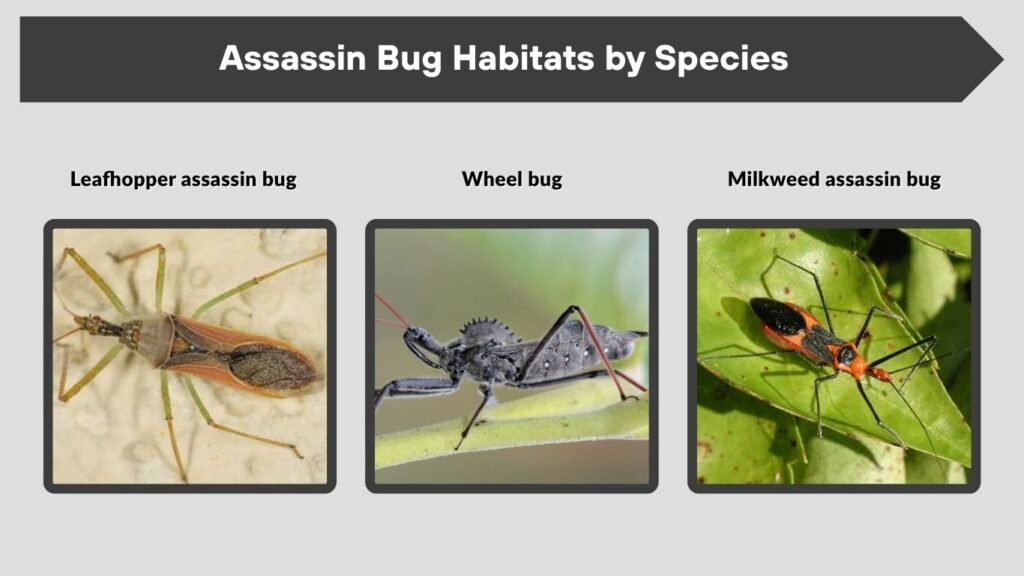
Different assassin bugs choose different surroundings. Identifying the species can help explain why it appeared in a particular location.
| Type of assassin bug | Common habitat |
| Leafhopper assassin bug | Gardens, landscapes, shrubs, crops, and trees |
| Wheel bug | Forest trees, orchards, flowers, shrubs, and tree trunks |
| Milkweed assassin bug | Gardens, crop fields, corn plants, and other vegetation |
| Masked hunter | Outdoor wooded habitats and occasionally buildings |
| Kissing bug | Wildlife nests, animal shelters, cracks, and nearby homes |
| Thread-legged assassin bug | Vegetation, sheltered surfaces, and sometimes spider webs |
Leafhopper Assassin Bugs
Species in the genus Zelus are commonly found on terrestrial plants. They have long legs and slender bodies that allow them to move across foliage while stalking insects. Some produce a sticky material that helps them remain on plant surfaces and capture prey. California has at least four Zelus species, including the widespread leafhopper assassin bug, Zelus renardii.
Wheel Bugs
Wheel bugs usually live around trees, shrubs, flowers, and agricultural plants. Their reported habitats include cotton, goldenrod, sunflower, citrus groves, pecan groves, locust tree trunks, forests, and fruit trees. Their egg masses are often attached to trunks, limbs, shrubs, or other solid outdoor objects.
Masked Hunters
Masked hunters normally live outdoors but sometimes enter houses. Adults are now common in parts of the eastern United States, including Minnesota. Indoors, they are considered occasional nuisance insects rather than destructive household pests. Their dust-covered nymphs may hide in quiet, sheltered areas.
Where Do Assassin Bugs Live in North America?
Assassin bugs are widely distributed across North America, although the available species change with climate and region. They can be found in Canada, the United States, Mexico, Central America, and the Caribbean.
Warm southern areas generally support more species, but assassin bugs also survive in northern states and provinces. The wheel bug alone has been reported from Rhode Island west to California and south through Texas and Florida.
In North America, likely places to encounter them include:
- Home gardens and yards
- Farms and crop fields
- Deciduous forests
- Parks and woodland trails
- Orchards and vineyards
- Roadsides and wildflower areas
- Around porch lights and exterior walls
Their presence normally depends more on available prey and suitable vegetation than on one specific plant.
Where Do Assassin Bugs Live in the United States?
Assassin bugs occur throughout much of the United States. Some species have broad ranges, while others are limited by temperature, rainfall, vegetation, and prey availability.
Eastern United States
The eastern states are home to wheel bugs, masked hunters, pale green assassin bugs, spined assassin bugs, and several other species. Wheel bugs are particularly associated with trees and gardens, while masked hunters sometimes enter homes. The masked hunter is now common in the eastern United States despite originally coming from Europe.
Southern United States
Southern states support many warm-climate species, including the milkweed assassin bug. This species occurs across Gulf Coast and South Atlantic states and is often found in gardens and agricultural fields.
Western United States
Western states contain several Zelus, Sinea, corsair, and kissing bug species. California alone has at least 13 assassin bug genera. Common predatory species can be found on plants, while blood-feeding conenose bugs are more strongly associated with wildlife habitats.
Where Do Assassin Bugs Live in California?
California assassin bugs occupy gardens, landscapes, agricultural fields, natural vegetation, trees, and shrubs. The leafhopper assassin bug, Zelus renardii, is common throughout the state, while other species may be more closely associated with natural habitats.
California also has conenose bugs, commonly called kissing bugs. These blood-feeding assassin bug relatives are most prevalent in foothill areas around the Central Valley and in the foothills and deserts of Southern California. They typically live in pack-rat and other wildlife nests but may fly into nearby homes.
Where Do Assassin Bugs Live in Florida?
Florida’s warm climate supports numerous assassin bugs throughout much of the year. They may be seen in home landscapes, wooded areas, gardens, citrus groves, crop fields, and around flowering vegetation.
The wheel bug occurs throughout Florida and is associated with citrus, pecan, forest, shade, and fruit trees. Some adults remain active into winter, especially in central and southern Florida.
The milkweed assassin bug is also one of Florida’s commonly encountered species. Research has documented it in South Florida cornfields, where it hunts crop pests and other insects.
Where Do Milkweed Assassin Bugs Live?
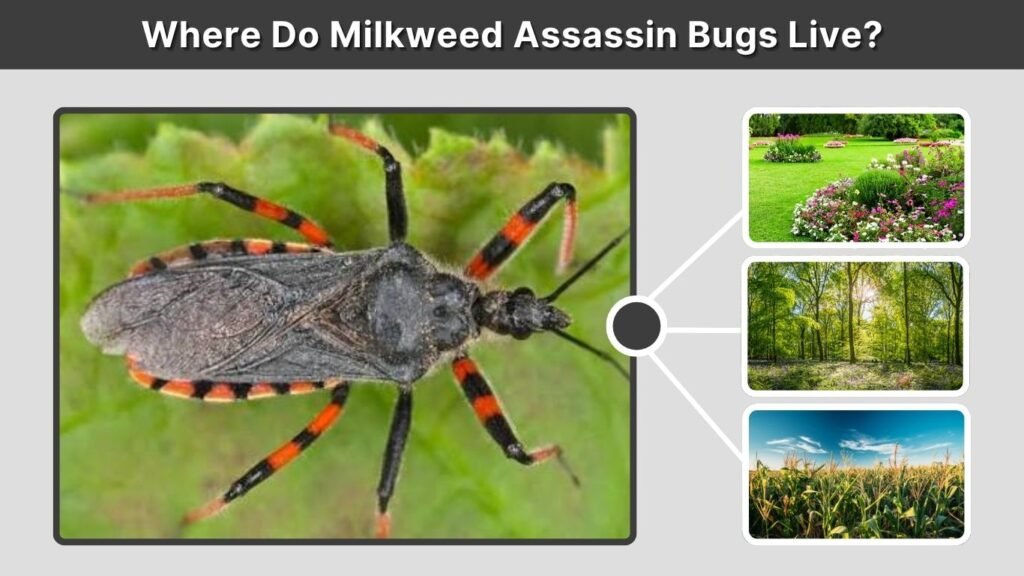
The milkweed assassin bug, Zelus longipes, lives across southern North America, Central America, much of South America, and the West Indies. Within the United States, its range includes Gulf Coast and South Atlantic states, southern California, and southwestern Arizona.
Despite its name, it does not depend entirely on milkweed plants. It commonly lives in gardens and fields where soft-bodied prey is plentiful. Adults and nymphs may rest or hunt on:
- Sweet corn and other crops
- Garden flowers
- Shrubs and weeds
- Milkweed and nearby vegetation
- Leaves and stems containing flies or caterpillars
Milkweed assassin bugs are active daytime predators. Their egg clusters may be attached to the undersides of leaves, and both adults and nymphs use vegetation for hunting.
Why Is an Assassin Bug in My House?
An assassin bug found inside is often an accidental visitor. Adults may enter through open doors, damaged screens, window gaps, or spaces around pipes. Some are attracted to exterior lights and follow prey insects toward buildings.
Masked hunters are the species most strongly associated with indoor reports. They may hunt small arthropods but do not normally damage furniture, clothing, or stored food. However, they can bite when handled carelessly.
Use a container and stiff paper to move an indoor assassin bug outside. Avoid picking it up with bare fingers.
FAQs
Do assassin bugs live underground?
Most commonly encountered species live on vegetation rather than underground. However, some may shelter close to the soil, beneath objects, or in ground-level debris. Their preferred location depends on the species and the type of prey they hunt.
Do assassin bugs build nests?
No. Assassin bugs do not build social nests like ants or wasps. Females generally attach eggs to leaves, stems, bark, tree trunks, or other surfaces. Wheel bug eggs are placed together in compact clusters on outdoor objects.
Do assassin bugs live in groups?
Most are solitary hunters. Newly hatched nymphs may remain near their egg mass briefly, but they eventually spread out to search for prey. Several individuals may gather where food is abundant, without forming a true colony.
Can assassin bugs live inside a house?
Yes, but most do not deliberately establish large indoor populations. Masked hunters are sometimes found inside, while other species may accidentally enter through doors or windows. Kissing bugs may enter homes located near wildlife nests.
What attracts assassin bugs to a yard?
They are primarily attracted by available prey, vegetation, and shelter. Gardens with caterpillars, beetles, flies, aphids, and other insects can provide suitable hunting grounds. Outdoor lights may also attract flying prey and the assassin bugs that hunt them.
