
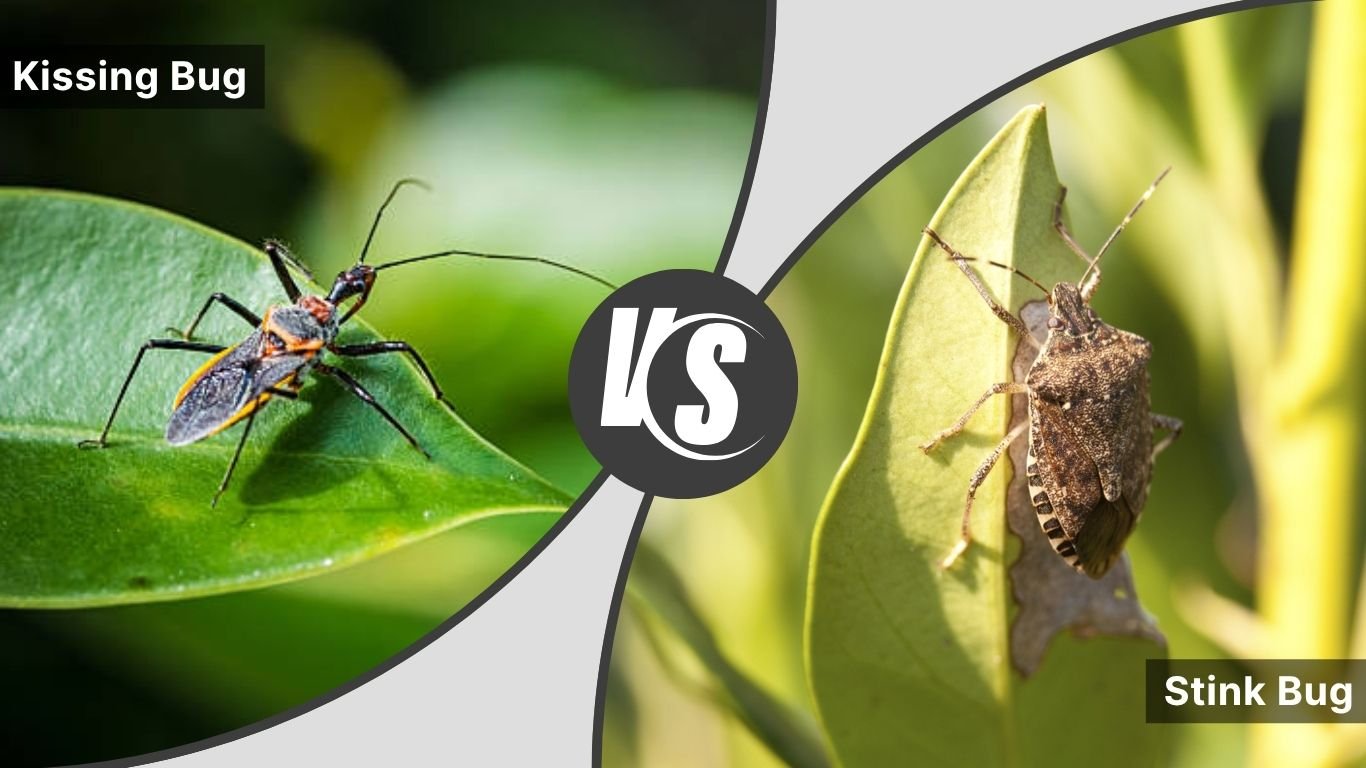
Kissing bugs and stink bugs may appear similar because both have six legs, long antennae, folded wings, and colored markings around the abdomen. However, they differ significantly in body shape, diet, behavior, and potential danger. A kissing bug is usually elongated, with a narrow cone-shaped head, and feeds on blood. A stink bug has a broad, shield-shaped body and generally feeds on plants. This guide compares kissing bugs and stink bugs using their size, colors, markings, habitat, behavior, and health risks.
Kissing Bug vs. Stink Bug: Quick Comparison
The fastest way to distinguish these insects is to look at their overall shape. Kissing bugs are long and narrow, while stink bugs are short, wide, and shield-shaped. The head, abdominal markings, and antennae provide additional identification clues.
| Feature | Kissing bug | Stink bug |
| Body shape | Long, narrow and flattened | Broad and shield-shaped |
| Typical size | About 0.5–1 inch | About 0.5–0.7 inch |
| Head | Long and cone-shaped | Short, broad and triangular |
| Color | Black or dark brown | Brown, green, gray or mottled |
| Markings | Red, orange or yellow abdominal edge | Alternating abdominal bands in some species |
| Antennae | Usually uniformly thin | May have pale bands |
| Diet | Blood from animals and people | Primarily plant juices |
| Odor | Not identified by a strong odor | Releases an unpleasant smell |
| Human risk | Can bite; some carry T. cruzi | Household species generally do not bite |
| Activity | Mostly nocturnal | Frequently active during daylight |
Adult kissing bugs are generally about one-half to one inch long and are active mainly at dusk or during the night. Brown marmorated stink bugs are approximately one-half inch long and are recognized by their mottled coloring and shield-shaped bodies.
What Does a Kissing Bug Look Like?
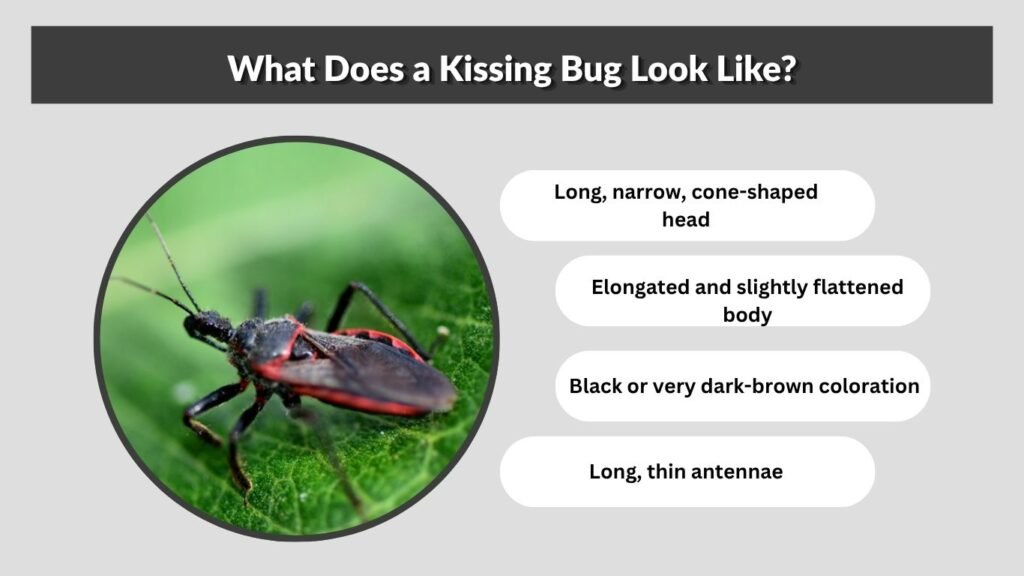
Kissing bugs are members of the triatomine group of assassin bugs. Although individual species vary, they share a distinctive elongated profile and blood-feeding mouthpart.
Kissing Bug Identification
Look for the following combination of features:
- Long, narrow, cone-shaped head
- Elongated and slightly flattened body
- Black or very dark-brown coloration
- Red, orange or yellow markings along the abdominal edge
- Long, thin antennae
- Slender legs without wide expansions
- Wings folded flat across an adult’s back
- Pointed feeding tube underneath the head
The narrow head is one of the strongest identification clues. It projects forward from the body and is noticeably thinner than the section behind it. Kissing bugs found in the United States are typically dark, with contrasting stripes or bars along the body’s outer edge.
Kissing Bug Size and Color
Most adult kissing bugs measure approximately 0.5–1 inch long. Depending on the species, the body may be almost entirely black or dark brown, with red, orange, yellow, tan or cream-colored abdominal markings.
Young kissing bugs, called nymphs, are smaller and do not have fully developed wings. They retain the narrow head and segmented abdomen seen in adults. Kissing bugs pass through five nymphal stages before becoming winged adults.
What Does a Stink Bug Look Like?
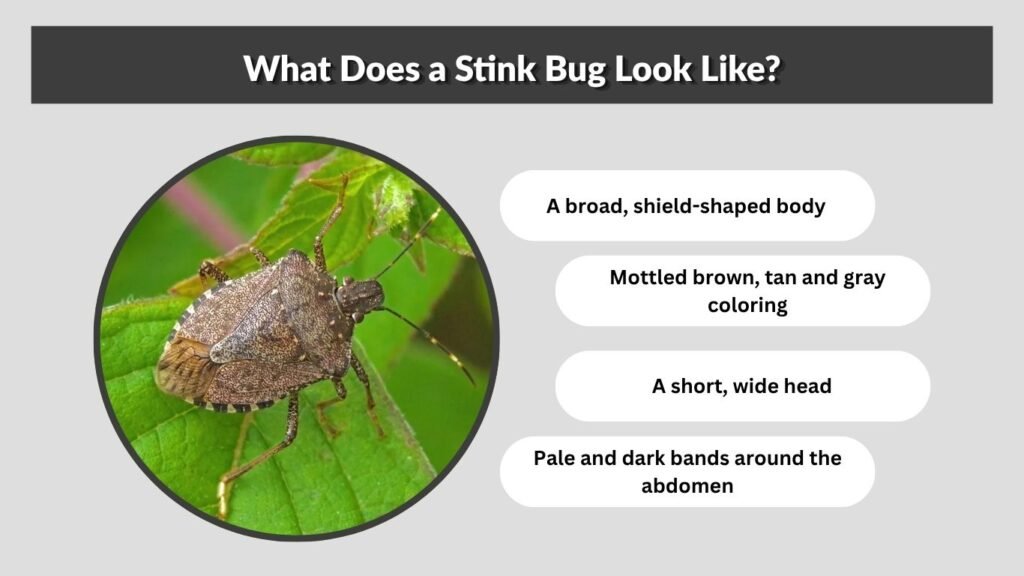
The term “stink bug” describes numerous insects in the family Pentatomidae. The brown marmorated stink bug is a particularly common household visitor and one of the species most likely to be confused with a kissing bug.
Stink Bug Identification
A typical brown marmorated stink bug has:
- A broad, shield-shaped body
- Mottled brown, tan and gray coloring
- A short, wide head
- Pale and dark bands around the abdomen
- White bands on the antennae
- A triangular plate in the middle of its back
- Rounded shoulders
- Scent glands that produce an unpleasant odor
The body is usually nearly as wide as it is long, especially across the shoulders. This compact, shield-like outline separates it from the much more elongated kissing bug.
Stink Bug Size and Color
Brown marmorated stink bugs are commonly around one-half inch long. Their upper surface has a speckled or marbled mixture of brown, gray, cream and black.
Alternating pale and dark marks may appear around the abdomen, creating a pattern that can resemble a kissing bug’s colored border. However, the stink bug’s white-banded antennae and broad body provide more reliable identification clues.
Diet, Habitat and Behavior
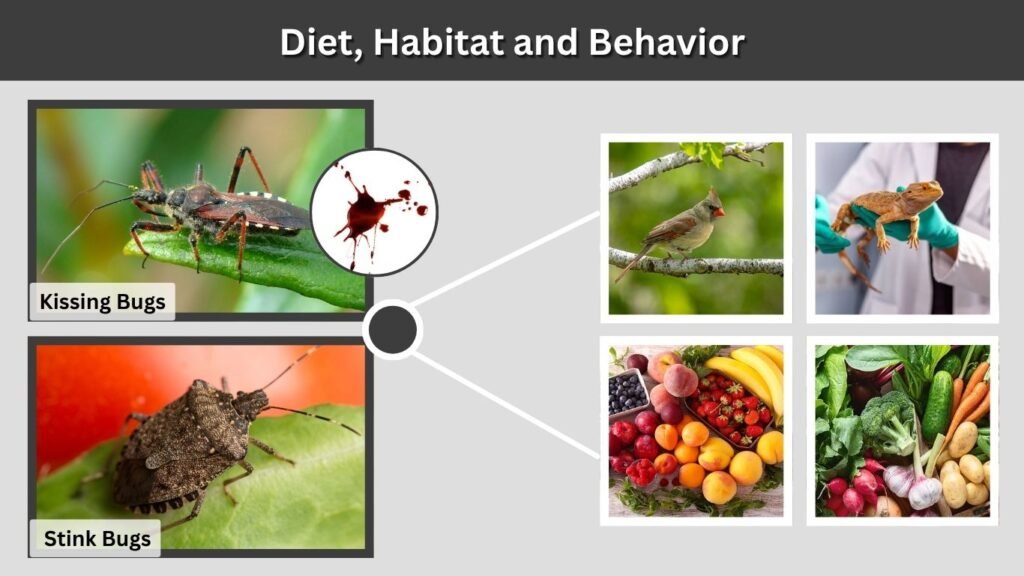
Appearance provides the most immediate identification clues, but the location and behavior of the insect can also help determine which species is present.
What Do Kissing Bugs Eat?
Kissing bugs feed on the blood of mammals, birds, reptiles and sometimes humans. They usually emerge at night and locate hosts using environmental cues such as warmth and exhaled carbon dioxide.
Outdoors, they are associated with rodent nests, animal burrows, chicken coops, kennels, woodpiles and other protected locations near potential hosts. Adults may fly toward lights and enter buildings through gaps or damaged screens.
What Do Stink Bugs Eat?
Most household stink bugs feed on plant fluids rather than blood. Brown marmorated stink bugs use piercing mouthparts to feed on fruits, vegetables, seeds and field crops.
They commonly occur in gardens, orchards and agricultural areas. During cooler weather, adults may gather on buildings and enter through cracks to overwinter. They do not normally feed or reproduce extensively inside houses.
Why Do Stink Bugs Smell?
Stink bugs produce a strong defensive odor when threatened, handled or crushed. The odor comes from scent glands on the insect’s body.
Kissing bugs are not normally identified by a powerful defensive smell. However, odor alone should not be used for identification because crushing an unknown insect may expose a person to irritating material.
Are Kissing Bugs or Stink Bugs Dangerous?
The health risks are substantially different. Common household stink bugs are mainly nuisance and agricultural pests, while kissing bugs deserve more cautious handling.
| Risk | Kissing bug | Brown marmorated stink bug |
| Feeds on humans | Sometimes | No |
| Bite | Usually initially painless | Does not normally bite |
| Defensive odor | Not a defining feature | Strong odor when disturbed |
| Disease concern | Some carry T. cruzi | Not associated with Chagas disease |
| Main problem | Blood feeding and potential exposure | Plant damage and indoor nuisance |
Do Kissing Bugs Bite?
Yes. Kissing bugs feed by inserting their mouthparts into exposed skin. Their bites are generally not painful while feeding, although itching, redness or swelling can develop afterward.
Some kissing bugs carry Trypanosoma cruzi, the parasite responsible for Chagas disease. Transmission does not usually occur directly through the bite. An infected bug may leave feces after feeding, and infection can occur if contaminated material enters the bite, another cut, the eyes or the mouth.
Do Stink Bugs Bite?
Brown marmorated stink bugs do not bite people or animals. They may become indoor nuisances when large numbers seek winter shelter, but they do not feed on blood, damage buildings or transmit Chagas disease.
What to Do When You Find One
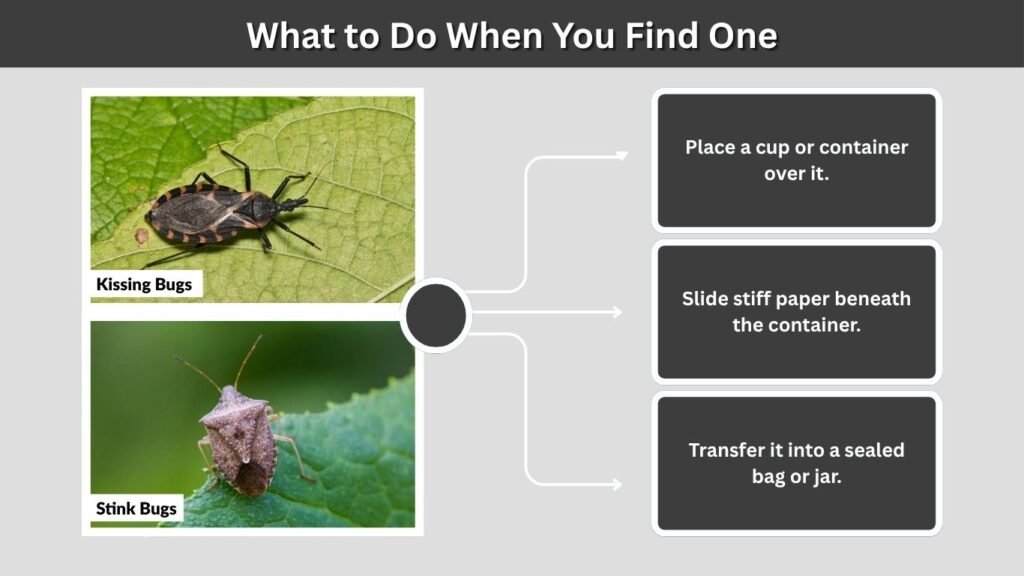
Avoid crushing an unknown insect with bare hands. A safely collected specimen or clear photograph is more useful for identification than a damaged insect.
For a suspected kissing bug:
- Place a cup or container over it.
- Slide stiff paper beneath the container.
- Transfer it into a sealed bag or jar.
- Photograph the head, back, legs and abdominal edge.
- Contact a local health department, extension office or entomologist.
For stink bugs, vacuuming or gently moving them outdoors helps prevent the defensive odor released when they are crushed. Seal cracks, repair screens and weather-strip doors to reduce future entry.
FAQs
What is the easiest way to tell a kissing bug from a stink bug?
Compare the body shape and head. A kissing bug is long and narrow, with a cone-shaped head extending forward. A stink bug is short, broad and shield-shaped, with a relatively small head. White antenna bands also suggest a brown marmorated stink bug.
Can a stink bug have markings like a kissing bug?
Yes. Some stink bugs have alternating pale and dark bands around their abdominal edges. However, they retain a broad shield-shaped body. A kissing bug is more elongated and commonly has red, orange or yellow side markings combined with a noticeably narrow head.
Is a brown marmorated stink bug a kissing bug?
No. A brown marmorated stink bug is a plant-feeding member of the stink bug family. It has a mottled brown, shield-shaped body and white-banded antennae. A kissing bug belongs to the assassin bug family and feeds on the blood of vertebrate hosts.
Which is more dangerous, a kissing bug or a stink bug?
A kissing bug presents the greatest health concern because it can bite, trigger an allergic response and potentially expose people to the parasite associated with Chagas disease. Brown marmorated stink bugs generally do not bite people and are mainly agricultural pests and household nuisances.
Should I crush a bug that might be a kissing bug?
No. Avoid touching or crushing it with bare hands. Capture the insect inside a sealed container without direct contact and take clear photographs. A local extension office or public-health department may help identify it and advise whether specimen testing or additional action is appropriate.
