
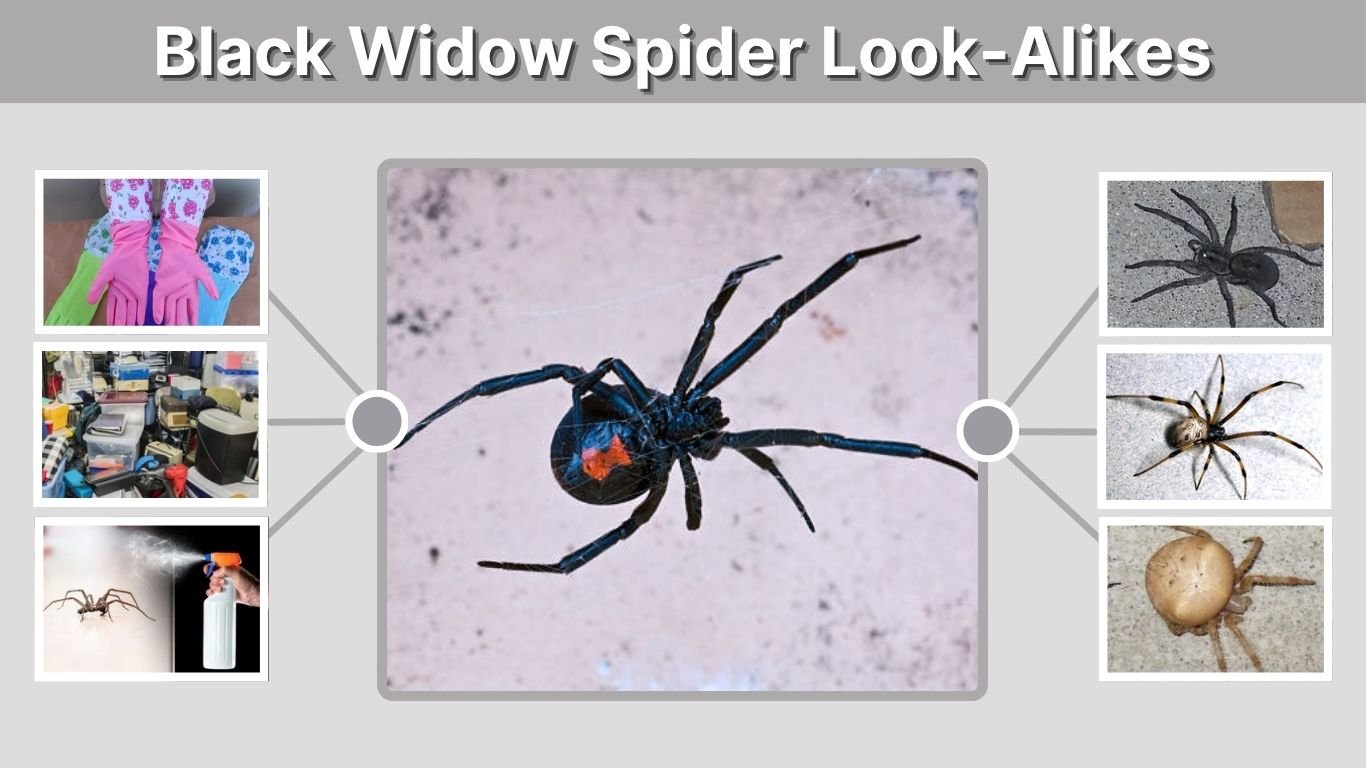
A black widow spider look-alike can cause instant panic, especially if the spider is dark, shiny, round-bodied, or hiding in a messy web. However, not every black spider with a bulb-shaped abdomen is a true black widow. False widows, brown widows, juvenile widows, cupboard spiders, and several harmless house spiders can look similar at first glance. Learning the key differences can help you decide when to be cautious, when to remove the spider, and when to call a professional.
What Does a Real Black Widow Spider Look Like?
Before comparing look-alikes, it helps to know the main features of a real black widow. Adult female black widows are usually shiny black with a rounded abdomen and a red or orange hourglass marking on the underside of the body. Some widow markings can vary, and the hourglass may appear broken, faint, or shaped like spots rather than a perfect hourglass.
Black widows usually build irregular, messy cobwebs in dark, quiet places. You may find them in garages, sheds, crawl spaces, woodpiles, meter boxes, outdoor furniture, basements, and cluttered storage areas. They are reclusive and often stay hidden unless disturbed.
Quick Identification Clues
A spider is more likely to be a black widow if it has:
- A glossy black, rounded abdomen
- A red, orange, or reddish hourglass marking underneath
- Long, thin legs
- A messy, irregular web
- A hiding spot in a dark, undisturbed area
- A body shape that looks bulbous rather than flat
Do not handle a spider to check the underside. If you need identification, take a photo from a safe distance and avoid disturbing the web.
Why So Many Spiders Look Like Black Widows
Many spiders have dark coloring, shiny bodies, and round abdomens. Some belong to the same cobweb spider family as widows, while others simply share similar body shapes. This is why homeowners often confuse harmless spiders with black widows.
The most common black widow spider look-alikes include false widows, brown widows, young black widows, male black widows, cupboard spiders, dark house spiders, and certain orb weavers. Some look-alikes are nearly harmless, while others, such as brown widows, are related to black widows and should still be treated with caution.
Black Widow Spider vs Look-Alike: Main Differences
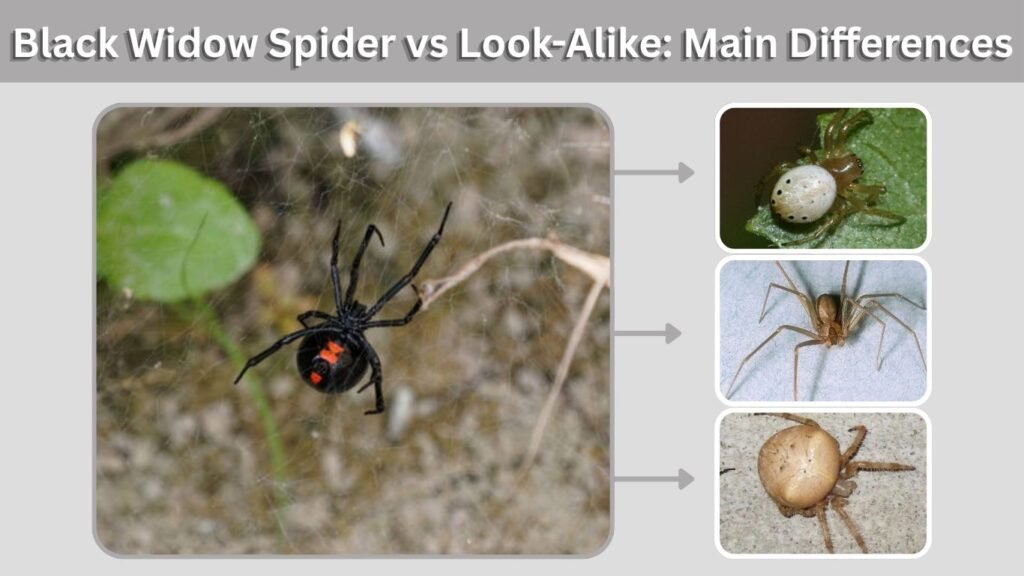
The easiest way to compare black widows with look-alikes is to check body color, markings, web type, and behavior. True adult female black widows are usually glossy black and have a red or orange marking underneath. False widows often lack the red hourglass and may have cream, tan, brown, or pale markings instead. Utah State University Extension notes that false black widows closely resemble black widows but lack the famous red hourglass marking.
| Feature | True Black Widow | Common Look-Alikes |
| Color | Glossy black or dark brown | Brown, dark brown, gray, black, or patterned |
| Abdomen | Round and bulbous | Round, oval, flatter, or patterned |
| Marking | Red/orange hourglass underneath | Pale bands, spots, mottling, or no hourglass |
| Web | Messy, irregular cobweb | Messy cobweb, sheet web, orb web, or no web |
| Risk level | Medically important bite | Usually lower, depending on species |
| Common locations | Garages, sheds, crawl spaces, woodpiles | Homes, gardens, sheds, basements, windows |
A Simple Rule
If the spider is shiny black, round-bodied, sitting in a messy web, and has a red or orange marking underneath, treat it as a black widow. If it is brown, patterned, pale-banded, or missing the hourglass, it may be a look-alike—but you should still avoid touching it.
False Widow Spider Look-Alike
False widow spiders are among the most common black widow look-alikes. They belong to the genus Steatoda and often have a rounded abdomen and dark body. Some are brown, dark purple-brown, or nearly black, which makes them easy to confuse with a true widow.
False widows usually do not have a clear red hourglass on the underside. Some may have pale markings, cream-colored patches, or a lighter band near the front of the abdomen. Colorado State University Extension notes that Steatoda spiders are often mistaken for widow spiders but lack the orange-red hourglass pattern underneath.
False Widow vs Black Widow
False widows are usually less dangerous than true black widows, but they can still bite if trapped or handled. Their bite may cause pain, redness, and swelling, though severe reactions are uncommon.
Look for these differences:
- False widows are often brown or purplish-brown, not jet black
- They may have pale or cream markings instead of red markings
- Their abdomen can look more oval or mottled
- They usually lack the red hourglass underneath
- They may be found indoors around windows, basements, and storage areas
If you are unsure, do not handle the spider. Use a photo for identification.
Cupboard Spider
The cupboard spider, also called Steatoda grossa, is one of the best-known false widow spiders. It can look very similar to a black widow because it has a dark, rounded abdomen and long legs. However, it usually lacks the red hourglass marking.
Cupboard spiders may be dark brown, purplish, or almost black. They often have faint pale markings on the abdomen. Because they live in homes, sheds, garages, and dark corners, many people mistake them for black widows.
How to Tell a Cupboard Spider Apart
A cupboard spider is more likely if:
- The spider is dark brown rather than shiny black
- The abdomen has pale or mottled markings
- There is no red hourglass underneath
- It is found indoors in a cupboard, basement, window frame, or corner
- It appears smaller or less glossy than a true black widow
Even though cupboard spiders are not true black widows, avoid squeezing or handling them.
Brown Widow Spider
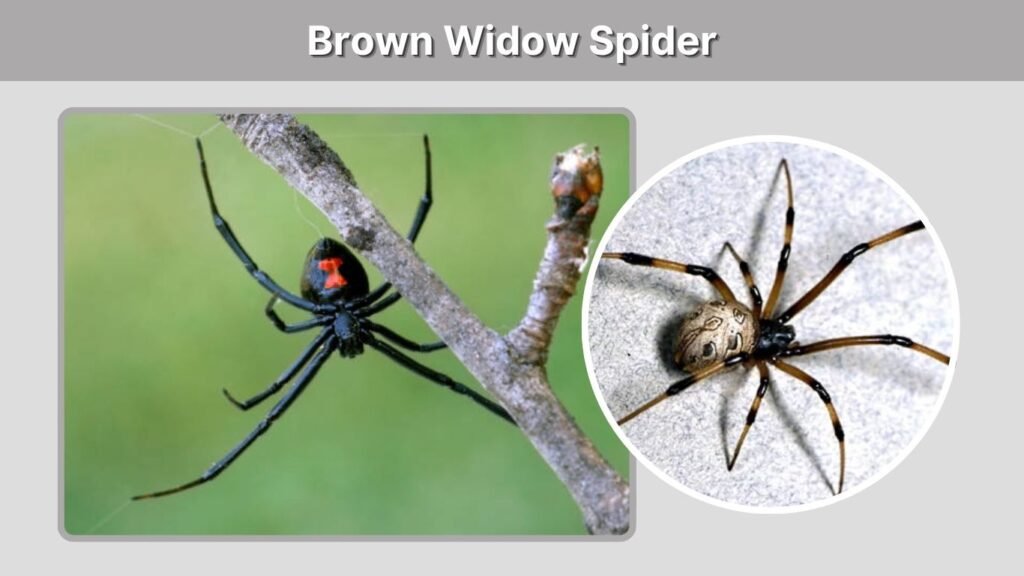
Brown widows are close relatives of black widows. They are not just random look-alikes; they are also widow spiders in the genus Latrodectus. UC IPM explains that California has both western black widows and brown widows, and both share a similar body shape, reclusive habits, and irregular cobwebs.
Brown widows are usually tan, grayish, or brown with mottled patterns. They may have an orange or yellowish hourglass underneath. Their egg sacs are often a helpful clue because brown widow egg sacs may look spiky or tufted, while black widow egg sacs are usually smoother.
Brown Widow vs Black Widow
Brown widows are usually lighter in color and more patterned. Black widows are usually darker and shinier. Brown widows may build webs around outdoor furniture, fences, mailboxes, playground equipment, and storage areas.
Use caution with brown widows because they are still medically relevant spiders, even if many bites are less severe than black widow bites.
Juvenile Black Widow Spider
A young black widow can look very different from an adult female. This is one reason people mistake juvenile widows for other spiders. Young black widows may have tan, cream, gray, orange, or white markings on the top of the abdomen. UC IPM notes that young female black widows are patterned on top and gradually develop adult female coloration with each molt.
Juvenile widows may also have banded legs and a less obvious hourglass. Because of this, a young black widow may look more like a brown widow, false widow, or patterned house spider.
How to Identify a Young Black Widow
A juvenile black widow may have:
- A rounded abdomen
- Tan, orange, cream, gray, or white markings
- Banded legs
- A yellowish-orange or developing hourglass underneath
- A messy web in a protected area
If the spider is in a widow-like web and has orange or red markings, treat it cautiously.
Male Black Widow Spider
Male black widows are much smaller than females and are often not recognized as black widows. Utah State University Extension describes male black widows as about one-third the size of females, pale brown, and marked with white.
Because males are smaller, lighter, and patterned, they are often mistaken for harmless house spiders or false widows. They are not the classic shiny black spider most people imagine.
Male Black Widow vs Female Black Widow
Female black widows are larger, darker, and more medically important. Males are smaller, lighter, and less likely to be noticed. However, if you see males, females may also be nearby, especially during mating season.
Dark House Spider
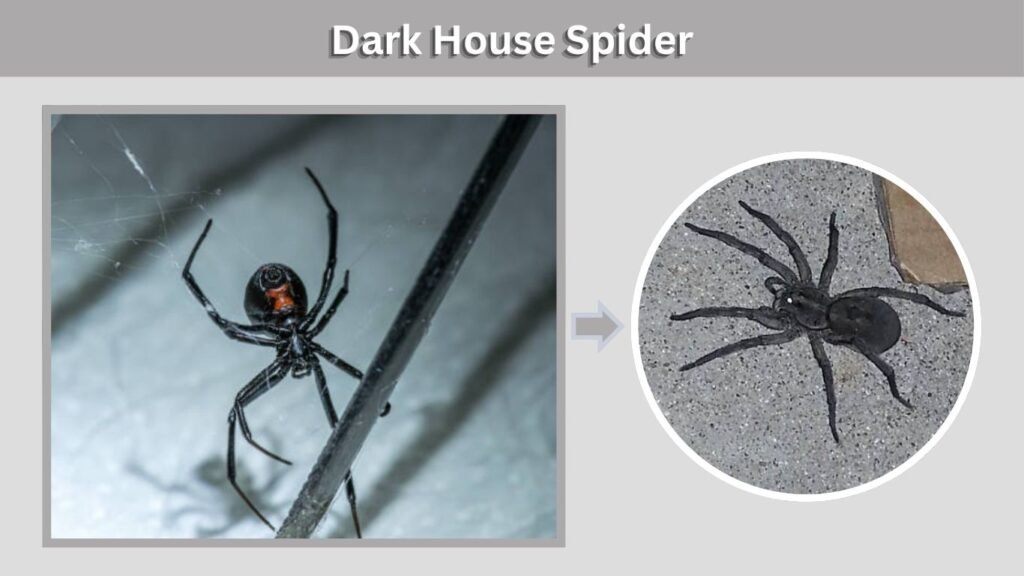
Dark house spiders may also be mistaken for black widows, especially when seen quickly in a corner or web. They are usually dark brown, grayish, or blackish with a less glossy appearance. Their abdomen may be oval rather than perfectly round.
Dark house spiders often build webs around windows, siding, basements, and outdoor corners. They do not have the classic red hourglass marking. If the spider has a more flattened or elongated body and no red underside marking, it is less likely to be a black widow.
Orb Weaver Look-Alikes
Some orb weavers have round bodies and dark markings, which can make them look threatening. However, orb weavers usually build organized, circular webs rather than messy cobwebs. They are often found in gardens, porches, trees, and around lights where flying insects gather.
A round-bodied spider in a neat wheel-shaped web is usually not a black widow. Black widow webs are messy, tangled, and irregular.
Black Widow Spider Look-Alike Pictures: What to Notice
When comparing black widow spider look-alike pictures, focus on the details that matter most. Many online images can be misleading because lighting, angle, and spider age affect appearance.
Photo Checklist
When looking at pictures, compare:
- Abdomen shape
- Body shine
- Top markings
- Underside markings
- Leg banding
- Web structure
- Location where the spider was found
- Size compared with nearby objects
A photo of the underside is helpful for identification, but do not put yourself at risk trying to get one. A side or top photo from a safe distance may still help a professional identify the spider.
Black Widow Spider Look-Alike in Texas
Texas has several spiders that may be mistaken for black widows, including true widows, false widows, brown widows, and other dark house spiders. Warm climates and outdoor storage areas can create good hiding spots for widow spiders.
In Texas, be careful around garages, sheds, firewood, patio furniture, meter boxes, and crawl spaces. If the spider is shiny black with a red underside marking, treat it as a black widow and avoid contact.
Black Widow Spider Look-Alike in Florida
Florida has warm, humid conditions where several widow and widow-like spiders may occur. Brown widows are especially common in many warm urban areas and may be confused with black widows because they share a similar body shape and messy web style.
A Florida spider that is tan, brown, or patterned may be a brown widow rather than a black widow. A glossy black spider with a red hourglass is more concerning and should be treated carefully.
Black Widow Spider Look-Alike in California
California has both western black widows and brown widows. UC IPM notes that the western black widow is widespread and is the species posing the greatest potential envenomation threat in the western United States. Brown widows became established in southern California in the first decade of the 21st century.
In California, look closely at color and markings. Western black widows are usually dark and glossy. Brown widows are lighter, mottled, and often found in urban outdoor areas.
Black Widow Spider Look-Alikes in New York
In New York and nearby regions, many black widow fears involve false widows, dark house spiders, cobweb spiders, or other dark indoor spiders. True widow spiders may occur in some areas, but many suspected black widows turn out to be look-alikes.
Since location alone is not enough for identification, use body shape, markings, and web type. If you are unsure, avoid handling the spider and consider local extension or pest identification services.
What to Do If You Find a Possible Black Widow
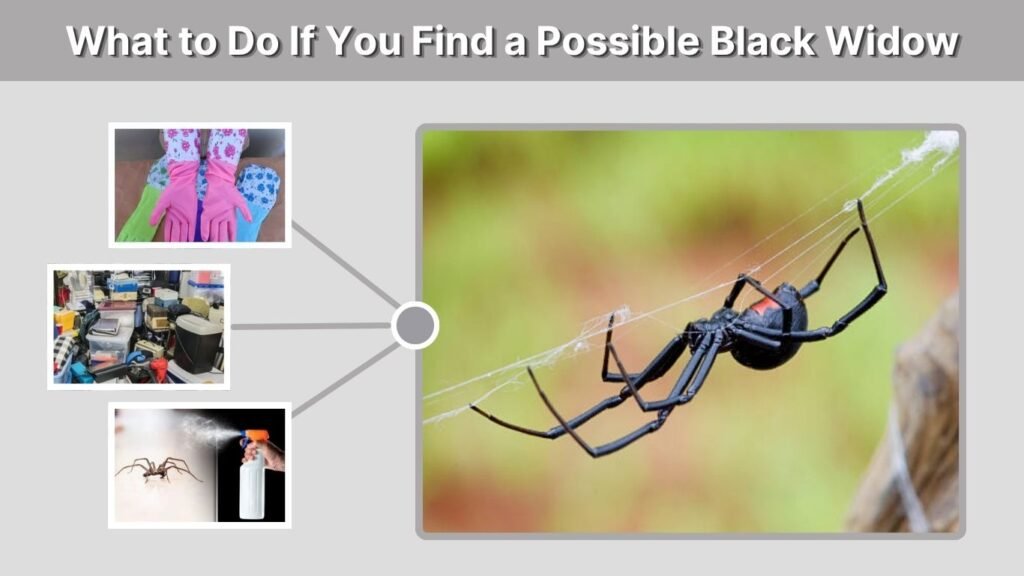
If you find a spider that looks like a black widow, do not touch it with bare hands. Keep children and pets away from the area. If the spider is in a high-traffic area, garage, shed, or play space, removal may be needed.
Safe Steps
You can:
- Take a photo from a safe distance
- Wear gloves, long sleeves, and closed shoes if cleaning nearby
- Vacuum webs and spiders carefully if safe
- Seal and discard vacuum contents outside
- Remove clutter, boxes, and debris
- Wear gloves when moving firewood or stored items
- Call a professional if you see multiple spiders or egg sacs
If someone is bitten by a suspected black widow, seek medical advice promptly. UC IPM recommends remaining calm and promptly seeking medical advice after a black widow bite.
How to Prevent Black Widow and Look-Alike Spiders
Prevention focuses on reducing hiding places and insect prey. Spiders are attracted to areas where they can build webs and catch insects. Regular cleaning and clutter reduction can lower the chance of finding them indoors.
Prevention Checklist
Use these steps:
- Clear clutter in garages, sheds, and basements
- Store boxes off the floor
- Wear gloves when moving firewood or outdoor furniture
- Seal gaps around doors, windows, and foundations
- Install door sweeps
- Vacuum webs regularly
- Reduce insects around outdoor lights
- Keep firewood away from the house
- Trim vegetation away from exterior walls
- Inspect patio furniture, playground equipment, and storage bins
Many spiders are beneficial because they feed on insects, but widows in high-contact areas should be taken seriously.
FAQs
What spider is most often mistaken for a black widow?
False widow spiders are among the most common black widow look-alikes. They have dark, rounded bodies and may live in similar areas, but they usually lack the red or orange hourglass marking on the underside of the abdomen.
How can I tell if a spider is a black widow?
Look for a glossy black rounded body, long legs, a messy irregular web, and a red or orange hourglass marking underneath the abdomen. Do not handle the spider to check. Take a photo from a safe distance if identification is needed.
Are black widow look-alikes dangerous?
Most black widow look-alikes are less dangerous than true black widows. However, some, such as brown widows, are related to black widows and should still be treated with caution. Any spider bite that causes severe symptoms should be checked by a medical professional.
Do false widow spiders have red markings?
False widow spiders usually do not have the classic red hourglass marking of a black widow. Some may have pale, cream, tan, or mottled markings. Because markings can vary, avoid handling any spider you cannot identify confidently.
What should I do if I find a black widow look-alike in my house?
Keep children and pets away, avoid touching it, and take a photo if safe. Vacuum or remove the spider carefully while wearing protection, or call pest control if you see multiple spiders, egg sacs, or activity in hard-to-reach areas.
