
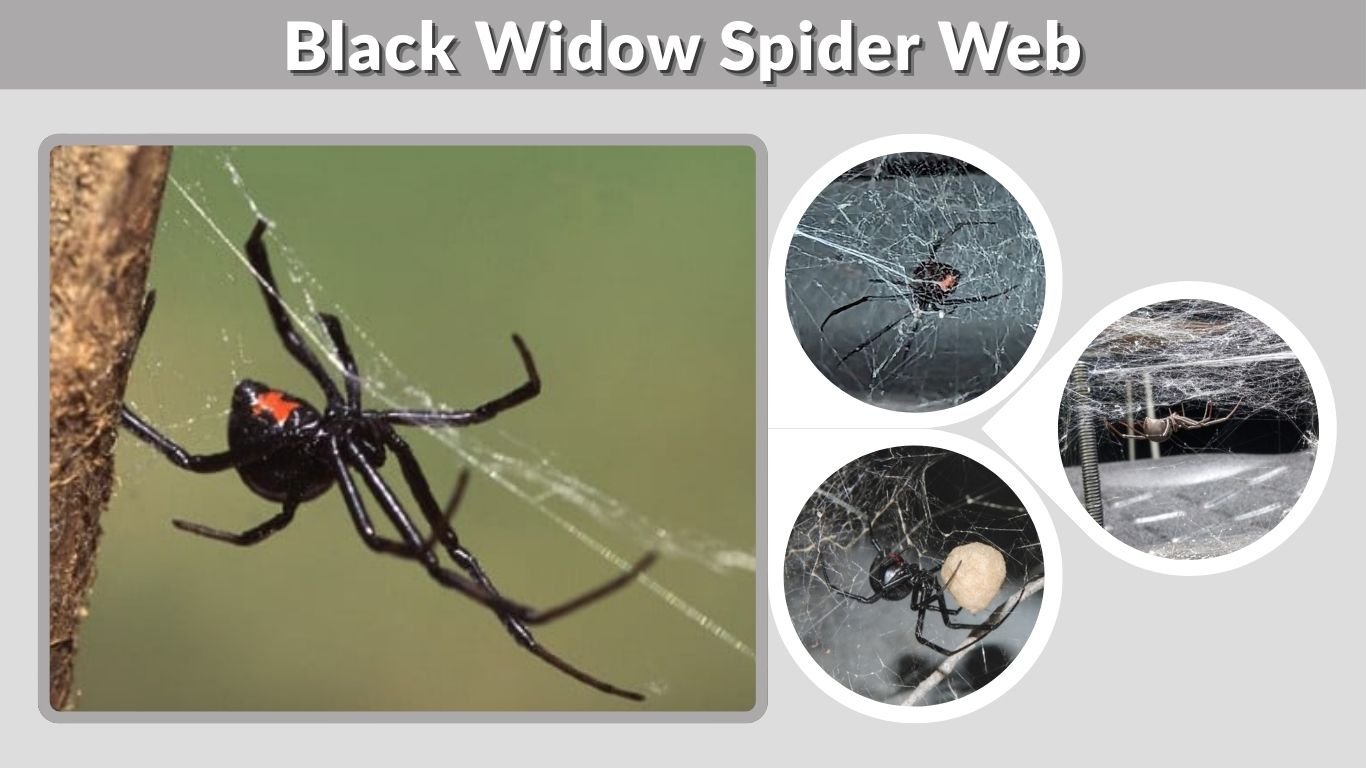
A black widow spider web does not look like the classic round spider web often seen in drawings. Instead, it is messy, tangled, sticky, and usually built in dark, quiet places. Learning what a black widow spider web looks like can help you identify possible black widow activity around sheds, garages, crawl spaces, woodpiles, and outdoor furniture before getting too close.
What Does a Black Widow Spider Web Look Like?
A black widow spider web usually looks irregular, messy, and three-dimensional. It does not have the neat spiral shape of an orb-weaver web. Instead, the web often appears like a tangled cobweb with random strands going in different directions.
These webs are usually close to the ground and hidden in protected spaces. You may find them in corners, under objects, behind stored items, or around outdoor structures. The web may look dusty or abandoned, but it can still be active.
Common Black Widow Spider Web Features
A black widow web often has several noticeable traits:
- messy, tangled appearance
- sticky silk strands
- irregular web pattern
- low placement near the ground
- hidden or protected location
- stronger silk than it looks
- funnel-like retreat area in some cases
- trapped insect remains nearby
The web may not be large, but it can feel tough or elastic if disturbed with a stick or tool. Never touch a suspected black widow web with bare hands.
Black Widow Spider Web Pattern
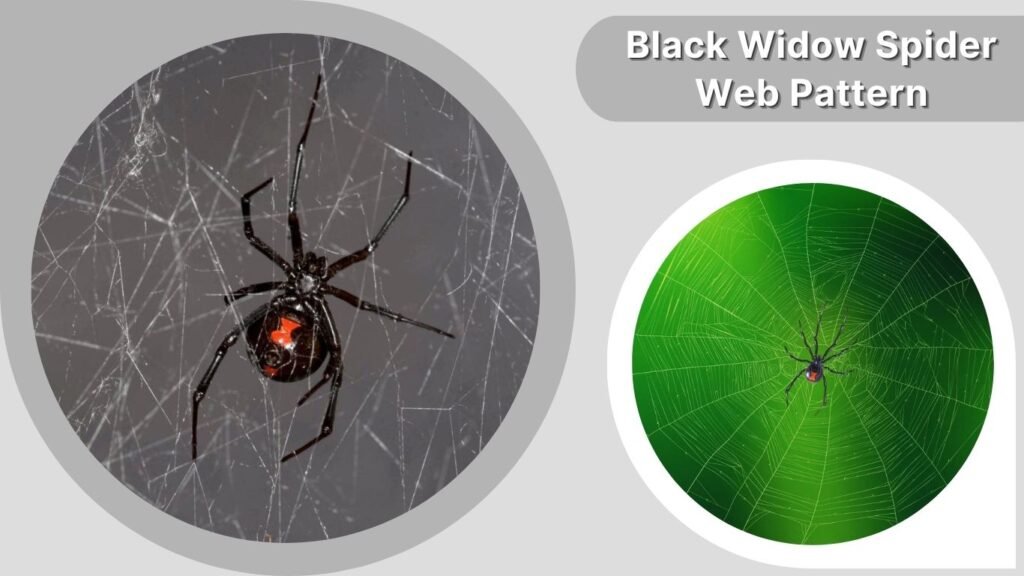
The black widow spider web pattern is usually described as irregular or cobweb-like. It does not follow a clean design. The strands may cross at different angles, creating a confusing, tangled structure.
This irregular web design is useful for trapping crawling insects. Black widows often wait upside down in or near the web. When an insect touches the sticky strands, the spider can quickly move in and wrap the prey.
Is a Black Widow Web Circular?
No, a black widow web is not usually circular. Many people expect spider webs to look like a wheel or spiral, but that type of web is made by orb-weaver spiders. Black widows make tangled cobwebs.
A circular web in a garden or between plants is usually not a black widow web. A messy web in a dark corner, under a shelf, or near the ground is more suspicious.
Are Black Widow Spider Webs Messy?
Yes, black widow spider webs are messy. In fact, their messy appearance is one of the best identification clues. The web may look unplanned, chaotic, and uneven.
However, not every messy web belongs to a black widow. Many house spiders and cobweb spiders also make tangled webs. Identification should include the spider’s appearance, web location, and other signs.
Black Widow Spider Web Identification
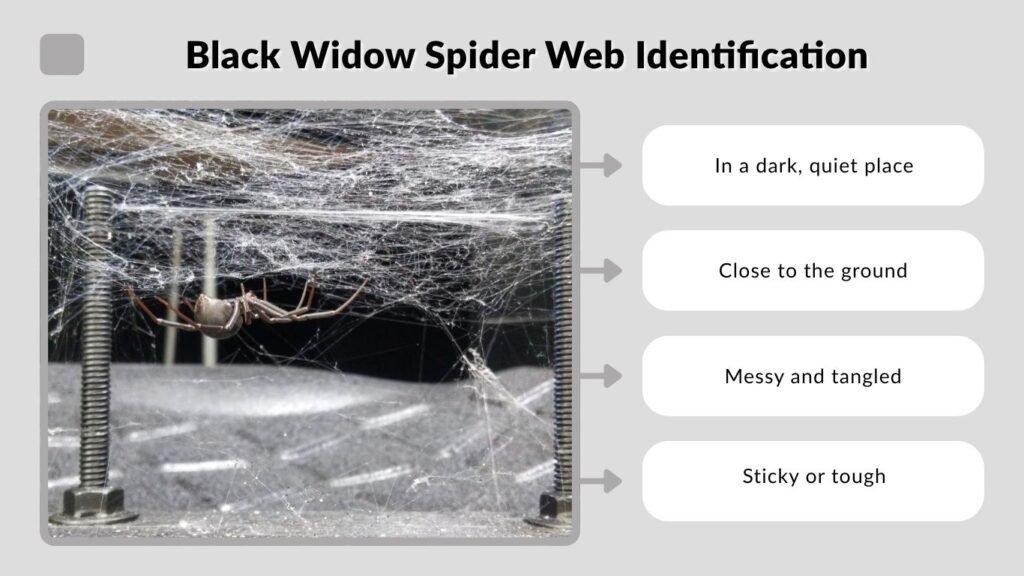
Black widow spider web identification works best when you look at the web and the environment together. The web alone is not enough for a perfect ID, but it can give strong clues.
A suspected black widow web is more likely if it is:
- in a dark, quiet place
- close to the ground
- messy and tangled
- sticky or tough
- near insect remains
- near a round black spider
- around an egg sac
- in an undisturbed storage area
If you see a shiny black spider with a round abdomen and red markings near the web, treat the area with caution.
Where Black Widow Webs Are Commonly Found
Black widow spiders prefer hidden places where they are unlikely to be disturbed. Their webs may appear indoors or outdoors.
Common locations include:
- garages
- sheds
- crawl spaces
- basements
- woodpiles
- outdoor furniture
- under decks
- fence corners
- meter boxes
- storage bins
- under rocks or boards
- cluttered corners
A black widow spider web in the house is most likely in an undisturbed area, not in a busy hallway or open room.
Black Widow Spider Web in the House
Finding a black widow spider web in the house can be concerning, especially if the web is in a garage, basement, storage room, or crawl space. Black widows usually avoid open human activity, but they may settle where insects and shelter are available.
Indoor webs are often found behind boxes, under shelves, near stored shoes, inside clutter, or in corners that are rarely cleaned.
What to Do If You Find One Indoors
If you suspect a black widow web indoors, avoid reaching into the area. Do not sweep it away with your bare hand. Wear gloves, long sleeves, and use tools if you need to inspect or clean the area.
If you see the spider, egg sacs, or several webs, consider contacting a pest control professional. This is especially important in homes with children, pets, older adults, or anyone who may accidentally disturb the spider.
Black Widow Spider Web Strength
Black widow spider web strength is one reason these spiders are so interesting. Their silk can be surprisingly strong, elastic, and tough for its size. Researchers have studied black widow spider silk because of its impressive material properties and potential use in synthetic fiber research.
The web may look thin, but it is built to hold struggling insects. Some strands can feel stronger than typical house spider webs.
Is Black Widow Spider Web Used for Bulletproof Vests?
You may see searches about black widow spider web bulletproof vest materials. This comes from interest in spider silk as a strong natural fiber. Spider silk has inspired research into lightweight, tough materials.
However, black widow webs are not literally collected and made into everyday bulletproof vests. The practical challenge is producing spider-silk-like material at scale. Scientists study the proteins and structure of spider silk to understand how similar materials might be made.
Black Widow Spider Web vs Other Spider Webs
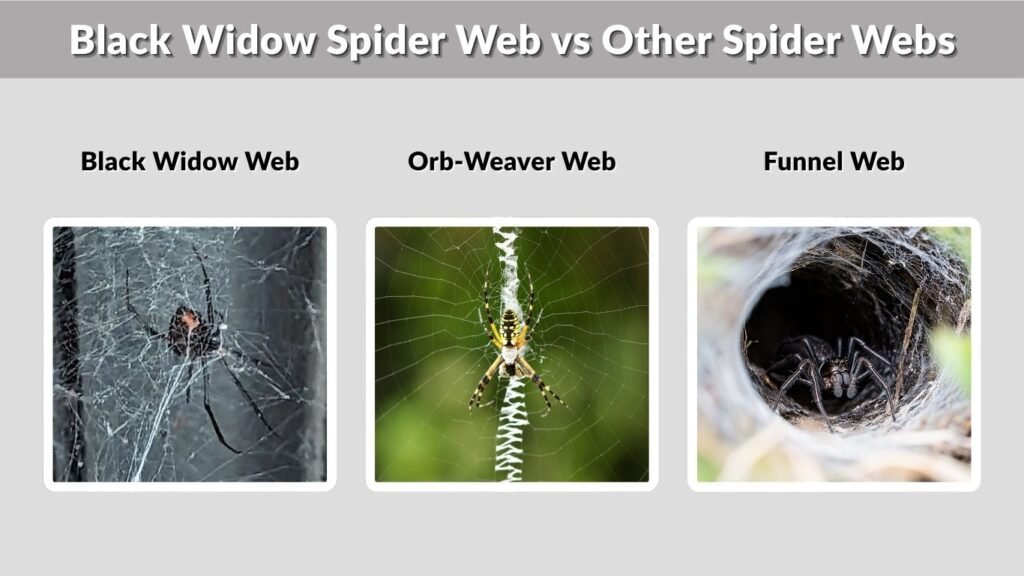
A black widow web differs from many other spider webs because it is not neat or symmetrical. It is a cobweb-style trap designed for hidden spaces.
| Web Type | Appearance | Common Spider | Main Location |
| Black widow web | Messy, tangled, irregular | Black widow | Dark, low, sheltered areas |
| Orb web | Round, spiral, organized | Orb-weaver | Gardens, plants, open spaces |
| Funnel web | Sheet-like with funnel retreat | Funnel-web or grass spider types | Ground, grass, holes, shelters |
| House spider web | Messy cobweb | Common house spiders | Corners, ceilings, windows |
Black Widow Web vs Orb-Weaver Web
Orb-weaver webs are the classic spider webs seen in drawings and Halloween decorations. They are round, flat, and patterned. Black widow webs are tangled and irregular.
If you see a neat round web between plants, it is probably not from a black widow. If you see a messy cobweb under a shelf, in a shed, or near the ground, it could be from a black widow or another cobweb spider.
Black Widow Web vs Funnel Web
A funnel web usually has a sheet of silk leading into a funnel-shaped retreat. The spider hides inside the funnel and rushes out when prey touches the web. Black widow webs are more tangled and less organized.
This comparison is important because many people search for “funnel web spider vs black widow” or “black widow vs funnel web spider.” These are different spiders with different web styles and different risks.
Funnel Web Spider vs Black Widow
The phrase “funnel web spider vs black widow” can mean two different comparisons. Some people mean ordinary funnel-building spiders, while others mean the Sydney funnel-web spider from Australia.
Sydney funnel-web spiders are not black widows. They belong to a different spider group and are known for medically significant venom. Black widows are also venomous, but they are different in body shape, behavior, web style, and location.
Sydney Funnel-Web Spider vs Black Widow
The Sydney funnel-web spider is strongly associated with Australia. It often shelters in burrows, moist places, or funnel-like retreats. A black widow usually makes a messy cobweb in sheltered corners and is more common in many temperate regions.
In simple terms:
- black widows make tangled cobwebs
- funnel-web spiders make funnel or burrow-like retreats
- Sydney funnel-web spiders are not the same as black widows
- both should be treated with caution
- identification depends on region and spider appearance
If you are in Australia and suspect a funnel-web spider, follow local safety advice and avoid handling it.
False Black Widow Spider Web
A false black widow spider web can look similar to a true black widow web because false widows also make messy cobwebs. False widows belong to the genus Steatoda, while true black widows belong to Latrodectus.
This is why web identification alone can be tricky. A messy web in a corner could belong to a black widow, a false widow, or another cobweb spider.
False Widow Web vs Black Widow Web
Both webs can look tangled and irregular. The better clues are the spider’s markings and body shape. A true black widow female is often glossy black with a red hourglass marking underneath the abdomen. A false widow is usually brown, purplish, or dark with pale markings and no clear red hourglass.
If you are unsure, avoid touching the spider or web.
Brown Widow Spider Web vs Black Widow Web
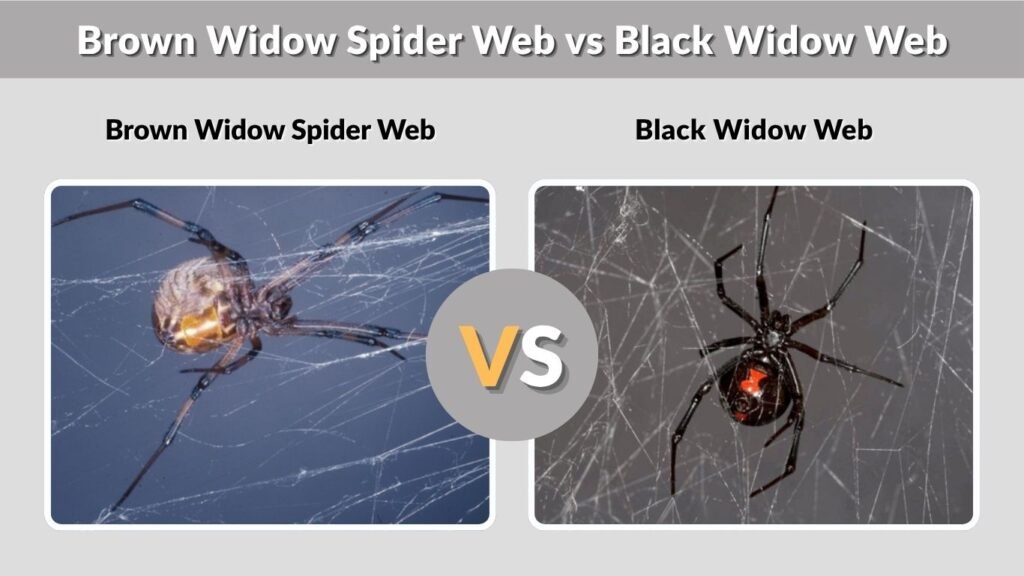
Brown widows are related to black widows and can make similar messy cobwebs. They may be brown or tan with banded legs and orange or yellowish markings. Their egg sacs are often distinctive because they may look spiky or textured.
A black widow egg sac is usually smoother and rounder, while a brown widow egg sac may have a more spiky appearance. Still, identification can be difficult without a close look.
Do Black Widows Make Spider Webs?
Yes, black widows make spider webs. They use silk to build webs, trap prey, protect egg sacs, and create shelter. Their web is not decorative or symmetrical. It is a practical hunting structure.
Black widows may spend a lot of time hanging upside down in the web. This position can make the red hourglass marking more visible on adult females.
Do Male Black Widows Make Webs?
Male black widows can produce silk, but they do not usually build the same large, prey-catching webs as adult females. Adult males often wander to find females. If you find a mature male, he may be near a female’s web rather than in a web of his own.
This is useful for identification because a male black widow near a messy web may suggest a female is nearby.
Black Widow Spider Web Facts
Black widow webs are more interesting than they first appear. They may look messy, but they are effective traps.
Important facts include:
- black widows do not make neat circular webs
- their webs are irregular and tangled
- webs are often close to the ground
- the silk can be very strong
- webs are commonly found in dark, quiet places
- female black widows often stay near their webs
- egg sacs may be attached nearby
- webs may collect dust and insect remains
A black widow web can look abandoned even when it is active, so caution is important.
Black Widow Spider Web Nest and Egg Sac
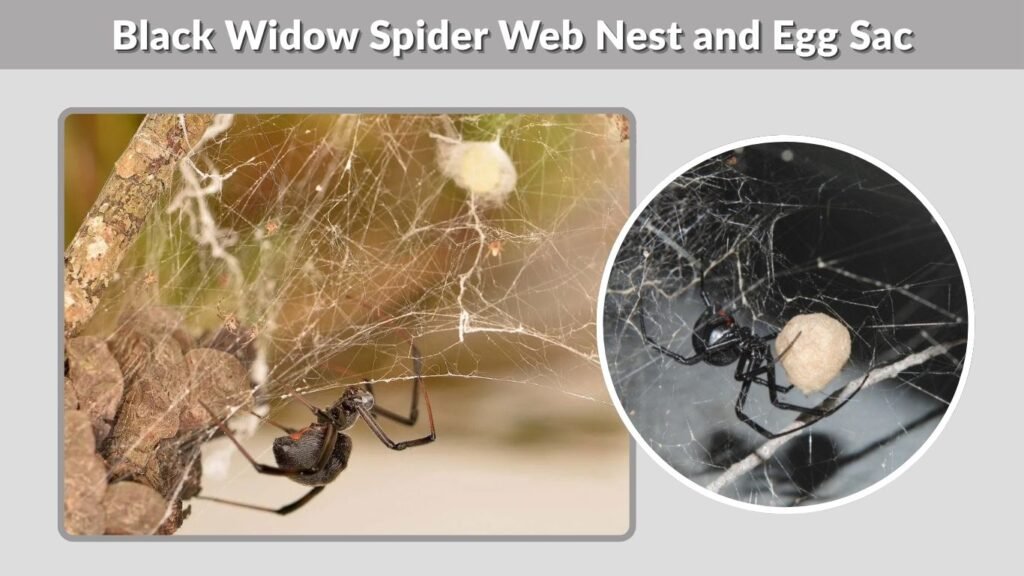
People often use the word “nest” for a black widow web, but spiders do not make nests in the same way birds do. A black widow’s web is more like a hunting area, shelter, and egg-sac support system.
A female may attach egg sacs to the web. These sacs are usually round or pear-shaped and made of silk. If you find egg sacs near a suspected black widow web, do not handle them.
Black Widow Web Cocoon
A “black widow spider web cocoon” may refer to an egg sac or wrapped prey. Black widows wrap captured insects in silk before feeding. They also use silk to protect their eggs.
If you see small silk-covered insects in the web, that may be prey. If you see a larger rounded silk ball attached to the web, it may be an egg sac.
Black Widow Spider Web Tattoo Meaning
Some searches are not about real spider webs but about tattoo designs. A black widow spider web tattoo may represent danger, mystery, survival, femininity, independence, or transformation. The meaning depends on the person wearing it and the design style.
A spider web with a black widow tattoo is often chosen for its bold visual symbolism. It may include a red hourglass, dark web lines, or a spider hanging from silk.
Are Spider Web Tattoos Racist?
A spider web tattoo can have different meanings depending on context. In some cases, web tattoos have been associated with prison culture or extremist symbolism, but not every spider web tattoo has that meaning. Placement, design, personal background, and added symbols matter.
A black widow spider web tattoo by itself is often used as gothic, horror, nature, or personal symbolism. Anyone concerned about meaning should discuss the design carefully with a tattoo artist.
Black Widow Spider Web Drawing and Design
A black widow spider web drawing often shows a black widow hanging from a web, but real black widow webs are usually messier than artistic versions. For design purposes, artists may combine a neat web with a black widow spider because it is easier to recognize.
For a more realistic drawing, show:
- tangled uneven silk strands
- a dark corner or low hidden space
- a shiny black spider hanging upside down
- a red hourglass marking
- small wrapped prey
- an egg sac near the web
This makes the drawing closer to how black widows actually live.
How to Safely Remove a Suspected Black Widow Web
Do not remove a suspected black widow web with bare hands. Even if you do not see the spider, it may be hiding nearby.
Basic safety steps include:
- wear thick gloves
- use a long-handled tool
- avoid putting hands into dark spaces
- check for egg sacs
- vacuum carefully if indoors
- seal the vacuum contents afterward
- reduce clutter around the area
- call pest control if you see several spiders
If you are bitten or think you were bitten, wash the area and seek medical advice if symptoms become serious.
FAQs
What does a black widow spider web look like?
A black widow spider web looks messy, tangled, and irregular. It does not look like a neat circular web. These webs are often built in dark, hidden places close to the ground, such as sheds, garages, crawl spaces, woodpiles, and cluttered corners.
Are black widow spider webs messy?
Yes, black widow spider webs are usually messy. Their web pattern is a tangled cobweb rather than a clean spiral. The messy structure helps trap crawling insects and gives the spider a hidden place to wait for prey.
How do you identify a black widow spider web?
Look for a tangled, sticky web in a dark, quiet, low area. Identification is stronger if you also see a shiny black spider with a round abdomen and red underside marking. Webs alone are not enough because other cobweb spiders make similar webs.
Is black widow spider web strong?
Yes, black widow spider silk is known for strength and toughness. The web may look thin, but it can be surprisingly elastic and durable. Scientists study black widow silk because its structure may help inspire strong synthetic materials.
Do black widows make funnel webs?
Black widows do not usually make true funnel webs. They make irregular cobwebs. Some parts of the web may create a retreat-like area, but that is different from the organized funnel-shaped web made by funnel-web or grass spiders.
