

Varied carpet beetles (Anthrenus verbasci) are among the most common household pests worldwide. Their distinctive patterned shells—spotted with black, brown, yellow, and white scales—make them easy to identify. However, most homeowners don’t realize that it’s not the adult beetles causing the real damage, but their hungry larvae.
Understanding the varied carpet beetle life cycle is the first step to effective prevention and control. From the egg stage to the adult beetle, each phase has unique behaviors that affect how infestations spread and how difficult they are to eliminate.
Overview of the Varied Carpet Beetle Life Cycle

Varied carpet beetles undergo complete metamorphosis, which means they pass through four distinct stages:
- Egg
- Larva
- Pupa
- Adult
The entire process can take anywhere from 4 months to a full year, depending on temperature, humidity, and food availability. While adults often live outdoors feeding on pollen, the larvae thrive indoors where they find plenty of natural fibers and organic materials to consume.
Egg Stage

What Carpet Beetle Eggs Look Like
Varied carpet beetle eggs are tiny, white to off-white, and oval-shaped. At just 0.5 millimeters long, they are nearly invisible to the naked eye. Females lay them in hidden spots that provide food for larvae once they hatch.
Where Eggs Are Laid
Common locations include:
- Inside carpets and rugs.
- In folds of clothing or upholstered furniture.
- In air ducts, closets, or baseboards.
- Near stored foods like grains or cereals.
Duration of the Egg Stage
Eggs hatch in 1–3 weeks, depending on warmth and humidity. Because they’re so small and well-hidden, infestations often go unnoticed until larvae emerge.
Why Eggs Matter in Pest Control
Since eggs are nearly undetectable, cleaning alone may not prevent an outbreak. A female varied carpet beetle can lay up to 90 eggs, ensuring rapid population growth. This makes early intervention crucial.
Larval Stage (Most Destructive Phase)
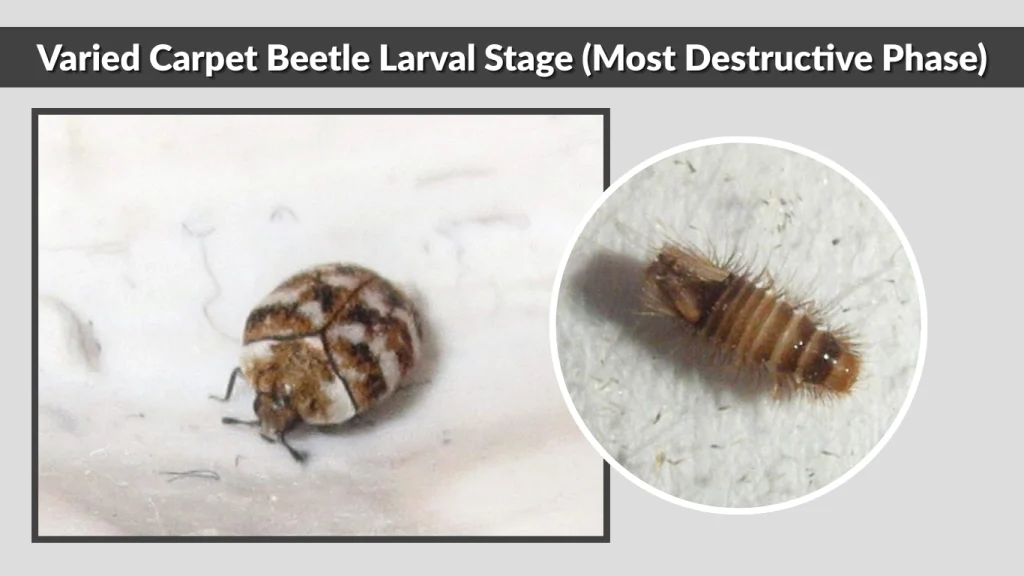
Appearance of Larvae
The larval stage is where most homeowners notice a problem. Larvae, often referred to as “woolly bears,” are:
- Brown to dark brown in color.
- Covered in short, stiff bristles or hairs.
- Elongated, tapering at the rear with small bristle tufts.
- Growing up to 4–5 millimeters long, larger than the adults themselves.
Their hairy appearance sometimes causes allergic reactions in humans, leading to skin rashes or irritation.
Feeding Habits of Larvae
Larvae feed aggressively on:
- Natural fibers like wool, silk, fur, and leather.
- Upholstery and carpeting.
- Animal-based materials such as feathers and pet hair.
- Stored food products including grains, flour, and pasta.
This wide diet explains why varied carpet beetle infestations spread quickly in households. Unlike adults, larvae are responsible for the bulk of household damage.
Duration of the Larval Stage
This stage lasts the longest—anywhere from several months to over a year depending on food supply and conditions. During this period, larvae molt multiple times, shedding their hairy skins. These shed casings are a common sign of infestation.
Why Larvae Are Hard to Control
- They hide in dark, undisturbed areas.
- Shed skins and bristles can trigger allergic reactions.
- Prolonged feeding means damage accumulates over time.
Since larvae are persistent and destructive, they’re the most important stage to target in any pest control strategy.
Pupal Stage

Transformation into Adulthood
Once larvae have fully matured, they enter the pupal stage, a short but critical phase in the varied carpet beetle’s life cycle. During this stage, larvae stop feeding and find a secluded, protected location—often inside carpets, cracks, or furniture padding—to pupate.
Characteristics of the Pupal Stage
- Appearance: Pupae are enclosed in a protective casing formed from the last larval skin.
- Duration: Lasts about 1–2 weeks under normal household conditions.
- Activity: Unlike larvae, pupae remain inactive, silently transforming into adults.
Though this stage doesn’t cause direct damage, it ensures the survival of the next generation, making infestations continuous unless interrupted.
Adult Stage
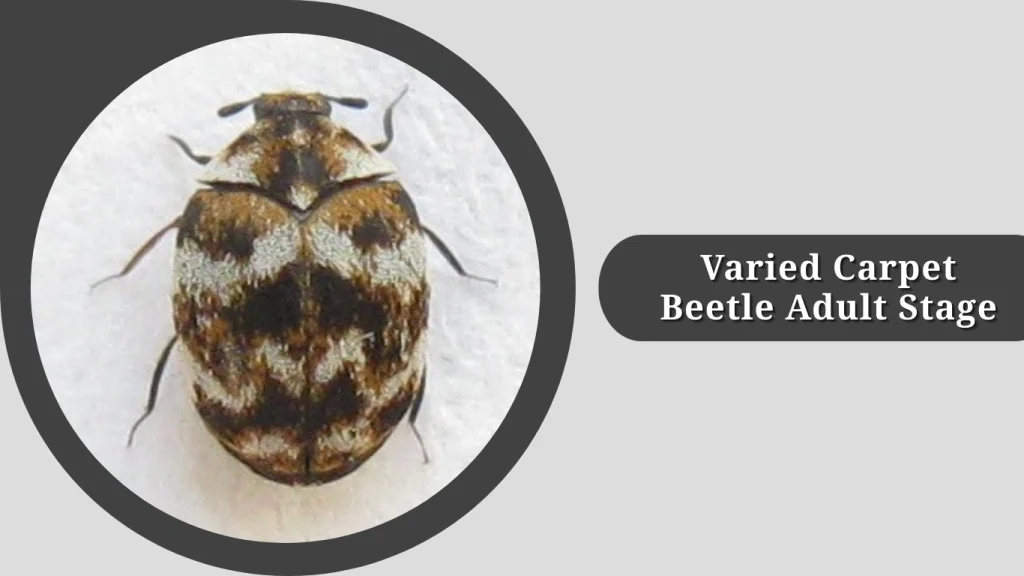
What Adult Varied Carpet Beetles Look Like
The adult beetles that emerge are:
- 2–3 millimeters long.
- Oval-shaped with patterned shells displaying black, brown, yellow, and white scales.
- Short-lived compared to larvae.
Their distinctive markings make them one of the most recognizable carpet beetle species.
Behavior and Feeding Habits
- Outdoors: Adults prefer feeding on pollen and nectar from flowers.
- Indoors: They don’t cause significant damage but may occasionally nibble on fabrics.
- Reproduction: Females lay eggs in hidden, fabric-rich areas to restart the cycle.
Lifespan of Adults
Adult varied carpet beetles typically live for 2–6 weeks. During this time, a female can lay up to 90 eggs, perpetuating the infestation cycle if left unchecked.
Duration of the Full Life Cycle
How Long Does It Take?
The entire life cycle of a varied carpet beetle, from egg to adult, can take 4 months to a year. The exact length depends on:
- Temperature: Warmer conditions accelerate development.
- Humidity: Moderate humidity supports faster growth.
- Food availability: Abundant natural fibers prolong the larval stage.
Why It Matters
The long larval stage means infestations can persist quietly for months before adults are even noticed. This explains why many homeowners only discover carpet beetles once damage is extensive.
Why Understanding the Life Cycle Is Important
Targeting the Right Stage
- Eggs are difficult to detect and almost impossible to remove without deep cleaning.
- Larvae cause the most damage, so control efforts must focus here.
- Pupae are hidden but mark the transition to reproducing adults.
- Adults spread infestations by laying eggs in new locations.
Effective Pest Control
Breaking the cycle at multiple stages—through cleaning, sealing, and treatment—is the only way to ensure long-term control. For severe infestations, professional pest control may be necessary.
Conclusion
The varied carpet beetle life cycle moves through four key stages: egg, larva, pupa, and adult. Each stage plays a different role, but the larval stage is the most destructive, causing damage to fabrics, furniture, and stored goods.
FAQs
How long do varied carpet beetles live?
Their entire life cycle can last from 4 months to a year. Adults typically live for 2–6 weeks, while larvae may survive for months, causing continuous damage indoors.
Which stage causes the most damage?
The larval stage is the most destructive. Larvae feed on fabrics, carpets, and stored food, making them the primary cause of household damage.
Can varied carpet beetles survive outdoors?
Yes, adults live outdoors feeding on pollen and nectar. However, they often enter homes to lay eggs, where larvae thrive on fabrics and organic matter.
How many eggs does a female varied carpet beetle lay?
A single female can lay up to 90 eggs, usually hidden in carpets, upholstery, or food storage areas, ensuring infestations spread rapidly.
What conditions speed up their life cycle?
Warm temperatures, moderate humidity, and abundant food supplies accelerate the cycle, allowing beetles to reproduce and infest homes more quickly.
