
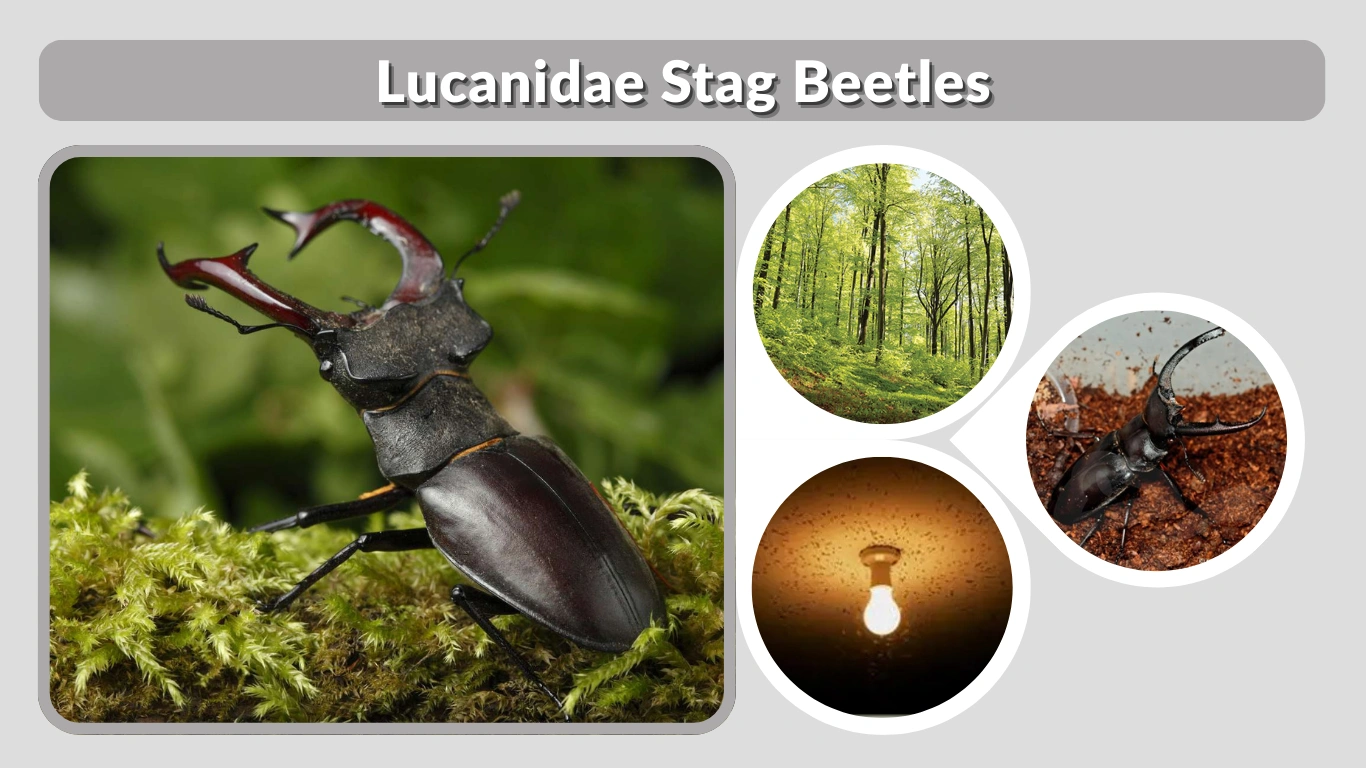
The Lucanidae family—commonly known as stag beetles—is one of the most captivating groups in the insect world. Known for their impressive mandibles, glossy exoskeletons, and remarkable diversity, these beetles inhabit forests across Europe, Asia, the Americas, and many tropical regions. Stag beetles play a vital role in decomposing wood, enriching soil, and maintaining biodiversity. Whether admired by collectors or studied by entomologists, Lucanidae species continue to fascinate with their dramatic appearance, unique behaviors, and complex life cycles.
Overview of the Lucanidae Family
What Are Stag Beetles?
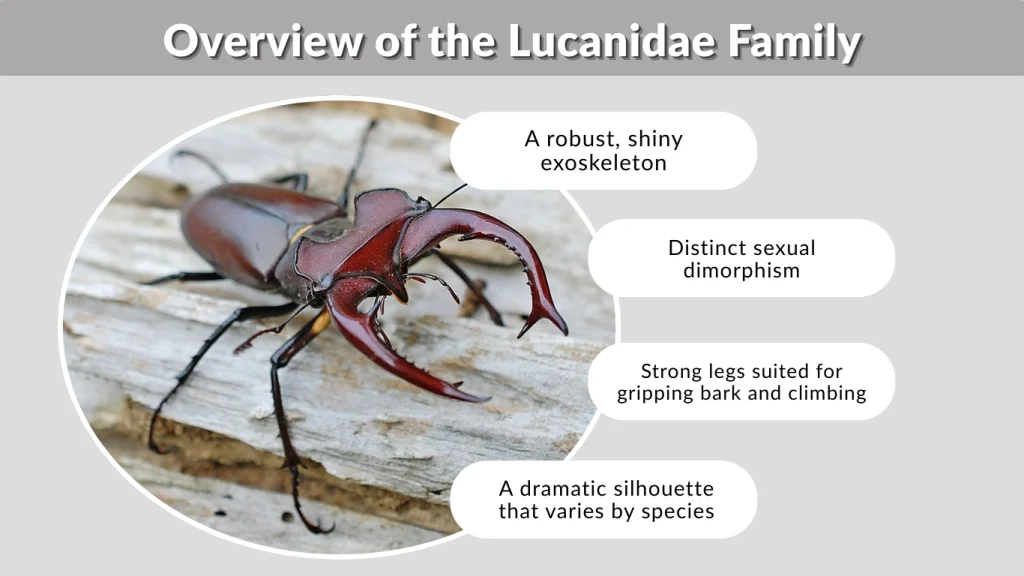
Stag beetles belong to the family Lucanidae, a large group featuring over 1,200 species worldwide. Their defining characteristic is the mandibles—often massive in males and more compact yet powerful in females. These jaws resemble deer antlers, inspiring the name “stag beetle.”
Other key traits include:
- A robust, shiny exoskeleton
- Distinct sexual dimorphism
- Strong legs suited for gripping bark and climbing
- A dramatic silhouette that varies by species
Global Distribution
Lucanidae species can be found on nearly every continent except Antarctica. The highest diversity appears in:
- Southeast Asia (Indonesia, Malaysia, Philippines)
- Japan
- Australia
- Europe (notably the famous Lucanus cervus)
- North America, home to the reddish-brown stag beetle and giant stag beetle
They thrive in environments rich in hardwood trees, moist soil, and natural forest debris.
Evolution & Classification
Stag beetles are divided into several subfamilies and tribes. These include:
- Lucaninae (largest group)
- Syndesinae
- Aesalinae
- Lampriminae
Fossil records indicate that Lucanidae have existed for tens of millions of years, adapting well to forested ecosystems. Their mandibles evolved primarily for competition during mating, not predation.
Anatomy & Key Characteristics of Lucanidae
Mandibles: Function, Shape & Variation
The mandibles are the most iconic feature of stag beetles.
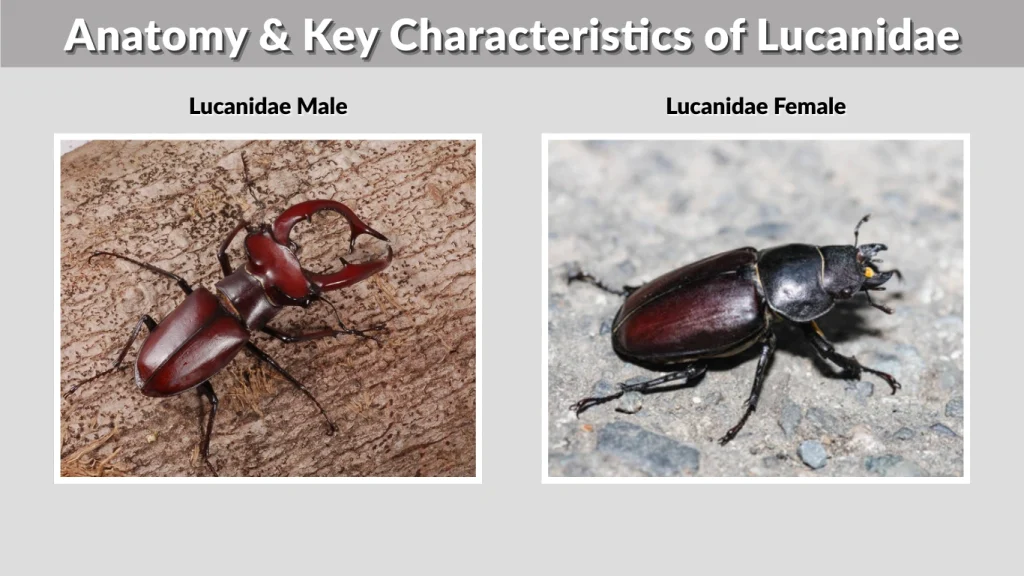
- Males have long, antler-like mandibles adapted for wrestling rivals.
- Females have shorter, stronger jaws designed for cutting wood and burrowing.
Different species exhibit unique mandible shapes:
- Sickle-shaped (Hexarthrius)
- Antler-shaped (Lucanus)
- Saw-toothed (Dorcus titanus)
- Needle-like (small Aegus species)
These variations make stag beetles one of the most visually diverse insect families.
Body Structure & Exoskeleton
Lucanidae species typically share:
- A broad thorax
- Hardened wing covers (elytra)
- A glossy, metallic, or matte finish depending on species
- Powerful legs and claws for gripping bark
While many stag beetles can fly, their flight is often slow and surprisingly loud due to their size.
Behavior & Temperament
Despite their fierce appearance, stag beetles are generally gentle.
Common behaviors include:
- Nocturnal activity, becoming active at dusk
- Males engaging in territorial battles during breeding season
- Adults feeding mainly on tree sap, nectar, and fermented fruit
- Larvae feeding steadily on decaying hardwood for years
Their movements are purposeful and slow, though some tropical species show bursts of energy when disturbed.
Major Stag Beetle Species in the Lucanidae Family
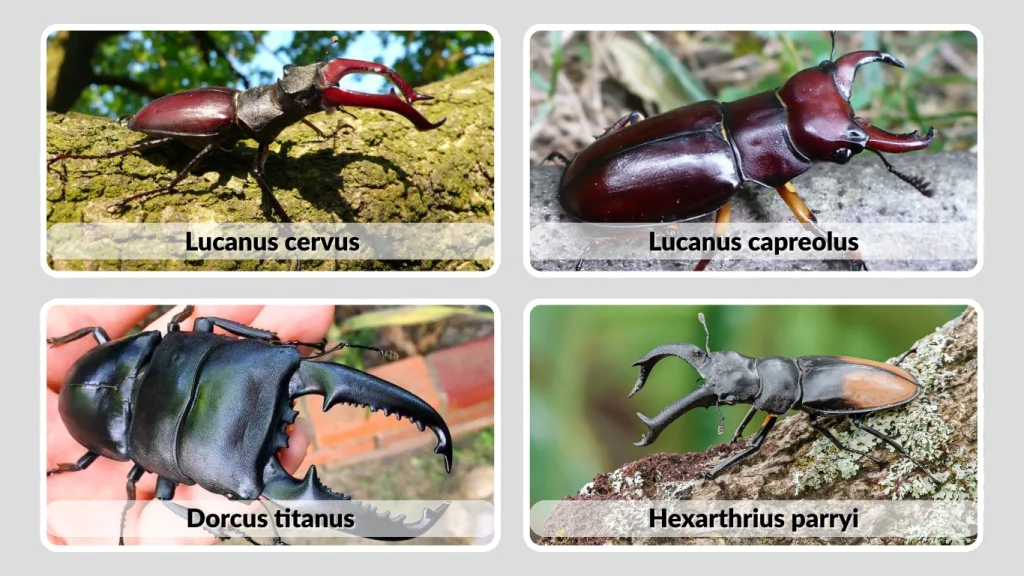
Lucanus cervus (European Stag Beetle)
One of the most famous stag beetles, Lucanus cervus features impressive mandibles and a deep mahogany-colored body.
Key traits:
- Widespread in Europe
- Protected in many countries due to habitat loss
- Large, striking males and strong females
Lucanus capreolus (Reddish-Brown Stag Beetle)
This North American species is known for:
- A shiny reddish-brown exoskeleton
- Medium-sized mandibles
- Harmless, calm behavior
Commonly found in deciduous forests across the eastern United States.
Dorcus titanus (Giant Stag Beetle)
One of the strongest-biting stag beetles:
- Found in Southeast Asia
- Known for flattened bodies and serrated jaws
- Highly sought after by collectors
Hexarthrius parryi (Parry’s Stag Beetle)
Recognized for its blade-like mandibles:
- Native to South and Southeast Asia
- Aggressive during mating season
- Popular in beetle-keeping hobby
Other Notable Lucanidae Species
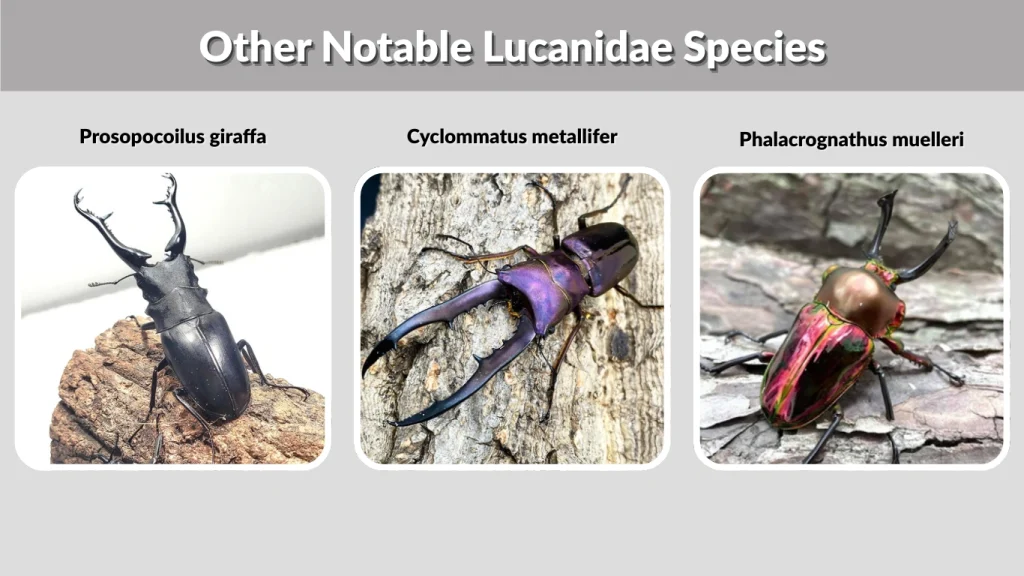
Prosopocoilus giraffa (Giraffe Stag Beetle)
One of the longest-mandibled stag beetles in the world:
- Extremely elongated jaws
- Found in Southeast Asia
- Known for its aggressive mating battles
Cyclommatus metallifer (Metallic Stag Beetle)
Famous for its shimmering, metallic coloration:
- Native to Indonesia
- Slender body and long mandibles
- One of the most photographed stag beetle species
Phalacrognathus muelleri (Rainbow Stag Beetle)
A hobbyist favorite:
- Brilliant rainbow-like iridescence
- Native to Australia
- Strong female bites due to compact mandibles
Aegus & Odontolabis Species
Featuring many small to medium-sized stag beetles:
- Common in tropical Asia
- Adaptable and hardy
- Often used in breeding programs
Habitat & Environmental Needs
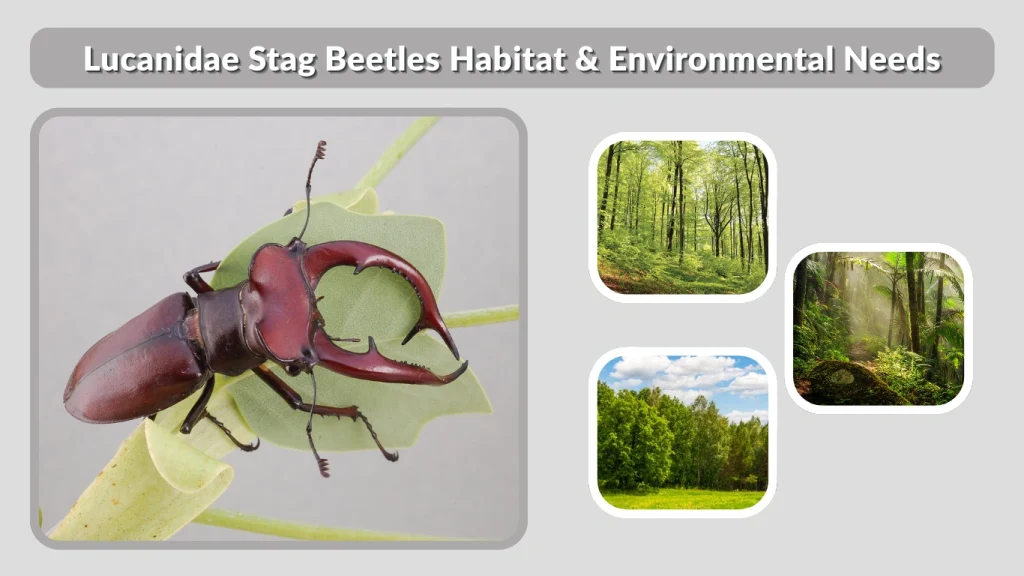
Natural Habitats
Lucanidae thrive in:
- Deciduous forests
- Tropical rainforests
- Woodland edges
- Areas rich in deadwood
They depend heavily on rotting logs, where larvae feed and pupate for years.
Microhabitats
Stag beetles live in:
- Leaf litter
- Hollow logs
- Bark crevices
- Soil cavities
Microclimates must maintain adequate moisture and shade.
Seasonality
Most stag beetles appear as adults during:
- Late spring
- Summer months
- Early monsoon seasons in Asia
Temperature and humidity strongly impact their development time.
Life Cycle of Lucanidae Stag Beetles
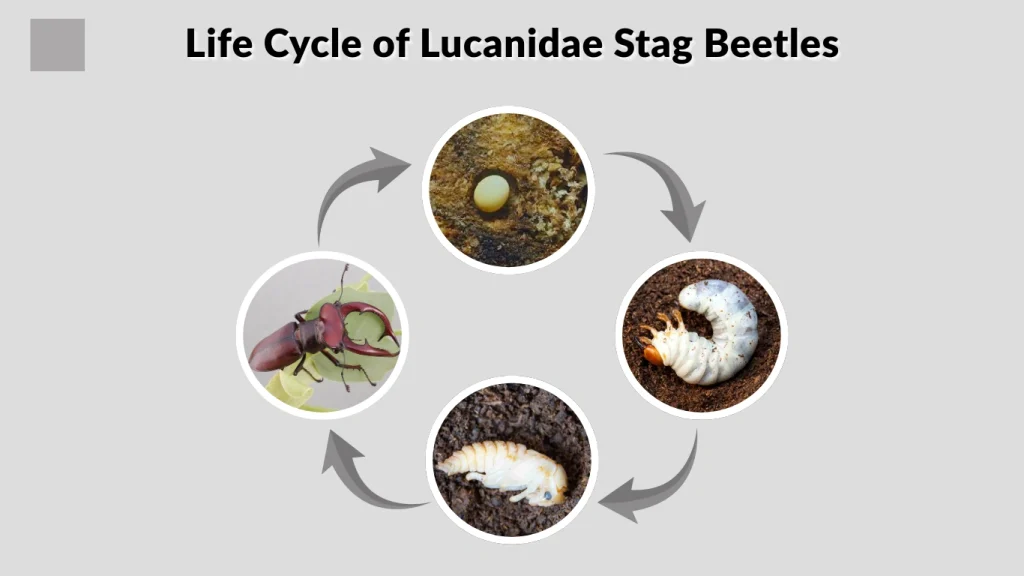
Egg Stage
Female stag beetles lay eggs in:
- Decaying stumps
- Moist logs
- Soft, nutrient-rich wood
Eggs hatch within 2–6 weeks, depending on species and climate.
Larval Stage (Grub)
Larvae are the longest life phase:
- Lasts 1–4 years
- They feed exclusively on decaying hardwood
- Grow through multiple molts
- Large, white, C-shaped grubs with strong jaws
Larvae play a critical ecological role in decomposition.
Pupation
Mature larvae form a pupal chamber inside softened wood.
During pupation:
- The larva transforms into an adult
- Mandibles form
- Wing structure develops
- The beetle hardens before emerging
This stage lasts several weeks to months.
Adult Stage
Adults live 3–12 months, depending on species.
They:
- Search for mates
- Feed on sap or fruit
- Protect small territories
Most adults die after the breeding season.
Diet & Feeding Behavior
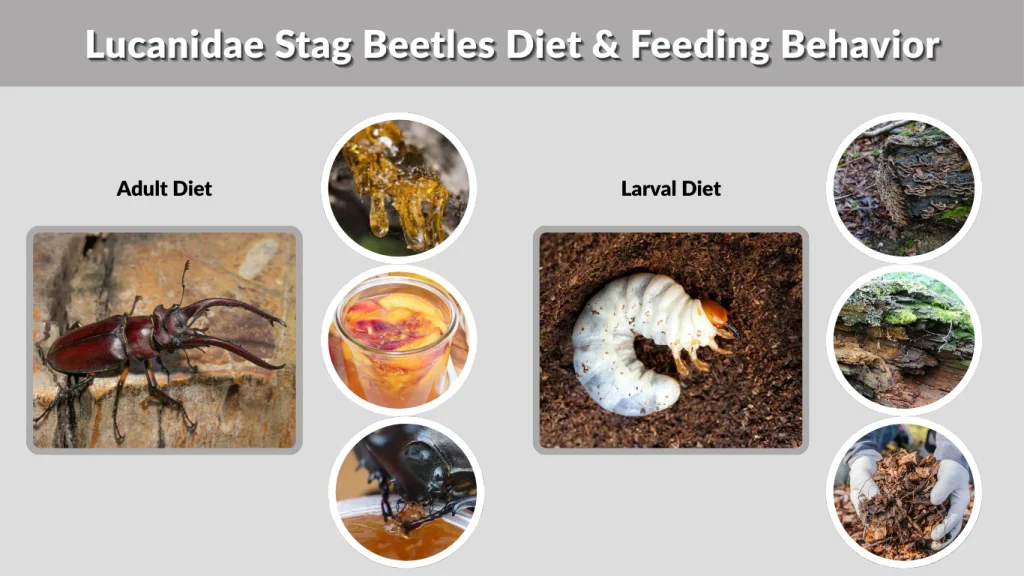
Adult Diet
Adult stag beetles feed on:
- Tree sap
- Fermented fruit
- Nectar
- Beetle jellies (in captivity)
They do not chew solid food; instead, they lap liquids.
Larval Diet
Larvae eat:
- Decayed hardwood fibers
- Fungal-rich wood
- Soil organic matter (rare exceptions)
Hardwood quality directly affects larval size and adult mandible development.
Feeding Mechanisms & Mandible Use
- Males use mandibles for wrestling, not feeding
- Females use compact jaws to cut into wood
- Larvae grind wood efficiently with sharp mandibles
Stag Beetle Behavior in the Wild
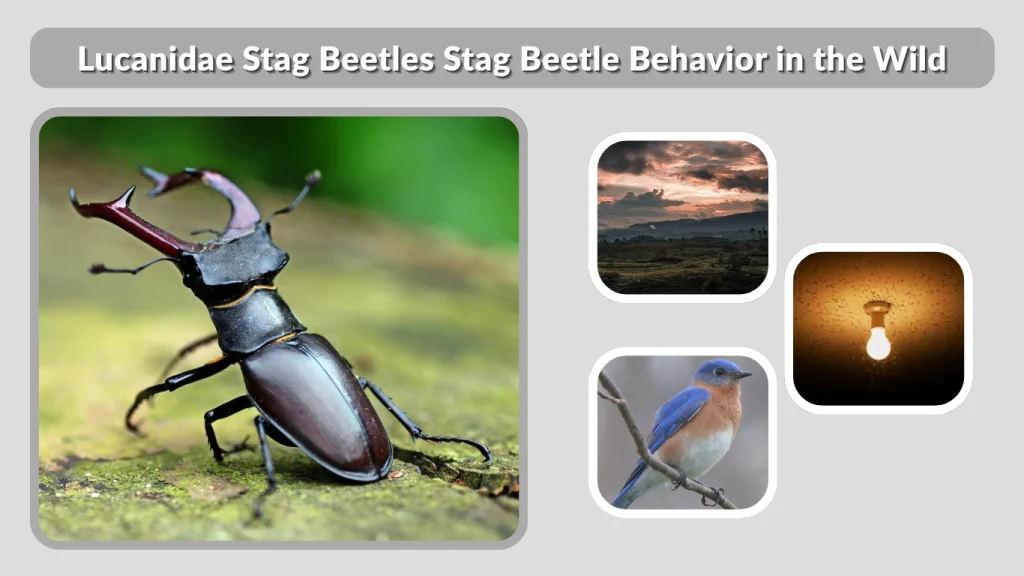
Mating Battles
Male stag beetles perform dramatic combat displays:
- Lifting opponents
- Pushing and flipping
- Locking jaws
- Displaying mandible width and shape
This behavior influences sexual selection.
Nocturnal Activity & Flight
Stag beetles:
- Become active at dusk
- Are attracted to lights (especially males)
- Fly with a loud buzzing noise due to wing size
Predators & Defense Mechanisms
Natural predators include:
- Birds
- Mammals
- Lizards
- Large insects
Defense strategies:
- Armor-like exoskeleton
- Mandible threats
- Staying still as camouflage
- Burrowing into soft soil
Keeping Lucanidae Species as Pets
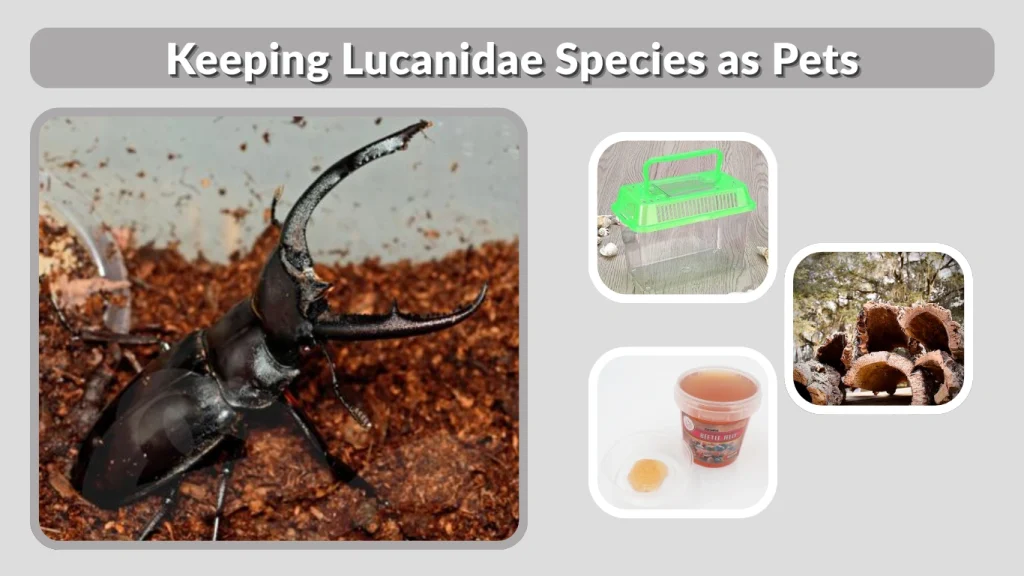
Enclosure Setup
To keep stag beetles healthy:
- Use a ventilated tank (15–30 cm deep)
- Provide 10–15 cm of moist hardwood substrate
- Maintain 70–85% humidity
- Add cork bark or logs for hiding
Feeding in Captivity
Best foods:
- Beetle jelly
- Banana slices
- Sugar-water gels
- Rot-resistant fruits (apple, pear)
Avoid citrus and mold-prone foods.
Breeding & Raising Larvae
Breeding steps:
- Introduce a healthy male and female
- Provide soft, decayed wood for egg laying
- Remove larvae to separate containers as they grow
- Feed larvae only decayed hardwood
Larvae must stay moist and undisturbed.
Conservation Status of Lucanidae
Threats to Stag Beetle Populations
Major threats include:
- Habitat destruction
- Loss of old-growth forests
- Pesticide use
- Illegal collecting
- Climate change impacts
Conservation Efforts
Current efforts focus on:
- Protected species designations
- Breeding programs
- Deadwood habitat preservation
- Public awareness education
How Hobbyists Can Help
Collectors can support conservation by:
- Buying only captive-bred beetles
- Avoiding wild collection
- Maintaining breeding colonies
- Supporting habitat restoration groups
Lucanidae Species Comparison Tables
Size Comparison
| Species | Size (mm) | Notable Feature |
| Dorcus titanus | 40–110 | Extremely powerful mandibles |
| Hexarthrius parryi | 50–90 | Long, blade-like jaws |
| Lucanus cervus | 35–75 | Iconic European stag beetle |
Lifespan Comparison
| Stage | Duration |
| Egg | 2–6 weeks |
| Larva | 1–4 years |
| Pupa | 1–3 months |
| Adult | 3–12 months |
Strongest-Biting Lucanidae
| Species | Bite Strength | Notes |
| Dorcus titanus | High | Compact, crushing jaws |
| Rainbow Stag Beetle | Medium | Strong but small mandibles |
| Parry’s Stag Beetle | Medium–High | Long slicing mandibles |
FAQs
What defines a stag beetle in the Lucanidae family?
Stag beetles are defined by their large mandibles, robust bodies, and dependence on decaying wood throughout their life cycle.
Which stag beetle species has the largest mandibles?
Prosopocoilus giraffa and Dorcus titanus rank among the longest and strongest-mandibled species.
How long do Lucanidae stag beetles live?
Adults live 3–12 months, but the full life cycle—including the larval stage—can last 1–4 years.
Can Lucanidae stag beetles be kept as pets?
Yes. They are popular pets when given proper humidity, substrate, and diet.
Are stag beetles endangered?
Some species, like Lucanus cervus, are protected due to habitat loss, while others remain abundant.
