

Horned rhino beetles are among the most extraordinary insects on Earth, known for their glossy armor and impressive horn structures. Their horns vary in shape and number—some have one, three, or even five horns—earning them names like the three-horned rhino beetle or the five-horned rhino beetle. These beetles symbolize strength, dominance, and endurance. Found across Asia, Africa, and South America, they are admired for their power, beauty, and fascinating evolutionary adaptations.
Overview and Key Features

Scientific Background
Horned rhino beetles belong to the subfamily Dynastinae, within the scarab beetle family (Scarabaeidae). This group includes some of the largest insects in the world, such as the Hercules beetle and the Atlas beetle. Their distinct horns—ranging from short stubs to elaborate multi-branched projections—make them instantly recognizable. Males use these horns primarily for combat, while females generally lack them.
Why They’re Called “Horned” Beetles
These beetles get their name from the horn-like structures on their heads and thoraxes, which resemble the horn of a rhinoceros. The horned appearance gives them a prehistoric look, making them favorites among insect collectors and researchers. The horns are not true bones or tusks; they are extensions of the exoskeleton made of chitin—a tough, lightweight material that provides durability and flexibility.
Horn Variety Across Species
Not all rhino beetles have the same horn structure. Some, like the Chalcosoma moellenkampi, feature three prominent horns that extend forward in a trident shape. Others, like the Eupatorus gracilicornis, boast five smaller horns arranged like a crown. Each horn design serves a unique purpose, from combat to species identification. These variations are among the most striking examples of sexual dimorphism in insects.
Horn Structure and Function

Purpose of the Horn
Male rhino beetles use their horns primarily to fight other males during mating season. They engage in pushing matches, attempting to flip or knock rivals off tree trunks where females feed on sap. The horns act as weapons and leverage tools, giving stronger males a mating advantage. Horns are also used to dig, climb, and defend against small predators.
Interestingly, horn size is directly linked to larval nutrition—well-fed larvae develop larger horns, signaling strength and vitality to potential mates.
Do Female Rhino Beetles Have Horns?
Female rhino beetles typically do not have horns. Instead, they have smoother, rounded heads designed for digging and laying eggs in soil. This difference between males and females is an example of sexual dimorphism, where physical traits differ based on reproductive roles. The absence of horns in females helps conserve energy for reproduction rather than combat.
Can Rhino Beetles Regrow Their Horns?
A rhino beetle’s horn is a permanent structure formed during the pupal stage. Once damaged or lost, it cannot regenerate. The horn is part of the exoskeleton, similar to a fingernail but non-regenerative. Damage to the horn may affect the beetle’s ability to fight or attract mates, but it doesn’t typically shorten its lifespan.
Researchers have also found that horn growth is influenced by insulin-like hormones, which regulate size and proportion. This means healthier larvae with better diets tend to develop larger, more symmetrical horns.
Horn Strength and Composition
Though they look heavy, the horns are surprisingly light and strong. Composed of chitin and protein, they can withstand powerful forces during fights without breaking. Their curved design distributes stress efficiently, preventing fractures even under intense pressure. Some species, like the Hercules beetle, can lift objects up to 100 times their body weight—an astonishing demonstration of natural engineering.
Types of Horned Rhino Beetles

One-Horned Rhino Beetles
The one-horned rhino beetle is the simplest form in the group, featuring a single upward-curving horn from the head. Found in regions like Africa and Southeast Asia, these beetles use their horn to lift debris, dig for sap, and fight rivals. Their smooth, symmetrical shape makes them popular in insect collections.
Three-Horned Rhino Beetles
The three-horned rhino beetle (Chalcosoma moellenkampi) is one of the most famous species. It has a large central horn on its head and two smaller horns projecting from the thorax, forming a trident-like structure. Native to Borneo and other Southeast Asian islands, this beetle can reach up to 10 centimeters in length. Its horns are used for wrestling other males and defending feeding sites. The beetle’s shiny black or dark green body adds to its intimidating appearance.
Five-Horned Rhino Beetles
The five-horned rhino beetle (Eupatorus gracilicornis) is an extraordinary insect native to Thailand and Myanmar. It features five distinct horns—one large central horn and four smaller ones surrounding it like a crown. Males use this elaborate structure to lock with opponents in dramatic mating battles. Despite their fierce look, these beetles are herbivores, feeding on fruit and tree sap. Their polished black exoskeleton and horn arrangement make them one of the most sought-after species among collectors.
Other Horned Varieties
There are also two-horned, giant, and black horned rhino beetles, each with unique regional adaptations. The giant three-horned beetle from Borneo and the black horned beetle from Africa are particularly notable for their size and strength. Some rare varieties display horn curvature differences depending on habitat conditions and diet during development.
Physical Appearance and Size

General Body Structure
Horned rhino beetles are robust and muscular, covered in a shiny exoskeleton that ranges from deep black to metallic brown. Their forelegs are strong and spined, designed for gripping bark and burrowing into soil. Despite their intimidating size, they are harmless to humans and cannot bite or sting.
Horn Size and Proportion
Horn size varies greatly between species, with some reaching up to one-third of the beetle’s total body length. The Hercules beetle and five-horned beetle boast the longest horns in proportion to their size. These features not only play a role in combat but also act as displays of dominance and health to potential mates.
Habitat and Behavior
Where Horned Rhino Beetles Live
Horned rhino beetles inhabit tropical and subtropical regions around the world, thriving in dense forests, jungles, and areas with abundant decaying vegetation. They are especially common in Southeast Asia, Central and South America, and parts of Africa. Many species, like the five-horned rhino beetle, prefer moist, shaded environments where rotting wood and tree sap are plentiful. These natural conditions provide both food and ideal breeding grounds for larvae.
Feeding Habits
Adult horned rhino beetles are herbivorous, feeding mainly on tree sap, fruit juices, and decaying plant matter. They are particularly drawn to trees that exude sap, such as oak or fig trees. In captivity, they can be fed beetle jelly, overripe fruit, or sugary liquids. Despite their fierce appearance, they do not harm plants or crops, and their feeding habits help recycle nutrients within ecosystems.
Predators and Threats
While their tough exoskeleton provides good protection, horned rhino beetles are still preyed upon by birds, reptiles, and small mammals. Chameleons, pythons, and bats are known to eat them. Humans also pose a threat through deforestation and illegal insect collection. In the wild, they rely on camouflage and nocturnal activity to avoid predators, emerging at night to feed and mate.
Mating Battles
Male horned rhino beetles are famous for their spectacular battles during mating season. When two males encounter each other near a female or a sap source, they engage in a wrestling match using their horns. The goal is to flip or push the rival off the tree trunk. These duels are tests of strength and endurance, with the victor gaining mating rights. Such behavior is so iconic that beetle-fighting competitions are popular in countries like Japan and Thailand.
Life Cycle and Reproduction
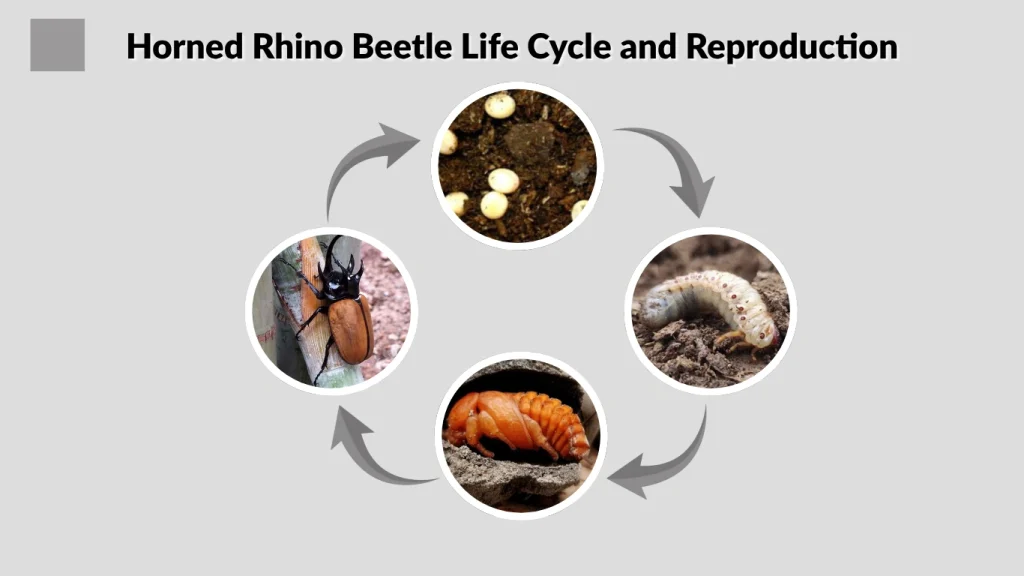
Egg to Larva
The life of a horned rhino beetle begins when the female lays eggs in decaying wood or moist soil. After two to four weeks, the eggs hatch into large white larvae, which spend several months feeding on decomposing plant material. This larval stage is the longest phase of their life cycle, often lasting up to a year or more.
Pupation and Horn Formation
Once fully grown, the larva creates a protective chamber underground and transforms into a pupa. During this stage, the adult beetle’s exoskeleton and horns begin to form. The horns are shaped and hardened before the adult emerges. The structure and length of these horns are determined by nutrition, genetics, and environmental conditions during larval growth.
Adult Lifespan
Adult horned rhino beetles typically live for three to six months, though some species can survive longer in captivity. Their main purpose as adults is reproduction. After the breeding season, most adults die naturally, leaving behind eggs to continue the cycle. Despite their short adult lives, their transformation process remains one of nature’s most remarkable metamorphoses.
Special Species Highlights
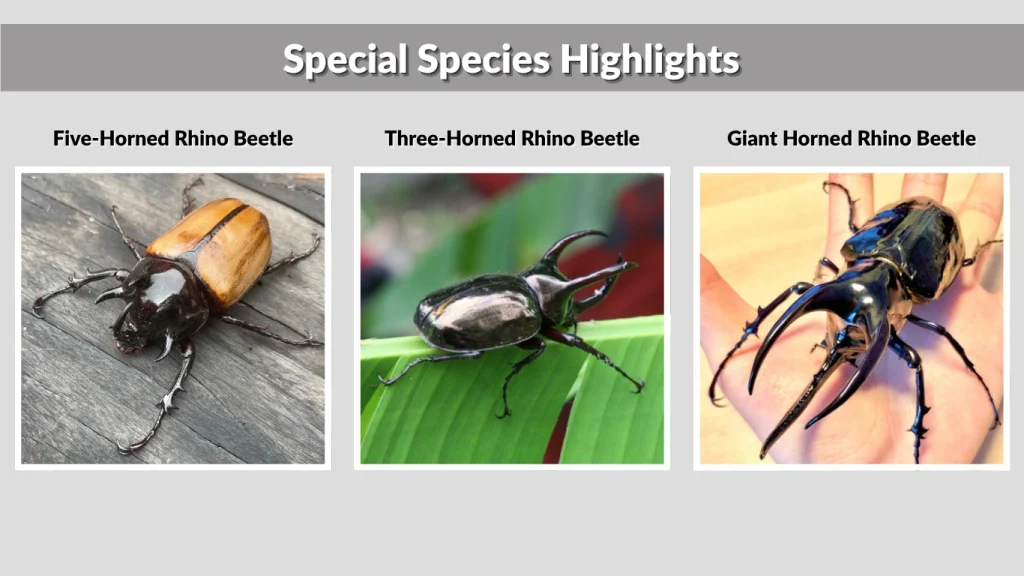
Five-Horned Rhino Beetle (Eupatorus gracilicornis)
One of the most magnificent species, this beetle sports five distinct horns — one large central horn and four smaller side horns resembling a crown. Native to Thailand, Laos, and Myanmar, it thrives in tropical forests and feeds on fruit sap. Its impressive horn structure and polished black body make it one of the most admired beetles among collectors.
Three-Horned Rhino Beetle (Chalcosoma moellenkampi)
Found in Borneo and other Southeast Asian regions, this species is known for its trident-shaped horns and metallic black coloration. It is exceptionally strong, able to lift objects far heavier than its own body weight. Its horn arrangement helps it grip and flip opponents in combat.
Giant Horned Rhino Beetle
This term refers to massive species such as Dynastes hercules and Chalcosoma atlas. These beetles can reach lengths exceeding 15 centimeters, with horns accounting for nearly half their size. Their sheer power and impressive structure make them legendary among insect enthusiasts.
Human Interaction and Symbolism
Cultural Importance
Horned rhino beetles hold significant symbolic value in many cultures. In Japan and Thailand, they are associated with strength, courage, and perseverance. Children often keep them as pets, while adults admire their beauty and resilience. In Southeast Asia, beetle-fighting contests are traditional summer events, where two males wrestle for dominance.
Conservation and Trade
While most horned rhino beetle species remain common, habitat loss and overcollection threaten some populations. Collectors and breeders are encouraged to focus on captive breeding programs to prevent depletion of wild stocks. Several countries now regulate exports to ensure ethical trade and species protection.
Horned Beetles in Media
Horned rhino beetles have appeared in various forms of media — from educational documentaries to popular video games like Tears of the Kingdom (TOTK), where players can collect virtual beetles. Their distinct appearance makes them ideal symbols of nature’s power and diversity.
Interesting Facts
- Horned rhino beetles can lift more than 100 times their body weight.
- The five-horned species is one of the rarest and most ornate beetles in the world.
- Horns are made of chitin, the same material that forms crustacean shells.
- Male beetles use their horns only for combat — not for defense or feeding.
- They are completely harmless to humans and plants.
FAQs
Why do rhino beetles have horns?
Males use their horns to fight rivals and attract females. The horns act as natural weapons and displays of dominance, helping stronger males win breeding opportunities.
Do female rhino beetles have horns?
No, females usually lack horns or have small ridges instead. Their smoother heads are designed for digging and egg-laying rather than fighting.
Can a rhino beetle regrow its horn?
No, once a horn is damaged or broken, it cannot regrow. Horns form during the pupal stage and remain fixed throughout the adult beetle’s life.
How long do five-horned rhino beetles live?
Five-horned rhino beetles live for about 3–6 months as adults. Their total lifespan, including the larval and pupal stages, can exceed one year.
What are the biggest species of horned rhino beetles?
The Hercules beetle (Dynastes hercules) and the Chalcosoma atlas are among the largest, with some individuals reaching over 17 centimeters in length — half of which is horn.
