
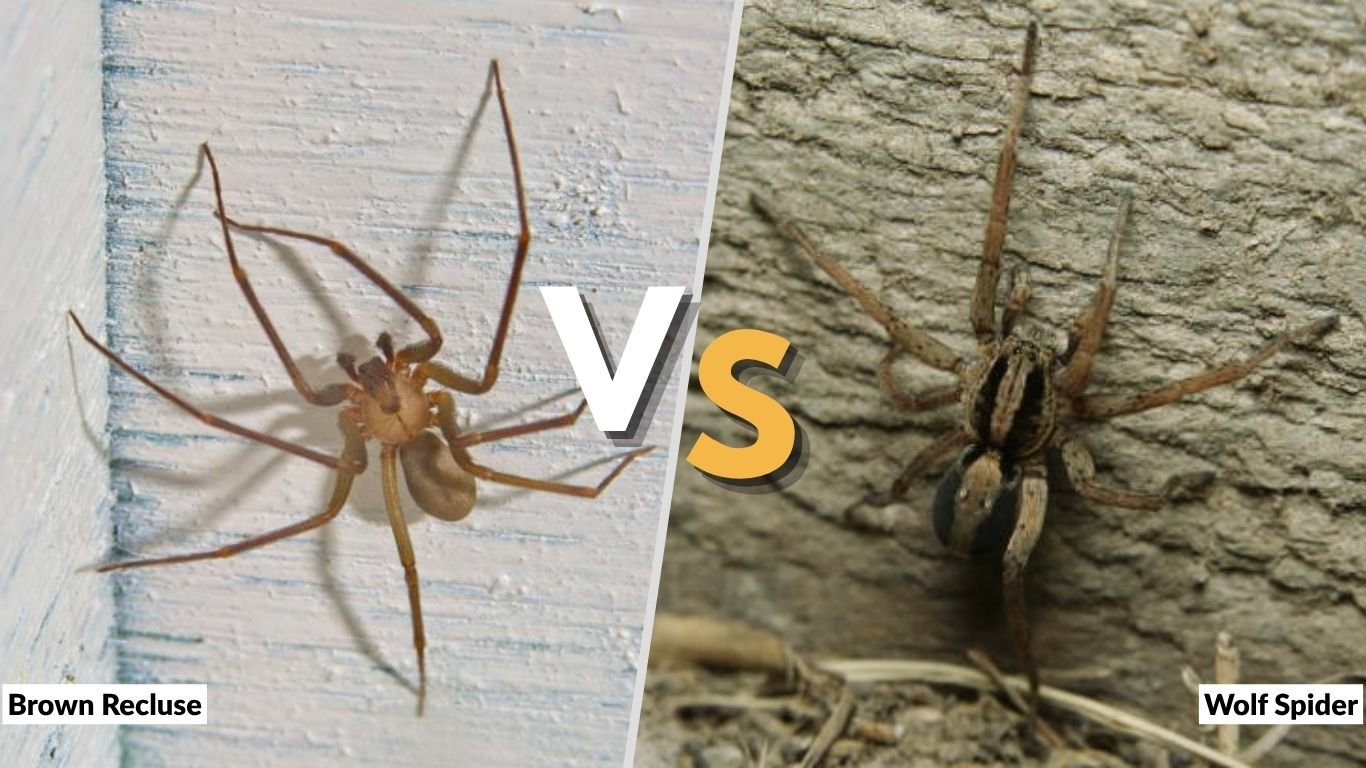
Brown recluse and wolf spiders are both brown and may occasionally appear around homes, so they are often confused. However, they differ significantly in appearance, eye arrangement, behavior, habitat, and medical importance. Wolf spiders are usually larger, hairier, and active hunters, while brown recluses have smoother bodies, six eyes, and a characteristic violin-shaped marking. Most importantly, wolf spider bites are generally mild, whereas a brown recluse bite can occasionally cause more serious tissue injury.
Brown Recluse vs Wolf Spider Identification
At first glance, both spiders may appear brown with long legs. Looking at body texture, markings, and especially the eyes provides a much more reliable way to tell them apart. Color alone is not enough because numerous harmless spiders are brown.
Key Identification Differences
Brown recluse:
- Usually tan to medium brown
- Relatively smooth-looking body and legs
- Six eyes arranged in three pairs
- Dark violin-shaped marking on the cephalothorax
- Legs generally lack obvious bands
- More uniform coloration
- Often hides in quiet, undisturbed locations
Wolf spider:
- Usually dark brown, gray, or mottled
- Noticeably hairy body and legs
- Eight eyes arranged in three rows
- Two particularly large forward-facing eyes
- Often has stripes, bands, or patterned markings
- Strong, sturdy-looking legs
- Frequently seen actively running across the ground
The eye arrangement is particularly useful. Brown recluses have six eyes in three pairs, while wolf spiders have eight eyes arranged as four small eyes in a lower row with two pairs above.
The Violin Marking
The brown recluse is famous for the darker violin-shaped marking on the front portion of its body. The narrow “neck” of the violin points toward the abdomen.
However, the violin marking should not be used alone for identification. Other brown spiders can have markings that resemble it. Checking the eyes, legs, overall coloration, and geographic location provides stronger evidence.
Body and Leg Appearance
Wolf spiders tend to look thick, robust, and hairy. Many have contrasting stripes or mottled patterns that help them blend into soil, leaves, and rocks.
Brown recluses have a more delicate appearance. Their legs are relatively long and covered with very fine hairs rather than the obvious dense hairiness seen on many wolf spiders. Their bodies and legs also generally lack strong bands or elaborate patterns.
Brown Recluse vs Wolf Spider Size
Size can provide another useful clue, although there are many species of wolf spiders and their dimensions vary considerably. A particularly large brown spider is often more likely to be a wolf spider than a brown recluse.
Brown Recluse Size
Adult brown recluses have relatively small bodies. Poison Control describes an adult, including its legs, as reaching approximately the size of a U.S. quarter. Females typically have slightly larger bodies than males.
Their long legs can make them appear bigger than their actual body size, especially when viewed quickly.
Wolf Spider Size
Wolf spiders range considerably in size. University of Minnesota Extension describes them as roughly 1/4 inch to 1 inch or more in body length, depending on species. Some large species, including Carolina wolf spiders, can look substantially bigger when their legs are included.
Their heavier build and thicker legs also make wolf spiders look more imposing.
Wolf Spider vs Brown Recluse Behavior
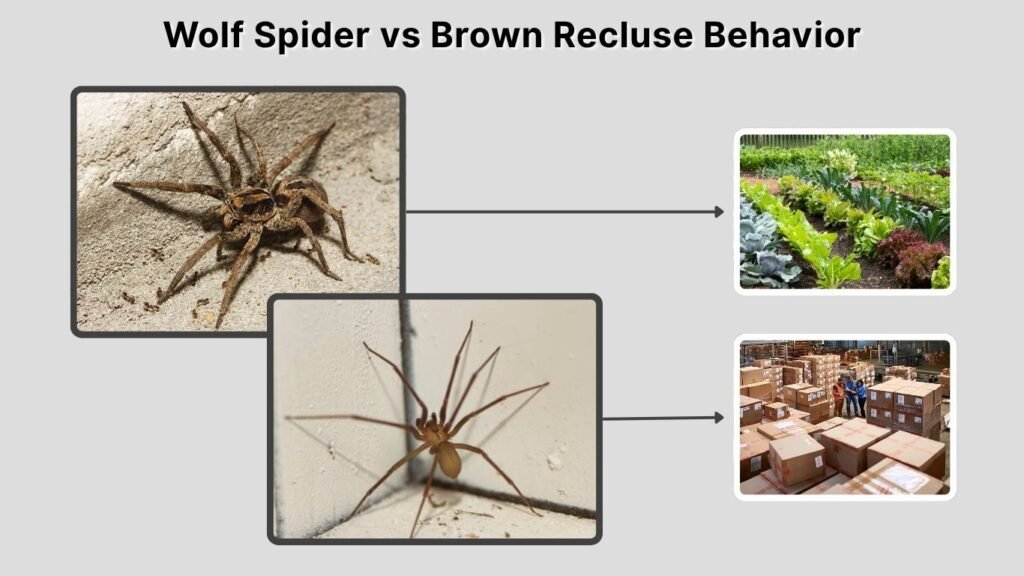
Behavior can sometimes identify a spider before you get close enough to examine physical details. Wolf spiders and brown recluses both hunt prey, but their typical movement and preferred hiding places differ.
How Wolf Spiders Behave
Wolf spiders are active hunters. Instead of constructing a prey-catching web, they move across the ground searching for insects and other small animals.
They can run surprisingly fast and are frequently encountered in gardens, grass, underneath stones, around foundations, or accidentally inside houses. Despite their intimidating appearance and speed, they are not considered aggressive toward people.
Female wolf spiders also display an unusual behavior: they carry their egg sacs attached to their spinnerets, and newly hatched spiderlings ride on the female’s abdomen.
How Brown Recluse Spiders Behave
Brown recluses prefer dark, quiet locations and normally attempt to avoid human activity.
Inside buildings, they may hide in storage boxes, shoes, clothing, closets, garages, attics, or other undisturbed spaces. Outdoors, they can shelter beneath rocks, bark, wood, and other protected materials. Bites typically occur when a spider becomes trapped against someone’s skin rather than because the spider actively attacks.
Wolf Spider Bite vs Brown Recluse Bite
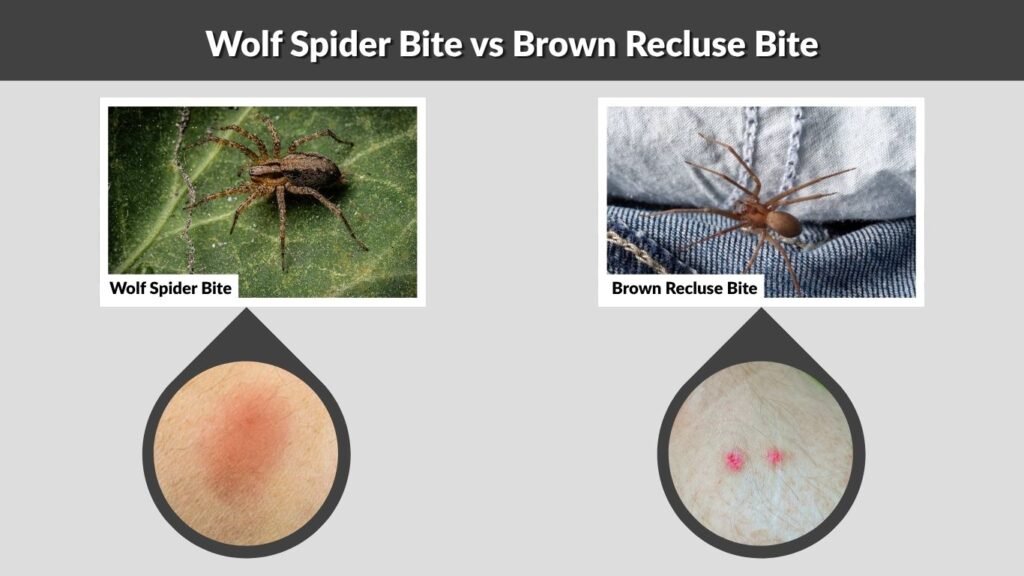
The difference in medical importance is one of the most important reasons to identify these spiders correctly. Both can bite defensively, but the potential effects are different.
Wolf Spider Bite
Wolf spiders may bite when handled, squeezed, or trapped against the skin. The usual reaction involves immediate pain, redness, and sometimes localized swelling.
Penn State Extension reports that symptoms generally resolve within about 24 hours and that serious medical consequences have not been noted for typical wolf spider bites.
Washing the area and monitoring it is sensible after any suspected spider bite. Seek medical advice if symptoms become severe, continue worsening, or signs of an allergic reaction develop.
Brown Recluse Bite
A brown recluse bite may initially go unnoticed. Early symptoms can include redness, irritation, itching, or inflammation similar to many other insect bites.
Most brown recluse bites do not develop into severe wounds, but some can become increasingly painful and develop blistering or tissue injury over the following days. Severe systemic illness is uncommon but possible.
Importantly, a skin lesion cannot reliably prove that a brown recluse caused it. Bacterial infections and several other medical conditions can resemble suspected spider bites, making diagnosis difficult unless the spider was actually seen and correctly identified.
Which Bite Is More Dangerous?
A brown recluse bite has greater potential medical significance than a wolf spider bite. Wolf spider bites generally produce temporary localized symptoms, while brown recluse venom can occasionally cause significant tissue damage.
Anyone with a rapidly worsening wound, significant pain, fever, spreading redness, darkening tissue, difficulty breathing, or other serious symptoms should seek prompt medical evaluation.
Brown Recluse vs Wolf Spider Habitat
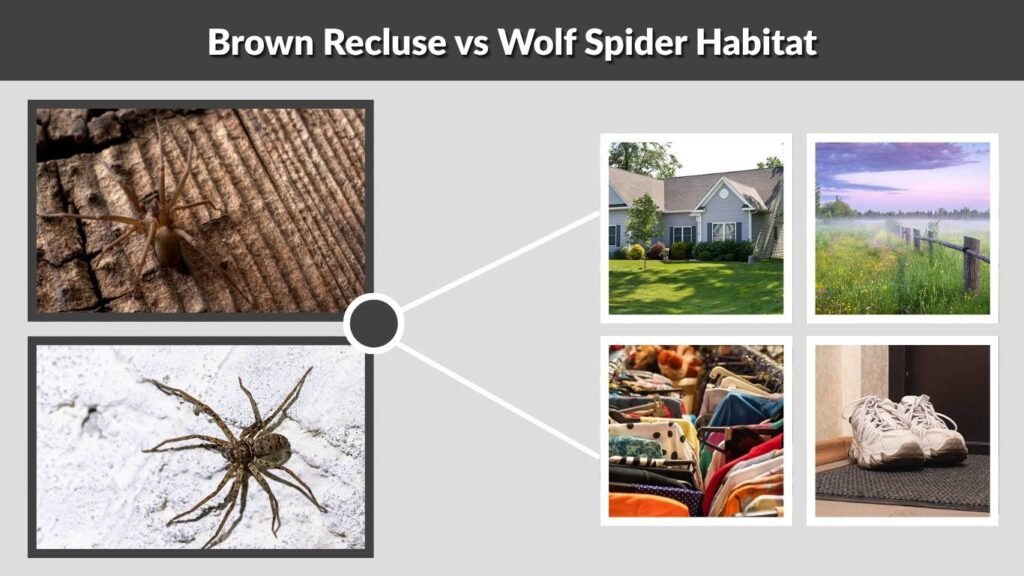
Knowing where the spider was found can provide another identification clue.
Where Wolf Spiders Live
Wolf spiders occupy a wide variety of outdoor habitats, including:
- Lawns
- Gardens
- Meadows
- Woodlands
- Fields
- Beaches
- Areas beneath stones
- Underground burrows
They may wander indoors accidentally, particularly while searching for shelter or prey.
Where Brown Recluses Live
Brown recluses are associated mainly with the south-central and Midwestern United States rather than occurring naturally throughout the entire country.
They favor protected, relatively undisturbed locations. Indoors, storage areas containing boxes, clothing, papers, shoes, and other materials can provide suitable hiding places.
Because many harmless brown spiders occur outside the brown recluse’s established range, geographic location is an important part of accurate identification.
Brown Recluse vs Wolf Spider: Who Would Win?
If a wolf spider and brown recluse encountered each other, there is no guaranteed winner. The outcome would depend on their species, individual size, defensive behavior, and circumstances.
Many wolf spiders are larger and are specialized active hunters capable of rapidly overpowering insect prey. A brown recluse is also a predator equipped with venom, but having medically significant venom does not automatically make it stronger in a spider-versus-spider encounter.
In nature, these spiders are more interested in finding prey and avoiding threats than fighting each other.
FAQs
Which is bigger, a wolf spider or brown recluse?
Wolf spiders are generally larger and more robust. Depending on species, a wolf spider’s body can approach or exceed an inch, while a brown recluse has a considerably smaller body and appears larger mainly because of its long legs.
How can I quickly tell a wolf spider from a brown recluse?
Look at body texture and markings. Wolf spiders are usually hairy and patterned, while brown recluses are relatively smooth and uniformly colored. For close identification, eye arrangement is stronger evidence: wolf spiders have eight eyes, while brown recluses have six arranged in three pairs.
Are wolf spiders poisonous like brown recluses?
Both are venomous, rather than poisonous, because venom is delivered through their fangs. However, wolf spider bites generally cause only localized symptoms, whereas brown recluse venom can occasionally produce more significant tissue injury.
Can a wolf spider look like a brown recluse?
Yes. Both can be brown and may occur around buildings, which causes frequent confusion. Wolf spiders are generally hairier, more patterned, and more robust, while brown recluses have six eyes, relatively plain legs, and a characteristic violin-shaped marking.
How do I know if a bite came from a brown recluse?
You usually cannot identify a brown recluse bite from the skin lesion alone. Numerous infections, insect bites, and medical conditions can produce similar symptoms. Correct identification is much more reliable when the spider responsible for the bite was actually seen and identified.
