
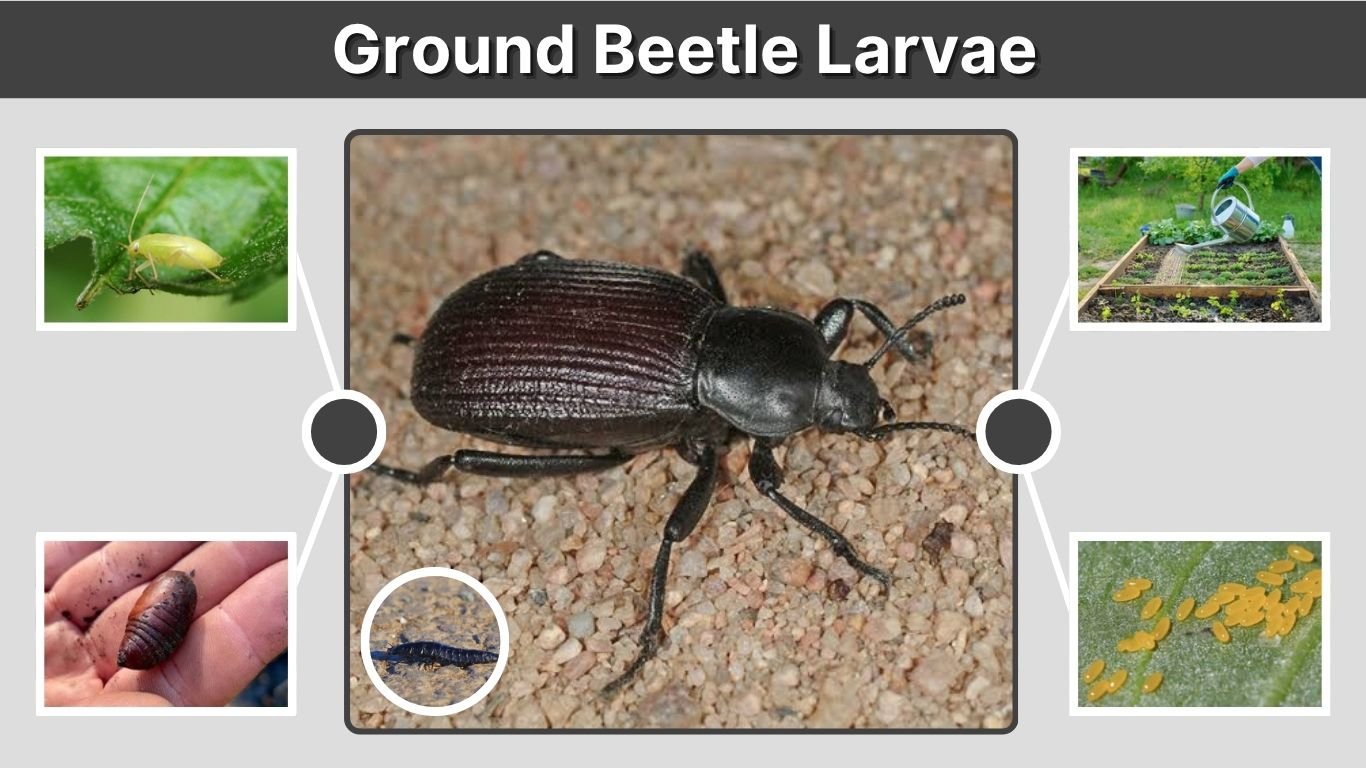
Ground beetle larvae are the immature stage of beetles in the family Carabidae, a large group of mostly ground-dwelling insects found in gardens, forests, fields, and around homes. Although their elongated bodies and prominent jaws can make them look intimidating, most are beneficial predators that hunt other small invertebrates. Learning ground beetle larvae identification can help you distinguish them from harmful grubs and other beetle larvae. This guide explains their appearance, diet, habitat, lifecycle, house sightings, and whether they are dangerous.
Ground Beetle Larvae Identification
Ground beetle larvae vary considerably between species, so color alone is not enough for identification. Most have elongated, somewhat flattened bodies with a clearly defined head, three pairs of developed legs, and noticeable mandibles. Colors commonly range from reddish-brown to almost black. Some species also have two projections, called urogomphi, at the rear of the abdomen.
Key Identification Features
Look for a combination of these characteristics when trying to identify a ground beetle larva:
- Long, slender or slightly flattened body
- Hardened, clearly visible head capsule
- Dark brown, reddish-brown, or black coloration
- Three pairs of jointed legs near the front of the body
- Large, forward-projecting, pincer-like mandibles
- Clearly segmented abdomen
- Two tail-like projections on many species
- Fast movement when disturbed
- Usually found on or close to soil, leaf litter, stones, or decaying wood
Black and Large Ground Beetle Larvae
A black ground beetle larva is not necessarily a separate species. Many members of Carabidae become dark brown or black as their outer covering hardens. Large ground beetle larvae may belong to species that also become comparatively large adults.
Larvae of genera such as Scarites can look especially formidable because of their developed head and jaws. However, exact species identification from larvae can be difficult and may require microscopic examination of legs, mouthparts, abdominal structures, and other features.
Where Do Ground Beetle Larvae Live?
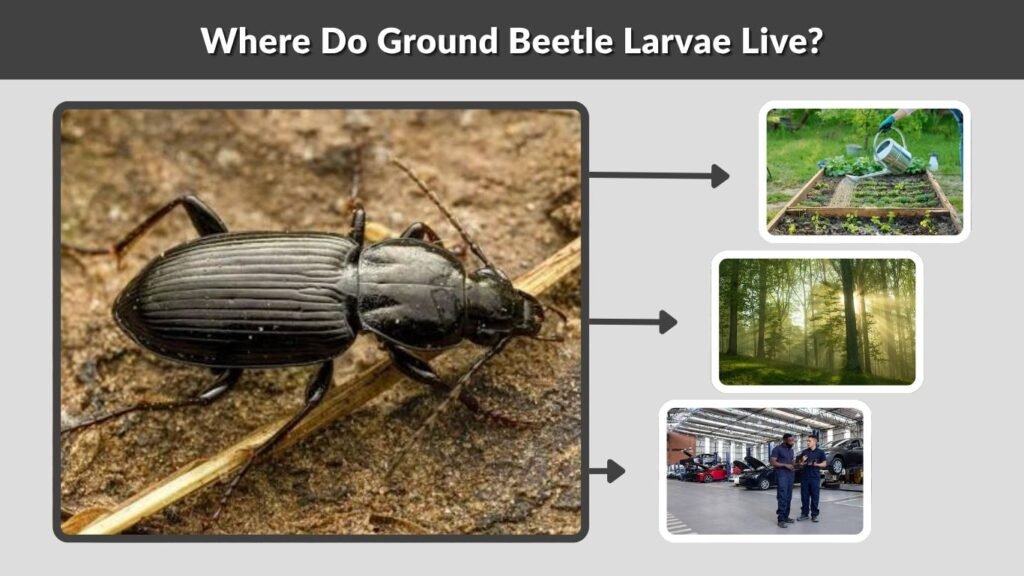
Most ground beetle larvae are terrestrial and stay close to the ground, where prey and protective cover are abundant. They frequently live in surface soil, under stones, beneath logs, in leaf litter, and among plant debris. They occur in many habitats, including woodland, grassland, gardens, crop fields, shorelines, and landscaped areas.
Ground Beetle Larvae in the House
Finding ground beetle larvae in a house is usually accidental. Their normal habitat is outdoors, especially in soil and organic debris. Larvae may occasionally end up in basements, garages, crawl spaces, or other ground-level locations when they enter through cracks or are carried inside with soil, firewood, or outdoor materials.
They are not typical indoor pests and are unlikely to establish a reproducing infestation inside a house. Ground beetles found indoors can usually be removed with a container or vacuum, while sealing cracks around foundations, windows, and doors can reduce future entry.
Ground Beetle Larvae in Gardens and Woodland
Gardens and woodlands provide excellent habitat because they contain moisture, shelter, and plentiful prey. Larvae may remain under mulch, logs, leaves, stones, grass clumps, and within the upper layers of soil.
Finding them in these locations is generally a positive sign. Both ground beetle adults and larvae can contribute to natural pest suppression by feeding on other soil-dwelling organisms.
What Do Ground Beetle Larvae Eat?
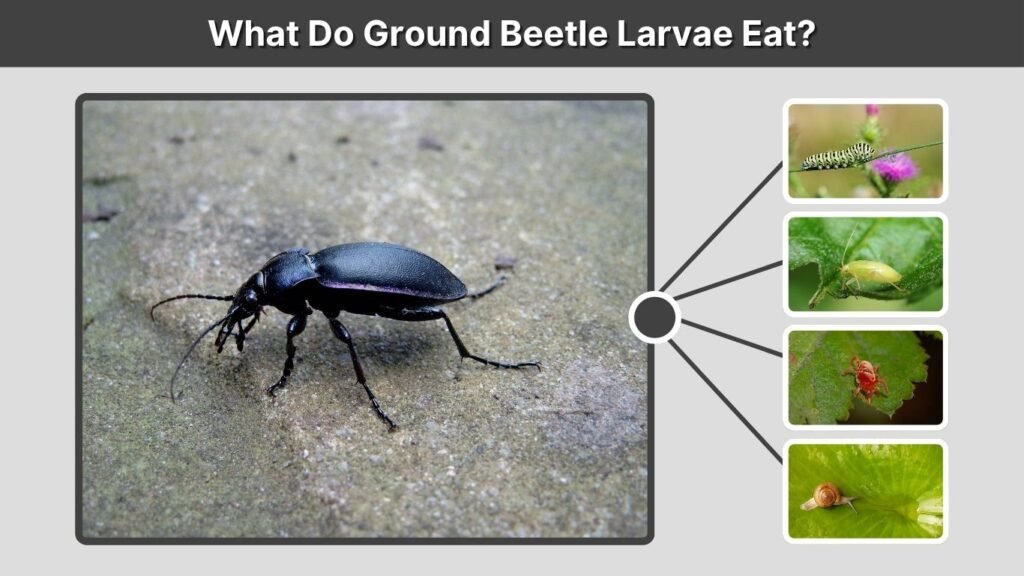
Most ground beetle larvae are predators. Their strong mandibles are used to capture other small organisms living in or near the soil. Diet varies by species and habitat, and larvae typically have a smaller hunting range than adults because many spend much of their development underground or within surface debris. A minority of ground beetle species may also have herbivorous or specialized feeding habits.
Common Prey of Ground Beetle Larvae
Predaceous ground beetle larvae may feed on:
- Caterpillars
- Fly maggots
- Other beetle larvae
- Aphids
- Mites
- Springtails
- Small slugs
- Small snails
- Insect eggs
- Soft-bodied soil insects
- Various small arthropods
Because they consume many organisms considered garden or agricultural pests, ground beetles are often regarded as beneficial natural predators.
Do Ground Beetle Larvae Eat Flea Beetle Larvae?
Some ground beetles prey on other beetle larvae, so interactions with flea beetles or similar soil-dwelling insects are possible. However, Carabidae contains thousands of species with different diets, and it is not accurate to assume every ground beetle larva specifically hunts flea beetle larvae.
Their ecological value comes largely from being generalist predators capable of feeding on many available prey species.
Are Ground Beetle Larvae Dangerous?
Ground beetle larvae may appear threatening because of their prominent jaws, but they are not considered dangerous household pests. They do not infest food, damage clothing, destroy wooden structures, or deliberately seek out people. Their mouthparts are primarily adapted to capturing small prey rather than attacking humans. Ground beetles are generally regarded as harmless and beneficial outdoors.
Can Ground Beetle Larvae Bite?
A large larva with strong mandibles could potentially pinch if it is trapped against the skin or handled roughly. However, ground beetles do not seek people out to bite, and defensive pinching is uncommon.
The easiest approach is simply to avoid picking unfamiliar larvae up with bare fingers. If one needs to be moved, guide it into a container and release it outdoors in a sheltered location.
Are They Dangerous to Plants or Pets?
Most predatory ground beetle larvae do not damage garden plants. Instead, they often feed on insects and other organisms associated with the soil.
They are also not normally a threat to household pets. A curious pet might investigate one, but the larvae are not parasites of dogs, cats, or humans. Because feeding habits vary across the very diverse Carabidae family, identification is useful before making assumptions about an unfamiliar larva.
Ground Beetle Larvae Life Cycle
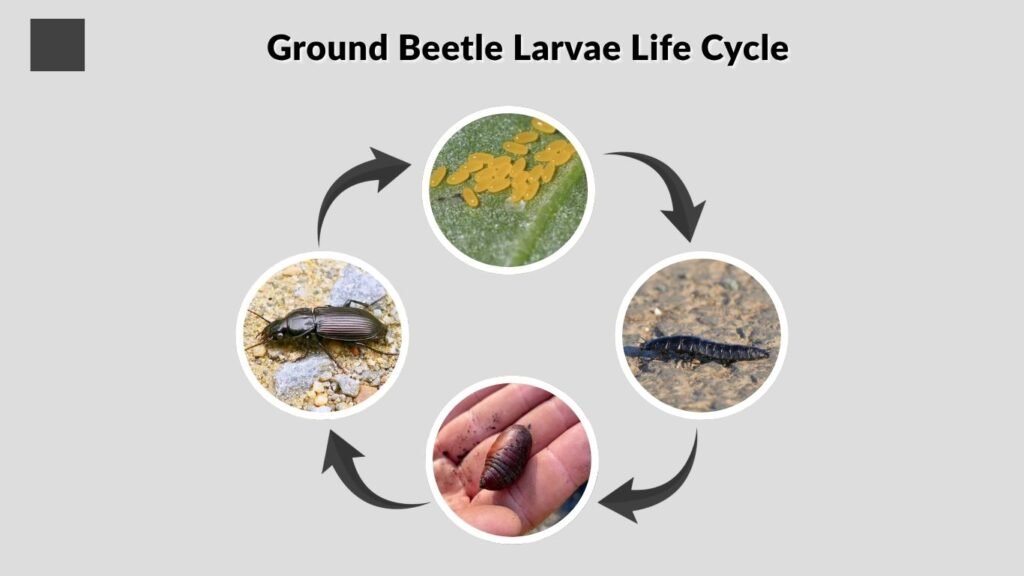
Ground beetles undergo complete metamorphosis, meaning their development passes through egg, larva, pupa, and adult stages. Females commonly place their eggs in soil or protected cracks and crevices. After hatching, larvae actively hunt and grow through several immature stages before creating a protected area where they pupate and eventually transform into adult beetles.
Ground Beetle Development Stages
The typical lifecycle includes:
- Egg: Females deposit eggs in or near the soil.
- Larva: The young beetle emerges and begins feeding and growing.
- Larval molts: Ground beetle larvae commonly pass through several developmental stages as they increase in size.
- Pupa: The mature larva changes into a relatively inactive pupa, often within the soil.
- Adult: A fully developed ground beetle emerges and eventually reproduces.
How Long Do Ground Beetle Larvae Live?
Development varies greatly according to species, temperature, food supply, and climate. Utah State University notes that larvae of some ground beetles may develop in soil for one to two years, while other species complete development more quickly. Some species overwinter as larvae, while others spend winter as adults.
This variation explains why ground beetle larvae may be encountered during different seasons and at very different sizes.
Common Types and Look-Alikes
Descriptions such as big-headed ground beetle larvae, violet ground beetle larvae, blue ground beetle larvae, woodland ground beetle larvae, or common black ground beetle larvae are often based on the adult beetle or general appearance rather than reliable larval characters. Larvae within Carabidae can look remarkably similar, so species-level identification from a photograph alone is often difficult.
Larvae Commonly Searched or Confused
- Big-headed ground beetle larvae: Often associated with robust ground beetles such as Scarites species.
- Violet ground beetle larvae: Refers to larvae associated with adult violet-colored ground beetles.
- Blue ground beetle larvae: May belong to species whose adults develop metallic blue coloration.
- Woodland ground beetle larvae: A broad description for larvae found beneath logs, bark, stones, and forest litter.
- Predaceous ground beetle larvae: General term for carnivorous Carabidae larvae.
- Rove beetle larvae: A common look-alike; certain species can closely resemble ground beetle larvae.
- Darkling beetle larvae: Sometimes confused with ground beetles, although they belong to a different beetle family.
Ground beetle and rove beetle larvae can be particularly difficult to separate without close examination. Features involving the legs and rear abdominal projections may be needed for reliable identification.
FAQs
1. What is the scientific name for ground beetle larvae?
Ground beetles belong to the family Carabidae within the order Coleoptera. Because Carabidae contains many species, there is no single species-level scientific name that applies to every ground beetle larva.
2. Are ground beetle larvae good for the garden?
Yes, many are beneficial predators. They can feed on caterpillars, maggots, other beetle larvae, aphids, mites, slugs, and additional soil-dwelling organisms that may damage plants.
3. Why did I find a ground beetle larva inside my house?
It probably wandered inside accidentally or was carried indoors with soil, firewood, plants, or other outdoor material. Ground beetle larvae naturally live outdoors and are not typical household-infesting insects.
4. Can ground beetle larvae hurt humans?
They are not considered dangerous to people. Their large mandibles are designed mainly for catching prey. Avoid squeezing or handling a large larva directly, since defensive pinching may be possible.
5. Should I kill ground beetle larvae?
Usually, there is no reason to kill one found outdoors. Many ground beetle larvae are useful predators that contribute to natural insect control. If one is found indoors, it can simply be collected and released outside in a sheltered area.
