
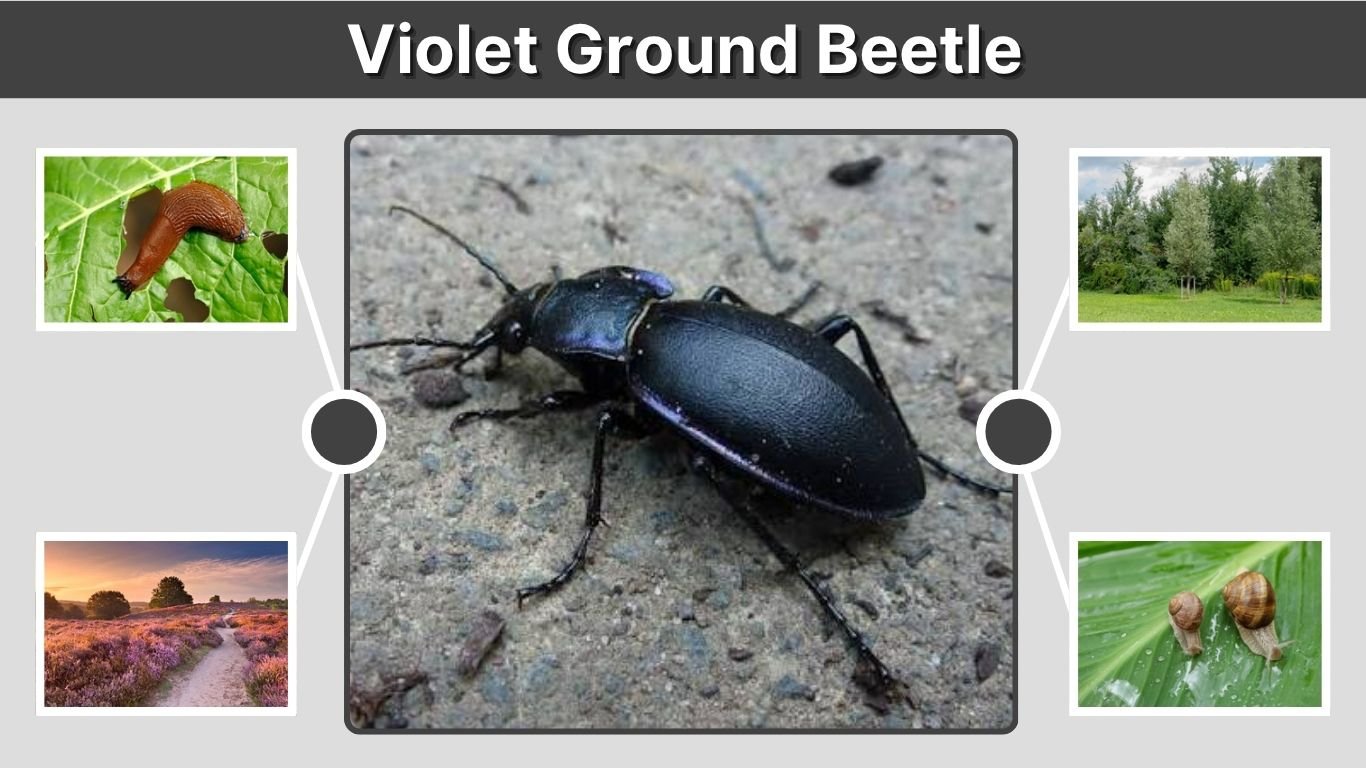
The violet ground beetle (Carabus violaceus) is a large, striking ground beetle recognized by its dark body and metallic violet, blue, or greenish edges. Common across much of mainland Britain, it spends most of its time hunting on the ground at night. Despite its intimidating jaws and size, this beetle is generally beneficial because it preys on slugs, snails, worms, and insect larvae. This guide covers violet ground beetle identification, size, habitat, diet, larvae, life cycle, behavior, house encounters, and whether it bites humans.
Violet Ground Beetle Identification
Violet ground beetles belong to the ground beetle family Carabidae. Adults have a robust, elongated body, powerful jaws, long legs, and a mostly black surface. Their most recognizable feature is the metallic violet or bluish border around the pronotum and wing cases. They can resemble the ridged violet ground beetle, so examining the wing-case texture is especially useful.
Key Identification Features
- Scientific name: Carabus violaceus
- Family: Carabidae
- Adult size: About 20–30 mm long
- Predominantly black body
- Metallic violet, blue, or occasionally greenish margins
- Smooth-looking, convex wing cases
- Long legs adapted for running
- Strong mandibles for catching prey
- Adults are unable to fly
The Natural History Museum also describes the species as reaching about 3 cm long, with a characteristic purple sheen.
Violet Ground Beetle vs. Rough or Ridged Violet Ground Beetle
The species most likely to cause confusion is the ridged violet ground beetle, Carabus problematicus. The ordinary violet ground beetle generally has smoother-looking wing cases and a more convex body.
By comparison, C. problematicus has strongly textured wing cases with visible ridges and dimples and tends to show more extensive violet coloration across the pronotum. Both species are large, dark, ground-dwelling predators and neither normally flies.
Violet Ground Beetle Habitat and Range
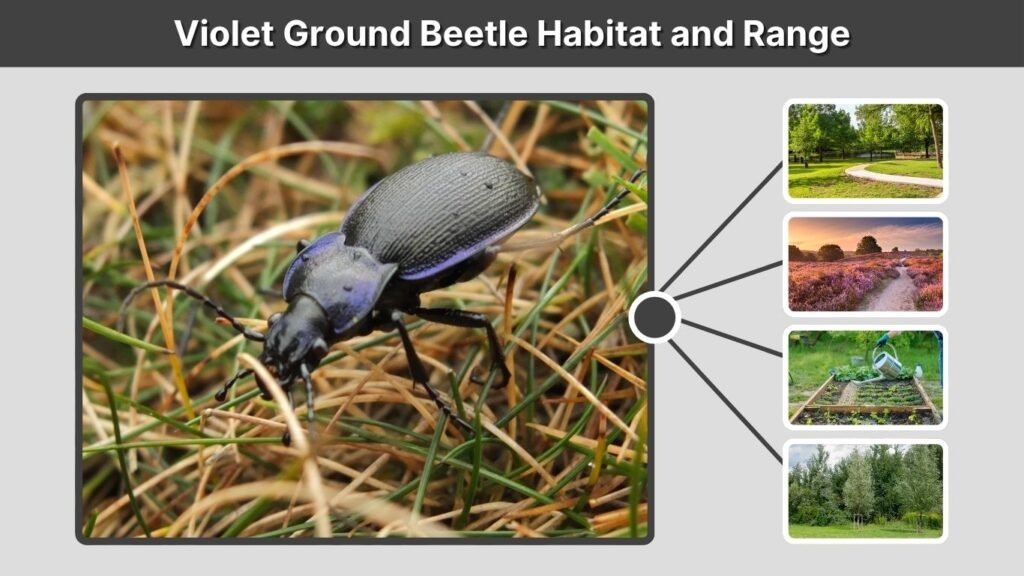
The violet ground beetle is widespread across mainland Britain and occurs in a surprisingly broad range of habitats. It favors places that provide damp ground, prey, and daytime shelter. Woodland is particularly suitable, but the species can also survive in parks, rough grassland, moorland, gardens, and urban areas where enough cover remains.
Where Violet Ground Beetles Live
Typical places include:
- Woodland and woodland edges
- Parkland
- Moorland
- Overgrown grassland
- Gardens
- Beneath logs and fallen bark
- Under stones
- Leaf litter
- Damp, shaded ground
- Urban green spaces
Adults are predominantly nocturnal. During daylight they often remain concealed beneath logs, stones, bark, or other debris before emerging to hunt after dark.
Violet Ground Beetles in Scotland and the UK
The violet ground beetle is native to Britain and occurs throughout mainland UK. It is considered more common than the similar ridged violet ground beetle.
Because it cannot fly, movement between suitable habitats happens on foot. This makes continuous woodland, grassland, hedgerows, and other connected habitats important. Habitat fragmentation can create stronger barriers for a flightless species than for beetles capable of flying between isolated sites.
What Do Violet Ground Beetles Eat?
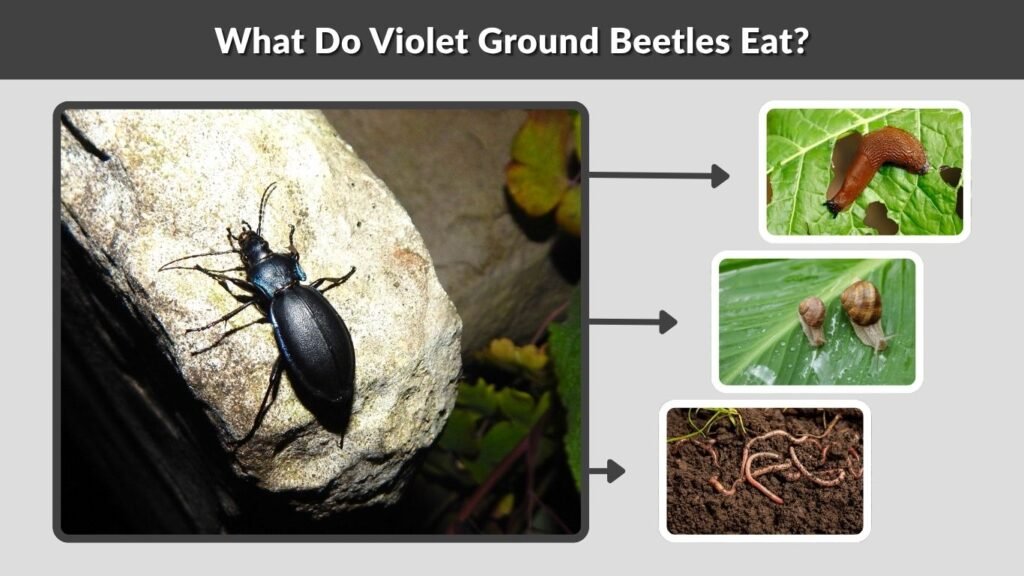
Violet ground beetles are predators rather than plant pests. Their diet makes them valuable inhabitants of gardens and other habitats because many of the animals they consume are species gardeners might otherwise consider troublesome. They patrol the soil surface and leaf litter, using their strong jaws to overpower soft-bodied invertebrates, particularly while active at night.
Violet Ground Beetle Diet
Adults commonly prey on:
- Slugs
- Snails
- Earthworms
- Caterpillars
- Other insect larvae
- Various soft-bodied invertebrates
The Natural History Museum specifically describes them as carnivorous ground hunters capable of taking relatively large prey such as slugs, snails, earthworms, and caterpillars.
How They Hunt
Rather than flying after prey, violet ground beetles search from the ground. Their long legs allow them to run rapidly through leaf litter and across soil, while their large mandibles help seize prey.
Most hunting occurs at night or around dusk. During the day, adults usually retreat to cool, protected hiding places. This nocturnal lifestyle explains why people may have violet ground beetles living in their gardens without seeing them very often.
Violet Ground Beetle Larvae and Life Cycle
The violet ground beetle undergoes complete metamorphosis, developing through egg, larva, pupa, and adult stages. In Britain, breeding typically occurs during autumn. Much of the immature development happens hidden in soil and organic material, meaning the larval stage is encountered far less often than the large, distinctive adults.
Life Cycle Stages
- Egg: Females lay eggs singly or in small groups in soil or organic material.
- Larva: Eggs hatch after roughly one to two weeks under suitable conditions.
- Growing larva: Larvae remain predatory and develop through winter.
- Pupa: Pupation takes place in spring, usually in soil or protected sites beneath logs or bark.
- Adult: New adults may emerge after approximately three weeks, commonly around April and May in Britain.
Adults can survive long enough to overwinter after breeding, rather than dying immediately at the end of the season.
What Do Violet Ground Beetle Larvae Look Like?
Like other ground beetles, the larvae look very different from the rounded adult beetle. They are elongated, segmented, predatory insects that live mainly near or within the soil and leaf litter.
Larvae spend much of their development concealed, actively feeding on small invertebrates. Eventually they create a protected pupation site before transforming into an adult beetle.
Violet Ground Beetle in the House
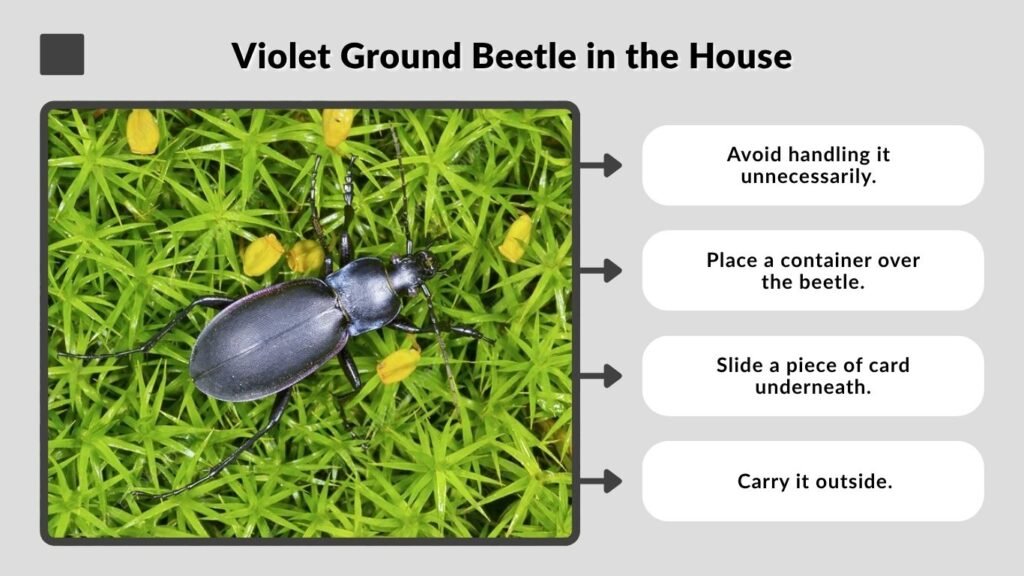
Finding a violet ground beetle indoors usually does not mean your house is infested. Ground beetles are outdoor predators and sometimes enter buildings accidentally through doors, cracks, or other openings. Ground beetles found indoors typically do not damage food, clothing, furniture, or the structure of a building.
What to Do if You Find One Indoors
- Avoid handling it unnecessarily.
- Place a container over the beetle.
- Slide a piece of card underneath.
- Carry it outside.
- Release it near vegetation, leaf litter, or logs.
- Seal obvious gaps if beetles regularly enter the house.
There is usually no reason to use insecticide for an occasional ground beetle indoors.
Why Violet Ground Beetles May Enter Homes
Ground beetles sometimes wander into buildings while hunting or searching for sheltered, damp places. Outdoor lights can also contribute to insects appearing around buildings.
Finding one or two individuals is therefore very different from finding an insect that actually breeds indoors. Violet ground beetles belong outside, where their predatory feeding can contribute to natural control of other invertebrates.
Do Violet Ground Beetles Bite?
Violet ground beetles have substantial mandibles for catching prey, so their appearance can make them seem threatening. However, ground beetles are not considered harmful to people and do not seek humans as food. They do not sting, suck blood, or behave like medically important biting insects. General guidance on ground beetles describes them as harmless to people.
Can a Violet Ground Beetle Hurt You?
The best approach is simply not to squeeze or deliberately provoke one. Its jaws are designed for invertebrate prey rather than attacking people.
If one is indoors, move it outside using a cup or container instead of grabbing it tightly. Their intimidating appearance actually reflects their role as active predators of slugs, worms, and insect larvae—not a threat to humans.
FAQs
1. How Big Is a Violet Ground Beetle?
Adult violet ground beetles are typically 20–30 mm long, making them one of the more noticeable ground beetles found in Britain.
2. Are Violet Ground Beetles Rare?
They are widespread across mainland UK and are considered more common than the similar ridged violet ground beetle. They occur in woodland, grassland, moorland, parks, gardens, and some urban habitats.
3. Can Violet Ground Beetles Fly?
No. Carabus violaceus is flightless. Instead, its long legs allow it to run rapidly across the ground while hunting and moving between habitats.
4. Are Violet Ground Beetles Good for Gardens?
Yes. They are beneficial predators that eat slugs, snails, caterpillars, insect larvae, worms, and other invertebrates. They do not normally damage garden plants.
5. Why Is a Violet Ground Beetle in My House?
It most likely wandered indoors accidentally while searching for shelter or prey. Ground beetles do not normally establish household infestations or damage food, fabrics, or buildings. Carefully relocate the beetle outdoors and seal obvious entry gaps if encounters become frequent.
