
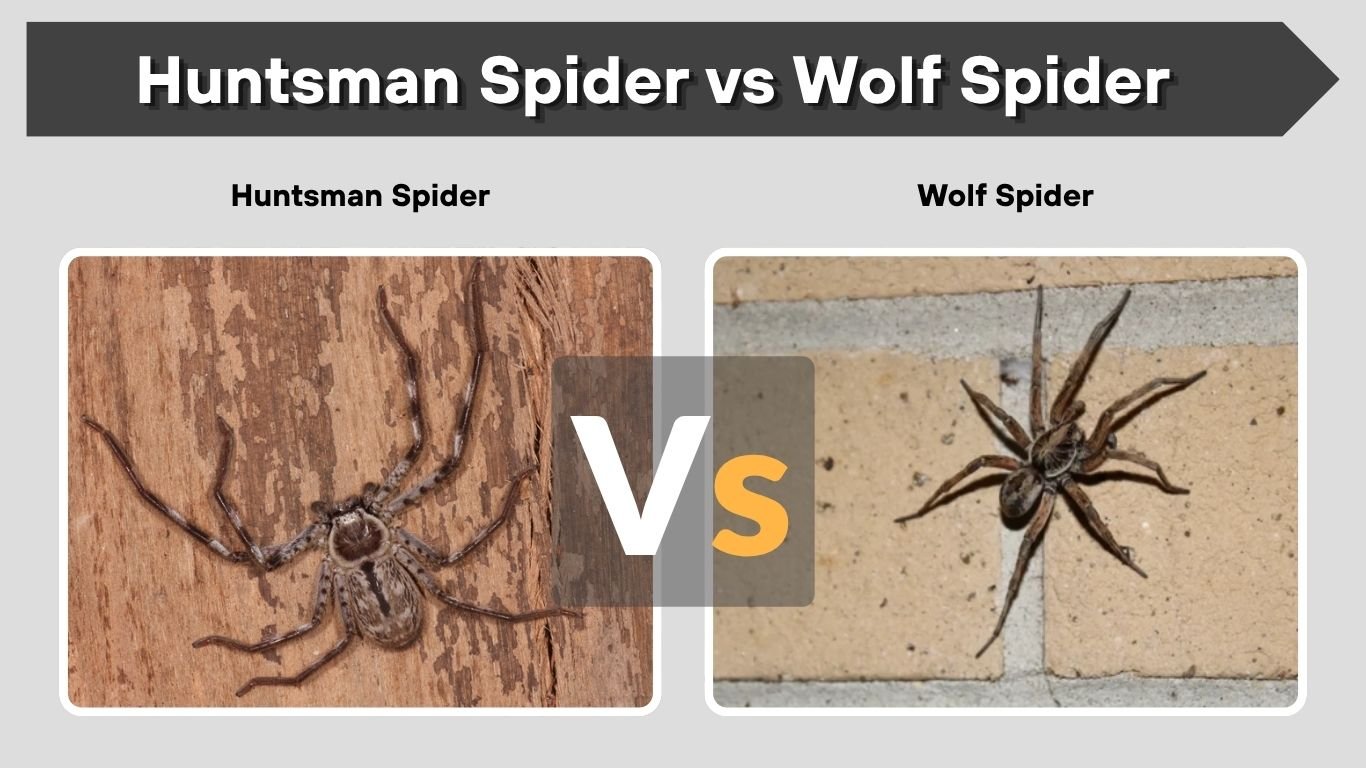
A huntsman spider vs wolf spider comparison can be confusing because both are fast, hairy-looking hunters that do not rely on traditional webs to capture prey. However, they belong to different spider families and have noticeable differences in body shape, leg position, eye arrangement, size, habitat, and behavior. Huntsman spiders usually have flatter bodies and long sideways-spreading legs, while wolf spiders are typically stockier ground hunters with two very large central eyes. This guide explains how to identify them and compares their size, bites, habitats, and behavior.
Huntsman Spider vs Wolf Spider: Quick Comparison
Huntsman spiders belong to the family Sparassidae, while wolf spiders belong to Lycosidae. Both contain many species, so size and coloration vary considerably.
| Feature | Huntsman Spider | Wolf Spider |
| Family | Sparassidae | Lycosidae |
| Body shape | Broad and flattened | Stocky and robust |
| Leg position | Spreads sideways | Extends forward and backward |
| Eyes | 8 eyes, usually in two rows | 8 eyes in three rows |
| Large central eyes | No | Yes |
| Hunting style | Active hunter | Active ground hunter |
| Prey-catching web | No | Usually no |
| Typical habitat | Trees, bark, walls, buildings | Ground, burrows, lawns, forests |
| Leg span | Often very large | Usually smaller overall |
| Babies on mother’s back | No | Yes |
| Danger to humans | Generally low | Generally low |
Body shape and eye arrangement are among the easiest ways to distinguish them.
How to Identify a Huntsman Spider
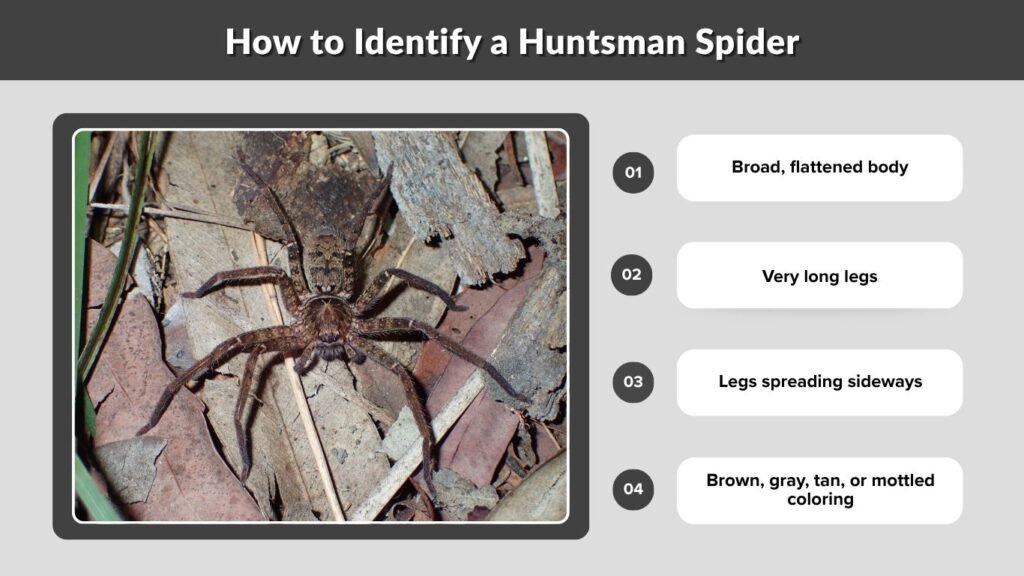
Huntsman spiders are famous for their impressive leg spans and extremely fast movements. Many have flattened bodies that allow them to squeeze beneath bark, rocks, doors, and narrow crevices.
Their legs are positioned somewhat like those of a crab, extending strongly toward the sides.
Huntsman Spider Identification
Look for features such as:
- Broad, flattened body
- Very long legs
- Legs spreading sideways
- Brown, gray, tan, or mottled coloring
- Eight eyes without two extremely enlarged central eyes
- Relatively flat appearance when resting
- Fast, crab-like sideways movement
- Large overall leg span
Some huntsman spiders can look enormous despite having relatively modest body lengths because their legs extend so far from the body.
Huntsman Spider Behavior
Huntsman spiders actively pursue insects instead of using a sticky capture web. They commonly hide beneath tree bark, logs, rocks, loose building materials, or other narrow spaces during the day.
At night, they may emerge to hunt cockroaches, moths, crickets, and other insects.
How to Identify a Wolf Spider
Wolf spiders are widespread ground hunters found in grasslands, forests, deserts, gardens, agricultural areas, and around homes.
They tend to have thicker bodies and shorter-looking legs compared with huntsman spiders.
Wolf Spider Identification
Typical features include:
- Hairy, robust body
- Brown, gray, tan, or black coloration
- Dark stripes or mottled markings
- Strong running legs
- Eight eyes arranged in three rows
- Two exceptionally large middle eyes
- Ground-hunting behavior
- Females carrying spiderlings on their backs
The large central eyes are especially useful when identifying a wolf spider from the front.
Wolf Spider Behavior
Wolf spiders actively search for insects rather than waiting inside a prey-catching web.
Some wander constantly, while others remain near burrows or sheltered retreats. Many are especially active at night, and their eyes can reflect flashlight beams.
Huntsman Spider vs Wolf Spider Size
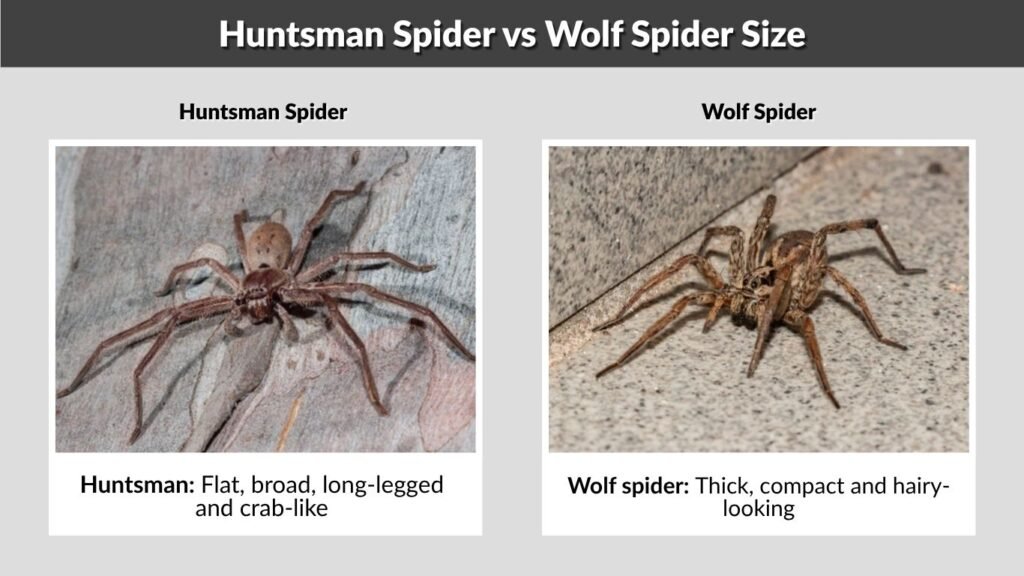
The huntsman spider vs wolf spider size comparison is one of the biggest reasons people confuse the two. Both groups include relatively large spiders, but huntsman spiders generally have much greater leg spans.
Which Is Bigger?
Huntsman spiders usually win when overall leg span is compared.
Large huntsman species can stretch several inches across, and some tropical species reach exceptionally impressive dimensions. Their flattened bodies and extended sideways legs make them appear even larger.
Wolf spiders can also become substantial, but their legs are generally proportionally shorter and their bodies more compact.
A large wolf spider may have a heavier-looking body even when a huntsman spider has the greater overall diameter.
Wolf Spider vs Huntsman Body Shape
Body shape can be more helpful than size:
- Huntsman: Flat, broad, long-legged and crab-like
- Wolf spider: Thick, compact and hairy-looking
A spider spread almost flat against a wall with extremely wide sideways legs is more likely to be a huntsman.
Huntsman vs Wolf Spider Eyes
Eye arrangement provides another excellent identification method.
Both spiders have eight eyes, but the arrangement is distinctly different.
Huntsman Spider Eyes
Huntsman spiders generally have their eight eyes arranged in two rows. The eyes vary somewhat in size but do not include the striking pair of huge central eyes found on wolf spiders.
From a distance, the eyes may be difficult to see clearly.
Wolf Spider Eyes
Wolf spiders have one of the most recognizable eye patterns among spiders.
Their eyes consist of:
- Four small eyes across the lower front
- Two very large eyes in the middle
- Two additional eyes positioned farther back
When comparing close-up wolf spider vs huntsman pictures, two prominent forward-facing eyes strongly indicate a wolf spider.
Huntsman Spider vs Wolf Spider in Florida
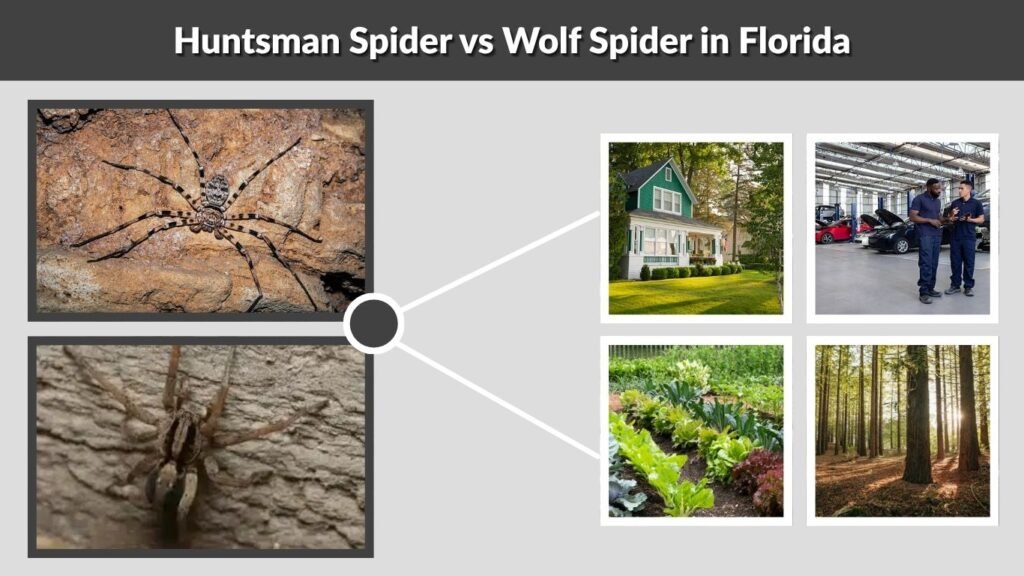
The huntsman spider Florida vs wolf spider comparison is common because both occur in the state.
Florida’s warm climate provides suitable conditions for several large hunting spiders.
Florida Huntsman Spider
One well-known huntsman found in Florida is the pantropical huntsman spider, Heteropoda venatoria.
It is a large, fast species often encountered around:
- Homes
- Garages
- Warehouses
- Tree trunks
- Sheds
- Outdoor walls
Its flattened body and widely spread legs make it relatively easy to distinguish from most wolf spiders.
Florida Wolf Spiders
Florida also has numerous wolf spider species. They are frequently found in lawns, gardens, woodland areas, agricultural habitats, and near buildings.
If the spider is running across the ground with a thick body and prominent large eyes, a wolf spider is more likely.
Australian Wolf Spider vs Huntsman
Australia is especially well known for huntsman spiders, but it also supports many wolf spider species.
Because both can become large, Australian homeowners sometimes encounter either group around yards and buildings.
Huntsman vs Wolf Spider Australia
Australian huntsman spiders commonly hide beneath bark, rocks, walls, roofs, and household objects. Their broad bodies and sideways legs are characteristic.
Australian wolf spiders are primarily associated with the ground. Many shelter in burrows and emerge to hunt insects.
The fastest visual distinction remains body shape: huntsman spiders look flattened and crab-like, while wolf spiders appear more compact and upright.
Huntsman Spider vs Wolf Spider Bite
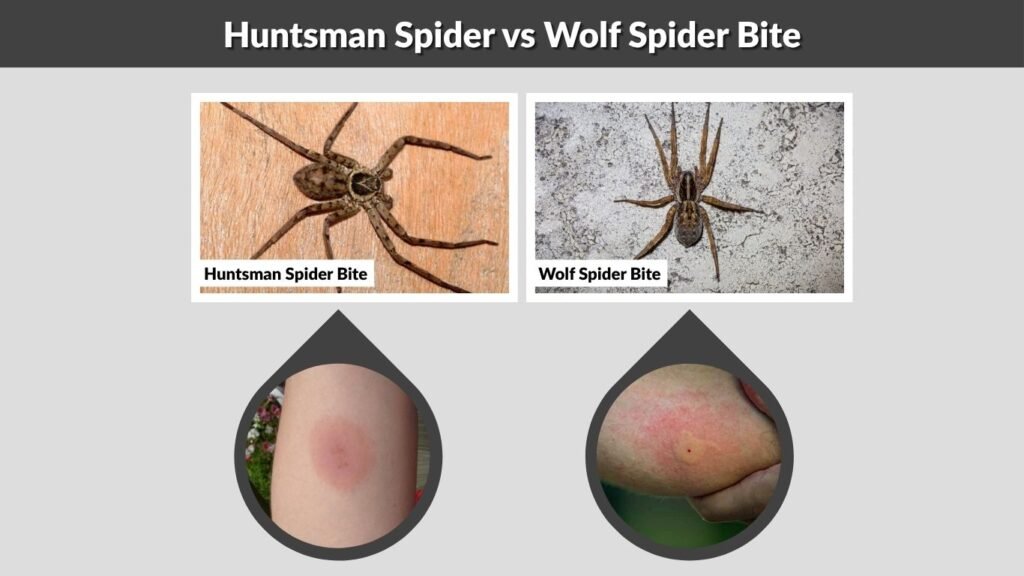
Both huntsman and wolf spiders possess venom for capturing prey. Both are also capable of biting humans when trapped, handled, or threatened.
Neither group normally seeks people out to bite.
Huntsman Spider Bite
A huntsman spider bite may cause:
- Immediate pain
- Local redness
- Mild swelling
- Tenderness
- Temporary irritation
Larger spiders have substantial fangs, so the mechanical bite itself may feel painful.
Wolf Spider Bite
A wolf spider bite may similarly produce:
- Pain
- Redness
- Mild swelling
- Itching
- Tenderness
Most bites from either group are not considered medically significant for healthy adults.
Wash a suspected bite with soap and water and keep it clean. Seek medical care if severe pain, extensive swelling, breathing difficulty, vomiting, signs of infection, or other serious symptoms develop.
Huntsman vs Wolf Spider Hunting Behavior
Although neither typically builds a prey-catching web, the two groups often hunt in different environments.
Wolf spiders are more strongly associated with ground surfaces, whereas huntsman spiders are excellent climbers.
What They Eat
Both may prey on:
- Cockroaches
- Crickets
- Beetles
- Moths
- Flies
- Grasshoppers
- Other spiders
- Various small arthropods
Their appetite for insects means both can be beneficial predators around homes, gardens, and natural habitats.
Wolf Spider vs Huntsman: Reproduction
Reproductive behavior offers one of the clearest differences between these spiders.
Female wolf spiders display unusually visible parental care.
Wolf Spider Babies
A female wolf spider attaches her egg sac to her spinnerets and carries it behind her.
After the eggs hatch, dozens of spiderlings may climb onto her abdomen and travel on her back until they are ready to disperse.
Huntsman spider mothers do not carry hatched young on their backs in this manner. Females instead guard or remain near their egg sacs depending on the species.
If you see a large spider completely covered with tiny babies, it is very likely a wolf spider.
Huntsman Spider vs Wolf Spider vs Brown Recluse
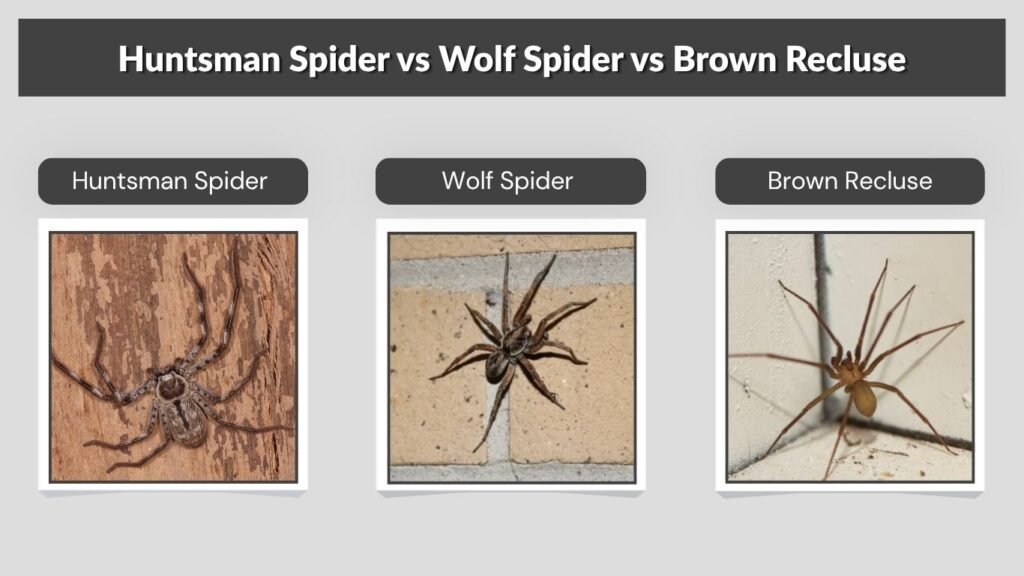
Huntsman spiders and wolf spiders are sometimes confused with brown recluse spiders simply because all can appear brown.
However, their body shapes are quite different.
Major Differences
A brown recluse generally has:
- Six eyes rather than eight
- Three pairs of eyes
- Relatively plain-colored legs
- A more delicate body
- A characteristic violin-like marking in typical adults
Wolf spiders usually look much hairier and more patterned, while huntsman spiders have dramatically longer sideways-oriented legs.
Identification should never rely on brown coloration alone.
Huntsman Spider vs Wolf Spider: Who Would Win?
A huntsman spider vs wolf spider who would win encounter cannot be predicted simply from the spider groups.
The result would depend on the particular species, individual size, sex, defensive behavior, and circumstances.
Both are capable predators equipped with speed, fangs, and venom. In nature, however, avoiding unnecessary conflict is often more beneficial than fighting another large predator.
FAQs
1. What is the difference between a huntsman and wolf spider?
Huntsman spiders usually have flatter bodies and long legs extending sideways. Wolf spiders are stockier and have two exceptionally large central eyes.
2. Which is bigger, a huntsman spider or wolf spider?
Huntsman spiders generally have larger overall leg spans. Wolf spiders can have thick bodies but usually do not reach the extreme width of large huntsman spiders.
3. Are huntsman spiders more dangerous than wolf spiders?
Neither group is generally considered highly dangerous to humans. Both can bite defensively and may cause temporary local pain, redness, or swelling.
4. Are huntsman spiders found in Florida?
Yes. The pantropical huntsman spider occurs in Florida and may be found around trees, homes, sheds, garages, and other structures.
5. How can I quickly tell a wolf spider from a huntsman?
Look at the legs and eyes. Huntsman spiders have long sideways-spreading legs and flattened bodies. Wolf spiders have more normally positioned legs and two very large central eyes.
