
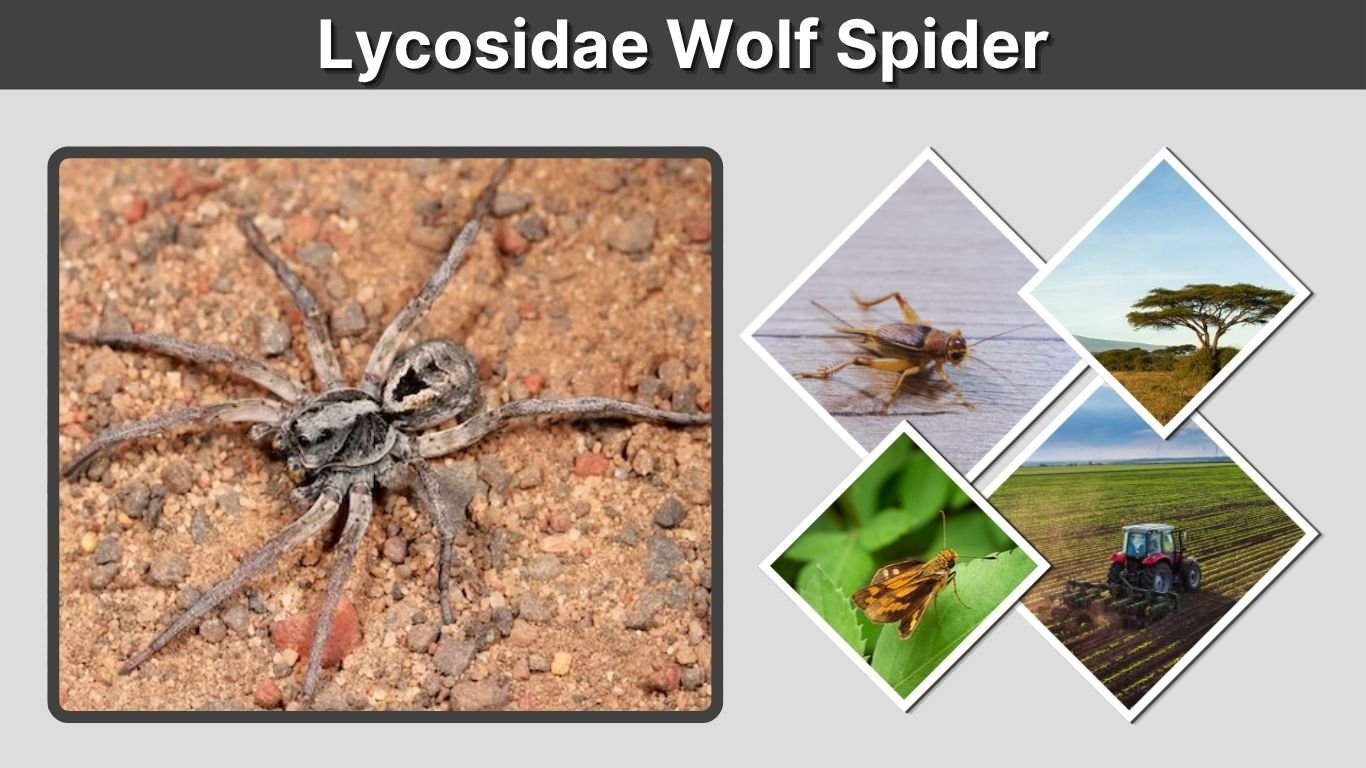
The Lycosidae wolf spider family includes thousands of active hunting spiders found across much of the world. Unlike many familiar spiders, wolf spiders usually capture prey by chasing or ambushing it rather than relying on sticky capture webs. They are recognizable by their unusual arrangement of eight eyes, strong legs, and often brown or gray coloration. Female wolf spiders are also famous for carrying their egg sacs and later transporting newly hatched spiderlings on their backs.
What Is a Lycosidae Wolf Spider?
Lycosidae is the scientific family containing the spiders commonly called wolf spiders. The family name was established by Carl Jakob Sundevall in 1833. According to the World Spider Catalog, Lycosidae currently contains 143 accepted genera and more than 2,500 accepted species, making it a highly diverse spider group.
Lycosidae Scientific Classification
The basic classification of wolf spiders includes:
- Kingdom: Animalia
- Phylum: Arthropoda
- Class: Arachnida
- Order: Araneae
- Family: Lycosidae
- Common name: Wolf spiders
- Accepted genera: 143
- Accepted species: More than 2,500
The World Spider Catalog recognizes Lycosidae as an accepted spider family and currently lists ten valid subfamilies.
Why Are They Called Wolf Spiders?
The name “wolf spider” reflects their reputation as active hunters. Instead of remaining in a large capture web, many species move across the ground or wait for prey and then rapidly attack when an insect comes within range.
Their hunting behavior is one of the family’s most recognizable characteristics. Some species wander continuously, while others remain around burrows or sheltered hunting sites.
Lycosidae Wolf Spider Characteristics
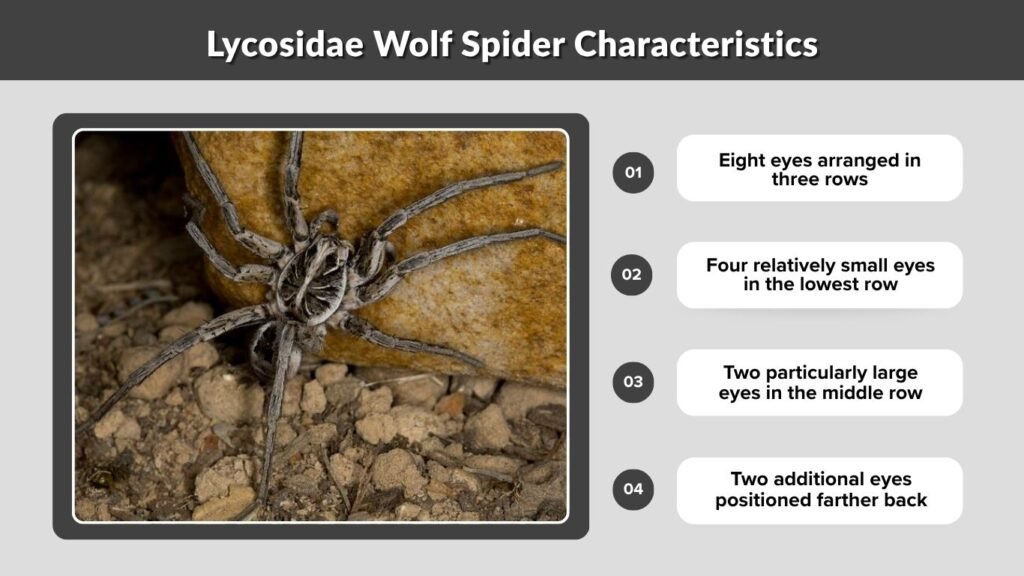
Wolf spiders vary greatly in size and appearance, but members of the family share several useful identification characteristics. Most have strong running legs, relatively robust bodies, and excellent vision compared with many other spiders. Their distinctive arrangement of eight eyes is especially important for separating them from similar-looking ground-dwelling species.
Key Identification Features
Common Lycosidae characteristics include:
- Eight eyes arranged in three rows
- Four relatively small eyes in the lowest row
- Two particularly large eyes in the middle row
- Two additional eyes positioned farther back
- Strong legs adapted for running
- Brown, gray, tan, or nearly black coloration
- Stripes or mottled patterns in many species
- Hairy or textured bodies
- Fast movement across the ground
The two prominent middle eyes can be particularly noticeable when a wolf spider is viewed from the front.
Wolf Spider Size
Size varies enormously throughout Lycosidae. Some species have bodies only several millimeters long, while larger species can exceed an inch in body length.
For example, Pardosa milvina is a relatively small wolf spider, with documented adults measuring only about 4.3–6.4 mm. In contrast, female rabid wolf spiders (Rabidosa rabida) have been reported at approximately 16–21 mm long.
Color and Body Pattern
Brown, gray, black, and tan dominate wolf spider coloration. Many have longitudinal stripes along the cephalothorax or patterned abdomens that help them blend into grass, soil, bark, stones, and leaf litter.
Color alone cannot reliably identify Lycosidae because many unrelated spider families share similar camouflage.
How Lycosidae Wolf Spiders Hunt
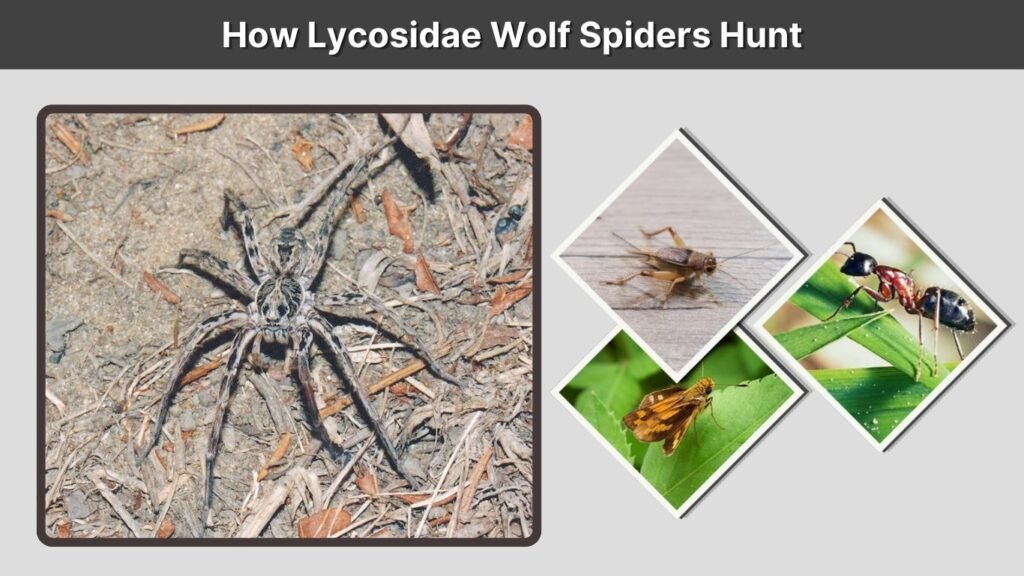
Wolf spiders are primarily predators of insects and other small invertebrates. Their behavior differs from spiders that depend on sticky orb webs or tangled webs to catch food. Many lycosids roam over the ground, while others wait in strategic locations until prey approaches. Their speed, vision, vibration sensitivity, and venom all help them capture prey.
Typical Wolf Spider Prey
Depending on species and size, wolf spiders may consume:
- Crickets
- Grasshoppers
- Ants
- Beetles
- Flies
- Small moths
- Other spiders
- Various terrestrial arthropods
Rabid wolf spiders, for example, have been documented feeding on crickets, locusts, ants, grasshoppers, and other spiders.
Do Lycosidae Wolf Spiders Make Webs?
Most wolf spiders do not build the familiar prey-catching webs associated with orb weavers or house spiders. A studied species such as Pardosa milvina wanders through grass and stones instead of constructing a snare.
Wolf spiders still produce silk. Females need it for egg sacs, and some species use silk around retreats or burrows. Therefore, describing wolf spiders as completely “non-web-spinning” would be inaccurate; they simply do not generally depend on large capture webs for hunting.
Lycosidae Reproduction and Baby Care
One of the most remarkable characteristics of Lycosidae is maternal care. Female wolf spiders do considerably more than simply deposit eggs and leave. They carry their developing eggs with them and later transport newly hatched offspring on their bodies, behavior that provides one of the easiest ways to recognize a female wolf spider outdoors.
Female Carrying an Egg Sac
After laying her eggs, a female encloses them inside a silk sac and attaches it to her spinnerets.
She continues moving and hunting while carrying the sac rather than leaving it attached to a permanent web. The sac may appear as a round white, gray, or darker ball connected to the rear of her abdomen.
Wolf Spider With Babies
Once the spiderlings hatch, they climb onto their mother’s abdomen and remain there until they are ready to disperse.
This can make the female appear rough, unusually dark, or covered in tiny moving dots. Both Pardosa milvina and Rabidosa rabida demonstrate this characteristic wolf-spider parental behavior.
Where Lycosidae Wolf Spiders Live
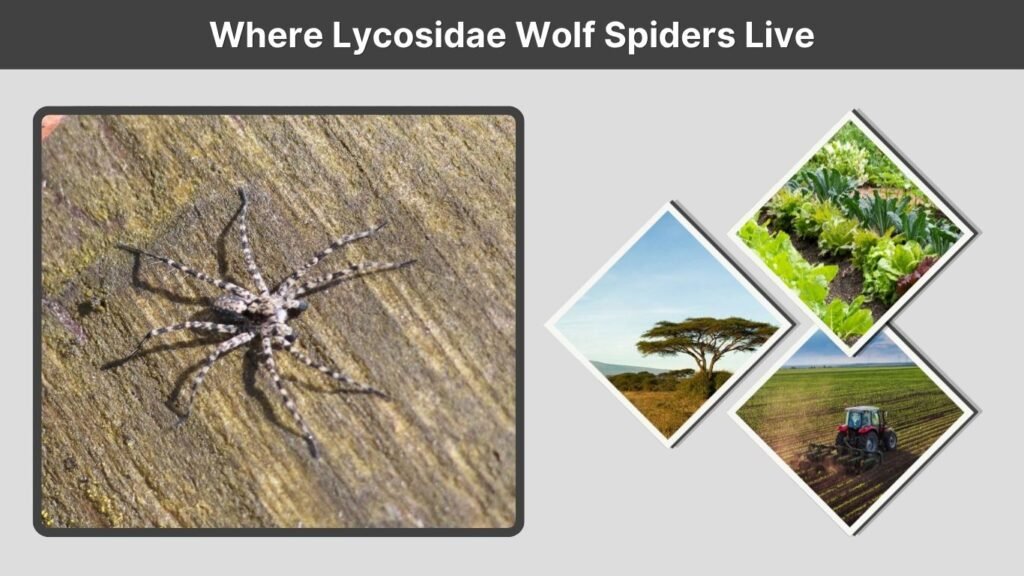
The enormous diversity of Lycosidae has allowed wolf spiders to occupy many terrestrial environments. Different species occur in grasslands, forests, agricultural areas, wetlands, gardens, suburban environments, and dry habitats. Some roam freely through vegetation, while others use holes, natural shelters, or burrows as resting and hunting sites.
Common Wolf Spider Habitats
Lycosidae species can be encountered in:
- Grasslands
- Forest floors
- Leaf litter
- Gardens
- Agricultural fields
- Around ponds and streams
- Beneath rocks and logs
- Burrows in soil
- Suburban yards
- Garages and buildings
For example, Pardosa milvina occurs in grasslands, woods, wet areas near water, and agricultural habitats, while Rabidosa rabida occurs in woods, fields, buildings, litter, holes, and beneath rocks.
Lycosidae in Europe
Wolf spiders are not restricted to North America. The family has representatives across numerous regions of the world, including Europe. Different genera and species occur in countries such as Germany, Italy, and Ukraine.
European wolf spiders vary in size and habitat just as North American species do, so geographic location should be considered when identifying an individual.
Lycosidae in Mexico and Other Regions
Wolf spiders also occur throughout Mexico and many warmer regions. They can occupy deserts, grasslands, forests, agricultural landscapes, and areas around human settlements.
The exact species present will depend heavily on geography, elevation, climate, moisture, and habitat.
Common Lycosidae Genera and Species
Because Lycosidae contains thousands of species, wolf spiders cannot be accurately represented by a single appearance or behavior. Different genera have evolved distinctive sizes, markings, habitats, and hunting strategies. The World Spider Catalog currently recognizes 143 genera within the family, illustrating the group’s exceptional taxonomic diversity.
Hogna
Hogna includes several large, robust wolf spiders. One particularly familiar example is the Carolina wolf spider, Hogna carolinensis.
These spiders have the sturdy body and ground-hunting behavior commonly associated with large wolf spiders.
Pardosa
Pardosa contains numerous generally smaller and more slender wolf spiders. Pardosa milvina is an example documented from several habitats in North America.
It has the characteristic wolf-spider eye arrangement and actively moves through ground vegetation rather than constructing a capture web.
Rabidosa
The genus Rabidosa includes the rabid wolf spider, Rabidosa rabida. Despite its common name, “rabid” does not indicate that the spider carries rabies.
R. rabida is a relatively large wolf spider with longitudinal markings. Females are larger than males, and mothers carry both their egg sacs and later their young.
Are Lycosidae Wolf Spiders Dangerous?
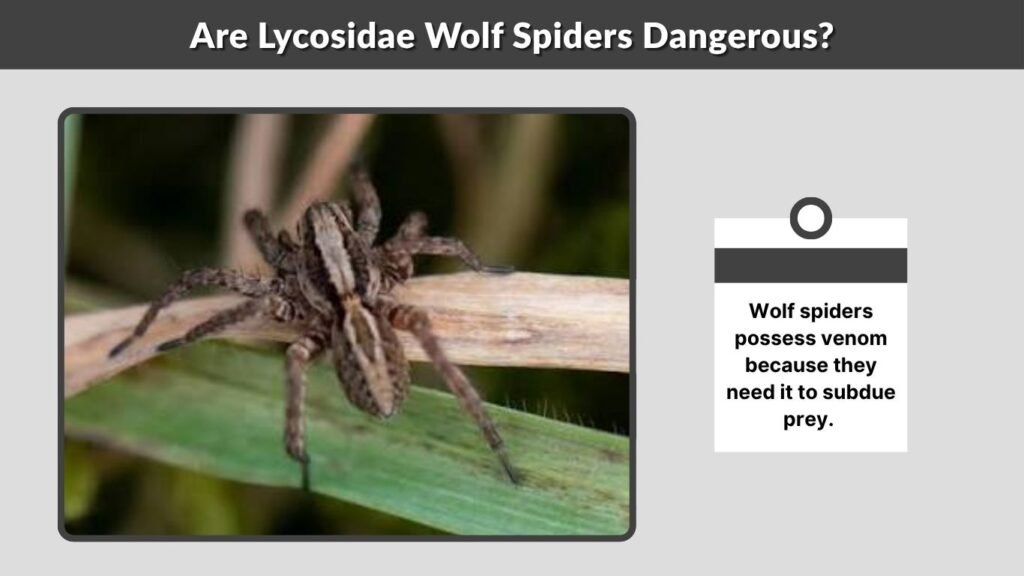
Wolf spiders possess venom because they need it to subdue prey. However, their relationship with humans is very different from their relationship with insects. Wolf spiders generally use running and hiding as defensive strategies and are more likely to escape than confront a person.
Can Lycosidae Bite Humans?
Yes. Any wolf spider with sufficiently large fangs can potentially bite when trapped, squeezed, or deliberately handled.
The best approach is to avoid picking up unidentified spiders. Finding a large Lycosidae indoors does not automatically mean it is aggressive or represents a serious threat.
A spider found inside can usually be encouraged into a container and released outdoors without direct handling.
FAQs
1. What does Lycosidae mean?
Lycosidae is the scientific family name for wolf spiders. It belongs to the spider order Araneae and currently includes more than 2,500 accepted species distributed among 143 accepted genera according to the World Spider Catalog.
2. How can you identify a Lycosidae wolf spider?
Look for a ground-running spider with eight eyes arranged in three rows. Two large middle eyes are particularly distinctive. Wolf spiders often have hairy brown, gray, tan, or dark bodies with stripes or mottled patterns.
3. Do all Lycosidae wolf spiders make webs?
Wolf spiders produce silk but generally do not use large sticky webs to capture prey. Many actively hunt across the ground. Silk is important for egg sacs, retreats, draglines, and other purposes.
4. What is a famous Lycosidae species?
The Carolina wolf spider, Hogna carolinensis, is a well-known large wolf spider. Other familiar examples include the rabid wolf spider, Rabidosa rabida, and various smaller species belonging to the genus Pardosa.
5. Why do wolf spider babies ride on their mother?
After hatching, wolf spiderlings climb onto their mother’s abdomen and remain there temporarily before dispersing. This unusual parental behavior protects the young during their earliest developmental period and is one of the most recognizable characteristics of the Lycosidae family.
