
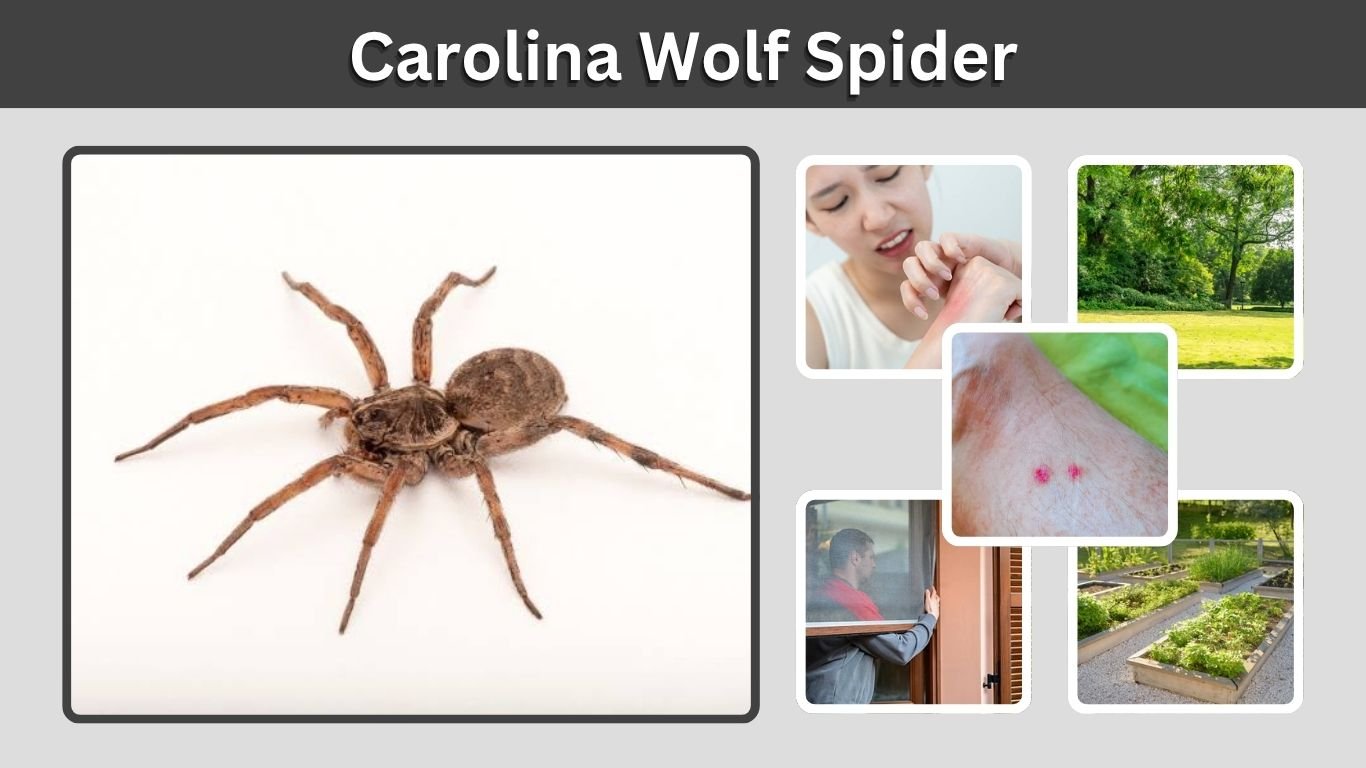
The Carolina wolf spider (Hogna carolinensis) is one of the largest wolf spiders found in North America. Its impressive size, hairy body, and fast movements can make it look intimidating, especially when encountered around homes, gardens, or open ground. Despite its appearance, this spider is generally not considered dangerous to people. Carolina wolf spiders are active hunters that usually live in burrows rather than relying on webs to catch prey. This guide covers identification, size, habitat, diet, behavior, bites, venom, and other useful facts.
What Is a Carolina Wolf Spider?
The Carolina wolf spider belongs to the family Lycosidae, a large group commonly known as wolf spiders. Its scientific name is Hogna carolinensis. Unlike many spiders that remain in webs waiting for prey, wolf spiders actively hunt insects on the ground. Carolina wolf spiders are particularly notable because of their relatively large body size and powerful build.
Carolina Wolf Spider Identification
Several physical characteristics can help identify a Carolina wolf spider:
- Body color: Usually grayish-brown, dark brown, or mottled brown.
- Body shape: Robust, hairy, and muscular-looking.
- Legs: Long, thick, and covered with fine hairs.
- Markings: A pale stripe may run along the middle of the cephalothorax.
- Eyes: Eight eyes arranged in three distinctive rows.
- Abdomen: Usually patterned with darker and lighter brown markings.
- Movement: Fast-running and usually found moving across the ground.
Color can vary considerably between individual spiders, which is why identification should not depend on color alone.
Carolina Wolf Spider Eyes
One of the easiest ways to recognize wolf spiders is their eye arrangement. They have eight eyes, including two particularly large forward-facing eyes.
These large eyes provide excellent vision compared with many web-building spiders. At night, their eyes can reflect light, creating a noticeable shine when illuminated with a flashlight.
Black Carolina Wolf Spiders
Some Carolina wolf spiders appear almost black, particularly under poor lighting. Dark individuals may therefore be described as black Carolina wolf spiders.
However, their bodies normally contain subtle brown, gray, tan, or black patterns rather than being completely uniform black. Lighting, age, sex, and individual variation can all influence their apparent coloration.
Carolina Wolf Spider Size
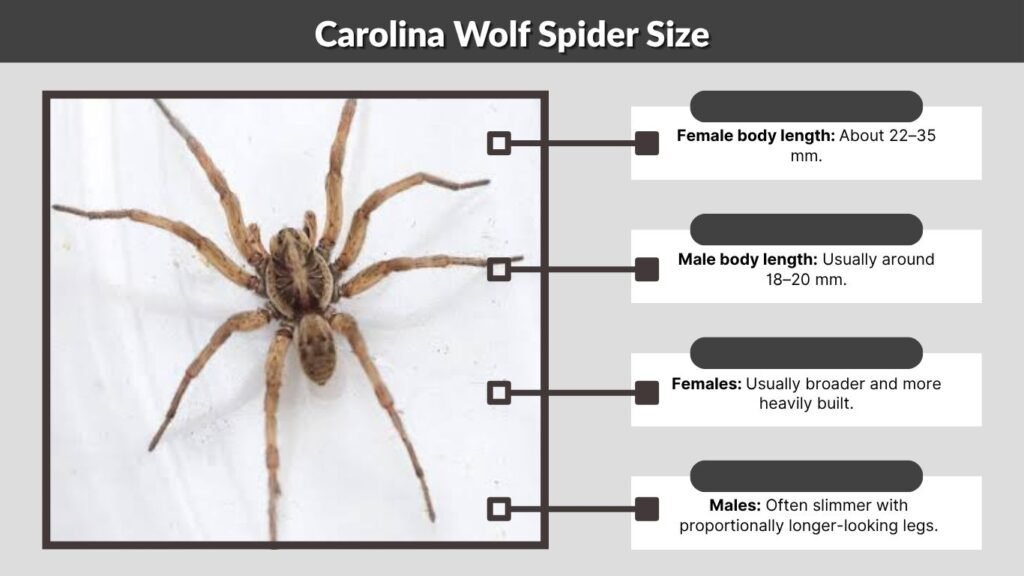
The Carolina wolf spider is among the larger wolf spider species in North America. Females are typically larger and heavier than males, particularly when mature. Their long legs can make them appear considerably larger than their actual body length, which sometimes leads people to describe unusually large individuals as giant Carolina wolf spiders.
How Big Is a Carolina Wolf Spider?
Typical measurements include:
- Female body length: About 22–35 mm.
- Male body length: Usually around 18–20 mm.
- Leg span: Large adults may span several inches when the legs are extended.
- Females: Usually broader and more heavily built.
- Males: Often slimmer with proportionally longer-looking legs.
Exact size varies according to age, sex, nutrition, and individual development.
Giant Carolina Wolf Spider
The term “giant Carolina wolf spider” generally refers to an especially large adult rather than a separate species.
A mature female carrying an egg sac can look especially large. The combination of a thick body, hairy legs, and wide leg span often exaggerates the spider’s apparent size when seen indoors or moving across open ground.
Male vs. Female Carolina Wolf Spider
Female Carolina wolf spiders tend to have larger, heavier bodies. Males are usually somewhat smaller and more slender.
Adult males also have enlarged pedipalps near the mouth that are involved in reproduction. Females are particularly recognizable during breeding periods because they may carry a round egg sac attached to the spinnerets.
Carolina Wolf Spider Habitat and Range
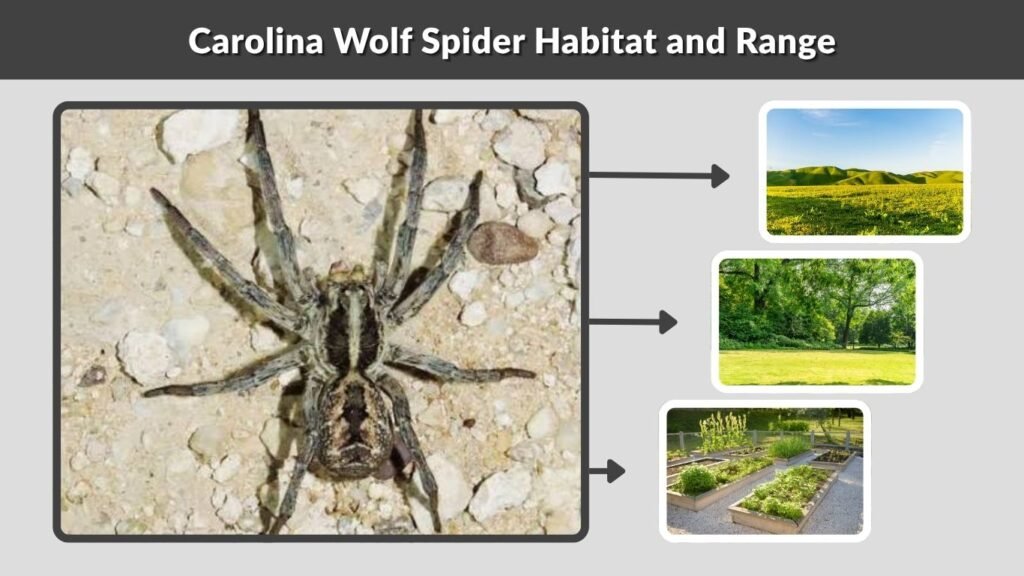
Carolina wolf spiders are primarily ground-dwelling spiders. They prefer habitats where they can construct retreats or burrows while remaining close to abundant insect prey. Although their name suggests a connection specifically with North and South Carolina, their distribution extends across a much broader portion of North America.
Where Do Carolina Wolf Spiders Live?
They may occur in:
- Grasslands
- Fields
- Open woodlands
- Gardens
- Agricultural areas
- Dry soil
- Sandy ground
- Areas beneath stones or logs
- Around buildings and landscaped yards
They are frequently encountered at ground level rather than high in vegetation.
Carolina Wolf Spider Range
The Carolina wolf spider occurs across much of the United States and into neighboring parts of North America.
Records are not limited to North Carolina and South Carolina. Carolina wolf spiders can occur well beyond the southeastern states, which explains reports from places such as Texas, Colorado, Ohio, and other regions.
Carolina Wolf Spider Burrow
Carolina wolf spiders commonly construct burrows in soil. These underground retreats provide protection from predators and extreme temperatures.
A spider may remain near its burrow during the day and become more active when hunting conditions improve. Some burrows have silk around their entrances, but they should not be confused with prey-catching webs.
Do Carolina Wolf Spiders Make Webs?
Carolina wolf spiders produce silk, but they do not normally construct the classic prey-catching webs associated with orb weavers or house spiders. Instead, they depend primarily on speed, vision, and ambush hunting.
Carolina Wolf Spider Web and Hunting
Silk may be used to:
- Line a burrow
- Reinforce a retreat
- Construct an egg sac
- Protect developing eggs
- Create temporary shelter
When hunting, the spider usually detects nearby prey and rushes toward it. Strong legs allow it to move quickly across soil and vegetation before grabbing prey with its front legs and fangs.
What Do Carolina Wolf Spiders Eat?
Their diet consists primarily of small terrestrial animals, especially insects and other arthropods.
They may prey on crickets, beetles, grasshoppers, cockroaches, smaller spiders, and various crawling insects. Because they consume numerous insects, Carolina wolf spiders can contribute to natural pest control in gardens and other outdoor habitats.
Carolina Wolf Spider Bite and Venom
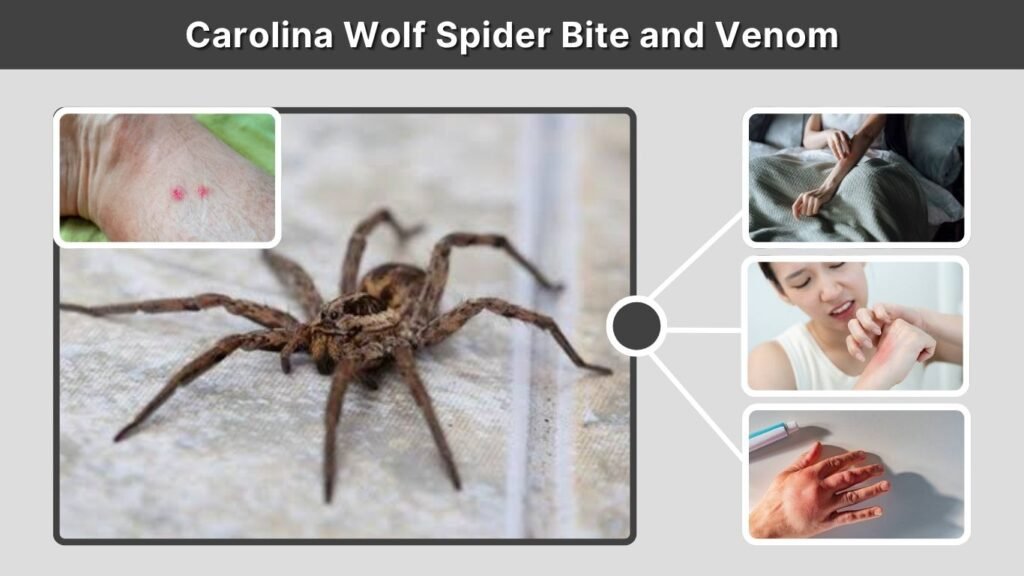
Like virtually all wolf spiders, Carolina wolf spiders possess venom used to immobilize prey. However, their venom is primarily adapted for hunting small animals and is not generally regarded as medically significant to healthy humans. Bites are uncommon because these spiders normally attempt to escape rather than confront people.
What Does a Carolina Wolf Spider Bite Look Like?
Possible local signs following a bite include:
- Mild redness
- Temporary swelling
- Pain or tenderness
- Itching
- A small raised bump
- Minor irritation around the bite site
Symptoms vary between individuals, and many unexplained skin marks cannot reliably be identified as spider bites based on appearance alone.
Is a Carolina Wolf Spider Poisonous or Venomous?
The technically correct term is venomous, not poisonous.
Carolina wolf spiders inject venom through their fangs when subduing prey. They do not contain a dangerous poison that harms someone simply by touching them.
Are Carolina Wolf Spiders Dangerous?
Carolina wolf spiders are generally not aggressive toward humans. A bite is most likely to occur if a spider becomes trapped against the skin, handled roughly, or deliberately disturbed.
Serious reactions are uncommon. Anyone experiencing severe swelling, breathing difficulty, spreading pain, dizziness, or other concerning symptoms after a suspected spider bite should seek medical attention.
Carolina Wolf Spider Life Cycle and Reproduction
Reproduction is one of the most interesting aspects of Carolina wolf spider behavior. Wolf spiders provide more direct maternal care than many other spider groups, particularly during the egg and early spiderling stages.
Carolina Wolf Spider Egg Sac
After mating, a female creates a silk egg sac and attaches it to the spinnerets at the rear of her abdomen.
She carries the egg sac while continuing to walk and hunt. This behavior helps protect the developing eggs while allowing the female to remain mobile.
Carolina Wolf Spider Babies
Once the spiderlings hatch, they climb onto their mother’s abdomen and remain there temporarily.
A female covered with dozens of tiny spiderlings can appear unusual or even alarming, but this is normal wolf spider behavior. After a period of maternal transport, the spiderlings disperse and begin living independently.
Carolina Wolf Spider Lifespan
Carolina wolf spiders generally live for more than one season, although lifespan can vary considerably according to sex, climate, food availability, and environmental conditions.
Females often survive longer than males because adult males invest significant energy in wandering and searching for mates.
Carolina Wolf Spider Behavior Around Homes
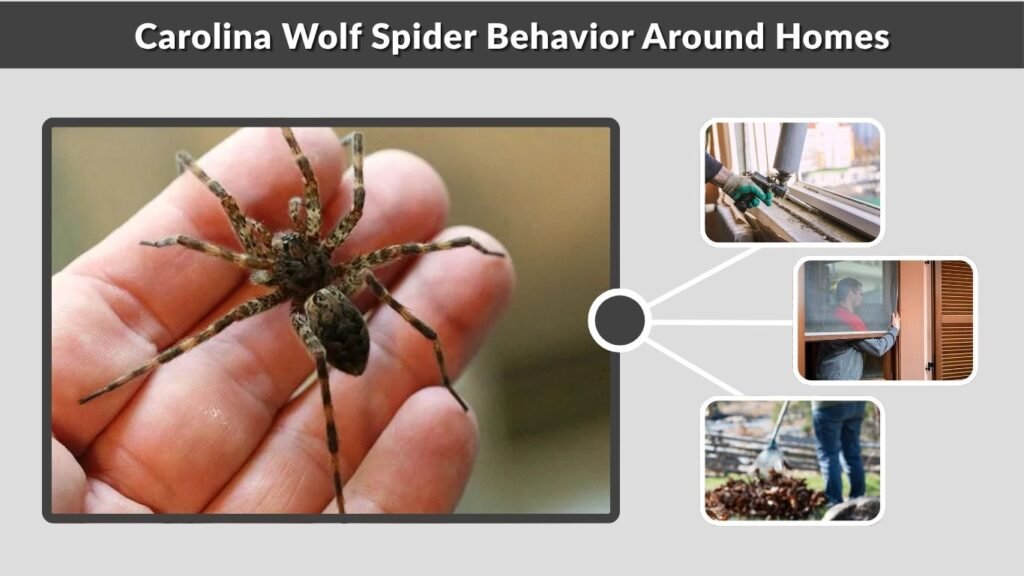
Carolina wolf spiders are mainly outdoor spiders, but they occasionally wander into houses, garages, sheds, basements, or other structures. Their appearance indoors is usually accidental rather than evidence of a large infestation.
How to Keep Carolina Wolf Spiders Out
Several simple measures can reduce indoor encounters:
- Seal cracks around doors and windows.
- Install or repair window screens.
- Reduce clutter close to exterior walls.
- Remove piles of leaves, wood, and debris near foundations.
- Use weather stripping around exterior doors.
- Reduce insects around entrances and outdoor lights.
- Move individual spiders outdoors when practical.
Because Carolina wolf spiders help control insects, they are often beneficial when left undisturbed outdoors.
FAQs
1. Is the Carolina wolf spider dangerous to humans?
Carolina wolf spiders are not generally considered dangerous to humans. They possess venom, but bites are uncommon and typically cause only localized symptoms such as pain, redness, or swelling. The spider usually prefers escaping rather than biting when approached.
2. How big can a Carolina wolf spider get?
Adult females can reach roughly 22–35 mm in body length and appear considerably larger when their legs are fully extended. Males are usually smaller and slimmer. Large females are often responsible for reports of unusually large or “giant” Carolina wolf spiders.
3. Does the Carolina wolf spider build a web?
It does not usually build a web for catching flying insects. Instead, it actively hunts prey on the ground. Silk is mainly used to line burrows, create retreats, produce egg sacs, and protect developing offspring.
4. Where are Carolina wolf spiders found?
Carolina wolf spiders occur across a broad portion of North America and are not restricted to North or South Carolina. They inhabit fields, grasslands, gardens, open woodlands, agricultural areas, and other locations containing suitable soil and abundant prey.
5. Can Carolina wolf spiders live inside houses?
They can enter houses accidentally, especially while searching for prey or shelter, but they are primarily outdoor spiders. Finding one indoors does not necessarily indicate an infestation. Sealing entry points and reducing insect prey around the home can limit future encounters.
